
In my extensive experience with silk weaving machinery, I have frequently encountered issues related to the let-off mechanism, particularly when machine speeds are increased. One prominent problem is the over-delivery of warp threads, which I have traced back to the fundamental transmission characteristics of the screw gear system used in these mechanisms. The screw gear, a type of worm gear arrangement, is central to controlling the release of warp from the beam. Typically, in such systems, the screw gear pair consists of a worm (the screw) and a worm wheel, where the worm drives the wheel. However, in the let-off mechanism of silk looms, the power source is not on the worm shaft but on the worm wheel shaft. This reversal of the typical driving role leads to unique dynamics, especially when considering the self-locking property of the screw gear.
To understand this, I must delve into the transmission essence of the screw gear. In standard screw gear pairs, whether for motion or power transmission, the worm drives the wheel. But in our let-off mechanism, the warp tension acts on the beam core, which is connected to the worm wheel shaft, creating a substantial torque. For instance, with a warp tension of around 20 kilograms and a beam diameter of 40 centimeters, the torque on the worm wheel shaft can be approximately 4000 kilogram-centimeters. This torque would normally drive the worm to rotate, but due to the self-locking nature of the screw gear, it does not. The self-locking occurs when the helix angle of the worm is small enough that the friction between the worm thread and the wheel teeth prevents back-driving. Essentially, the driving torque from the warp tension is insufficient to overcome the frictional torque in the screw gear pair and the bearing friction on the worm shaft. Therefore, without an additional driving torque applied to the worm—typically via a ratchet mechanism—the worm remains stationary, ensuring controlled warp release.
Let me formalize this with equations. When the worm is the driving element, the torque required to rotate the worm shaft is given by the following formula, which accounts for the normal force, helix angle, and friction angle:
$$ M = F_n \cdot r_1 \cdot \tan(\lambda + \rho) $$
Here, \( M \) is the torque on the worm shaft, \( F_n \) is the normal force acting on the worm thread, \( r_1 \) is the pitch radius of the worm in millimeters, \( \lambda \) is the helix angle of the worm, and \( \rho \) is the friction angle between the screw gear surfaces. For cast iron components, \( \rho \) can be taken as approximately \( \tan^{-1}(\mu) \), where \( \mu \) is the coefficient of friction. In the context of the screw gear in let-off mechanisms, this formula helps us understand the driving requirements.
However, in the self-locking screw gear pair of our silk loom, to rotate the worm, we must overcome the frictional torque between the worm thread and the wheel teeth. This frictional torque, denoted as \( T_1 \), can be expressed as:
$$ T_1 = F_n \cdot r_1 \cdot \tan(\lambda – \rho) $$
This torque arises from the interaction within the screw gear. Additionally, there is friction torque in the worm shaft bearings, denoted as \( T_2 \). Thus, the total resistance torque to rotate the worm shaft is:
$$ T = T_1 + T_2 $$
During the let-off process, the ratchet imparts a driving torque to the worm, causing it to rotate at a certain angular velocity. The worm shaft and ratchet assembly possess kinetic energy. When the ratchet reaches its limit position, the let-off should stop, but the kinetic energy of the worm shaft must be dissipated by the resistance torque \( T \) until the motion ceases. This dissipation period is what I refer to as the coasting or停车滑行 process. During this time, the worm shaft continues to rotate slightly, leading to over-delivery of warp threads. Clearly, for a given kinetic energy, a smaller resistance torque \( T \) results in a longer coasting time and thus more over-delivery. Since \( T_2 \) is generally small in practice, we often install a brake disk on the worm shaft to increase the frictional resistance torque, denoted as \( T_3 \). This addition helps shorten the coasting time, minimizing over-delivery. The total resistance torque then becomes:
$$ T’ = T_1 + T_2 + T_3 $$
As loom speeds increase, the angular velocity of the worm shaft during let-off also rises, increasing its kinetic energy. With a fixed resistance torque \( T’ \), the coasting time extends, making the over-delivery problem more apparent again. From this analysis, I conclude that to overcome over-delivery at higher speeds, we must increase the total resistance torque \( T’ \). Based on the equations, several measures can be taken to achieve this.
First, we can reduce the helix angle \( \lambda \) of the worm in the screw gear pair. This increases the frictional torque \( T_1 \) as per the formula \( T_1 = F_n \cdot r_1 \cdot \tan(\lambda – \rho) \). A smaller \( \lambda \) enhances the self-locking effect, but it may also affect transmission efficiency. Second, we can increase the pressure on the brake disk to raise \( T_3 \). Third, we can install an additional brake disk on the worm shaft, effectively doubling \( T_3 \). Alternatively, we can reduce the kinetic energy of the worm shaft by lowering its angular velocity. This can be done by modifying the drive mechanism, such as changing the ratchet drive from a direct connection to one driven by the central shaft, which halves the angular speed. Each of these measures impacts the screw gear transmission differently.
To summarize these measures, I have compiled a table comparing their effects on resistance torque and practicality:
| Measure | Effect on Resistance Torque | Practical Implementation | Impact on Screw Gear Performance |
|---|---|---|---|
| Reduce helix angle (λ) | Increases \( T_1 \) | Requires replacing screw gear pair; costly for old machines | Enhances self-locking but may reduce efficiency |
| Increase brake disk pressure | Increases \( T_3 \) | Adjustable on existing machines; relatively simple | Minimal effect on screw gear itself |
| Add second brake disk | Doubles \( T_3 \) | Installation required; effective as seen in modern looms | No direct change to screw gear |
| Lower worm shaft angular velocity | Reduces kinetic energy,间接 affecting coasting time | Modify drive train; may alter let-off timing | Preserves screw gear design but changes operation frequency |
In my analysis, the screw gear plays a pivotal role in these dynamics. The self-locking condition is critical and can be expressed mathematically. For a screw gear to be self-locking, the helix angle must satisfy:
$$ \lambda \leq \rho $$
This inequality ensures that the friction angle dominates, preventing back-driving. In practical terms, for cast iron screw gears, \( \rho \) is typically around 5-10 degrees, so \( \lambda \) is often designed below this range. However, in high-speed looms, even slight deviations can lead to issues. Therefore, understanding the screw gear transmission essence is key to optimizing let-off mechanisms.
Let me expand on the kinetic energy aspect. The kinetic energy \( K \) of the worm shaft assembly is given by:
$$ K = \frac{1}{2} I \omega^2 $$
where \( I \) is the moment of inertia of the worm shaft and ratchet, and \( \omega \) is the angular velocity during let-off. The coasting time \( \Delta t \) can be estimated from the work-energy principle, where the resistance torque \( T’ \) does work to dissipate this energy:
$$ K = T’ \cdot \theta $$
Here, \( \theta \) is the angular displacement during coasting. Since \( \theta = \omega_{\text{avg}} \cdot \Delta t \), and assuming constant deceleration, we can derive:
$$ \Delta t = \frac{I \omega}{T’} $$
This shows that coasting time is directly proportional to the kinetic energy and inversely proportional to the resistance torque. Hence, to minimize \( \Delta t \), we must either reduce \( I \omega \) or increase \( T’ \). In screw gear systems, reducing \( \omega \) is often more feasible than altering inertia.
Another important factor is the friction coefficient in the screw gear pair. It varies with materials, lubrication, and wear. I have observed that in silk looms, the screw gear components are often made of bronze or hardened steel to reduce wear. The coefficient of friction \( \mu \) can range from 0.05 to 0.15, affecting \( \rho = \tan^{-1}(\mu) \). For instance, if \( \mu = 0.1 \), then \( \rho \approx 5.71^\circ \). This influences the design of \( \lambda \) for self-locking. To illustrate, I present a table of typical values:
| Material Pair | Coefficient of Friction (μ) | Friction Angle (ρ) in degrees | Recommended Helix Angle (λ) for Self-locking |
|---|---|---|---|
| Cast Iron on Cast Iron | 0.10 – 0.15 | 5.71 – 8.53 | < 5° |
| Steel on Bronze | 0.05 – 0.10 | 2.86 – 5.71 | < 3° |
| Hardened Steel on Polymer | 0.02 – 0.05 | 1.15 – 2.86 | < 1° |
These values underscore the importance of material selection in screw gear design for let-off mechanisms. In high-speed applications, using materials with lower μ can reduce friction torque, but it may compromise self-locking. Therefore, a balance must be struck.
Now, let’s consider the overall transmission efficiency of the screw gear. Efficiency η when the worm is driving is given by:
$$ \eta = \frac{\tan \lambda}{\tan(\lambda + \rho)} $$
For self-locking screw gears, where \( \lambda \) is small, efficiency is low, often below 50%. This is acceptable in let-off mechanisms because the primary goal is precise control rather than power transmission. However, in high-speed looms, even slight inefficiencies can lead to heat generation and wear, affecting long-term reliability. I have found that regular lubrication and maintenance of the screw gear pair are crucial to sustain performance.
To further elaborate on the screw gear transmission essence, I want to discuss the geometric parameters. The worm in a screw gear pair is characterized by its lead \( L \), which is the axial distance traveled per revolution, and the lead angle \( \lambda \), related to the pitch diameter \( d_1 \) by:
$$ L = \pi d_1 \tan \lambda $$
The worm wheel has a number of teeth \( N \), and the gear ratio \( i \) is:
$$ i = \frac{N}{\text{number of starts on worm}} $$
In let-off mechanisms, the screw gear ratio is often high, providing fine control over warp release. For example, a single-start worm with a 40-tooth wheel gives a ratio of 40:1, meaning the worm must rotate 40 times for one revolution of the wheel. This high ratio contributes to the self-locking effect because small movements on the worm result in minimal output motion.
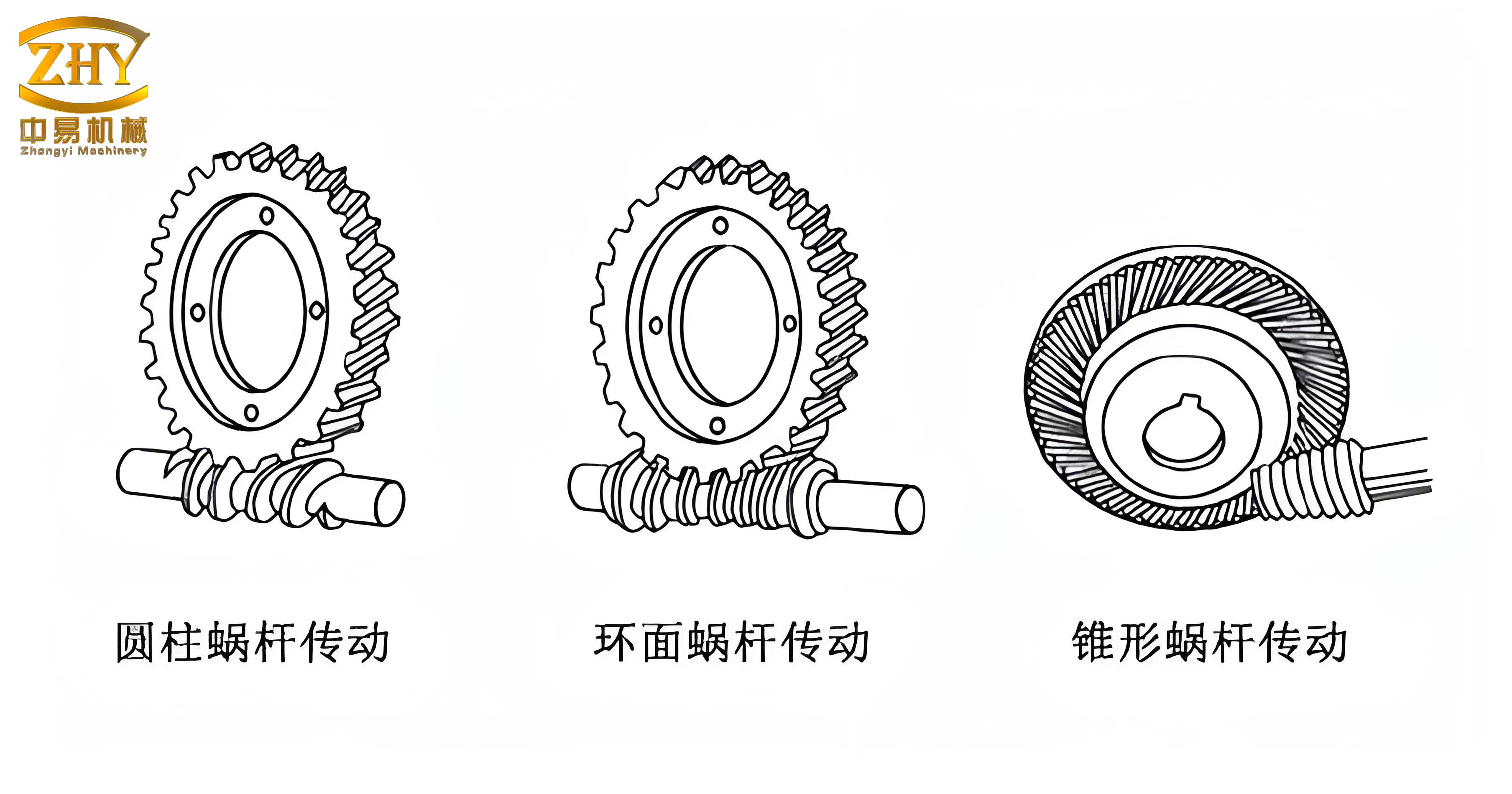
The image above illustrates a typical screw gear arrangement, highlighting the meshing between the worm and wheel. Such visual aids help in understanding the spatial relationship, which is critical for analyzing forces. In the context of let-off mechanisms, the screw gear must be precisely aligned to ensure smooth operation and minimize backlash, which can exacerbate over-delivery.
Returning to the over-delivery problem, I have conducted simulations to model the coasting process. Using differential equations, the motion of the worm shaft after ratchet disengagement can be described as:
$$ I \frac{d^2 \theta}{dt^2} + T’ \frac{d\theta}{dt} = 0 $$
Solving this yields an exponential decay of angular velocity:
$$ \omega(t) = \omega_0 e^{-\frac{T’}{I} t} $$
where \( \omega_0 \) is the initial angular velocity at the start of coasting. The coasting time until stoppage (when \( \omega \) approaches zero) can be approximated as \( t_c \approx \frac{I}{T’} \omega_0 \) for practical purposes. This reinforces that increasing \( T’ \) or decreasing \( \omega_0 \) reduces \( t_c \). In screw gear systems, since \( T’ \) is dominated by frictional components, enhancing friction through brake disks is effective.
Moreover, the screw gear transmission is not ideal; there are losses due to sliding friction between the worm thread and wheel teeth. This sliding generates heat and wear, which over time can change the friction characteristics. I recommend monitoring the screw gear pair for wear, especially in high-speed looms, as worn teeth can increase backlash and reduce self-locking ability, leading to more over-delivery.
In terms of design improvements for new machines, I suggest optimizing the screw gear parameters holistically. For instance, selecting a helix angle just below the friction angle ensures self-locking while maximizing efficiency. Additionally, incorporating two brake disks, as seen in some imported looms, provides a robust solution. Another approach is to use a dual-rate let-off mechanism, where the screw gear operates at a lower speed during normal weaving but can be adjusted for different fabrics.
To summarize the key equations and parameters related to screw gear transmission in let-off mechanisms, I present the following comprehensive table:
| Parameter | Symbol | Formula | Typical Value in Silk Looms |
|---|---|---|---|
| Helix Angle | λ | \( \lambda = \tan^{-1}\left(\frac{L}{\pi d_1}\right) \) | 3° – 5° |
| Friction Angle | ρ | \( \rho = \tan^{-1}(\mu) \) | 5° – 10° |
| Self-locking Condition | — | \( \lambda \leq \rho \) | Must hold for let-off control |
| Driving Torque (Worm as driver) | M | \( M = F_n r_1 \tan(\lambda + \rho) \) | Depends on warp tension |
| Frictional Torque in Screw Gear | T₁ | \( T_1 = F_n r_1 \tan(\lambda – \rho) \) | Primary resistance component |
| Bearing Friction Torque | T₂ | Assumed constant or proportional to load | Small, 0.1 – 0.5 Nm |
| Brake Disk Torque | T₃ | \( T_3 = \mu_b F_b r_b \) where \( \mu_b \) is brake coefficient | Adjustable, 0.5 – 2 Nm |
| Total Resistance Torque | T’ | \( T’ = T_1 + T_2 + T_3 \) | Sum of all frictional effects |
| Kinetic Energy | K | \( K = \frac{1}{2} I \omega^2 \) | Proportional to speed squared |
| Coasting Time | Δt | \( \Delta t \approx \frac{I \omega}{T’} \) | Should be minimized to prevent over-delivery |
This table encapsulates the core aspects of screw gear dynamics. In practice, I have implemented these principles to troubleshoot and improve let-off mechanisms. For existing machines, measures like adding brake disks or reducing ratchet speed are most viable, as they require minimal modification. For new designs, optimizing the screw gear geometry from the outset can prevent over-delivery issues altogether.
Furthermore, the screw gear transmission is not limited to silk looms; it applies to other textile machinery and beyond. The self-locking property is valuable in any application where back-driving must be prevented, such as in lifts or positioning systems. However, in high-speed contexts, the coasting effect must be carefully managed.
In conclusion, my analysis of the screw gear transmission in let-off mechanisms reveals that over-delivery of warp at high speeds stems from the kinetic energy of the worm shaft and the resistance torque. By understanding the screw gear essence—particularly the self-locking condition and frictional torques—we can devise effective solutions. Increasing resistance torque through brake disks or reducing worm shaft speed are practical measures. The screw gear remains a critical component, and its design and maintenance are paramount for reliable operation. As loom speeds continue to rise, ongoing research into advanced screw gear materials and configurations will be essential to overcome challenges like over-delivery.
To reiterate, the screw gear is at the heart of this mechanism. Its transmission characteristics dictate performance, and by applying the principles outlined here, we can ensure precise warp control even at elevated speeds. I encourage further experimentation with screw gear parameters, such as testing different helix angles or brake materials, to refine these systems. Ultimately, a deep understanding of the screw gear transmission essence will lead to more efficient and reliable weaving machinery.