
As a researcher deeply immersed in the field of precision motion control, I have always been fascinated by the unique capabilities of harmonic drive gears. This fascination stems from their fundamental departure from traditional rigid-body gear mechanics. The harmonic drive gear operates on the elegant principle of controlled elastic deformation, enabling exceptional performance metrics that are often unattainable with conventional gearing. The core advantages of a harmonic drive gear—exceptionally high single-stage reduction ratios, near-zero backlash, high torsional stiffness, compact size, and coaxial input/output shaft configuration—have cemented its role as a critical component in robotics, aerospace systems, semiconductor manufacturing, and medical devices. At the heart of this performance lies the geometry of the teeth—the tooth profile. The pursuit of the optimal tooth profile for a harmonic drive gear is a continuous journey, balancing theoretical perfection with practical manufacturability and application demands. This article aims to provide a comprehensive, first-person perspective on the research, development, and comparative analysis of the major tooth profiles that have defined the evolution of harmonic drive technology.
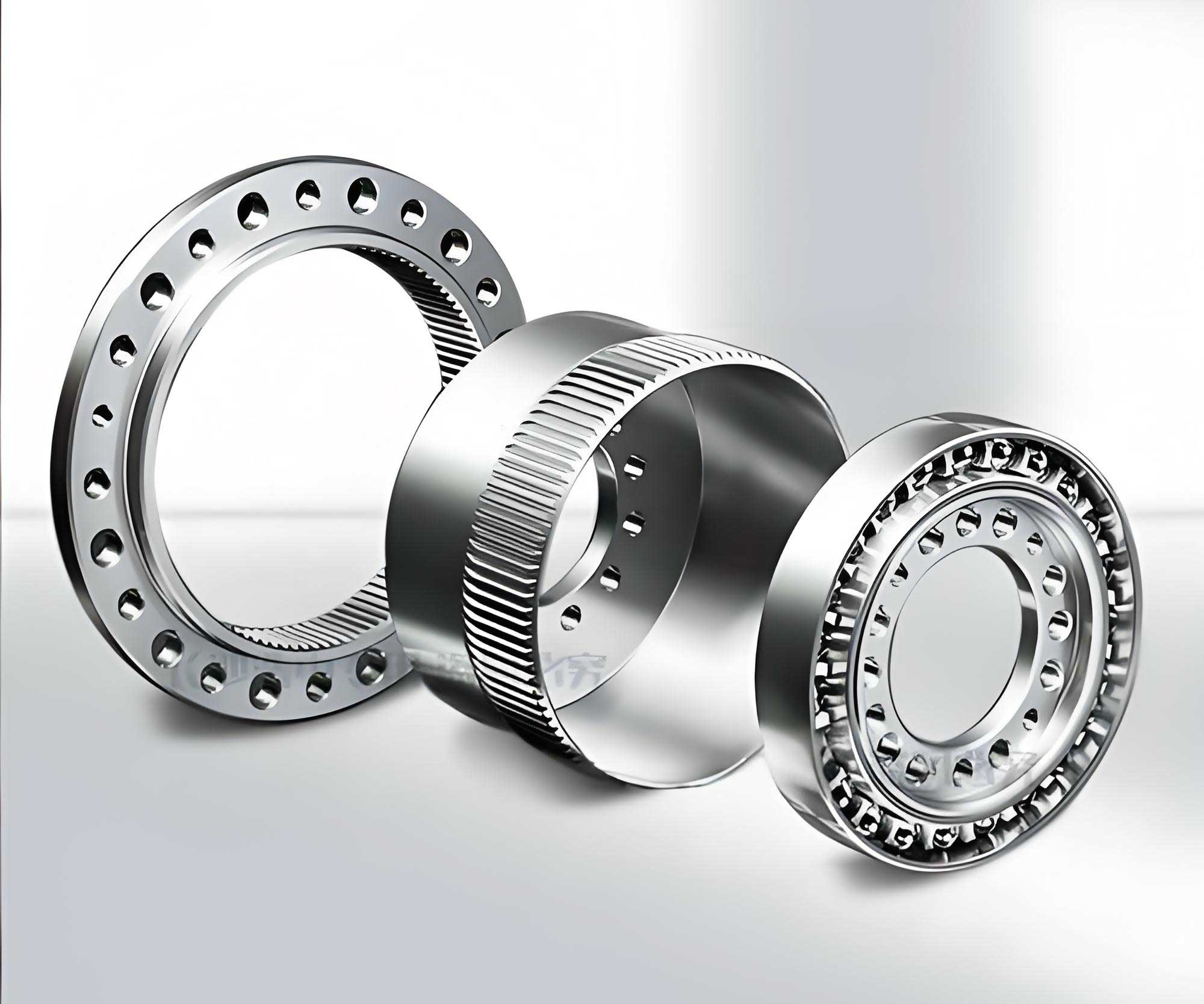
The operational principle of a harmonic drive gear is deceptively simple yet mechanically profound. The system consists of three primary components: a rigid Circular Spline (CS), a flexible Flexspline (FS), and an elliptical Wave Generator (WG). The Wave Generator, typically an elliptical bearing or cam, is inserted into the Flexspline, causing its thin-walled cup or hat-shaped body to deform into an elliptical shape. This deformation forces the teeth of the Flexspline to mesh with the teeth of the Circular Spline at two diametrically opposite regions along the major axis of the ellipse. As the Wave Generator rotates, the elliptical deformation pattern rotates with it. Because the Flexspline has slightly fewer teeth (usually 2 teeth fewer) than the Circular Spline, each revolution of the Wave Generator results in a small relative angular displacement between the Flexspline and the Circular Spline. This kinematic relationship yields the high reduction ratio characteristic of a harmonic drive gear, given by:
$$ i = -\frac{N_f}{N_c – N_f} $$
where \( N_c \) is the number of teeth on the Circular Spline, \( N_f \) is the number of teeth on the Flexspline, and the negative sign indicates opposite rotation directions. The critical challenge is to design tooth profiles on both the Flexspline and Circular Spline that ensure smooth, continuous, and theoretically correct motion transfer throughout this dynamic meshing process, which involves continuous deformation of the Flexspline.
The Genesis: Involute Tooth Profiles and Their Dominance
The first harmonic drive gear, pioneered by C.W. Musser, utilized a straight-sided, high-pressure-angle tooth profile. Musser’s initial design was predicated on achieving constant velocity ratio by assuming the neutral curve of the deformed Flexspline followed an Archimedean spiral. However, this model was an oversimplification, as it neglected tangential displacements of points on the neutral curve and the rotation of the tooth centerline due to changing curvature during deformation. Consequently, the straight-sided profile was not an ideal conjugate profile. This realization spurred a shift towards a more manufacturable and familiar solution: the involute tooth profile.
The adoption of the involute profile for harmonic drive gears was largely driven by pragmatic considerations. For high tooth counts, the involute approximates a straight line, and the theoretical error introduced was deemed acceptable for many applications. More importantly, the vast existing infrastructure for manufacturing involute gears (hobbling, shaping, grinding) could be readily adapted for producing harmonic drive gear components. Involute profiles for harmonic drive gears are broadly categorized into two types: narrow-gap and wide-gap profiles. The wide-gap profile, with reduced addendum, is essentially a modified involute intended to lower root stress concentrations in the Flexspline.
From a kinematic analysis standpoint, the engagement of an involute harmonic drive gear under no-load conditions reveals a fundamental characteristic: only a limited number of tooth pairs are in true contact within the engagement zones. The motion trajectory of a Flexspline tooth relative to the Circular Spline does not perfectly envelope a standard involute profile. The theoretical conjugate condition for harmonic drive gears is complex. If we define the neutral curve of the deformed Flexspline parametrically and consider the motion of a tooth relative to the fixed Circular Spline, the condition for continuous contact can be derived from envelope theory. The locus of the Flexspline tooth flank must satisfy the equation of meshing:
$$ \mathbf{n} \cdot \mathbf{v}^{12} = 0 $$
where \( \mathbf{n} \) is the unit normal vector to the tooth surface at the contact point and \( \mathbf{v}^{12} \) is the relative velocity vector between the Flexspline tooth and the Circular Spline tooth. For a standard involute profile, this condition is only approximately met over a small portion of the tooth flank. This results in an “approximate conjugate” action.
Under load, the situation changes dramatically. Elastic deformation of the teeth and the Flexspline body itself allows many more tooth pairs to share the load. However, this multi-pair contact in a traditional involute harmonic drive gear is often achieved through edge or point contact at the tips or roots of the teeth, rather than ideal surface contact along the active profile. This edge contact is detrimental as it creates high local contact stresses, hinders the formation of a protective lubricant film, and can accelerate wear. Therefore, substantial effort was dedicated to “profile modification” or “crowning” of involute teeth to distribute load more evenly and move the contact area away from the edges. Despite these modifications, the fundamental kinematic compromise of the involute profile in a harmonic drive gear remained.
The following table summarizes the key characteristics and trade-offs of the involute tooth profile in harmonic drive gear applications:
| Aspect | Advantages | Disadvantages & Challenges |
|---|---|---|
| Manufacturability | Excellent. Leverages standard gear production technology (hobs, shapers). Low tooling cost. | Requires precise profile modification/crowning for optimal performance. |
| Load Distribution (No-Load) | Limited to a few tooth pairs in true conjugate contact. | Theoretically discontinuous engagement in the conjugate sense. |
| Load Distribution (Under Load) | Multiple tooth pairs engage due to system elasticity. | Contact is often at tooth edges or points, leading to high stress concentrations. |
| Backlash | Can be made very small with precise manufacturing and preload. | Backlash control highly dependent on machining tolerances and assembly. |
| Theoretical Foundation | Well-understood geometry from conventional gearing. | Not a perfect conjugate solution for the harmonic drive gear kinematics. |
A Paradigm Shift: The “S” Tooth Profile
The limitations of approximate conjugate profiles like the involute prompted a fundamental rethinking of the design philosophy for harmonic drive gear teeth. In the late 1980s and 1990s, Japanese researchers introduced a novel approach, leading to the development of what is now commonly known as the “S” tooth profile (named for its sigmoidal shape). This represented a significant conceptual breakthrough. The core idea was to abandon the search for a profile that was conjugate under a simplified kinematic model and instead design a profile that guaranteed continuous, multi-pair contact without relying on load-induced elastic deformation of the teeth themselves.
The methodology is based on a curve mapping technique. The starting point is the trajectory of the Flexspline tooth tip relative to the Circular Spline, which is meticulously calculated based on the exact deformation mechanics of the Flexspline under the influence of the Wave Generator. This trajectory, often a complex epitrochoid-like curve, serves as the “reference curve” or “generating path.” The active tooth profile of the Circular Spline is then defined as an envelope to a family of curves derived from this reference curve. Conversely, the Flexspline tooth profile is designed to mate continuously with this generated Circular Spline profile throughout the entire engagement arc.
Mathematically, if \( \mathbf{R}_t(\theta) \) defines the trajectory of the Flexspline tooth tip in the Circular Spline coordinate system as a function of Wave Generator angle \( \theta \), the active profile of the Circular Spline can be derived as the envelope of a family of curves offset from this trajectory, representing the tooth flank. The condition for tangency (envelope condition) is again given by the equation of meshing. The resulting profiles are not standard geometric curves like involutes or arcs but are numerically defined to satisfy the condition of continuous contact. A simplified representation of the principle can be visualized as the Circular Spline tooth profile being the “negative” of the tip path’s curvature over the engagement zone.
The key outcome of this approach is that in the theoretical model, all teeth within the engagement zone (typically 15-30% of the total teeth) are in simultaneous contact even at zero torque. This drastically improves load sharing from the moment torque is applied, reduces stress concentrations, enhances torsional stiffness, and improves positional accuracy. The tooth profile typically features a concave-convex pairing with a pronounced “S” shape, providing a large contact area and favorable pressure angle distribution.
The advantages of the S-tooth profile harmonic drive gear are substantial, but the design is computationally intensive and requires advanced manufacturing techniques, such form grinding with precisely dressed wheels, to achieve the complex non-standard profile. Its theoretical foundation, while robust, sometimes relied on simplifications like treating the gear pair as rack-and-pinion equivalents for high tooth counts, which could introduce inaccuracies for gears with lower tooth numbers.
The Arc-Based Family: Circular Arc Tooth Profiles
Parallel to the development of involute and S-profiles, significant research, particularly in the former Soviet Union and later in Japan, focused on circular arc tooth profiles for harmonic drive gears. The motivation was to combine improved stress conditions with good manufacturability. A circular arc profile, especially a concave shape on the Flexspline, creates a wider tooth root, significantly reducing stress concentration compared to the relatively narrow root of an involute tooth. Furthermore, the wedge-shaped clearance inherent in arc profiles can promote better lubrication film formation.
The kinematic analysis for circular arc profiles starts with the recognition that the relative motion of a point on the Flexspline tooth is approximately a hypocycloid. This suggests that a convex arc on the Circular Spline could be a reasonable starting point. The conjugate profile for the Flexspline would then be a more complex curve. In practice, true conjugate arc profiles are difficult to realize, so practical designs utilize “mating” arc profiles that are not perfectly conjugate but perform excellently under load due to system compliance.
The primary types of circular arc profiles used in harmonic drive gears are:
- Single Circular Arc: Uses a simple circular arc for the tooth flank. While easy to conceptualize, the contact path can be short.
- Tangent Dual Circular Arc: This is the most common and successful type. The Flexspline tooth has a concave arc near the root and a convex arc near the tip, with a smooth tangent connection at the “filler” point. The Circular Spline tooth has a corresponding convex-concave shape. This design maximizes the contact area and provides a favorable load-bearing configuration. The geometry can be parameterized by radii \( R_f1, R_f2 \) for the Flexspline and \( R_c1, R_c2 \) for the Circular Spline, along with pressure angles \( \alpha_1 \) and \( \alpha_2 \).
Let’s define a simple coordinate system for a Flexspline dual-circular-arc tooth. The main parameters are the module \( m \), the radius of the concave arc \( R_a \), the radius of the convex arc \( R_b \), and their center coordinates. The transition point is defined by the pressure angle. The coordinates of a point on the concave segment can be expressed parametrically. While the full derivation is lengthy, the essence is creating two arcs that meet smoothly to provide extended contact.
A major challenge with circular arc profiles is tooling. They require specialized, non-involute hobs or form-grinding wheels, which are more expensive to produce than standard involute tooling. A compromise solution, sometimes called a “substitute” or “approximate” arc profile, uses a straight-sided or modified trochoidal profile that can be cut with simpler tooling while approximating the benefits of the true arc.
The performance benefits of a well-designed dual-circular-arc harmonic drive gear are notable: increased torque capacity, higher torsional stiffness, improved fatigue life of the Flexspline, and smoother motion. Japanese manufacturers have widely adopted this technology for high-performance robotics. The following table compares the three major families of harmonic drive gear tooth profiles:
| Profile Type | Design Philosophy | Key Advantage | Primary Challenge | Typical Application Focus |
|---|---|---|---|---|
| Involute (Modified) | Approximate conjugate, manufacturability-driven. | Low cost, easy to produce, vast existing knowledge base. | Edge/point contact under load, requires careful modification. | Cost-sensitive, moderate performance applications. |
| “S” Profile | Theoretical continuous contact, kinematics-driven. | Superior load sharing, high stiffness & accuracy from zero load. | Complex design & manufacturing, higher cost. | High-performance robotics, aerospace, precision stages. |
| Circular Arc (Dual) | Strength & contact-driven, practical conjugate. | Excellent stress distribution, good lubrication, high torque density. | Specialized tooling required, design optimization is complex. | Industrial robots, actuators requiring high torque & stiffness. |
Parametric Influence and Optimization of Harmonic Drive Gear Teeth
Beyond the choice of the basic profile curve, the detailed parametric design of a harmonic drive gear tooth is critical to its performance. Key parameters include:
- Module (m) and Pressure Angle (α): The module defines the tooth size. A finer module allows more teeth for a given diameter, increasing the reduction ratio and potential contact points. Pressure angle affects the radial vs. tangential force component. Higher pressure angles (e.g., 30°-45° are common in harmonic drive gears vs. 20° for standard gears) increase radial load on the Flexspline but can improve resistance to slipping under high torque.
- Profile Displacement (X-shift): Applying a profile shift to the Flexspline and Circular Spline teeth is a powerful tool to optimize the contact pattern, avoid interference, and adjust the center distance to accommodate the Wave Generator’s major axis dimension.
- Rim Thickness and Tooth Depth: The Flexspline’s rim must be thick enough to transmit torque but thin enough to flex reliably without exceeding fatigue limits. The tooth depth is often reduced (short addendum) compared to standard gears to lower bending stress.
The optimization process involves complex multi-objective trade-offs. Goals include maximizing torque capacity \( T_{max} \), minimizing peak tooth root stress \( \sigma_b \), maximizing torsional stiffness \( K_t \), and ensuring smooth, low-loss meshing. Finite Element Analysis (FEA) and advanced contact mechanics simulations are indispensable tools for this optimization. An objective function for a parametric optimization might look like:
$$ \text{Minimize: } w_1 \cdot \frac{1}{T_{max}} + w_2 \cdot \sigma_{b,max} + w_3 \cdot \frac{1}{K_t} $$
subject to constraints such as no tooth tip interference, minimum rim thickness, and manufacturing limits. Here, \( w_1, w_2, w_3 \) are weighting factors reflecting the design priorities for the specific harmonic drive gear application.
Future Trajectories and Concluding Synthesis
The evolution of the harmonic drive gear tooth profile is a clear narrative of progressing from convenient approximations (involute) to strength-optimized solutions (arcs) and finally to kinematically ideal designs (S-profile). Today, the frontier of harmonic drive gear research involves several exciting avenues:
- Hybrid and Asymmetric Profiles: Designing profiles that are not symmetric about the tooth centerline to better suit the asymmetric loading conditions during engagement and disengagement.
- Additive Manufacturing: The rise of metal additive manufacturing (3D printing) could liberate tooth profile design from the constraints of subtractive machining (hobbing, grinding). Profiles optimized purely for performance, with internal lattice structures for weight reduction or cooling, may become feasible.
- Integrated Topology Optimization: Using generative design algorithms to create novel, organic tooth and Flexspline rim shapes that optimally distribute stress and maximize stiffness-to-weight ratio.
- Advanced Materials and Coatings: The development of new high-strength, high-fatigue limit alloys or composites for the Flexspline could allow for more aggressive profile designs or higher deformation ratios, further improving the power density of the harmonic drive gear.
In my assessment, there is no single “best” tooth profile for all harmonic drive gear applications. The choice is a strategic decision based on the application’s priority matrix:
- For ultra-high precision and stiffness (e.g., satellite pointing mechanisms, lithography stages), the S-profile or its evolved derivatives represent the pinnacle of performance.
- For high torque density and robustness in industrial settings (e.g., robot joints), the dual-circular-arc profile offers an outstanding balance.
- For cost-sensitive volume production where extreme performance is not critical, a well-modified involute profile remains a perfectly valid and economical solution.
The ongoing research and refinement of tooth profiles are fundamental to unlocking the full potential of harmonic drive technology. As a fundamental component enabling precision motion, the harmonic drive gear will continue to benefit from innovations in its core geometry, pushing the boundaries of what is possible in mechatronic system design. The journey from Musser’s straight sides to today’s complex, computationally optimized curves exemplifies the relentless pursuit of engineering excellence in this unique and indispensable field of power transmission.