
Harmonic drive gears, renowned for their high precision, compactness, and substantial torque transmission capabilities, are pivotal in applications ranging from robotics to aerospace systems. However, in loaded conditions, these systems often exhibit undesirable phenomena such as elevated friction, diminished efficiency, and even catastrophic seizure. As an engineer deeply involved in precision mechanical design, I have observed that these issues frequently stem not from inherent flaws in the harmonic drive principle but from integrated errors introduced during design, manufacturing, and assembly. In this comprehensive analysis, I will delve into the theoretical underpinnings of these problems, focusing on the statically indeterminate nature of the output shaft, the quantification of various error sources, and the derivation of optimal structural parameters to mitigate their effects. The goal is to provide a framework for enhancing the reliability and performance of harmonic drive gear systems.
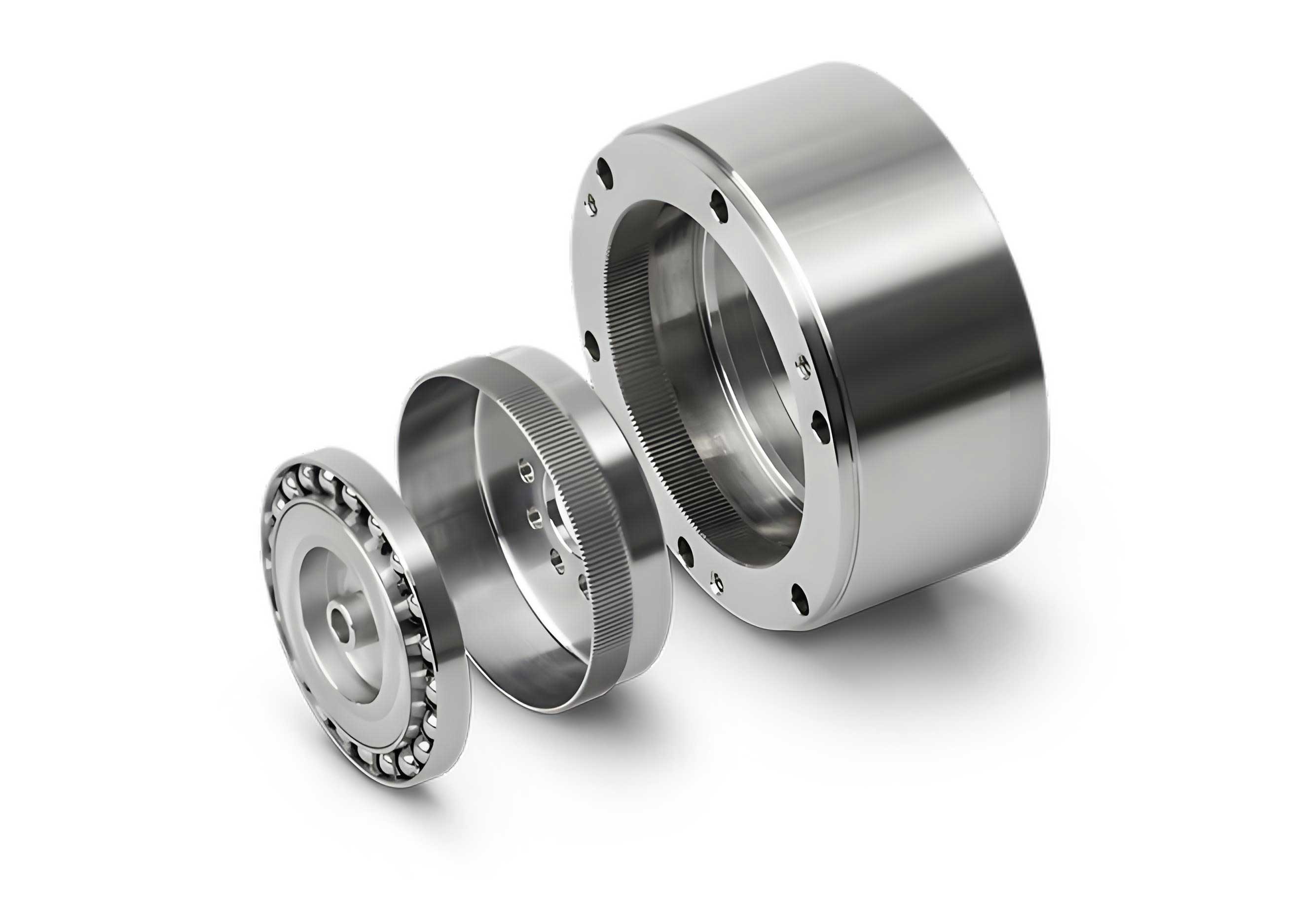
The core of a harmonic drive gear system comprises a wave generator, a flexspline (often a thin-walled elastic component), and a circular spline. Under ideal conditions, the dual-wave symmetry ensures uniform load distribution across multiple simultaneously engaged teeth. However, real-world implementations deviate from this ideal due to elastic deformations under load and inevitable tolerances. I will first address the output shaft’s behavior, as it is a critical load-bearing element whose deflection can severely disrupt the meshing symmetry between the flexspline and the fixed circular spline. This disruption leads to uneven contact pressures, escalating friction, and potential lock-up.
To model the output shaft’s response, consider a simplified yet representative system: the shaft is supported by two bearings and carries an external load at a distance from the supports. The flexspline, mounted on the shaft via a bearing, engages with both the fixed circular spline and an output circular spline. When an external load is applied, the shaft deflects, causing the flexspline to tilt. This tilt induces a radial reaction force at the meshing interface with the fixed circular spline, creating a statically indeterminate problem. Using the principle of superposition and energy methods (specifically Castigliano’s theorem), I can decompose the system into two scenarios: one with only the external load and another with only the induced radial meshing force. The compatibility condition requires that the radial displacement at the flexspline location due to the external load equals the displacement due to the meshing force.
Let the shaft have a diameter $d$, Young’s modulus $E$, and area moment of inertia $I = \pi d^4 / 64$. The distances are defined as follows: $a$ is the span from the left bearing to the flexspline, $b$ is the span from the flexspline to the right bearing, and $c$ is the distance from the right bearing to the point of external load application $F$. The induced radial force at the flexspline-circular spline interface is denoted $F_3$. The radial displacement at the flexspline due to force $F$ is $\Delta_1$, and that due to $F_3$ is $\Delta_2$. Through integration of the bending moment diagrams and application of the unit load method, I derive the following expressions:
$$ \Delta_1 = \frac{Fc}{6EI} \cdot \frac{2a^2b + ab^2}{(a + b)} $$
$$ \Delta_2 = \frac{F_3}{3EI} \cdot \frac{a^2b^2}{(a + b)} $$
Enforcing compatibility $\Delta_1 = \Delta_2$ yields the solution for the induced radial force:
$$ F_3 = \frac{Fc}{2} \cdot \frac{2a + b}{ab} $$
The bearing reaction forces, $F_1$ at the left and $F_2$ at the right, are obtained via superposition of the forces from the two scenarios:
$$ F_1 = \left(1 + \frac{c}{a+b}\right)F + \frac{a}{a+b}F_3 $$
$$ F_2 = -\frac{c}{a+b}F + \frac{b}{a+b}F_3 $$
These equations reveal fundamental relationships critical for harmonic drive gear design. To clarify, I present them in a tabular form:
| Design Parameter | Mathematical Relationship | Physical Implication for Harmonic Drive Gear |
|---|---|---|
| Shaft Stiffness | $\propto E I \propto E d^4$ | Increasing shaft diameter dramatically enhances rigidity, reducing deflection-induced misalignment. |
| Bearing Reaction Forces ($F_1$, $F_2$) | $\propto 1 / (a+b)$ | Larger bearing span reduces bearing loads, improving longevity and stability. |
| Meshing Radial Force ($F_3$) | $\propto 1 / [ab(a+b)]$ | Increasing span $a+b$ or optimizing $a$ and $b$ minimizes parasitic radial forces, lowering friction. |
For a typical harmonic drive gear with a shaft diameter of 15 mm, finite element analysis (using tools like ANSYS) confirms that maximum deflections are on the order of $10^{-4}$ mm, rendering the shaft effectively rigid if diameters are sufficiently large. Thus, the primary concern shifts from elastic deflection to errors arising from manufacturing and assembly.
The integrated errors in a harmonic drive gear system encompass a variety of factors: bearing clearances, radial runout of shafts and bearings, housing bore misalignment, and tolerances in component dimensions. Under the assumptions of independence and linear superposition, the total error is the sum of individual contributions. However, the most detrimental effect is the tilting of the output shaft axis due to clearances in the support bearings. This tilt causes the flexspline to rotate relative to the fixed circular spline, leading to non-uniform contact along the tooth width. The upper part of the engagement may become overly tight, while the lower part loosens, dramatically increasing normal and shear stresses at the interface.
To quantify this, consider the model where the output shaft tilts as a rigid body due to clearances in the two support bearings. Let the left bearing have a radial clearance $\varepsilon$ and the right bearing a clearance $\delta$. The shaft tilts about an effective pivot point, causing the flexspline, with tooth width $B$ and pitch diameter $d_{ar}$, to shift. The goal is to find the radial deviation of the flexspline’s engagement point with the fixed circular spline. Using small-angle approximations (valid since clearances are micron-scale while spans are millimeter-scale), the tilt angle $\alpha$ is:
$$ \alpha \approx \tan \alpha = \frac{\delta + \varepsilon}{a + b} $$
The vertical offset $h$ of the flexspline’s geometric center from the baseline (ideal axis) is:
$$ h = \frac{a\delta – b\varepsilon}{a + b} $$
The radial deviations at the top and bottom engagement points of the flexspline, $\Delta_1$ and $\Delta_2$, relative to the nominal position, are derived from geometric considerations:
$$ \Delta_1 = \frac{1}{a+b} \left[ \frac{B}{2} (\delta + \varepsilon) – (a\delta – b\varepsilon) \right] $$
$$ \Delta_2 = \frac{1}{a+b} \left[ (a\delta – b\varepsilon) – \frac{B}{2} (\delta + \varepsilon) \right] $$
Notice that $\Delta_1 = -\Delta_2$. For optimal meshing, we aim to minimize these deviations, ideally setting $\Delta_1 = \Delta_2 = 0$. This condition leads to the critical design equation for positioning the flexspline along the output shaft:
$$ a\delta – b\varepsilon = \frac{B(\delta + \varepsilon)}{2} $$
This equation dictates the axial location of the flexspline (determined by $a$ and $b$) relative to the bearing supports, given the expected clearances ($\delta$, $\varepsilon$) and the flexspline tooth width $B$. Satisfying this condition balances the radial errors, promoting even contact and reducing stress concentrations in the harmonic drive gear.
The magnitudes of errors from various sources vary significantly. To guide tolerance allocation and design focus, I compare typical deformation values in the table below. These values assume a medium-sized harmonic drive gear with nominal dimensions: shaft diameter 20 mm, span $a+b=100$ mm, load $F=500$ N, and clearances in the micron range.
| Error Source | Typical Magnitude | Effect on Harmonic Drive Gear Meshing |
|---|---|---|
| Output Shaft Elastic Deflection | $10^{-4}$ to $10^{-3}$ mm | Negligible if $d \geq 15$ mm; otherwise contributes to tilt. |
| Bearing Radial Clearance ($\delta, \varepsilon$) | 5 to 20 µm | Primary cause of shaft tilt; directly amplifies radial meshing forces. |
| Shaft Radial Runout | 2 to 10 µm | Adds to effective clearance; varies with rotation. |
| Housing Bore Misalignment | 5 to 15 µm | Induces additional tilt; difficult to compensate. |
| Tooth Profile Errors | 1 to 5 µm | Affects local contact but less impactful than gross tilt. |
The clearances $\delta$ and $\varepsilon$ are not independent; they result from the accumulation of tolerances in the bearing fit, housing bore, and shaft journal. Using worst-case or statistical tolerance analysis, designers can estimate these values. For instance, if a bearing has an internal clearance of 10 µm and is mounted with a transition fit, the effective radial play might be 8 µm. Similarly, housing bore machining tolerances might contribute ±5 µm. By summing these contributions, we obtain $\delta$ and $\varepsilon$ for use in the positioning equation.
To further illustrate the design process, consider a numerical example. Suppose a harmonic drive gear has a flexspline tooth width $B = 10$ mm. From tolerance analysis, the left bearing effective clearance $\varepsilon = 12$ µm and the right $\delta = 8$ µm. The total span $a+b$ is fixed at 120 mm due to housing constraints. We need to determine the optimal distances $a$ and $b$. Substituting into the design equation:
$$ a(8 \times 10^{-3}) – b(12 \times 10^{-3}) = \frac{10(8 \times 10^{-3} + 12 \times 10^{-3})}{2} $$
Simplifying (units in mm):
$$ 0.008a – 0.012b = 0.1 $$
And since $a + b = 120$, we solve simultaneously to get $a = 70$ mm and $b = 50$ mm. This positions the flexspline 70 mm from the left bearing and 50 mm from the right, optimally balancing the radial errors. Verification via the deviation formulas yields $\Delta_1 = \Delta_2 = 0$, indicating theoretically perfect compensation.
Beyond the output shaft, the structural design of the harmonic drive gear housing and splines also demands attention. The fixed circular spline must exhibit high stiffness to resist deformation under the radial forces $F_3$. If the housing warps, it exacerbates misalignment. I recommend using finite element analysis to simulate the entire assembly under load, identifying weak points. Moreover, the choice of bearing type is crucial. Angular contact ball bearings can better accommodate combined radial and axial loads, but their preload must be carefully set to minimize clearance without inducing excessive friction. For high-precision harmonic drive gears, matched bearing pairs or tapered roller bearings might be employed.
Thermal effects, though often secondary due to symmetry, can become significant in high-speed or high-load applications. Differential expansion between the steel components and aluminum housing can alter clearances. A comprehensive error budget should include thermal expansions coefficients and operating temperature ranges. The linear thermal expansion $\Delta L$ is given by $\Delta L = \alpha L \Delta T$, where $\alpha$ is the coefficient, $L$ a characteristic length, and $\Delta T$ the temperature change. For a steel shaft in an aluminum housing, the differential expansion can be on the order of microns per 10°C, comparable to mechanical clearances. Therefore, in critical applications, thermal management or material matching is essential.
Manufacturing techniques also play a role. Grinding of the spline teeth to higher precision (e.g., DIN class 5 or better) reduces tooth profile errors. Similarly, honing of housing bores ensures better alignment. However, tighter tolerances increase cost. The design equation derived earlier allows engineers to relax certain tolerances by strategically positioning the flexspline, offering a cost-effective optimization path.
In summary, the performance degradation of harmonic drive gears under load is predominantly due to integrated errors causing output shaft tilt and subsequent uneven meshing. My analysis underscores several key design principles:
- Shaft Diameter: Maximize the output shaft diameter to boost stiffness, as rigidity scales with $d^4$. This minimizes elastic deflection, a prerequisite for treating the shaft as rigid in error analysis.
- Bearing Span: Increase the distance between support bearings to reduce bearing reaction forces and the induced radial meshing force $F_3$. This lowers friction and wear.
- Error Compensation: Use the derived equation $a\delta – b\varepsilon = B(\delta + \varepsilon)/2$ to axially position the flexspline, effectively canceling out the first-order effects of bearing clearances. This is a powerful tool for harmonic drive gear design.
- Tolerance Management: Conduct a thorough tolerance stack-up analysis to estimate $\delta$ and $\varepsilon$, then adjust design parameters accordingly. Consider both mechanical and thermal expansions.
- Verification: Employ simulation tools like FEA to validate designs under expected loads, ensuring housing and spline stiffness are adequate.
Future work could involve dynamic analysis of harmonic drive gears, considering time-varying loads and the impact of errors on transmission accuracy over time. Additionally, advanced materials or compliant bearing supports might offer further improvements. Nevertheless, the principles outlined here provide a solid foundation for designing robust, high-performance harmonic drive gear systems that minimize the risks of friction, efficiency loss, and seizure in demanding applications.
In conclusion, the intricate behavior of harmonic drive gears under load necessitates a holistic approach that integrates mechanical analysis, tolerance engineering, and strategic design. By rigorously addressing the statically indeterminate nature of the output shaft and quantitatively managing integrated errors, engineers can unlock the full potential of these remarkable transmission systems, ensuring reliability and precision in the most challenging environments.