
In my extensive experience with power transmission systems, the assembly and adjustment of straight bevel gear pairs, including the common 90-degree miter gear configuration, often present a significant challenge. A frequent and troublesome phenomenon encountered on the shop floor is poor tooth contact patterning post-assembly. While certain machining errors in the gear blanks or the housing—such as misalignment between the gear tooth trace and its bore axis, excessive radial runout of the gear rim, or non-coplanarity of the perpendicular bearing bore axes in the housing—lead to irreparable contact issues requiring part rework, there is another prevalent cause. Even with perfectly machined components, incorrect axial positioning of the pinion and gear, defined by their mounting distances, will invariably result in suboptimal tooth contact. However, in this latter case, the contact patterns on both the drive and coast flanks of the teeth typically exhibit a similar, predictable shape. This characteristic becomes the key to diagnosing and rectifying the problem. The core issue lies in the misalignment of the pitch cone apexes of the pinion and the gear. When the mounting distances deviate from their theoretical values, the two apexes no longer coincide at the theoretical intersection point of their axes. This non-coincidence directly and systematically alters the meshing geometry, affecting both the localization of contact across the tooth flank and the operating backlash of the miter gear pair.
To analyze this problem methodically, we establish a coordinate system. Let the origin, point O, be fixed at the theoretical pitch cone apex of the gear (often the larger gear in a general bevel pair, but for a true miter gear, both are identical). The X-axis is aligned with the gear’s axis of rotation, and the Y-axis with the pinion’s axis. When the actual mounting distances \( A_{p}’ \) and \( A_{g}’ \) differ from their theoretical values \( A_{p} \) and \( A_{g} \), the pinion’s pitch cone apex, point P, is displaced from the origin O. This point P can lie in any quadrant of the XY-plane. By dividing each quadrant with a line at the pinion’s pitch angle \(\delta_p\), we can define 16 distinct positional zones and boundaries for point P, as conceptually illustrated below. The position of P is uniquely described by its coordinates (x, y) and its angular position relative to the origin, often characterized by a slope angle \( \psi \), where \( \psi = \arctan(y/x) \).
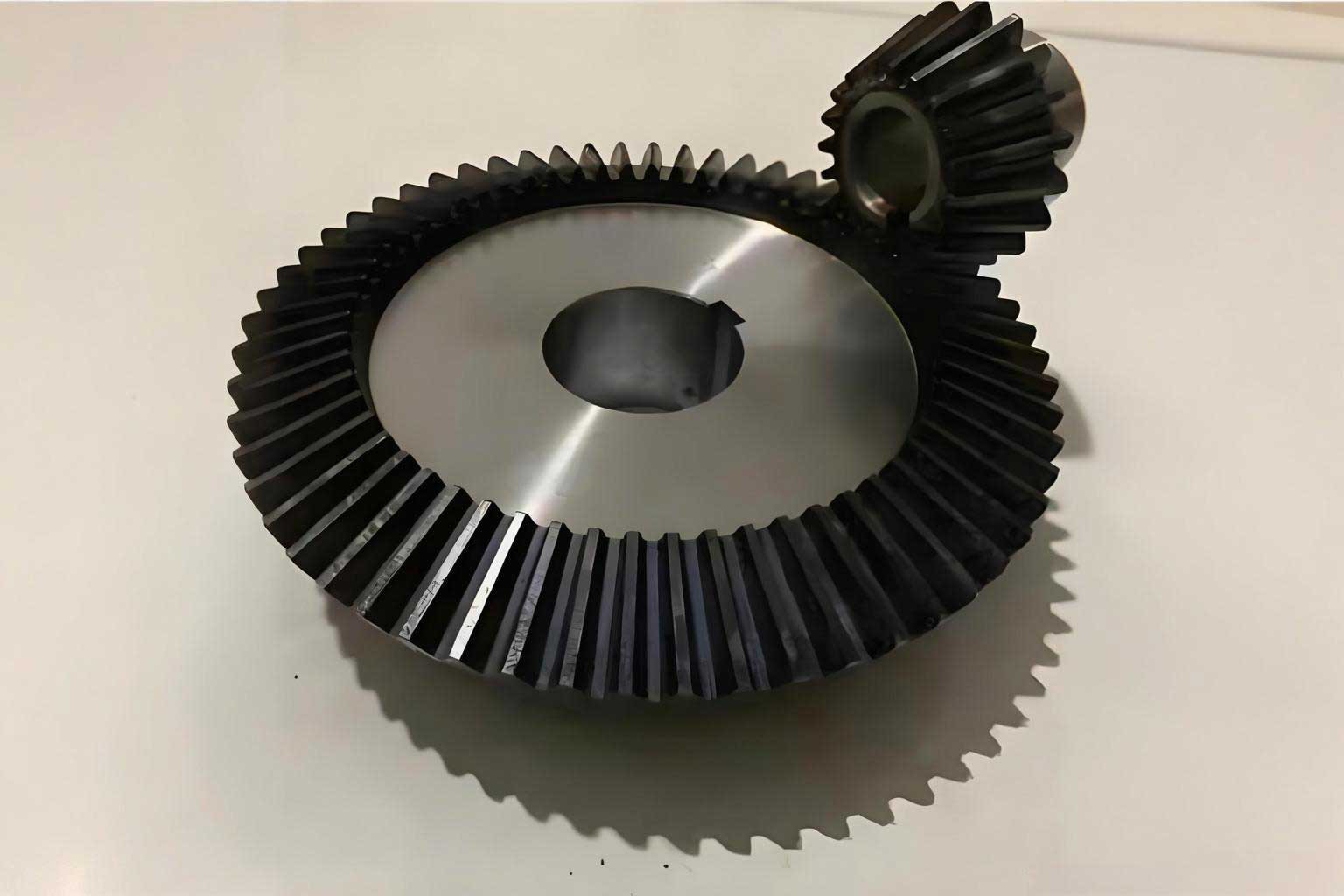
Through kinematic analysis of the non-conjugate contact between the displaced tooth surfaces and extensive practical validation, a direct correlation has been established between the position of point P and the resulting contact pattern shape on the pinion teeth. For a miter gear, where the shaft angle is 90 degrees and the pitch angles are typically 45 degrees, this relationship becomes particularly symmetric. The table below summarizes this relationship for key boundary positions. The contact patterns for intermediate zones can be logically interpolated from these.
| Position Code of Point P | Coordinates (x, y) | Slope Angle \( \psi \) | Typical Pinion Tooth Contact Pattern Description |
|---|---|---|---|
| A | +, 0 | 0° | Contact biased heavily towards the toe on both flanks. |
| B | +, + | \( \delta_p \) | Contact biased towards the toe and the top of the tooth. |
| C | 0, + | 90° | Contact biased heavily towards the top (face) on both flanks. |
| D | -, + | \( 180° – \delta_p \) | Contact biased towards the heel and the top of the tooth. |
| E | -, 0 | 180° | Contact biased heavily towards the heel on both flanks. |
| F | -, – | \( 180° + \delta_p \) | Contact biased towards the heel and the bottom of the tooth. |
| G | 0, – | 270° | Contact biased heavily towards the bottom (flank) on both flanks. |
| H | +, – | \( -\delta_p \) (or \( 360° – \delta_p \)) | Contact biased towards the toe and the bottom of the tooth. |
Therefore, by observing the contact pattern on the pinion of a straight miter gear set, one can directly infer the approximate quadrant and slope angle region where the displaced apex point P is located. This visual diagnosis is the first critical step. However, to perform a precise quantitative adjustment, we must determine the exact coordinates (x, y) of point P. This requires examining the second major effect of apex misalignment: the change in operating backlash. Mounting distance error not only shifts the contact pattern but also alters the clearance between the non-driving flanks of the miter gear pair. The relationship is systematic: for certain positions of P, the backlash increases; for others, it decreases.
We define the “Theoretical Backlash” \( J_t \) as the sum of the intentional tooth thinning (compared to the theoretical tooth thickness) at the heel of both the pinion and gear. The “Actual Measured Backlash” \( J_a \) is the clearance measured at the heel of the assembled gear pair under zero load. The change in backlash, \( \Delta J \), is therefore:
$$ \Delta J = J_a – J_t $$
This change \( \Delta J \) is geometrically related to the coordinates (x, y) of point P. For a straight bevel or miter gear with a shaft angle \(\Sigma = 90^\circ\), the relationship can be derived from the fundamental geometry of the spherical involute or equivalent bevel gear tooth form. The general form of the equation relating backlash change to apex displacement is:
$$ \Delta J \approx 2 \cdot (x \sin\delta_p \cos\delta_g + y \sin\delta_g \cos\delta_p) \cdot \tan\alpha_n / R_m $$
Where \(\delta_p\) and \(\delta_g\) are the pinion and gear pitch angles, \(\alpha_n\) is the normal pressure angle, and \(R_m\) is the mean cone distance. For the specific and critical case of a standard miter gear, where \(\delta_p = \delta_g = 45^\circ\) and \(\Sigma = 90^\circ\), this equation simplifies dramatically. The relationship between the backlash change and the apex displacement coordinates for a miter gear becomes more direct and is a function of the module and number of teeth.
A more practical formulation for a miter gear involves the displacement along lines of constant backlash change. It can be shown that:
$$ \Delta J = k \cdot (x \cos\delta_p + y \sin\delta_p) $$
Where \(k\) is a constant dependent on the gear geometry (module, number of teeth). For a miter gear with \(\delta_p=45^\circ\), \(\cos\delta_p = \sin\delta_p\). From this, and by knowing the contact pattern gives us the slope angle \(\psi\), we can solve for the coordinates. First, we note the slope angle: \( \psi = \arctan(y/x) \). The radial distance \( r = \sqrt{x^2 + y^2} \) is related to the backlash change. Combining these, the coordinates can be estimated as:
$$ x \approx \frac{\Delta J}{2k \cos\delta_p} \cdot \frac{1}{\cos(\psi – \delta_p)} \cdot \cos\psi $$
$$ y \approx \frac{\Delta J}{2k \cos\delta_p} \cdot \frac{1}{\cos(\psi – \delta_p)} \cdot \sin\psi $$
Where \( k \) is a geometry factor, often approximated for initial adjustment as \( k \propto m_n / Z_v \) where \( m_n \) is the normal module and \( Z_v \) is the virtual number of teeth.
There exists a special line, the line of zero backlash change, defined by the slope angle \(\psi_0\). When point P lies on this line, \(\Delta J = 0\) even though the apexes are misaligned. For a miter gear, this line is typically found at:
$$ \psi_0 = \arctan\left(-\frac{\cos(\delta_p + \delta_g)}{\sin(\delta_p + \delta_g)}\right) $$
With \(\delta_p = \delta_g = 45^\circ\) and \(\Sigma=90^\circ\), \(\delta_p + \delta_g = 90^\circ\), so \(\psi_0 = \arctan(0)\), which is \(0^\circ\) or \(180^\circ\). This means for a standard miter gear, the line of zero backlash change is along the X-axis (the gear’s axis). Displacement purely along the gear’s axis changes the contact pattern (e.g., Position A or E) but does not affect the measured heel backlash significantly. Conversely, displacement along the pinion’s axis (Y-axis) causes the most significant change in backlash. This is a crucial insight for diagnosing miter gear issues.
The on-site diagnosis and adjustment procedure for a straight miter gear pair suffering from poor contact due to mounting distance error is as follows:
- Visual Inspection: Apply marking compound (e.g., Prussian blue) to the pinion teeth and rotate the assembled miter gear pair through several mesh cycles. Observe the contact pattern on both the drive and coast flanks of the pinion.
- Pattern Classification: Compare the observed pattern(s) to the standard charts (like the table above). Identify the position code (e.g., “Bias towards toe and top” corresponding to Position B). This gives an estimated slope angle \( \psi \). For a pattern biased purely to the toe, \( \psi \approx 0^\circ \); purely to the heel, \( \psi \approx 180^\circ \); purely to the top, \( \psi \approx 90^\circ \); etc.
- Backlash Measurement: Precisely measure the actual operating backlash \( J_a \) at the heel of the miter gear. This often requires locking one gear and using a dial indicator on the other. Calculate or obtain from the drawing the theoretical or “required” backlash \( J_t \) (the sum of specified tooth thinning allowances). Compute the backlash change: \( \Delta J = J_a – J_t \).
- Consistency Check: Verify that the sign (increase or decrease) of \( \Delta J \) is consistent with the predicted zone from the contact pattern. For a miter gear, a pattern biased “toe and top” (Position B) should correspond to a specific direction of backlash change. If inconsistency is found, re-measure backlash or suspect other errors like incorrect tooth thickness.
- Coordinate Calculation: Using the estimated \( \psi \) from Step 2 and the calculated \( \Delta J \) from Step 3, apply the coordinate formulas. Often, a simplified nomogram or spreadsheet is used in practice for a specific miter gear design. The key outputs are the required axial adjustment amounts:
- x: This is the required axial adjustment for the gear (the component whose axis is the X-axis). A positive (+) x value indicates the gear needs to be moved away from the pinion’s axis (increasing its mounting distance). A negative (-) x value indicates the gear needs to be moved towards the pinion’s axis.
- y: This is the required axial adjustment for the pinion. A positive (+) y value indicates the pinion needs to be moved towards the gear’s axis. A negative (-) y value indicates the pinion needs to be moved away from the gear’s axis.
- Adjustment Execution: Shift the pinion and gear axially by the calculated amounts \( y \) and \( x \), respectively. This is typically done by adding or removing shims behind the bearing housings or by adjusting threaded sleeves in the case of taper roller bearing setups common in miter gear applications.
- Verification: Re-check the contact pattern and the backlash. The contact should now be centered on the pinion tooth flank, and the measured backlash \( J_a \) should be close to the required value \( J_t \). Fine-tuning by very small additional shim changes may be necessary for optimal results.
The precision of this method hinges on accurate backlash measurement and correct interpretation of the contact pattern. It is a powerful technique because it uses two independent symptoms—contact location and backlash change—to solve for the two unknown adjustment values. For a miter gear pair, this process is fundamental to achieving quiet, efficient, and long-lasting operation. Proper mounting distance ensures the theoretical conjugate contact conditions are restored, minimizing stress concentrations, reducing noise, and preventing premature wear or failure. Mastery of this adjustment principle is therefore essential for any engineer or technician working with straight bevel and miter gear drives.