
In our gear manufacturing operations, surface finish has emerged as a critical quality metric, directly influencing the performance, noise reduction, and longevity of gear systems. The pursuit of superior surface integrity during machining, particularly in processes like gear hobbing or shaping, is often hampered by numerous variables. Among these, the inherent microstructure and mechanical properties of the gear material, largely dictated by its pre-heat treatment history, play a paramount role. This article chronicles our extensive investigation into how various pre-heat treatment protocols—including annealing, normalizing, quenching and tempering, and incomplete quenching—affect the final surface finish of gears machined from common steels. We will delve into the intricate relationships between microstructure, hardness, cutting parameters, and the resultant surface quality, with a particular emphasis on mitigating issues stemming from heat treatment defects. The presence of such heat treatment defects, whether in the form of non-uniform microstructure, undesirable phase formations, or improper hardness gradients, can severely degrade machinability and surface finish.
The factors influencing surface finish are multifaceted and interconnected. They encompass the metallurgical state of the workpiece (its microstructure and hardness), the formation of built-up edge on the cutting tool, the material’s inherent mechanical properties, the tool’s geometry and its own surface finish, and the selected cutting conditions (speed, feed, depth of cut). In our plant, as quality standards for gear components were elevated, the surface finish achieved during gear shaping became a persistent challenge. While many factories have researched and advanced pre-heat treatment techniques, we undertook a focused experimental study to systematically quantify these effects. Our goal was to optimize pre-heat treatment operations to consistently achieve the required surface quality, thereby minimizing rework and scrap caused by machining issues linked to heat treatment defects.
Experimental Methodology and Materials
We selected three steels ubiquitous in gear production: AISI 1020 (a low-carbon steel), 18CrMnTi (a chromium-manganese-titanium alloy carburizing steel), and 40Cr (a chromium alloy steel). Test specimens were fabricated into spur gears with a module of 3 and 30 teeth. These blanks underwent a range of pre-heat treatments designed to produce distinct microstructural states:
- Annealing: Full annealing and isothermal annealing.
- Normalizing: At various temperatures.
- Quenching and Tempering (Q&T): Both oil and water quenching followed by tempering.
- Incomplete Quenching: Quenching from the intercritical region (between Ac1 and Ac3).
Each treatment aimed to generate specific combinations of ferrite, pearlite, bainite, tempered martensite (sorbite), and sometimes, undesired constituents like Widmanstätten structures. Hardness (HB) was measured for each condition. Machining trials were conducted on precisely adjusted 5A and 5B type gear shaping machines. For each microstructural condition, we varied cutting parameters such as cutting speed and feed rate, and also experimented with different tool rake angles. The surface finish was evaluated and recorded. Furthermore, we monitored production batches, conducting metallographic and hardness checks to correlate real-world processing outcomes with our controlled experiments. This approach allowed us to diagnose production issues where surface finish was unsatisfactory, often tracing the root cause back to specific heat treatment defects such as coarse grain boundaries or mixed microstructures.
Results: Microstructure, Hardness, and Surface Finish Interplay
The core of our findings is summarized in the comprehensive table below, which consolidates data from numerous test runs. The surface finish is reported on a standardized scale, where a lower numerical value indicates a smoother surface. The “Average Finish” column represents the typical outcome for a given treatment.
| Material | Pre-Heat Treatment | Predominant Microstructure | Hardness (HB) | Optimal Tool Rake Angle | Average Surface Finish Achieved | Key Observations |
|---|---|---|---|---|---|---|
| AISI 1020 | As-received (Forged) | Widmanstätten Ferrite | ~140 | 5° | ▽▽5 | Brittle cutting behavior improves finish but mechanical properties are poor. |
| Normalizing (900°C) | Fine Pearlite + Ferrite | 150-160 | 5° | ▽▽4 – ▽▽5 | Large, soft ferrite patches cause material adhesion (“sticking”) to tool. | |
| Normalizing (950°C) | Coarser Pearlite + Ferrite | 145-155 | 8° | ▽▽5 – ▽▽6 | Improved over lower temperature normalizing; reduced ferrite patch size. | |
| Isothermal Anneal | Pearlite + Ferrite + Carbides | 160-170 | 5° | ▽▽4 – ▽▽5 | Hard carbide particles impede cutting; complex process. | |
| Incomplete Quench (780°C, oil) | Tempered Martensite (Sorbite) + Ferrite | 180-200 | 5° | ▽▽6 – ▽▽7 | Best result. Uniform microstructure allows easy chip formation. | |
| 18CrMnTi | Annealing | Coarse Pearlite + Ferrite | 170-180 | 5° | ▽▽4 | Large pearlite colonies are difficult to shear. |
| Normalizing | Fine Pearlite + Ferrite | 185-200 | 8° | ▽▽6 | Uniform structure yields good finish. Crucial to avoid mixed structures. | |
| Q&T (Oil Quench) | Tempered Martensite (Sorbite) | 250-280 | 5° | ▽▽3 – ▽▽4 | Fine, hard carbides in tough matrix degrade tool life and finish. | |
| Q&T (Water Quench) | Tempered Martensite + Troostite | 280-320 | 0° | ▽▽2 – ▽▽3 | Very poor finish; cutting forces high, prone to built-up edge and chatter. | |
| 40Cr | Normalizing | Pearlite + Ferrite | 200-220 | 8° | ▽▽5 | Alloying elements increase strength, making cutting more difficult. |
| Annealing | Coarse Pearlite | 180-190 | 5° | ▽▽4 | Poor finish due to hard, coarse pearlitic regions. | |
| Q&T | Tempered Martensite | 280-300 | 0° to 5° | ▽▽3 | High hardness and fine structure lead to abrasive wear on tool. |
The data reveals clear trends. For low-carbon AISI 1020 steel, the incomplete quench treatment produces the best surface finish (▽▽6 to ▽▽7). This treatment yields a homogeneous mixture of relatively soft ferrite and harder sorbite, offering an optimal balance where the cutting tool can easily dislodge the hard particles from the ductile matrix. In contrast, normalized 1020 often shows large ferrite patches, a common heat treatment defect when temperature or time is insufficient, leading to “sticky” material behavior and worse finish. The presence of a Widmanstätten structure, while improving machinability due to embrittlement, constitutes a serious heat treatment defect from a mechanical property standpoint.
For alloy steels like 18CrMnTi and 40Cr, normalizing generally provides the best machinability and finish, but only when executed correctly to ensure microstructural uniformity. Non-uniform heating, overcrowding in the furnace, or inadequate soaking times can introduce mixed microstructures—a classic set of heat treatment defects—that drastically harm surface finish. Quenched and tempered states, while offering high strength, consistently deliver the poorest surface finish due to their high hardness and fine, dispersed carbides.
The effect of cutting parameters, while present, was less pronounced than the material’s condition. Generally, lower cutting speeds promoted steadier cutting with less built-up edge formation. A slight increase in feed rate sometimes benefited the machining of Q&T materials by increasing the chip load. Tool rake angle showed a nuanced influence: a slightly positive rake (e.g., 8°) improved finish for normalized materials but could be detrimental for very hard Q&T materials. Tool hardness itself is a factor; we observed that tools with hardness below HRC 62 performed worse, likely due to increased wear and deformation.
Analytical Framework and the Role of Heat Treatment Defects
To model the influence of material state on surface finish, we can consider a simplified relationship where the achievable surface roughness ($R_a$) is a function of material hardness ($H$), microstructure factor ($M$), and cutting parameters ($C_p$).
$$ R_a = k \cdot \frac{H^\alpha \cdot M^\beta}{C_p^\gamma} $$
Here, $k$ is a constant, and the exponents $\alpha$, $\beta$, $\gamma$ are positive. The microstructure factor $M$ encapsulates the “cuttable脆性” or the ease with which the chip separates. An ideal microstructure for machining has a certain brittleness but not excessive hardness. For instance, in a sorbite-ferrite mixture from incomplete quenching, $M$ is low (favorable), while in a fully tempered martensite structure, $M$ is high (unfavorable). Heat treatment defects directly increase $M$. Examples include:
- Chemical Segregation or Banding: Leads to uneven hardness ($H$ varies locally), causing vibration and inconsistent finish.
- Coarse or Mixed Grain Structure: Increases $M$ by creating abrupt changes in shear resistance during cutting.
- Unintended Hard Phases (e.g., retained austenite, massive carbides): Dramatically increase local $H$ and $M$, acting as abrasive points that scratch the surface.
- Decarburization: A surface-specific heat treatment defect that creates a soft skin over a hard core, leading to tearing and poor finish.
The impact of these defects is not merely additive but often synergistic. A part suffering from both segregation and improper cooling might exhibit a wildly varying microstructure, making any consistent machining outcome impossible. Therefore, controlling pre-heat treatment to avoid these heat treatment defects is paramount. The visual manifestation of some such defects can be critical for diagnosis.
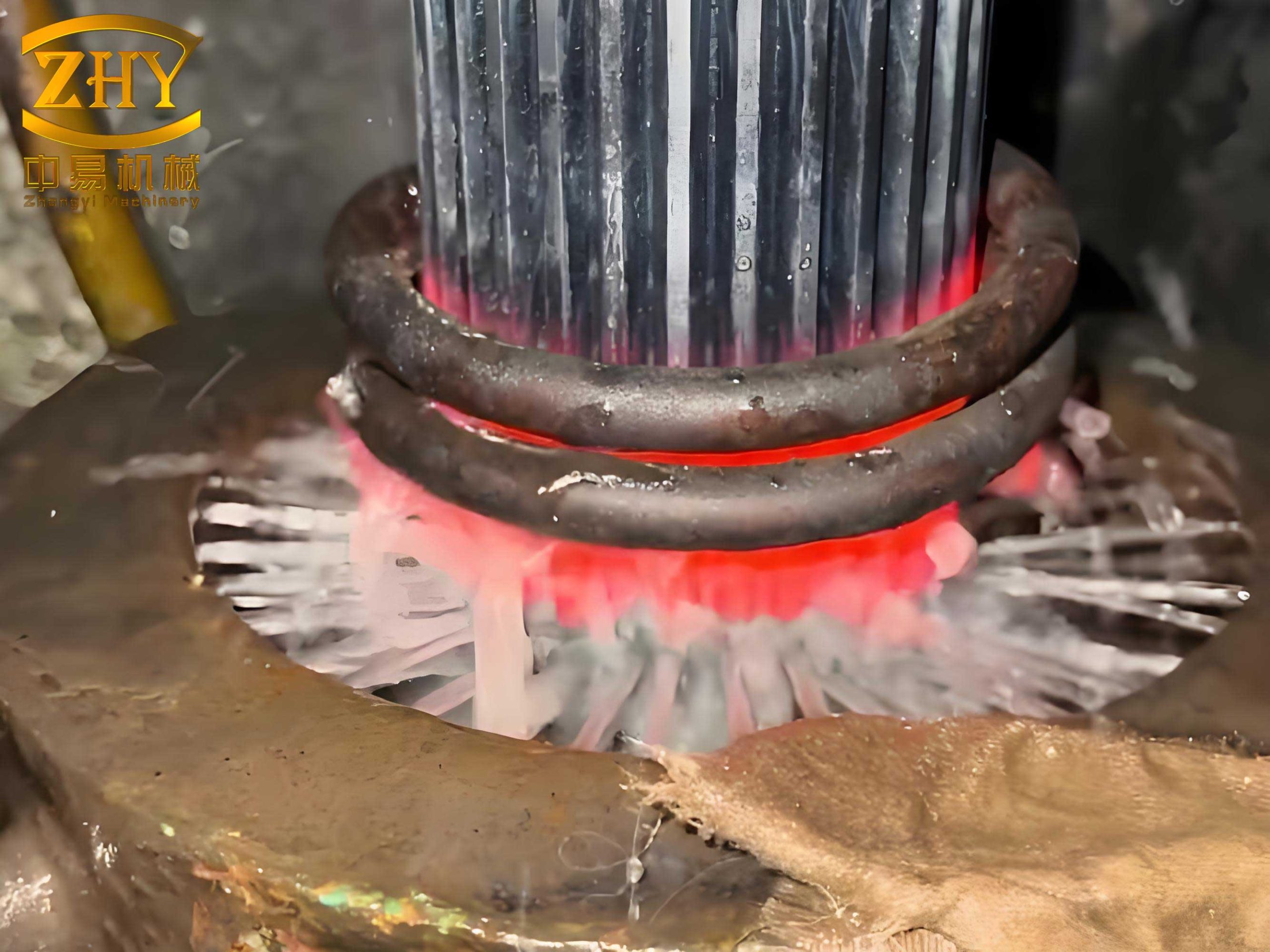
For example, consider the effect of hardness gradient due to improper quenching, a frequent heat treatment defect. The cutting force ($F_c$) can be related to hardness and feed ($f$) approximately by:
$$ F_c \approx K_c \cdot H^{n} \cdot f^{m} $$
where $K_c$ is a specific cutting force coefficient, and $n$, $m$ are exponents. A non-uniform $H$ across the workpiece depth leads to fluctuating $F_c$, inducing chatter and degrading surface finish. This is a direct consequence of a heat treatment defect in the form of non-uniform cooling.
Extended Discussion on Optimization and Defect Mitigation
Our trials underscore that the choice of steel grade must be informed not only by final service requirements (strength, wear resistance) but also by its machinability in the pre-hardened state. The concept of “optimal脆性” for machining is key. Materials should be sufficiently soft to allow plastic deformation during chip formation but possess enough brittleness to facilitate clean shear. Pre-heat treatment is the primary lever to tune this property.
For AISI 1020 gears where high surface finish is critical, we now standardize on incomplete quenching. The process window is narrow: heating to between $Ac_1$ and $Ac_3$ (approx. 750°C-780°C), holding for sufficient austenitization of the pearlite regions, followed by oil quenching. This produces the desired sorbite-ferrite mix. Deviations, such as overheating (causing full austenitization and martensite formation) or underheating (leaving excessive pearlite), are heat treatment defects that move the microstructure away from the optimal machinability zone.
For alloy steels like 18CrMnTi, normalizing requires stringent control. The furnace temperature must be high enough (often 920-950°C) and the soaking time adequate to ensure complete and homogeneous austenitization. Parts must be spaced properly to allow uniform air cooling. Rapid or uneven cooling can generate mixed microstructures—fine pearlite alongside bainitic or martensitic regions—a severe heat treatment defect that we frequently correlated with poor gear shaping results. The equation for diffusion-controlled transformation suggests that time at temperature is critical:
$$ \text{Diffusion Distance} \propto \sqrt{D \cdot t} $$
where $D$ is the diffusion coefficient (temperature-dependent) and $t$ is time. Inadequate $t$ leads to compositional inhomogeneity, a precursor to microstructural non-uniformity upon cooling.
Quenching and tempering, while beneficial for final gear strength, are generally unsuitable as a pre-machining treatment for finish-critical operations. If unavoidable, using oil quench over water quench provides a slightly better finish due to a less severe thermal gradient and potentially lower residual stresses—another form of heat treatment defect that can cause distortion during machining.
Tooling interaction is also microstructure-dependent. The tendency to form a built-up edge (BUE) is high with soft, ductile structures (e.g., normalized 1020 with large ferrite) and low with very hard structures. The BUE dynamically changes the tool’s effective rake angle, causing variations in finish. The optimal condition, as found with incompletely quenched 1020, seems to minimize BUE formation while keeping cutting forces moderate. This balance is disrupted by any heat treatment defect that creates an overly ductile or an overly hard and brittle matrix.
Conclusion and Industrial Implications
This comprehensive study firmly establishes that pre-heat treatment is a decisive factor governing the surface finish attainable in gear machining. The mechanical “preparation” of the material through thermal cycles dictates its behavior under the cutting tool. We have demonstrated that:
- For AISI 1020, incomplete quenching yields the best surface finish (▽▽6-▽▽7) by creating a uniform, dual-phase structure with an ideal hardness balance.
- For alloy carburizing steels like 18CrMnTi and 40Cr, a carefully controlled normalizing process is optimal, achieving finishes of ▽▽5 to ▽▽6.
- Quenching and tempering should be avoided prior to finish machining operations if possible, as it leads to the poorest surface quality (▽▽3 or worse).
- Cutting parameters offer secondary optimization, but their effectiveness is bounded by the underlying material condition.
The pervasive theme is the critical need to avoid heat treatment defects. Whether it’s coarse grain growth, non-uniform phase distribution, inappropriate hardness, or the presence of brittle undesirable structures like Widmanstätten ferrite, each defect acts as a detriment to smooth chip formation and thus to surface finish. In production, this translates to rigorous process control in the heat treatment shop: calibrated furnaces, controlled atmospheres to prevent decarburization, proper loading to ensure uniform heating and cooling, and strict adherence to specified temperature-time profiles.
Implementing the insights from this work has allowed our plant to significantly improve gear quality consistency. By treating pre-heat treatment not as a mere preparatory step but as a foundational process defining machinability, we have reduced the incidence of finish-related rejects. For applications demanding even finer finishes than those achievable through optimized heat treatment and cutting alone, subsequent processes like honing or grinding remain necessary. However, starting with a workpiece free from heat treatment defects ensures that these final operations are more efficient and effective, laying the groundwork for high-performance, reliable gears. The journey towards perfect surface finish begins not at the machine tool, but in the furnace of the heat treatment department.