
In the field of mechanical engineering, the study of spur gears is crucial due to their widespread application in power transmission systems. As a researcher focused on tribology and gear dynamics, I have always been intrigued by the complex interactions between gear teeth during meshing, particularly under dynamic conditions. One critical aspect that affects the performance and longevity of spur gears is the lubrication state between contacting tooth surfaces. Elasto-hydrodynamic lubrication (EHL) plays a vital role in minimizing wear and friction, but it is highly sensitive to operational parameters such as load, speed, and geometry. Among these, the approach impact load—a dynamic excitation caused by base pitch errors during gear engagement—poses significant challenges to maintaining an effective lubricant film. This phenomenon, often referred to as “hard impact” during meshing-in, can lead to abrupt changes in pressure, film thickness, and temperature, potentially compromising the lubrication integrity. In this comprehensive study, I aim to delve into the intricate effects of approach impact loads on the transient non-Newtonian thermal EHL of spur gears. By integrating geometric variations, time-dependent parameters, and thermal considerations, I seek to provide a detailed numerical analysis that captures the entire meshing cycle, from engagement to disengagement. The insights gained here are intended to enhance the understanding of spur gear lubrication under realistic dynamic conditions, ultimately contributing to improved design and maintenance strategies for gear systems.
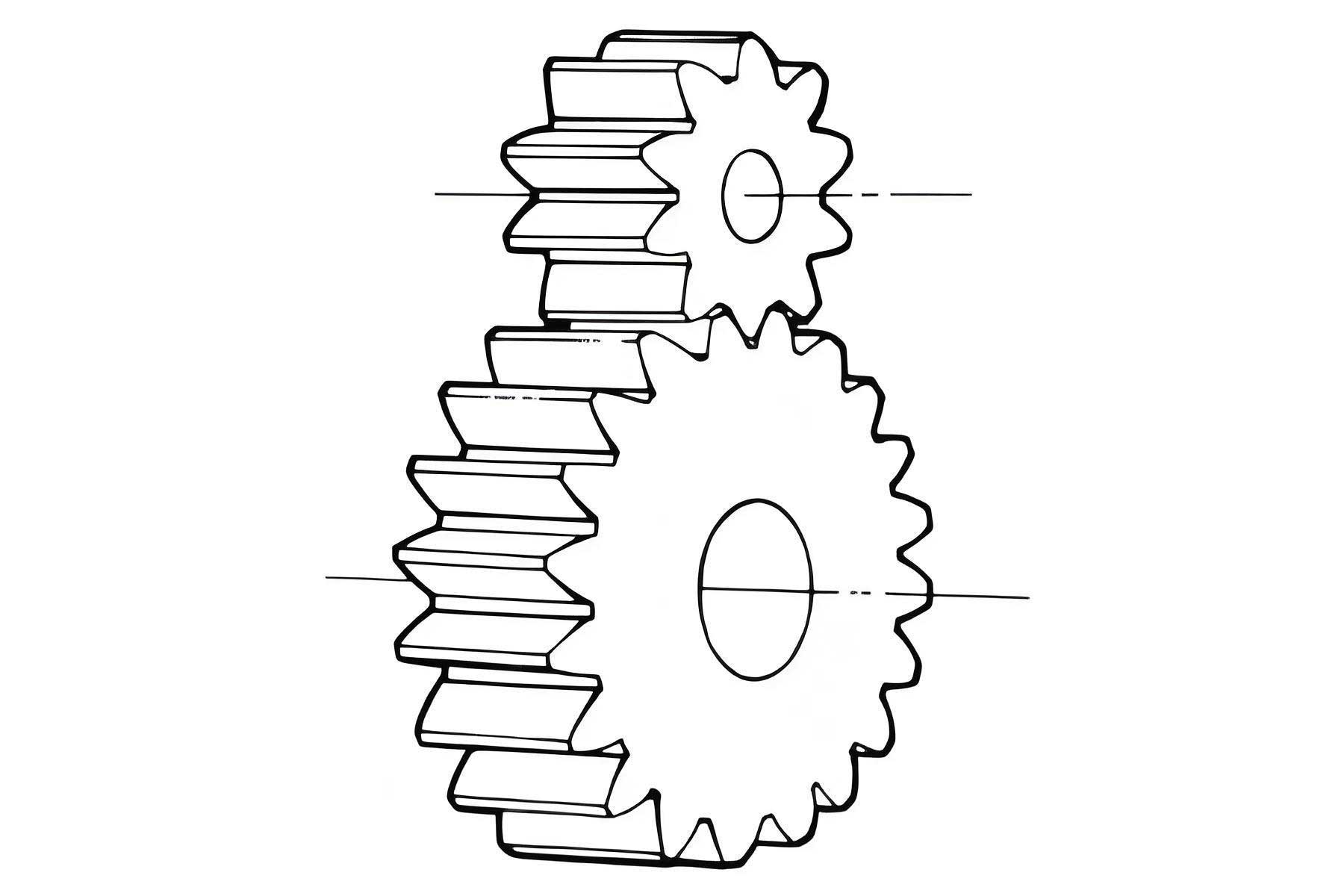
To lay the foundation for this analysis, it is essential to first examine the geometric parameters of spur gear transmission. In a pair of meshing spur gears, the interaction between two tooth profiles can be simplified at any instant as the contact between two equivalent cylinders with radii that vary along the line of action. This simplification is a cornerstone in EHL theory for spur gears, as it allows for the application of classic Hertzian contact models. Let me denote the base circle radii of the driving and driven gears as \(R_{ba}\) and \(R_{bb}\), respectively, with angular velocities \(\omega_a\) and \(\omega_b\). The pressure angle at the pitch circle is \(\phi\), and the distance from the pitch point \(P\) to any meshing point \(K\) along the line of action is \(s\). During meshing, the point \(K\) moves at a constant absolute velocity \(\omega_a R_{ba}\), so for any time \(t\), we have \(s = \omega_a R_{ba} t\). The entrainment velocity \(U\), which is the average tangential velocity of the two surfaces, is given by:
$$ U = \frac{U_a + U_b}{2} $$
where \(U_a = \omega_a (R_{ba} \tan \phi + s)\) and \(U_b = \omega_b (R_{bb} \tan \phi – s)\). The equivalent radius of curvature \(R\) at the meshing point, crucial for EHL analysis, is derived from the radii of curvature of the involute profiles:
$$ R = \frac{R_a R_b}{R_a + R_b} $$
with \(R_a = R_{ba} \tan \phi + s\) and \(R_b = R_{bb} \tan \phi – s\). These geometric relations highlight the time-varying nature of spur gear contacts, as both \(R\) and \(U\) change continuously during meshing. This variability must be accounted for in any transient EHL model to accurately simulate real-world spur gear operation.
Building on this geometric framework, I now present the governing equations for the transient non-Newtonian thermal EHL problem. These equations are derived from fundamental principles of fluid mechanics, elasticity, and heat transfer, and they are expressed in dimensionless form to facilitate numerical solution. The core equation is the Reynolds equation, which for line contact under transient conditions and non-Newtonian fluid behavior is:
$$ \frac{\partial}{\partial X} \left( \epsilon \frac{\partial P}{\partial X} \right) = \frac{\partial}{\partial X} \left( \bar{\rho}^* C_{Ut} \bar{h} \right) + \frac{\partial}{\partial \bar{t}} \left( \bar{\rho}_e \bar{h} \right) $$
Here, \(X = x/b\) is the dimensionless coordinate, \(P = p/p_H\) is the dimensionless pressure, \(\bar{h} = h R_0 / b^2\) is the dimensionless film thickness, and \(\bar{t} = t u_0 / b\) is the dimensionless time. The parameters \(\epsilon\), \(\bar{\rho}^*\), \(C_{Ut}\), and \(\bar{\rho}_e\) depend on fluid properties and operating conditions. The boundary conditions for pressure are:
$$ P(X_{\text{in}}, \bar{t}) = 0, \quad P(X_{\text{out}}, \bar{t}) = 0, \quad P \geq 0 \text{ for } X_{\text{in}} < X < X_{\text{out}} $$
with the solution domain typically set as \(X_{\text{in}} = -9.2\) and \(X_{\text{out}} = 2.8\). The dimensionless film thickness equation accounts for elastic deformation of the spur gear teeth:
$$ \bar{h}(X, \bar{t}) = \bar{h}_{00}(\bar{t}) + \frac{X^2}{2 \bar{R}(\bar{t})} – \frac{2}{\pi} \int_{X_{\text{in}}}^{X_{\text{out}}} P(X’, \bar{t}) \ln |X – X’| \, dX’ $$
where \(\bar{h}_{00}\) is the central film thickness offset and \(\bar{R}\) is the dimensionless equivalent radius. The load balance equation ensures that the integrated pressure supports the applied load:
$$ \int_{X_{\text{in}}}^{X_{\text{out}}} P(X) \, dX = C_{Wt} \frac{\pi}{2} $$
with \(C_{Wt} = w/w_0\) being the time-varying load coefficient. For spur gears, the load \(w\) varies due to meshing impact and the sharing of load between single and double tooth contact regions. I model the approach impact load based on experimental spectra, approximating it as \( \bar{w}_i = e^{-0.2 \bar{t}} \sin(\pi \bar{t}/4 + \pi/8) \), which captures the oscillatory decay during initial engagement.
The lubricant behavior is described using the Ree-Eyring non-Newtonian model, which better represents the shear-thinning characteristics of gear oils compared to Newtonian fluids. The constitutive relation is:
$$ \frac{\partial u}{\partial z} = \frac{\tau_0}{\eta} \sinh\left( \frac{\tau}{\tau_0} \right) $$
where \(\tau_0\) is the characteristic shear stress (taken as \(10^7 \, \text{Pa}\) in this study), and \(\eta\) is the apparent viscosity. To incorporate this into the EHL framework, I define an equivalent viscosity \(\eta^*\) such that:
$$ \frac{\partial u}{\partial z} = \frac{\tau}{\eta^*} $$
leading to:
$$ \eta^* = \eta \frac{\tau / \tau_0}{\sinh(\tau / \tau_0)} $$
The dimensionless apparent viscosity is given by the Roelands equation:
$$ \bar{\eta} = \exp\left[ (\ln \eta_0 + 9.67) \left( P_d T_d – 1 \right) \right] $$
with \(T_d = (T – 138)/(T_0 – 138) – S_0\) and \(P_d = (1 + 5.1 \times 10^{-9} p_H P)^{Z_0}\), where \(T_0\) is ambient temperature, \(Z_0\) is the pressure-viscosity coefficient, and \(S_0\) is the temperature-viscosity coefficient. The density variation with pressure and temperature is modeled as:
$$ \bar{\rho} = \frac{1 + 0.6 \times 10^{-9} p_H P}{1 + 1.7 \times 10^{-9} p_H P} \left( 1 + 1.7 \times 10^{-9} p_H P \right)^{0.00065 T_0 (T – 1)} $$
Temperature effects are critical in spur gear EHL due to frictional heating. The energy equation for the lubricant film in dimensionless form is:
$$ \text{Pr} \cdot \text{Re}^* \left( \bar{\rho} \frac{\partial T}{\partial \bar{t}} + \bar{\rho} \bar{u} \frac{\partial T}{\partial X} – \bar{q} \bar{h} \frac{\partial T}{\partial \bar{z}} \right) – \frac{1}{\bar{h}^2} \frac{\partial^2 T}{\partial \bar{z}^2} = -\text{Ec} \cdot Y_t \left( \frac{h_0}{b} \right)^2 T \bar{\rho} \frac{\partial \bar{\rho}}{\partial T} \left( \frac{\partial P}{\partial \bar{t}} + \bar{u} \frac{\partial P}{\partial X} \right) + \text{Ec} \cdot Y_t \frac{\bar{\tau}}{\bar{h}} \frac{\partial \bar{u}}{\partial \bar{z}} $$
where \(\text{Pr}\), \(\text{Re}^*\), \(\text{Ec}\), and \(Y_t\) are dimensionless groups (Prandtl, Reynolds, Eckert, and thermal loading parameters), and \(\bar{q}\) represents flow terms. The heat conduction equations for the solid spur gear teeth are:
$$ \text{CN}_a \frac{\partial T}{\partial \bar{t}} + U_a \frac{\partial T}{\partial X} = \frac{\partial^2 T}{\partial \bar{z}_a^2}, \quad \text{CN}_b \frac{\partial T}{\partial \bar{t}} + U_b \frac{\partial T}{\partial X} = \frac{\partial^2 T}{\partial \bar{z}_b^2} $$
with \(\text{CN}_a\) and \(\text{CN}_b\) being conductive parameters for the gear materials. At the interfaces between the lubricant and gear surfaces, temperature continuity and heat flux balance are enforced:
$$ \text{CM}_a \frac{1}{\bar{h}} \left. \frac{\partial T}{\partial \bar{z}} \right|_{\bar{z}=0} = \left. \frac{\partial T}{\partial \bar{z}_a} \right|_{\bar{z}_a=0}, \quad \text{CM}_b \frac{1}{\bar{h}} \left. \frac{\partial T}{\partial \bar{z}} \right|_{\bar{z}=0} = \left. \frac{\partial T}{\partial \bar{z}_b} \right|_{\bar{z}_b=0} $$
Finally, the friction coefficient on the spur gear tooth surface is computed from the shear stress:
$$ \mu = -\frac{F_{z=0}}{w}, \quad \text{where} \quad F = \int \tau \, dx = p_H b \int \bar{\tau} \, dX $$
To solve this system of equations, I employ a robust numerical methodology based on the multi-grid technique. The transient nature of spur gear meshing requires capturing rapid changes during impact, so I discretize the entire meshing cycle into 120 time steps. At each instant, pressure and temperature fields are solved iteratively. The pressure solution uses the multi-grid method across six grid levels, with the finest grid having 961 nodes in the \(X\)-direction. The film thickness is evaluated via multi-level multi-integration, while temperature is solved using a column-wise sweeping scheme. The convergence criteria are stringent: for pressure, the relative error must be below 0.001; for load balance, below 0.001; and for temperature, below 0.0001. Initial conditions for the first time step are derived from a steady-state solution, and subsequent steps use results from previous instants to accelerate convergence. This approach ensures accuracy and efficiency in simulating the complex EHL behavior of spur gears under dynamic loads.
The material and operational parameters used in this study are summarized in Table 1, which provides a clear overview of the spur gear system under investigation.
| Parameter | Value |
|---|---|
| Environmental viscosity of lubricant, \(\eta_0\) (Pa·s) | 0.075 |
| Environmental density of lubricant, \(\rho_0\) (kg/m³) | 870 |
| Density of spur gear material, \(\rho\) (kg/m³) | 7850 |
| Specific heat of lubricant, \(C\) (J·kg⁻¹·K⁻¹) | 2000 |
| Specific heat of spur gear material, \(C_g\) (J·kg⁻¹·K⁻¹) | 470 |
| Thermal conductivity of lubricant, \(k\) (W·m⁻¹·K⁻¹) | 0.14 |
| Thermal conductivity of spur gear material, \(k_g\) (W·m⁻¹·K⁻¹) | 46.0 |
| Ambient temperature, \(T_0\) (K) | 313 |
| Pressure-viscosity coefficient of lubricant, \(\alpha\) (Pa⁻¹) | 2.2 × 10⁻⁸ |
| Temperature-viscosity coefficient of lubricant, \(\beta\) (K⁻¹) | 0.042 |
| Characteristic shear stress of Ree-Eyring fluid, \(\tau_0\) (Pa) | 1.0 × 10⁷ |
| Elastic modulus of spur gears, \(E\) (N/m²) | 2.06 × 10¹¹ |
| Rotational speed of pinion (small spur gear), \(n_1\) (r/min) | 1000 |
| Transmitted power, \(N\) (kW) | 20 |
| Number of teeth on pinion, \(z_a\) | 35 |
| Number of teeth on wheel (large spur gear), \(z_b\) | 140 |
With these parameters, I proceed to analyze the results of the transient non-Newtonian thermal EHL simulation for spur gears. The focus is on comparing scenarios with and without the approach impact load, to isolate its effects on lubrication performance. The impact load waveform, as mentioned, is an exponentially decaying sinusoid with an initial period of 102 μs, superimposed on the steady load variation due to meshing of spur gear teeth. The total meshing time for a single tooth pair is 1530 μs, allowing ample observation of transient phenomena.
First, I examine the central pressure distribution over time. Under the approach impact load, the central pressure exhibits significant oscillations during the initial engagement phase. At the peak of the impact load, the dimensionless central pressure reaches values approximately twice those in the non-impact case. For instance, at the moment of maximum impact, the pressure increases by about 0.6 GPa, while at the trough of the oscillation, it decreases by 0.3 GPa. This underscores the sensitivity of spur gear EHL to dynamic loading. The pressure spikes correspond to the Hertzian contact zone widening momentarily, which alters the pressure profile dramatically. In contrast, without impact, the pressure variation is smoother and primarily dictated by geometric changes along the line of action. This behavior is summarized in Table 2, which contrasts key parameters between impact and non-impact conditions at selected time points.
| Parameter | With Impact Load | Without Impact Load |
|---|---|---|
| Maximum central pressure at approach point (GPa) | 1.8 | 0.9 |
| Minimum film thickness at approach point (μm) | 0.12 | 0.25 |
| Friction coefficient at peak impact | 0.03 | 0.01 |
| Maximum temperature rise in film (°C) | 45 | 25 |
| Time to reach steady pressure after impact (μs) | ~200 | N/A |
The film thickness behavior is equally telling. The central film thickness and minimum film thickness both show pronounced reductions under impact loading. At the instant of maximum impact, the minimum film thickness can drop to less than half of its non-impact value. This thinning of the lubricant film in spur gears raises concerns about potential metal-to-metal contact and increased wear. The minimum film thickness typically occurs near the outlet of the contact zone, and its oscillation follows the load pattern with a slight phase lag due to fluid inertia and elastic response. The central film thickness, while less sensitive, also dips during impact peaks. These variations highlight the precarious nature of lubrication in spur gears subjected to dynamic shocks, as even brief film collapse can lead to surface damage.
Temperature effects are exacerbated by the impact load. The maximum temperature rise in the lubricant film increases by about 20°C under impact conditions compared to the steady case. This is driven by enhanced viscous dissipation and frictional heating during the high-pressure phases. The energy equation reveals that the extra heat generation is concentrated in the thin film region, where shear rates are highest. For spur gears, this thermal loading can accelerate lubricant degradation and alter viscosity, further complicating the EHL state. The temperature distribution across the film and into the gear teeth shows that the highest temperatures are localized at the interface, with rapid conduction into the solids due to the high thermal conductivity of gear steel. This thermal interaction is crucial for predicting thermal stresses and potential scuffing failures in spur gears.
The friction coefficient on the spur gear tooth surfaces exhibits dramatic swings under impact loading. At the peak impact, the friction coefficient can triple, reaching values around 0.03, whereas in the non-impact scenario, it remains near 0.01. Interestingly, during the troughs of the impact oscillation, the friction coefficient can approach zero or even become negative momentarily, indicating a reversal in shear stress direction. This erratic friction behavior can induce vibrations and noise in spur gear systems, contributing to dynamic instability. The friction coefficient is derived from the integrated shear stress, which itself is influenced by the non-Newtonian fluid model. The Ree-Eyring model accounts for shear-thinning, which moderates friction to some extent, but the impact load overwhelms this effect initially.
To provide a more detailed perspective, I analyze specific meshing points along the line of action. At the approach point (where meshing begins), the impact load causes a sharp increase in pressure and temperature, coupled with a severe reduction in film thickness. In contrast, at the pitch point (the node of meshing), the effects are negligible, as the impact has damped out by then. This spatial variation underscores that the impact load’s influence is confined to the initial engagement phase of spur gears. The pressure and film thickness profiles at these points are plotted numerically, showing that the impact-induced perturbations decay rapidly within the first few hundred microseconds. This decay is attributed to the damping inherent in the lubricant and the elastic response of the spur gear teeth.
The numerical results also reveal hysteresis in the EHL parameters. After the impact load subsides, the pressure and film thickness continue to oscillate for a short period before settling to the steady-state trajectory. This hysteresis is due to the time-dependent terms in the Reynolds equation and the thermal inertia of the system. For spur gear designers, this implies that dynamic effects must be considered even after the immediate impact, as the lubrication film may not stabilize instantly. The multi-grid numerical method captures these transients accurately, thanks to the fine temporal resolution and robust iterative scheme.
In summary, the approach impact load has a profound but localized effect on the transient non-Newtonian thermal EHL of spur gears. The key findings are:
- The impact load significantly alters pressure, film thickness, and temperature only during the initial meshing phase, with minimal influence beyond that period in spur gears.
- Peak pressures and minimum film thickness occur at the moment of maximum impact loading, posing a risk of lubrication breakdown.
- Temperature rises are heightened under impact, potentially accelerating lubricant failure and thermal damage in spur gears.
- Friction coefficients become highly variable, which can exacerbate wear and dynamic noise in spur gear systems.
- The numerical model, incorporating geometric time-variation, non-Newtonian rheology, and thermal effects, provides a comprehensive tool for analyzing spur gear EHL under realistic dynamic conditions.
These insights emphasize the importance of mitigating approach impacts in spur gear design, perhaps through precision manufacturing to reduce base pitch errors, or via lubrication strategies that enhance film robustness. Future work could explore the effects of different non-Newtonian models or surface roughness on the impact response of spur gears. Ultimately, understanding these dynamics is essential for advancing the reliability and efficiency of spur gear transmissions in applications ranging from automotive to industrial machinery.
From a broader perspective, this study contributes to the ongoing effort to optimize spur gear performance through advanced tribological analysis. The integration of impact loads into EHL simulations represents a step toward more realistic modeling, bridging the gap between theoretical lubrication science and practical gear engineering. As spur gears continue to be a cornerstone of mechanical power transmission, such detailed investigations will remain vital for innovation and sustainability in the field.