
In the vast landscape of mechanical power transmission, gear drives stand as the most ubiquitous and reliable method for transmitting motion and torque between rotating shafts. Among the various gear types, the spur and pinion gear pair, characterized by straight teeth parallel to the axis of rotation, is the most commonly employed due to its simplicity in design, ease of manufacturing, and predictable performance. The accurate determination of the fundamental parameters of a spur gear is not merely an academic exercise but a critical, routine task in manufacturing quality control, reverse engineering, and maintenance. Traditional manual calculation methods for deriving these parameters from physical measurements are notoriously labor-intensive, prone to human error, and inefficient, creating a bottleneck in modern production environments. This article details a significant departure from these conventional techniques by presenting a comprehensive, programmatic solution developed to automate, accelerate, and error-proof the parameter measurement process for spur and pinion assemblies.
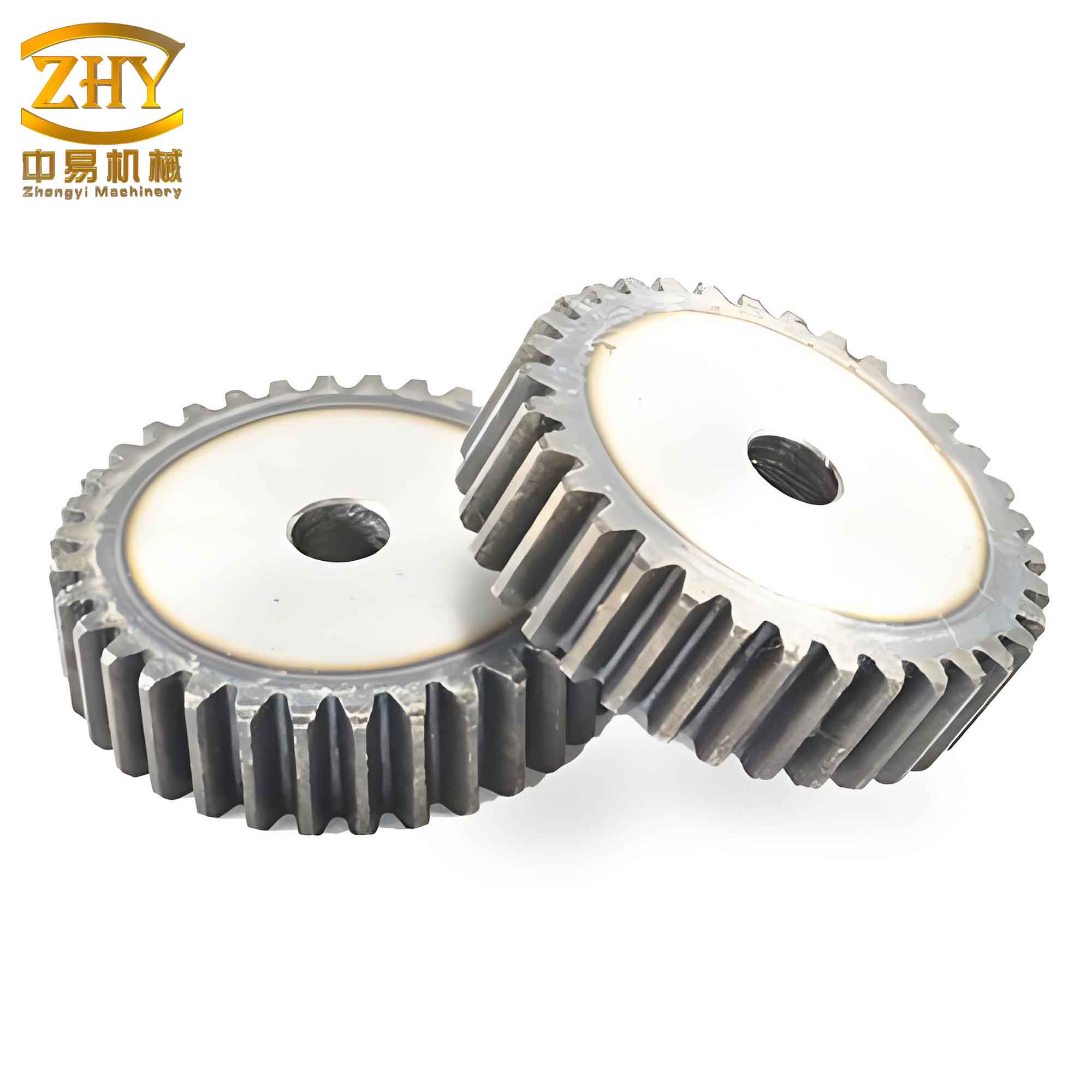
The foundational parameters that completely define a standard or modified involute spur and pinion gear are: the number of teeth (z), the module (m), the pressure angle (α), the addendum coefficient (ha*), the dedendum or clearance coefficient (c*), and the profile shift coefficient (x). The process of reverse-engineering these parameters from a physical gear sample hinges on a few precise measurements and a series of derived calculations.
The initial and most straightforward step is simply counting the number of teeth, z. The subsequent, more nuanced measurements involve the gear’s geometry. Two crucial measurements are the base tangent lengths, commonly known as the span measurement or measurement over k teeth (Wk) and over k+1 teeth (Wk+1). The selection of the correct span number, k, is vital for the caliper to contact the tooth flanks near the pitch circle for accuracy. A standard formula for estimating k for a standard gear is: $$k = \frac{\alpha}{180^{\circ}}z + 0.5$$ rounded to the nearest whole number. For a 20° pressure angle gear, this simplifies to approximately k = z/9 + 0.5. The third critical measurement is the root diameter (df). To mitigate errors from eccentricity or measurement inaccuracies, each of these dimensions (Wk, Wk+1, df) should be taken at several positions around the gear (e.g., rotated by ~120°) and averaged.
The core computational logic for extracting parameters from these measurements proceeds as follows:
- Base Pitch (Pb): The difference between the two span measurements directly yields the base pitch, a fundamental property of the involute profile.
$$P_b = W_{k+1} – W_k$$ - Module (m) and Pressure Angle (α): The base pitch is related to the module and pressure angle by:
$$P_b = \pi m \cos\alpha$$
Since α is typically 20° or, less commonly, 14.5° or 15°, we substitute these standard values into the equation to solve for corresponding module candidates:
$$m_{\alpha} = \frac{P_b}{\pi \cos\alpha}$$
The pair (m, α) whose calculated m value is closest to a standard module from the preferred series (e.g., 1, 1.25, 1.5, 2, 2.5, 3, …) is identified as the correct gear module and pressure angle. - Theoretical Span Measurement for a Standard Gear (Wk‘): Using the identified m and α, the expected span measurement for a standard (non-shifted) gear with the same number of teeth is calculated. A common empirical formula for a 20° pressure angle gear is:
$$W_k’ = m[2.9521(k – 0.5) + 0.014z]$$
For other pressure angles, the formula coefficients differ accordingly. - Profile Shift Coefficient (x): The deviation of the actual measured span (Wk) from the theoretical standard span (Wk‘) directly indicates profile shift. The shift coefficient is calculated as:
$$x = \frac{W_k – W_k’}{2m \sin\alpha}$$
A positive x indicates an addendum modification; a negative x indicates a dedendum modification. - Calculated Dedendum Height (hf): From the measured root diameter (df) and the pitch diameter (m*z), the total dedendum height can be found.
$$h_f = \frac{mz – d_f}{2}$$ - Addendum and Clearance Coefficients (ha*, c*): The dedendum height is also defined by the basic tooth system parameters:
$$h_f = m(h_a^* + c^* – x)$$
By substituting the calculated values for hf, m, and x, and testing against standard coefficient sets (e.g., full-depth: ha*=1, c*=0.25; stub: ha*=0.8, c*=0.3), the system to which the gear belongs can be identified. The set that yields a result closest to satisfying the equality is the correct one.
Manually performing this sequence of interdependent calculations for every spur and pinion gear inspected is tedious and error-prone. A single mis-keyed number or arithmetic mistake can cascade, leading to an incorrect parameter identification. This is where the power of software automation becomes indispensable. For this application, Visual Basic (VB) was chosen as the development platform. VB, with its intuitive graphical user interface (GUI) design tools, rapid application development (RAD) capabilities, and straightforward syntax, is perfectly suited for creating compact, efficient, and user-friendly desktop applications for specific engineering tasks like this one. Its event-driven programming model allows for the creation of a responsive interface where clicking a “Calculate” button triggers the entire analysis chain instantly.
The implementation of the spur and pinion gear parameter calculator follows a clear, object-oriented structure. The first step is designing an intuitive user interface. The form contains labeled text boxes for each required input measurement, a dedicated area (or button) to initiate the calculation, and labeled fields to display all calculated output parameters.
Table 1: Input Parameters for the Spur and Pinion Measurement Program
| Label on GUI | Variable | Description |
|---|---|---|
| Number of Teeth | z | Total count of teeth on the gear. |
| Span Number (k) | k | Number of teeth spanned for the Wk measurement. |
| Span Measurement Wk | Wk | Measured base tangent length over k teeth (mm or in). |
| Span Measurement Wk+1 | Wk1 | Measured base tangent length over k+1 teeth. |
| Root Diameter | df | Measured diameter at the root of the teeth. |
The core program logic resides in the event handler for the “Calculate” button. The code performs the following sequence, translating the mathematical procedure into algorithmic steps:
- Data Acquisition & Validation: The values from the text boxes are read into program variables, often converting them to a numeric data type (e.g., Double for precision). Simple validation checks (e.g., ensuring values are positive numbers) can be implemented.
- Base Pitch Calculation:
Pb = Wk1 - Wk - Module & Pressure Angle Determination: This is a pivotal logic block. The program calculates candidate modules for a predefined set of standard pressure angles (e.g., 14.5°, 20°, 25°).
m_20 = Pb / (Pi * Cos(20 * Pi / 180))
m_145 = Pb / (Pi * Cos(14.5 * Pi / 180))
It then compares each calculated module to a list of standard module values. The pair (standard_m, pressure_angle) with the smallest absolute difference is selected.For Each stdMod In StandardModuleList diff20 = Abs(stdMod - m_20) diff145 = Abs(stdMod - m_145) '... Keep track of the smallest difference and associated angle... Next stdMod - Standard Span & Shift Coefficient: Using the determined m and α, it calculates Wk’ and then x.
Wk_theoretical = m * (2.9521 * (k - 0.5) + 0.014 * z) 'For 20°
x = (Wk - Wk_theoretical) / (2 * m * Sin(alpha_rad)) - Dedendum & Tooth System Identification: It calculates the measured dedendum height.
hf_measured = (m * z - df) / 2
Then, it iterates through standard coefficient sets.For Each system In ToothSystems hf_calculated = m * (system.ha_star + system.c_star - x) error = Abs(hf_measured - hf_calculated) '... Identify the system with the minimum error... Next system - Output Display: Finally, all calculated parameters—m, α, x, ha*, c*—are formatted and displayed in their respective output fields on the GUI, providing the user with an immediate, complete, and verified answer.
The power of this programmatic approach extends beyond mere calculation. It enables sophisticated “what-if” analysis and error assessment. For instance, the program can be easily extended to evaluate the sensitivity of the final parameters to measurement tolerances. By running the core algorithm multiple times with inputs perturbed within the expected measurement uncertainty (e.g., Wk ± 0.01 mm), the propagation of error can be quantified. This is invaluable for understanding the required measurement precision for a given application or for assessing the confidence in the identified parameters of an unknown spur and pinion gear.
Table 2: Sensitivity Analysis Example (Module 2, 20°, x=0, z=25)
| Parameter | Nominal Input | Input with +0.02mm Error | Calculated Output Change |
|---|---|---|---|
| Wk (k=3) | 21.552 mm | 21.572 mm | — |
| Wk+1 | 29.425 mm | 29.425 mm | — |
| Base Pitch (Pb) | 7.8730 mm | 7.8530 mm | -0.0200 mm |
| Module (m) | 2.000 | 1.994 | -0.006 |
| Shift Coeff. (x) | 0.000 | +0.015 | +0.015 |
Furthermore, the application’s architecture allows for seamless integration of additional features. A database of standard module and pressure angle values can be embedded. The results for each analyzed gear can be logged to a file or database for traceability and batch analysis. The GUI can be enhanced with graphical elements, such as a simple sketch of the gear with critical diameters labeled based on the calculated parameters. For advanced users, the option to manually override the automatically determined pressure angle or module can be provided, allowing for the analysis of non-standard or damaged gears where the automatic logic might fail.
In conclusion, the transition from manual calculation to an automated, programmatic solution for measuring spur and pinion gear parameters represents a substantial leap in efficiency, reliability, and capability. The Visual Basic application described encapsulates complex gear geometry mathematics into a simple, click-button process. It eliminates computational errors, reduces measurement and analysis time from minutes to seconds, and provides a consistent, auditable method for parameter identification. This approach is not just a convenience; it is a strategic enabler for quality assurance in high-volume manufacturing, for efficient maintenance and replacement part sourcing, and for effective engineering education. The principles demonstrated—using fundamental metrology, robust algorithms, and a user-centric interface—can be extended to other gear types, such as helical or bevel gears, solidifying the role of software as an indispensable tool in the modern mechanical engineer’s and technician’s toolkit. The future evolution of such tools may involve direct integration with digital measuring devices (USB calipers, CMMs) or cloud-based analysis platforms, but the core algorithmic logic for decoding the geometry of the humble yet essential spur and pinion will remain at its heart.