
In the field of power transmission, particularly for intersecting shafts, spiral bevel gears are a critical component. Their design and manufacture directly influence the efficiency, noise, vibration, and longevity of the entire drivetrain system. The Klingelnberg spiral bevel gear system, produced on specialized AMK-series machine tools, represents a specific and advanced gear geometry. While the introduction of such manufacturing technology has been significant, a comprehensive theoretical and practical understanding, especially concerning the precise control of the tooth contact pattern, remains an area requiring deeper exploration. This paper focuses on establishing a systematic geometrical correction methodology for the contact zone in Klingelnberg spiral bevel gears. I will derive the fundamental relationships between machine tool settings and the resulting tooth surface geometry, and subsequently present detailed formulas and methods for second-order corrections targeting the length, height, and undesirable diagonal orientation of the contact pattern.
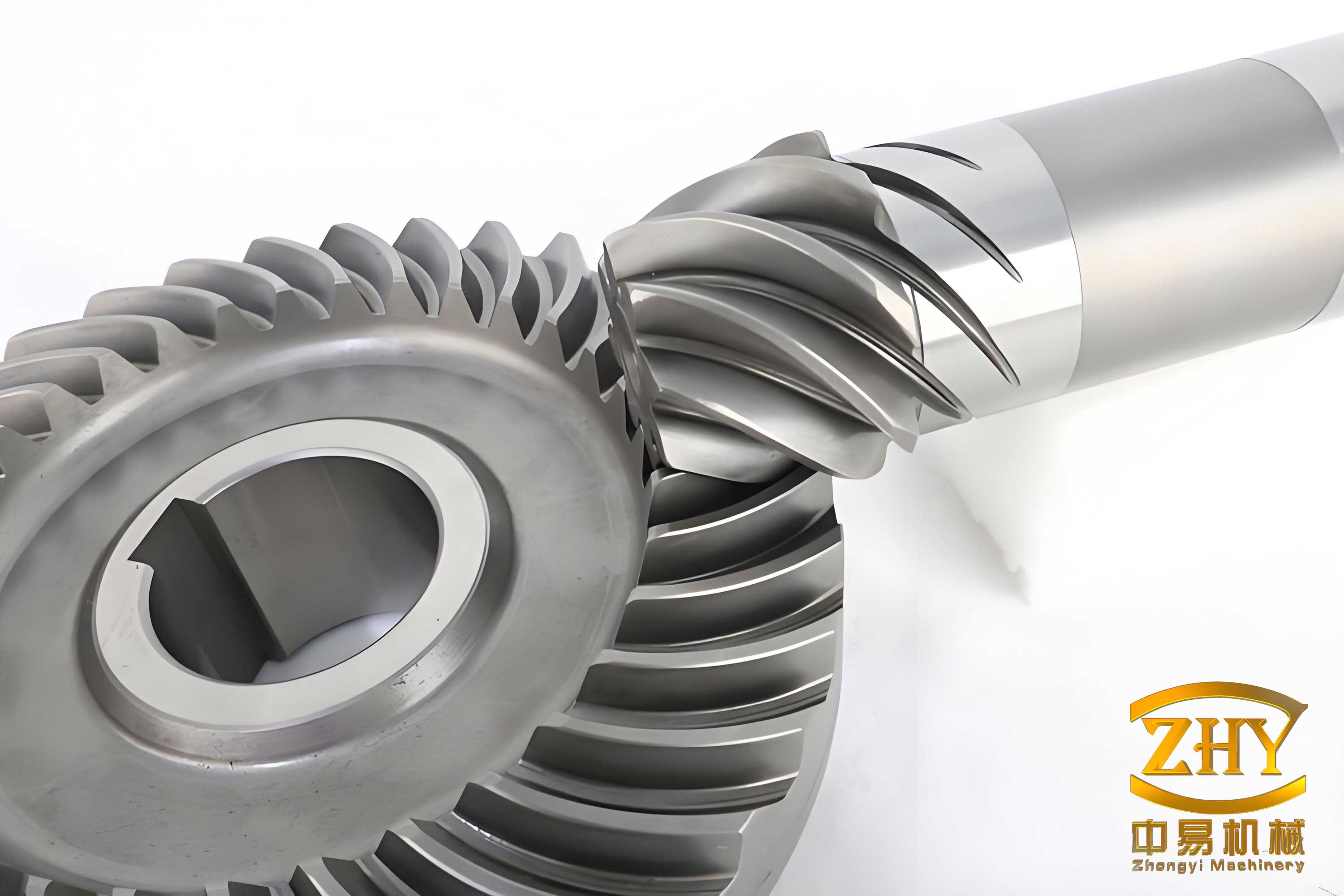
The core of contact pattern analysis lies in understanding the conjugate action between the pinion and gear tooth surfaces. For the Klingelnberg system, the pinion is typically generated first, and the gear is then cut in a duplex or spread-blade method to match the pinion. Therefore, controlling the contact pattern fundamentally involves precise modification of the pinion tooth surface geometry during its generation. The contact pattern’s characteristics—its length, width, and position—are governed by the relative curvatures of the mating surfaces along the tooth length and height directions, as well as by the alignment of their principal directions.
Theoretical Foundation: Coordinate Systems and Basic Kinematics
To analyze the contact pattern, one must first define the coordinate systems involved in the gear generation process. Let us establish a machine coordinate system $S_m(X_m, Y_m, Z_m)$ fixed to the cradle. The cradle, representing the imaginary generating gear, rotates about its axis with an angular velocity $\omega_c$. The workpiece (pinion blank) coordinate system $S_w(X_w, Y_w, Z_w)$ is attached to the pinion, rotating about its axis with angular velocity $\omega_w$. The ratio $i_v = \omega_c / \omega_w$ is the fundamental machine roll ratio. The cutter head, which carries the cutting blades, is positioned relative to the cradle. Its center is defined by two essential parameters: the horizontal center distance (also called the sliding base) $H$, and the vertical offset $V$. The cutter head itself has a nominal radius $r_0$ and a blade angle that defines the basic pressure angle.
The radial and angular positions of the cutter center within the cradle plane are more intrinsic from a kinematic perspective. The radial distance from the cradle center to the cutter center is the radial setting $S_1$, and the angle this line makes with a reference axis is the angular setting $q_1$. The transformation between these two sets of parameters is foundational:
$$H = S_1 \cos q_1$$
$$V = S_1 \sin q_1$$
Differentiating these equations provides the relationship between incremental changes, which is crucial for correction calculations:
$$\Delta H = \Delta S_1 \cos q_1 – S_1 \sin q_1 \Delta q_1$$
$$\Delta V = \Delta S_1 \sin q_1 + S_1 \cos q_1 \Delta q_1$$
Solving this system for $\Delta S_1$ and $\Delta q_1$ yields:
$$\Delta S_1 = \Delta H \cos q_1 + \Delta V \sin q_1 \quad \text{(1)}$$
$$\Delta q_1 = \frac{\Delta V \cos q_1 – \Delta H \sin q_1}{S_1} \quad \text{(2)}$$
These equations (1) and (2) are pivotal. They tell us how adjustments in the horizontal and vertical positions of the cutter head ($\Delta H$, $\Delta V$) translate into adjustments of the more fundamental radial and angular settings ($\Delta S_1$, $\Delta q_1$). Furthermore, the machine tool has additional axes: the sliding base $X_B$ (often called “bedding”) and the work head setting $X_P$. Their adjustments are linked to $\Delta H$ and $\Delta V$ through the pinion pitch angle $\delta_{01}$:
$$\Delta X_B = -\Delta H \tan \delta_{01} \quad \text{(3)}$$
$$\Delta X_P = -\frac{\Delta V}{\cos \delta_{01}} \quad \text{(4)}$$
With this kinematic framework, we can proceed to analyze how specific machine setting changes affect the tooth surface curvature and, consequently, the contact pattern of the spiral bevel gear.
Second-Order Correction for Contact Pattern Length
The length of the contact pattern along the tooth face is predominantly governed by the relative (induced) normal curvature in the lengthwise direction. Since the gear is cut to match the pinion in the Klingelnberg system, modifying the lengthwise curvature essentially means modifying the pinion’s longitudinal tooth profile. The primary machine parameter influencing this curvature is the nominal cutter radius $r_0$. Changing the effective diameter of the cutter head alters the radius of curvature of the cutting edges as they sweep through the generating motion, thereby changing the longitudinal curvature of the generated pinion tooth surface.
Consider a change in the nominal cutter radius by an amount $\Delta r$. If all other settings remain unchanged, this alteration would significantly affect the spiral angle at the midpoint of the tooth. To maintain the designed mean spiral angle $\beta_m$, a compensatory adjustment in the radial setting $S_1$ is mandatory. The required changes in horizontal and vertical settings due solely to a radius change, aimed at preserving the mean spiral angle, are:
$$\Delta H = \Delta r \cos \beta_m$$
$$\Delta V = -\Delta r \sin \beta_m$$
Substituting these into equations (1) and (2) provides the necessary adjustments to the fundamental cutter head settings:
$$\Delta S_1 = \Delta r \cos \beta_m \cos q_1 – \Delta r \sin \beta_m \sin q_1 = \Delta r \cos(\beta_m + q_1) \quad \text{(5)}$$
$$\Delta q_1 = \frac{-\Delta r \sin \beta_m \cos q_1 – \Delta r \cos \beta_m \sin q_1}{S_1} = -\frac{\Delta r}{S_1} \sin(\beta_m + q_1) \quad \text{(6)}$$
The physical interpretation is clear: increasing the cutter radius ($\Delta r > 0$) requires both an increase in radial setting $\Delta S_1$ and an adjustment in angular setting $\Delta q_1$. Conversely, decreasing the radius requires a reduction in both. Finally, the corresponding changes to the machine’s sliding base and work head, derived from equations (3) and (4), are:
$$\Delta X_B = -\Delta r \cos \beta_m \tan \delta_{01}$$
$$\Delta X_P = \frac{\Delta r \sin \beta_m}{\cos \delta_{01}}$$
The effect of this correction is summarized in the table below:
| Parameter Change | Effect on Pinion Longitudinal Curvature | Effect on Contact Pattern Length |
|---|---|---|
| Increase Cutter Radius ($\Delta r > 0$) | Decreases longitudinal curvature (flattens tooth length profile) | Lengthens the contact pattern |
| Decrease Cutter Radius ($\Delta r < 0$) | Increases longitudinal curvature (sharpens tooth length profile) | Shortens the contact pattern |
Therefore, for a Klingelnberg spiral bevel gear set exhibiting a contact pattern that is too short, the corrective action involves increasing the nominal cutter diameter (or effective radius) and simultaneously implementing the calculated adjustments from equations (5) and (6) to maintain the correct spiral angle.
Second-Order Correction for Contact Pattern Height (Width)
The width or height of the contact pattern across the tooth profile is primarily determined by the induced normal curvature in the profile (tooth depth) direction. Correcting this equates to modifying the pinion’s tooth profile curvature, often referred to as the “gap” or “profile curvature.” A flatter profile curvature results in a narrower contact band, while a more curved profile leads to a wider band. Practical experience with cutting Klingelnberg spiral bevel gears shows that altering the horizontal position of the cradle center (or equivalently, introducing a horizontal offset $\Delta H$ to the imaginary generating gear center) is the most effective way to change this profile curvature.
When the cradle center is shifted horizontally, the effective cutting pitch cone during generation is altered. This change means that the straight-sided cutting blade, which is set at a fixed pressure angle relative to the cutter axis, now presents a different effective pressure angle relative to the new generating pitch cone. This variation along the tooth profile modifies the local tooth thickness and, more importantly for contact analysis, the curvature of the generated tooth profile in the depth direction. To prevent an unintended change in the mean spiral angle due to this horizontal shift, a compensatory adjustment to the radial setting $S_1$ is again required. For a pure horizontal shift, $\Delta V = 0$. Substituting into equations (1) and (2) gives:
$$\Delta S_1 = \Delta H \cos q_1 \quad \text{(7)}$$
$$\Delta q_1 = -\frac{\Delta H}{S_1} \sin q_1 \quad \text{(8)}$$
The adjustments to the machine axes, from equations (3) and (4) with $\Delta V=0$, are:
$$\Delta X_B = -\Delta H \tan \delta_{01}$$
$$\Delta X_P = 0 \quad \text{(Note: This is a key difference from the length correction)}$$
The direction of the horizontal shift $\Delta H$ and its effect depend on the hand of spiral (left-hand or right-hand) and the desired change in contact width. The following table outlines the general correction logic:
| Target Change | Hand of Spiral | Horizontal Shift ($\Delta H$) | Effect on Profile Curvature |
|---|---|---|---|
| Widen Contact Pattern | Left-Hand | Negative (Move cradle center away from workpiece axis) | Increases profile curvature |
| Widen Contact Pattern | Right-Hand | Positive (Move cradle center towards workpiece axis) | Increases profile curvature |
| Narrow Contact Pattern | Left-Hand | Positive | Decreases profile curvature |
| Narrow Contact Pattern | Right-Hand | Negative | Decreases profile curvature |
Thus, to correct a contact pattern that is too narrow on a right-hand spiral bevel gear pinion, one would apply a positive $\Delta H$, calculate the required $\Delta S_1$ and $\Delta q_1$ from (7) and (8), and adjust the machine settings accordingly, including $\Delta X_B$.
Correction of Diagonal Contact Pattern
A diagonal contact pattern is one of the most common and troublesome misalignments in spiral bevel gears. Instead of being oriented along the intended lengthwise direction of the tooth, the contact ellipse runs diagonally from the toe-to-heel or heel-to-toe. This condition is primarily caused by a mismatch in the relative geodesic torsion (or induced geodesic curvature) between the mating surfaces. From a manufacturing perspective, it arises because the spiral angle varies along the tooth length in an unintended way, which in turn causes a systematic variation in the effective pressure angle from the toe to the heel of the tooth.
The fundamental cause is a discrepancy between the generating pitch cone used during cutting and the operational pitch cone of the gear pair. If the cutting pitch cone is larger than the operational pitch cone at a given point (e.g., at the toe), the local effective pressure angle becomes smaller. Conversely, if it is smaller (e.g., at the heel), the local pressure angle becomes larger. This toe-heel pressure angle gradient is what skews the contact pattern diagonally. The correction, therefore, aims to introduce a controlled, compensating pressure angle gradient via machine settings to cancel out the existing error.
This requires a combined correction of both the cradle center position (horizontal shift, $\Delta H$) and the machine roll ratio ($i_v$). Changing only the cradle center alters the pressure angle uniformly. Combining it with a roll change allows the pressure angle to decrease on one end of the tooth and increase on the other. The new generating pitch cone must still pass through the tooth midpoint $M$ to keep its basic geometry stable. The derivation starts with the basic roll ratio formula at the midpoint. Let the initial horizontal distance from the workpiece axis to the cradle center be $H$, and the mean cone distance to the midpoint be $r$. The initial roll ratio is $i_v = H / r$. After applying a horizontal shift $\Delta H$, the new cradle center position is $H’ = H – \Delta H$. To maintain the correct pressure angle at the midpoint $M’$ on the new pitch cone, a new roll ratio $i_v’$ must be established. From similar triangles in the modified setup, the new ratio is:
$$i_v’ = \frac{H – \Delta H}{r} \quad \text{(9)}$$
Therefore, the required change in machine roll ratio is $\Delta i_v = i_v’ – i_v = -\Delta H / r$. For this combined correction, the vertical setting change $\Delta V$ remains zero. The adjustments for the cutter head settings are identical to those for the pure horizontal shift (equations 7 and 8), but the sign convention relative to the goal must be carefully considered. The machine axis adjustments become:
$$\Delta X_B = \Delta H \tan \delta_{01}$$
$$\Delta X_P = -\frac{\Delta H}{\cos \delta_{01}}$$
The direction of the $\Delta H$ shift depends on the direction of the observed diagonal contact. A heel-to-toe diagonal (contact runs from the heel at the top to the toe at the bottom) typically requires one direction of shift, while a toe-to-heel diagonal requires the opposite. The logic is to shift the cradle center and adjust the roll so that the cutting pitch cone becomes larger at the end of the tooth where the contact is “low” and smaller where the contact is “high,” thereby rotating the contact ellipse back to a lengthwise orientation.
Comprehensive Summary and Application
The second-order correction of the contact pattern in Klingelnberg spiral bevel gears is a systematic process that addresses three distinct geometrical attributes: length, width, and orientation. Each correction targets a specific curvature property of the pinion tooth surface, which is the master gear in this manufacturing philosophy. The following table consolidates the key correction methods, their governing parameters, and the primary adjustment formulas.
| Contact Pattern Issue | Target Surface Property | Primary Correction Parameter | Key Adjustment Formulas (with $\Delta V=0$ for Height/Diagonal) | Compensatory Adjustments Required |
|---|---|---|---|---|
| Length (Too Short/Long) | Longitudinal Curvature | Cutter Radius $r_0$ | $\Delta S_1 = \Delta r \cos(\beta_m + q_1)$ $\Delta q_1 = -\frac{\Delta r}{S_1} \sin(\beta_m + q_1)$ |
Radial ($S_1$) & Angular ($q_1$) settings to preserve $\beta_m$. |
| Height/Width (Too Narrow/Wide) | Profile Curvature | Cradle Horizontal Shift $\Delta H$ | $\Delta S_1 = \Delta H \cos q_1$ $\Delta q_1 = -\frac{\Delta H}{S_1} \sin q_1$ |
Radial ($S_1$) setting to preserve $\beta_m$. Machine roll is unchanged. |
| Diagonal Orientation | Geodesic Torsion / Pressure Angle Gradient | Combined $\Delta H$ & Roll Change $\Delta i_v$ | $\Delta S_1 = \Delta H \cos q_1$ $\Delta q_1 = -\frac{\Delta H}{S_1} \sin q_1$ $\Delta i_v = -\Delta H / r$ |
Radial ($S_1$) setting to preserve $\beta_m$ at midpoint. Machine roll must be changed synchronously. |
In practice, correcting a spiral bevel gear contact pattern is often an iterative process. One must first identify the primary defect in the contact pattern from a testing machine. The appropriate correction is then calculated and applied. The gear is re-cut and tested again. It is common for multiple corrections to interact; for instance, a change intended to fix length might slightly affect width or induce a minor diagonal. Therefore, the sequence of application is important. A recommended approach is to first establish the correct length and general position of the contact pattern using the cutter radius adjustment. Next, correct any diagonal contact using the combined horizontal shift and roll change method. Finally, fine-tune the width of the pattern using the pure horizontal shift correction. This sequence helps to minimize cross-coupling effects between the different types of corrections.
The mathematical models and formulas presented here provide a rigorous foundation for this process. They transform the art of “pattern matching” into a more predictable engineering task. By understanding the direct links between machine tool kinematics—encapsulated in parameters like $H$, $V$, $S_1$, $q_1$, and $i_v$—and the resulting differential geometry of the spiral bevel gear tooth surface, manufacturers can achieve optimal contact patterns that ensure smooth, quiet, and durable gear operation. Future work in this domain could involve the development of integrated software that uses these principles to automatically calculate correction settings from measured contact pattern data, further streamlining the production of high-performance Klingelnberg spiral bevel gears.