
In the realm of precision engineering and metrology, the accurate definition, measurement, and application of geometric principles are paramount. My focus here is to delve into the underlying mathematics and metrological considerations for straight bevel gears, with particular emphasis on miter gears. The theory of the spherical involute provides the most precise foundation for understanding their tooth geometry, moving beyond the approximations of the equivalent spur gear method. Concurrently, advancements in optical metrology, such as frequency-modulated interferometry, offer tools that could, in principle, be adapted for the direct verification of large-scale components like gear housings. This discussion synthesizes these concepts from a first-person perspective of analysis and application.
1. The Foundation: Spherical Involute Generation
The accurate tooth profile of a straight bevel gear is not a plane involute but a spherical involute. This curve is generated on the surface of a sphere. Imagine a base cone with its apex at the sphere’s center, O. A generating plane is tangential to this base cone. As this plane rolls without slipping on the base cone, any line through the apex O lying in this plane traces out a spherical involute on the spherical surface. This generated surface constitutes the true conjugate flank of a straight bevel gear.
The fundamental parameters are intrinsically linked. The base cone angle $\delta_b$ is derived from the pitch cone angle $\delta$ and the normal pressure angle $\alpha_n$ using the spatial relationship:
$$\cos \delta_b = \cos \delta \cdot \cos \alpha_n$$
The base circle radius $r_b$, a concept projected from the spherical geometry onto a tangent plane, is given by:
$$r_b = r \cdot \cos \alpha_n = \frac{m \cdot z}{2} \cdot \cos \alpha_n$$
where $m$ is the module and $z$ is the number of teeth. The outer cone distance $R_e$ is a crucial linear dimension from the apex to the outer edge of the tooth.
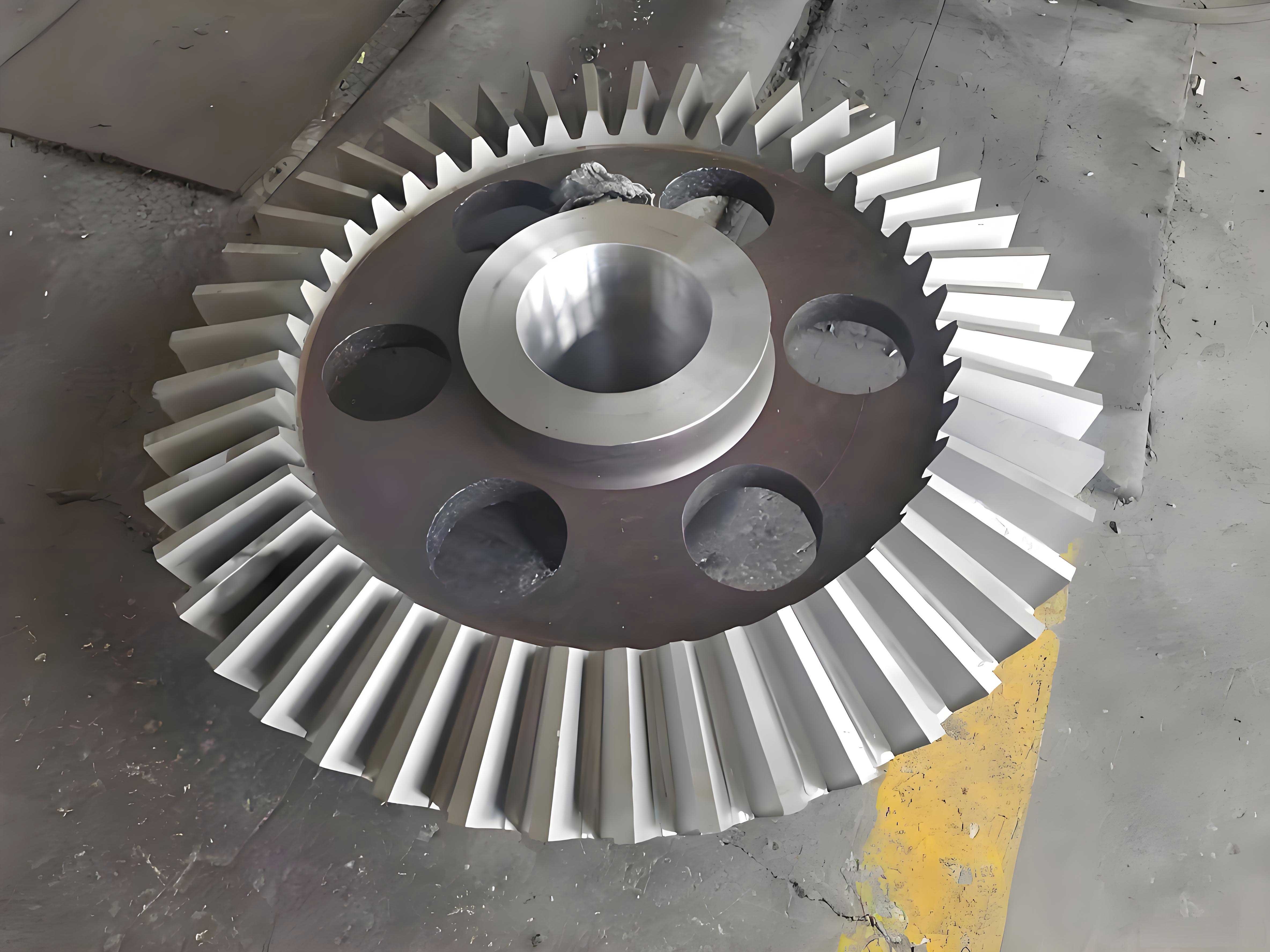
The figure above illustrates a typical miter gear pair, where the shaft angle is 90° and the pitch cone angles are 45° each. For such miter gears, the symmetry simplifies some relationships, but the spherical involute theory remains essential for high-precision analysis.
2. Key Angular Relationships and the Mesh Plane
For a pair of meshing bevel gears, the mesh plane is defined as the common plane that is tangent to both base cones and contains the line of action (which coincides with the pitch line in the case of non-modified designs). This plane is analogous to the line of action in cylindrical gears but extended into three dimensions.
Within this framework, we define the unfolding angle $\theta_i$ for any point on the tooth flank. For a point located on a cone with angle $\delta_i$ (where $\delta_b \leq \delta_i \leq \delta_a$, the face cone angle), the corresponding spherical involute unfolding angle on the generating plane is:
$$\theta_i = \tan \delta_i \cdot \sin \delta_b \cdot (\varphi_i – \varphi_0)$$
However, a more directly useful formulation relates the angular displacement on the mesh plane. The roll angle $\varphi$ on the base cone corresponding to a point on the pitch cone (angle $\delta$) is given by:
$$\varphi = \frac{\tan \delta}{\sin \delta_b} – \text{inv} \alpha_n$$
where the spherical involute function $\text{inv} \alpha_n$ is used, analogous to its planar counterpart. The expansion angle $\psi$ on the mesh plane for a flank point is:
$$\psi = \varphi \cdot \sin \delta_b$$
The following table summarizes the core geometrical relationships for straight bevel gears, highlighting the distinct spherical nature compared to cylindrical gears.
| Parameter | Cylindrical Gear (Spur) | Straight Bevel Gear (Spherical) | Key Formula (Bevel) |
|---|---|---|---|
| Base Geometry | Base Cylinder | Base Cone | $r_b = \frac{m z}{2} \cos \alpha_n$ |
| Involute Generation | Planar, on a plane | Spherical, on a sphere | Rolling tangential plane |
| Pressure Angle | Constant along line of action | Constant in mesh plane | $\cos \delta_b = \cos \delta \cdot \cos \alpha_n$ |
| Reference Action | Line of Action | Mesh Plane | Plane tangent to both base cones |
| Critical Feature of Miter Gears | Not Applicable | Shaft angle Σ=90°, δ₁=δ₂=45° | $\delta_1 = \delta_2 = \frac{\Sigma}{2}$ |
3. Calculation of the Start-of-Measurement Point for Tooth Flank Inspection
In metrology, inspecting the involute profile does not start at the base circle but at the so-called “start-of-measurement point,” which corresponds to the lowest point of single-tooth contact, typically defined by the tip of the mating gear. Calculating the unfolding angle $\theta_{start}$ for this point is critical for setting up gear inspection instruments like gear rolling testers.
The calculation proceeds stepwise, considering the pinion (gear 1) and the wheel (gear 2):
- Determine base cone angles: $\delta_{b1} = \arccos(\cos \delta_1 \cdot \cos \alpha_n)$, $\delta_{b2} = \arccos(\cos \delta_2 \cdot \cos \alpha_n)$.
- Calculate mesh plane angles for pitch cones: For each gear, the roll angle on its base cone for the pitch point is $\varphi_{pitch} = \frac{\tan \delta}{\sin \delta_b}$. The corresponding mesh plane expansion angle is $\psi_{pitch} = \varphi_{pitch} \cdot \sin \delta_b$.
- Calculate mesh plane angles for face cones: The face cone angle $\delta_a$ is known from design (addendum applied to pitch cone). Its mesh plane expansion angle is: $$\psi_a = \left( \frac{\tan \delta_a}{\sin \delta_b} \right) \cdot \sin \delta_b = \tan \delta_a \cdot \cos \delta_b$$ This simplification arises because $\sin \delta_b / \sin \delta_b$ cancels in the derivation for the expansion angle directly on the mesh plane.
- Determine the start-of-measurement expansion angle $\psi_{start}$: For Gear 1, the start point is determined by the tip of Gear 2. The relevant angular distance on the mesh plane is $\psi_{a2}$ (from the pitch line to Gear 2’s tip). Therefore, the expansion angle from Gear 1’s axis to its start-of-measurement point is: $$\psi_{start1} = \psi_{pitch1} + (\psi_{a2} – \psi_{pitch2})$$ This can be consolidated into a single operational formula for Gear 1: $$\psi_{start1} = \tan \delta_{a2} \cdot \cos \delta_{b2} + \left( \frac{\tan \delta_1}{\sin \delta_{b1}} – \frac{\tan \delta_2}{\sin \delta_{b2}} \right) \cdot \sin \delta_{b1}$$
- Convert to generating plane unfolding angle $\theta_{start}$: Finally, for instrument setup, this mesh plane angle is converted back to the unfolding angle on the generating plane tangential to the base cone: $$\theta_{start} = \frac{\psi_{start}}{\sin \delta_b}$$
This rigorous method, based on the spherical involute and the mesh plane, is superior to the approximate method using equivalent spur gears, especially for gears with large cone angles like miter gears.
4. Application Example and Comparative Table
Consider a pair of straight bevel gears with the following parameters: Module $m=4$ mm, Normal Pressure Angle $\alpha_n=20^\circ$, Pinion Teeth $z_1=20$, Wheel Teeth $z_2=40$, Shaft Angle $\Sigma=90^\circ$. The pitch cone angles are $\delta_1 = \arctan(z_1/z_2) \approx 26.565^\circ$, $\delta_2 = 63.435^\circ$. Addendum coefficient is 1.0, so $h_a = m = 4$ mm. Outer cone distance $R_e = \frac{m z_1}{2 \sin \delta_1} \approx 89.44$ mm.
| Calculation Step | Symbol | Pinion (Gear 1) | Wheel (Gear 2) | Formula |
|---|---|---|---|---|
| Base Cone Angle | $\delta_b$ | 24.791° | 58.285° | $\arccos(\cos \delta \cdot \cos 20°)$ |
| Face Cone Angle* | $\delta_a$ | 28.800° | 65.224° | $\delta + \arctan(h_a / R_e)$ |
| Pitch Pt. Mesh Angle | $\psi_{pitch}$ | 0.500 | 1.000 | $\tan \delta$ |
| Face Cone Mesh Angle | $\psi_{a}$ | 0.550 | 1.225 | $\tan \delta_a \cdot \cos \delta_b$ |
| Start Pt. Mesh Angle | $\psi_{start}$ | 0.725 | 1.275 | $\psi_{pitch1} + (\psi_{a2} – \psi_{pitch2})$ |
| Start Pt. Unfolding Angle | $\theta_{start}$ | 1.763 rad | 1.438 rad | $\psi_{start} / \sin \delta_b$ |
For a 1:1 ratio pair of miter gears where $\delta_1 = \delta_2 = 45^\circ$, the calculation simplifies due to symmetry. If both have the same number of teeth $z$ and pressure angle $\alpha_n=20^\circ$, then $\delta_b = \arccos(\cos 45° \cdot \cos 20°) \approx 46.103°$. The mesh plane angles become identical: $\psi_{pitch} = \tan 45° = 1.000$, $\psi_a = \tan \delta_a \cdot \cos \delta_b$. Consequently, the start-of-measurement mesh angle for each miter gear is simply $\psi_{start} = \psi_a$.
5. Contact Ratio (Transverse) Based on Spherical Geometry
The contact ratio $\epsilon_\alpha$ is a vital indicator of smooth power transmission. The spherical involute theory provides a more accurate formula than the equivalent spur gear method. The contact ratio is the ratio of the angular path of action on the mesh plane to the angular base pitch.
The angular length of the path of contact $g_\alpha$ on the mesh plane is the sum of the approach and recess arcs from the tips of the two gears:
$$g_{\alpha\psi} = (\psi_{a1} – \psi_{pitch1}) + (\psi_{a2} – \psi_{pitch2}) = \psi_{a1} + \psi_{a2} – (\psi_{pitch1} + \psi_{pitch2})$$
The angular base pitch $p_{b\psi}$ on the mesh plane is the angular distance corresponding to one base pitch on the sphere, projected onto the mesh plane. It is derived from the base circle circumference: $2\pi r_b$, divided by the cone distance $R$, and projected:
$$p_{b\psi} = \frac{2 \pi \cdot \cos \alpha_n}{z} \cdot \sin \delta_b$$
Therefore, the transverse contact ratio $\epsilon_\alpha$ is:
$$\epsilon_\alpha = \frac{g_{\alpha\psi}}{p_{b\psi}} = \frac{z_1 (\psi_{a1} + \psi_{a2} – \psi_{pitch1} – \psi_{pitch2})}{2 \pi \cdot \cos \alpha_n \cdot \sin \delta_{b1}}$$
Note the use of $z_1$ and $\delta_{b1}$ in the denominator for the pinion’s base; using the wheel’s parameters yields the same result when the gear ratio is applied.
For the example pair above, $\psi_{a1}+\psi_{a2} \approx 1.775$, $\psi_{pitch1}+\psi_{pitch2}=1.500$, so $g_{\alpha\psi}=0.275$. The angular base pitch for the pinion is $p_{b\psi1} = (2\pi \cdot \cos 20°) / 20 \cdot \sin(24.791°) \approx 0.125$. Thus, $\epsilon_\alpha \approx 0.275 / 0.125 = 2.20$.
For miter gears with identical parameters, this simplifies to:
$$\epsilon_\alpha = \frac{z \cdot (2\psi_a – 2\psi_{pitch})}{2 \pi \cdot \cos \alpha_n \cdot \sin \delta_b} = \frac{z \cdot (\tan \delta_a \cdot \cos \delta_b – \tan \delta)}{\pi \cdot \cos \alpha_n \cdot \sin \delta_b}$$
It’s crucial to note that this value represents the contact ratio at the outer heel of the tooth. Due to the linear taper of the tooth, the contact ratio decreases towards the inner toe. A more conservative design analysis may use the midpoint or inner cone distance for calculating a local $\psi_a$ and $\delta_b$.
6. The Intersection with Modern Metrology: Long-Range Absolute Distance Measurement
The precise manufacturing and inspection of large gearboxes or assemblies containing miter gears and other bevel gears require metrology capable of verifying large dimensions. While tactile CMMs have limits, optical interferometric methods offer solutions for absolute distance measurement over ranges of several meters with micrometer-level uncertainty.
One advanced technique is Frequency-Modulated Continuous-Wave (FMCW) laser interferometry. A tunable laser source, such as an external-cavity diode laser (ECDL), emits light whose optical frequency is linearly swept over time. The beam is split into a reference path and a measurement path reflected from a target. The recombined beams create a beat signal with a frequency $f_b$ proportional to the time delay, and hence the distance $L$:
$$f_b = \frac{2 \gamma n L}{c}$$
where $\gamma$ is the chirp rate (frequency sweep speed), $n$ is the refractive index of air, and $c$ is the speed of light. The distance is thus:
$$L = \frac{c \cdot f_b}{2 \gamma n}$$
This method is absolute, requiring no incremental fringe counting.
The relative measurement uncertainty $u_r(L)/L$ depends critically on the stability and linearity of the laser’s frequency sweep $\gamma$, the stability of its center frequency, and environmental control (temperature, pressure, and humidity affecting $n$). For a system with a highly stable ECDL, relative uncertainties on the order of $1 \times 10^{-7}$ over tens of meters are achievable. This means an uncertainty of about 10 µm over a 100 m path. The primary limiting factors often include mechanical stability of the laser cavity, temperature control precision of the laser diode, and the accuracy of the air refractive index compensation.
Applying such a system to large workpiece alignment—for example, measuring the coaxiality of two distant bores in a large gear housing—involves establishing a stable optical line of sight (the “light axis”). A measuring telescope or an auto-collimator can be used in conjunction with specialized target mirrors or reticles mounted in the bores. The FMCW interferometer would measure the absolute distances to each target. Any deviation from coaxiality manifests as a difference in the lateral position of the targets relative to the light axis and a calculated offset in their axial centers based on the measured distances. This non-contact method is ideal for large, heavy workpieces that cannot be easily moved or measured on a CMM.
7. Synthesis and Concluding Perspective
The design and metrology of precision components like straight bevel and miter gears rest on a foundation of rigorous geometry—the spherical involute. The formulas derived for base cone angles, mesh plane expansion angles, start-of-measurement points, and contact ratio provide a more accurate framework than approximate planar analogies. This accuracy is non-negotiable for high-performance applications involving miter gears in power transmission systems where vibration, noise, and efficiency are critical.
Simultaneously, the field of dimensional metrology continues to advance, providing tools like FMCW laser interferometry that can theoretically support the manufacturing and verification of the large-scale systems in which these gears operate. The convergence of precise geometric models and advanced measurement capability enables the realization of ever-more demanding engineering designs. Future improvements in laser frequency stability, thermal control, and real-time environmental compensation will push the boundaries of what is measurable, ensuring that the theoretical perfection of the spherical involute can be faithfully translated into manufactured reality, from the smallest instrument gear to the largest marine propulsion unit employing precision miter gears.