
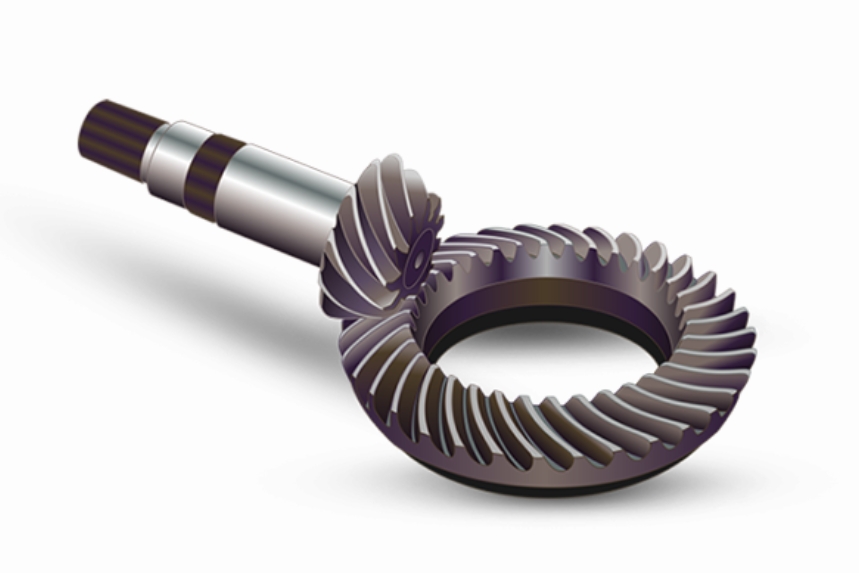
In the precision manufacturing of power transmission systems, the accurate measurement of gear geometry is paramount. Among various gear types, spiral bevel gears present a unique set of challenges due to their complex, spatially curved tooth flanks. The tooth alignment error, or the deviation of the actual tooth trace from its theoretically designed path, directly impacts noise, vibration, load distribution, and the overall service life of the gear pair. My extensive work in gear metrology has often focused on a specific and sophisticated variant: the epicycloidal spiral bevel gear. The measurement of its tooth alignment error requires not only high-precision equipment but also a deep understanding of the mathematical foundation governing its tooth form. This article details, from my first-person perspective, the complete theoretical framework and a practical, coordinate-based measurement methodology developed and applied for this critical task.
The defining characteristic of an epicycloidal spiral bevel gear is that its theoretical tooth trace on the pitch cone is an extended epicycloid. This curve is generated by a point fixed to a circle (the generating circle) that rolls without slipping on the outside circumference of a fixed base circle. To establish a measurable model, we must first derive its parametric equations. Let \( R \) be the radius of the fixed base circle, \( r \) the radius of the rolling generating circle, and \( r_e \) the extended radius from the center of the generating circle to the trace point \( P \). If the line connecting the centers of the two circles makes an angle \( \varphi \) with the x-axis, the coordinates of point \( P \) can be derived from the geometry of pure rolling. The rolling condition dictates that the arc length on the base circle equals the arc length on the generating circle, establishing a relationship between their rotation angles.
The parametric equations for the extended epicycloid are thus:
$$
x = R \cos \varphi + r_e \cos(\frac{R}{r} \varphi)
$$
$$
y = R \sin \varphi + r_e \sin(\frac{R}{r} \varphi)
$$
Here, \( \varphi \) is the generating parameter. For a spiral bevel gear, the parameter of interest is the cone distance \( L \), measured from the apex along the pitch cone. The relationship between \( L \) and the parameter \( \varphi \) is not linear and must be derived from the specific gear geometry, linking the planar extended epicycloid to its conical projection.
A fundamental parameter for assessing the performance of a spiral bevel gear is its spiral angle \( \beta \). By definition, at any point on the tooth trace, the spiral angle is the angle between the tangent to the tooth trace and the pitch cone generator (line from the apex) at that point. Because the curvature of the extended epicycloid is not constant, the spiral angle varies along the tooth length, typically being larger at the heel (outer end) than at the toe (inner end). To find the spiral angle \( \beta_L \) at a given cone distance \( L \), we need the slope of the tangent, \( dy/dx \), and the slope of the pitch cone generator, \( y/x \). The tangent slope is obtained by differentiating the parametric equations:
$$
\frac{dy}{dx} = \frac{dy/d\varphi}{dx/d\varphi} = \frac{R \cos \varphi + r_e (R/r) \cos(\frac{R}{r} \varphi)}{-R \sin \varphi – r_e (R/r) \sin(\frac{R}{r} \varphi)}
$$
The slope of the pitch cone generator line at point \( P(L) \) is simply \( y/x \). Therefore, the spiral angle \( \beta_L \) is given by:
$$
\tan \beta_L = \left| \frac{\frac{dy}{dx} – \frac{y}{x}}{1 + \frac{dy}{dx} \cdot \frac{y}{x}} \right|
$$
This formula allows for the calculation of the theoretical spiral angle at any cone distance \( L \) for the perfect epicycloidal spiral bevel gear, serving as the benchmark for all measurements.
The three-dimensional nature of the spiral bevel gear complicates direct measurement. A powerful conceptual tool is the “generating” or “imaginary” planar gear. The epicycloidal spiral bevel gear is typically of a constant-height tooth design. When its pitch cone angle is 90 degrees, it becomes a planar gear whose pitch line is precisely the extended epicycloid we derived. The manufacturing and design of actual spiral bevel gears are based on the principle of simulated conjugation with this imaginary planar gear. Therefore, for measurement, we can establish two coordinate systems: one for the actual gear (\( O-xyz \)) and one for its planar counterpart (\( O’-x’y’z’ \)). The angle between these two coordinate planes is \( \theta = 90^\circ – \delta \), where \( \delta \) is the pitch cone angle of the actual gear. A cone distance \( L’ \) in the planar gear system projects to a cone distance \( L \) in the actual gear system. Their relationship, derived from spherical trigonometry, is:
$$
L = \frac{L’ \sin \delta}{\sin(90^\circ – \delta + \alpha’)} = \frac{L’ \sin \delta}{\cos(\delta – \alpha’)}
$$
where \( \alpha’ \) is the angle between \( L’ \) and the \( x’ \)-axis in the plane. This transformation is crucial for mapping theoretical planar coordinates to measurable positions on the actual spiral bevel gear mounted on a rotary table.
| Parameter | Symbol | Role in Measurement |
|---|---|---|
| Base Circle Radius | \( R \) | Defines the fixed circle in epicycloid generation. |
| Generating Circle Radius | \( r \) | Defines the rolling circle in epicycloid generation. |
| Extended Radius | \( r_e \) | Distance from generating circle center to trace point P. |
| Generation Parameter | \( \varphi \) | Primary variable in parametric equations. |
| Cone Distance | \( L \) | Measured distance from apex along pitch cone; key practical variable. |
| Spiral Angle at L | \( \beta_L \) | Target measurement, defined by tangent and generator slope. |
| Pitch Cone Angle | \( \delta \) | Links actual gear geometry to imaginary planar gear. |
The practical measurement is performed using a universal measuring microscope (UMM) equipped with a high-precision rotary table. The core idea is to use the microscope’s 3D coordinate stages (X, Y, Z) in conjunction with the rotary table’s angular positioning (θ) to physically trace the theoretical tooth path and compare it with the actual tooth surface of the spiral bevel gear. The first and most critical step is establishing a reliable measurement datum. For epicycloidal spiral bevel gears, the design reference point \( M \) on the tooth trace is ideal. This point, often the mid-point of the tooth face width, serves as the conjugate contact point in the gear’s theoretical mesh. Its theoretical cone distance \( L_m \) (often called the mean or reference cone distance) is calculated from the outer cone distance \( A \) and face width \( b \):
$$
L_m = A – \frac{b}{2}
$$
The gear is carefully centered on the rotary table. Using the microscope’s optical probe (e.g., a centering microscope or a touch probe), the rotary table’s center coordinates \( (X_0, Y_0) \) are determined. The probe is then positioned at the calculated theoretical coordinates of point \( M \) by moving the longitudinal (X) and transverse (Y) stages, and the rotary table is adjusted to the corresponding theoretical angle \( \alpha’_m \) derived from the planar gear equations. This completes the datum alignment, locking the theoretical coordinate system to the physical gear.
With the datum set, the measurement of tooth alignment error proceeds by comparing the theoretical and actual tooth trace at specific locations, typically at the heel (large end) and toe (small end). The microscope probe must be moved from the reference point \( M \) at \( L_m \) to the heel point at cone distance \( L_h \). This movement involves simultaneous adjustments in three axes: the longitudinal stage (ΔX), the vertical column (ΔZ), and the rotary table (Δθ). The required movements are calculated from the imaginary planar gear model and the gear’s pitch cone angle \( \delta \). The longitudinal and vertical displacements are:
$$
\Delta X = (L_h – L_m) \cos \delta
$$
$$
\Delta Z = (L_h – L_m) \sin \delta
$$
The required rotation of the rotary table \( \Delta \alpha’_{h} \) is the difference between the theoretical projection angles for \( L_h \) and \( L_m \) in the planar gear system:
$$
\Delta \alpha’_{h} = \alpha’_h – \alpha’_m
$$
After making these coordinated adjustments, the probe should ideally contact the theoretical tooth trace at the heel. In practice, a deviation will be observed in the microscope’s eyepiece (e.g., misalignment of crosshairs). To quantify the angular error, only the rotary table is adjusted (keeping X, Y fixed) until the crosshairs realign. The additional angle \( \Delta \alpha_{err} \) through which the table was turned is the tooth trace angular deviation, or “spread angle error,” at that point.
$$
\alpha’_{actual} = \alpha’_h + \Delta \alpha_{err}
$$
This measured actual angle \( \alpha’_{actual} \) is then plugged back into the spiral angle formula to compute the actual spiral angle \( \beta_{actual} \) at the heel. The tooth alignment error in angular form is:
$$
\Delta \beta_h = \beta_{actual} – \beta_{h\_theoretical}
$$
| Measurement Step | Instrument Adjustment | Purpose / Result |
|---|---|---|
| 1. Workpiece Centering | Rotary Table & XY Stage | Aligns gear axis with rotary table axis. |
| 2. Datum Point (M) Setup | XY Stage & Rotary Table (θ) | Establishes theoretical origin on the actual spiral bevel gear. |
| 3. Move to Heel Point | X Stage (ΔX), Z Column (ΔZ), Rotary Table (Δθh) | Positions probe at theoretical large-end cone distance. |
| 4. Detect Angular Error | Rotary Table only (Δαerr) | Measures angular deviation of actual tooth trace from theory. |
| 5. Convert to Spiral Angle Error | Calculation using βL formula | Outputs Δβ, the primary alignment error metric. |
| 6. Measure Linear Error (Optional) | X or Y Stage only | Measures normal direction deviation ΔF for tolerance checking. |
For direct linear error measurement, which is often specified in gear tolerance standards, a different procedure is followed after detecting the misalignment at the heel. Instead of rotating the table, the transverse (Y) stage is moved to bring the crosshairs back into alignment. If the required transverse movement is \( \Delta Y \), the linear tooth alignment error \( \Delta F \) in the direction normal to the theoretical tooth trace is obtained by considering the local spiral angle \( \beta_h \):
$$
\Delta F = \Delta Y \cdot \cos \beta_h
$$
This value \( \Delta F \) represents the actual profile deviation in a linear dimension, which is crucial for quality control of the spiral bevel gear. The entire process is repeated for the toe (small end) and for multiple teeth around the gear circumference (e.g., every 90 or 120 degrees). The maximum recorded error value, whether angular \( \Delta \beta_{max} \) or linear \( \Delta F_{max} \), is reported as the tooth alignment error for that spiral bevel gear.
To illustrate with a practical example from my work, consider a pair of epicycloidal spiral bevel gears from a reducer with the following key parameters: Outer Cone Distance \( A = 105mm \), Face Width \( b = 28mm \), Pitch Cone Angle \( \delta = 45^\circ \), Number of Teeth \( z = 11 \), Generating Circle Ratio \( R/r = 13/4 \), and Extended Radius \( r_e = 70.5mm \). The reference cone distance is \( L_m = 105 – 28/2 = 91mm \). Using the full set of derived formulas, a complete measurement table was calculated for the heel (\( L_h = 105mm \)) and toe (\( L_t = 77mm \)). After aligning the gear on the UMM and setting the datum, measurements were taken. The angular deviations \( \Delta \alpha_{err} \) were found to be +0.05° at the heel and -0.03° at the toe for one tooth. Substituting these into the spiral angle calculations yielded:
$$
\Delta \beta_{heel} = \beta_{actual} – \beta_{theory} \approx +0.008^\circ
$$
$$
\Delta \beta_{toe} = \beta_{actual} – \beta_{theory} \approx -0.005^\circ
$$
The corresponding linear errors \( \Delta F \) were also computed using the local spiral angles. This process confirmed the gear was within specified tolerances.
The methodology, while computationally intensive in its setup phase, proves highly efficient for routine inspection of production spiral bevel gears. Once the theoretical measurement parameters (target X, Z, and θ coordinates for datum, heel, and toe) are pre-calculated for a given gear design, the physical measurement process on the universal measuring microscope becomes straightforward and repeatable. This coordinate-based approach provides a direct and traceable link between the sophisticated mathematical model of the epicycloidal spiral bevel gear and its physical manifestation, enabling precise quantification of tooth alignment error—a critical factor in ensuring the quiet, efficient, and durable operation of these complex mechanical components. The fusion of theoretical gear geometry with practical metrology, as outlined here, forms a robust foundation for quality assurance in the manufacture of high-performance spiral bevel gears.