
Spur gears are critical components in various industrial applications due to their high transmission efficiency, broad applicability, and strong load-bearing capacity. They are widely used in fields such as aerospace, automotive, and machinery tools. Traditional manufacturing methods for spur gears, including milling, hobbing, and shaping, often result in low mechanical properties, significant material waste, and high production costs. As an advanced near-net shaping technology, cross-rolling of spur gears offers advantages such as high production efficiency, minimal material waste, and superior surface quality. The forming force during cross-rolling, influenced by material properties, roller parameters, and processing conditions, is crucial for workpiece quality and roller longevity. Accurate calculation of the forming force is essential for roller design and equipment selection. In this study, we focus on developing a theoretical model for the forming force in spur gears cross-rolling, validated through finite element simulations and experimental tests.
To establish a reliable constitutive model for the material used in spur gears, we conducted isothermal compression tests on 40CrNiMo gear steel. The tests were performed at temperatures of 20°C, 80°C, 140°C, and 200°C, with strain rates of 0.005 s⁻¹, 0.05 s⁻¹, and 0.5 s⁻¹. The true stress-true strain curves obtained from these tests reveal that stress decreases with increasing temperature and increases with higher strain rates. Based on this data, we developed a modified Johnson-Cook constitutive model to accurately describe the material behavior under deformation. The original Johnson-Cook model is expressed as:
$$ \sigma = (A + B\varepsilon^n)(1 + C\ln\dot{\varepsilon}^*)\left[1 – \left(\frac{T – T_0}{T_m – T_0}\right)^m\right] $$
where $\sigma$ is the equivalent stress, $\varepsilon$ is the equivalent strain, $\dot{\varepsilon}^*$ is the dimensionless strain rate, $T$ is the deformation temperature, $T_0$ is the reference temperature, $T_m$ is the melting temperature, and $A$, $B$, $C$, $n$, and $m$ are material constants. For 40CrNiMo steel, the parameters were determined as $A = 905$ MPa, $B = 1529.93$, $n = 0.8334$, $C = 0.03249$, and $m = 0.66$. However, the original model showed deviations at higher temperatures, leading to a modified version:
$$ \sigma = (A_1 + B_1\varepsilon + B_2\varepsilon^2 + B_3\varepsilon^3)(1 + C_1 \ln\dot{\varepsilon}^*)\left[1 – \left(\frac{T – T_0}{T_m – T_0}\right)^m\right] $$
with parameters $A_1 = -221$, $B_1 = 17519$, $B_2 = -64889$, $B_3 = 82894$, $C_1 = 0.017$, and $m = 0.7744$. The root mean square error (RMSE) for this modified model is 9.575, indicating high accuracy in predicting stress-strain behavior for spur gears materials.
The cross-rolling process for spur gears involves complex interactions between the roller and workpiece. We derived a theoretical model for the forming force based on the thin slice method and integral approach. First, we established a model for tooth height evolution during rolling. The process is divided into two stages: initial engagement where the roller’s tooth tip and transition arc contact the workpiece, and full engagement where the involute profile forms. The tooth height increase is calculated using area conservation principles, considering the deformation geometry. For instance, in the first stage, the rolled area $S_{BCDG}$ and tooth growth area $S_{AEFB}$ are related by:
$$ S_{BCDG} = S_{AEFB} $$
where these areas are computed based on coordinate transformations and gear meshing principles. Similarly, in the second stage, the area $S_{KLMNG}$ and tooth growth area $S_{HIJK}$ satisfy:
$$ S_{KLMNG} = S_{HIJK} $$
The contact area between the roller and workpiece is critical for forming force calculation. Using integration methods, the contact arc length $l_r$ is derived for each stage. For the first stage:
$$ l_{r1} = 2\int_{x_{D_i}}^{x_{D_0}} \sqrt{1 + (y’)^2} dx $$
and the contact area $S_1$ is:
$$ S_1 = \int_0^{\frac{H_{D_i}}{\sin\alpha_0}} \frac{l_{r1}}{2} dz $$
For the second stage:
$$ l_{r2} = 2\int_{x_{N_i}}^{x_{N_0}} \sqrt{1 + (y’)^2} dx $$
and the contact area $S_2$ is:
$$ S_2 = \int_{\frac{H_{D_i}}{\sin\alpha_0}}^{\frac{H_{N_i} – H_{D_i}}{\sin\alpha_0}} \frac{l_{r1} + l_{r2}}{2} dz $$
The average stress $\bar{\sigma}$ during forming is computed using the slab method, assuming plane strain conditions. The equilibrium equation for a base element leads to:
$$ \sigma_0 = -\frac{2\mu k}{\pi m / 2} r + 2k\left(1 + \frac{\mu}{\pi m / 2} r_H\right) $$
where $\mu$ is the friction factor, $k$ is the shear yield stress, and $r_H$ is the radius at the tooth tip. The forming force $F$ for single-tooth and double-tooth models is then:
$$ F_{\text{one}} = \bar{\sigma} (S_1 + S_2) $$
$$ F_{\text{two}} = \bar{\sigma} (S’_1 + S’_2) $$
These equations form the basis for predicting the forming force in spur gears cross-rolling.
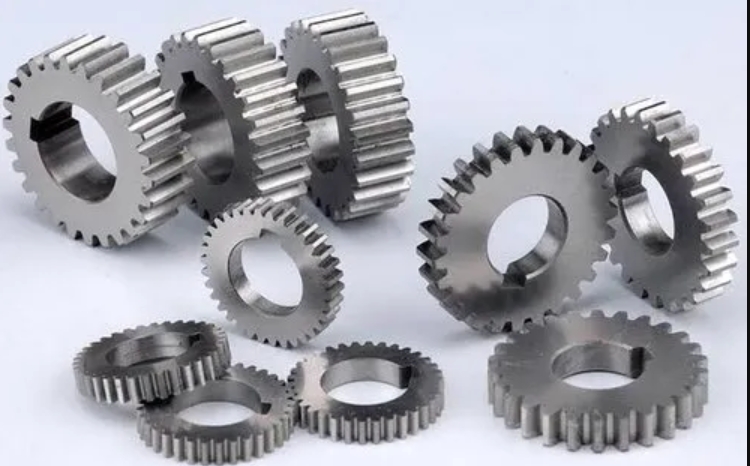
To validate the theoretical model, we performed finite element simulations using Deform software. The model included a spur gears workpiece with a module of 1.75 mm, pressure angle of 20°, and 46 teeth. The initial workpiece diameter was 80.8 mm, and the material was assigned the modified Johnson-Cook model. The roller was treated as a rigid body, and the simulation parameters included a temperature of 20°C, shear friction factor of 0.15, roller rotation speed of 1.05 r/s, and axial feed rate of 0.7 mm/s. The mesh consisted of tetrahedral elements, with refined zones in deformation areas. The simulation results show that the cross-rolling process for spur gears involves three stages: tooth division, forming, and finishing. In the tooth division stage, the roller initially contacts the workpiece, creating indentations. In the forming stage, the involute profile develops, and material flows axially. In the finishing stage, the tooth profile is refined. The tooth height evolution from simulation aligns with the theoretical model, with a maximum relative error of 4.48%. The contact area and forming force were analyzed for single-tooth and double-tooth models. For the single-tooth model, the theoretical maximum forming force was 258.485 kN, while the simulation gave 255.355 kN, a relative error of 1.23%. For the double-tooth model, the theoretical value was 347.794 kN versus 315.95 kN in simulation, a relative error of 10.08%. These results confirm the accuracy of the theoretical approach for spur gears.
We conducted experimental tests on a cross-rolling platform to further validate the model. The workpiece material was 40CrNiMo steel, with an initial diameter of 80.8 mm and dry friction conditions. The roller parameters matched those in the simulation. The forming process was monitored, and the spur gears were measured using a 2D imaging system to determine tooth height and forming force. The experimental results show that the theoretical model slightly overestimates the forming force due to assumptions like plane strain and neglected axial flow. The maximum forming force in experiments was 331.246 kN for the double-tooth model, compared to the theoretical 347.794 kN, a relative error of 4.48%. The tooth height measurements also correlated well with predictions, demonstrating the model’s applicability in industrial settings for spur gears manufacturing.
In conclusion, we developed a modified Johnson-Cook constitutive model for 40CrNiMo steel, with an RMSE of 9.575, accurately capturing its deformation behavior. The theoretical model for spur gears cross-rolling forming force, based on contact area derivation and average stress calculation, shows good agreement with finite element simulations and experimental tests. The relative errors for single-tooth and double-tooth models are within acceptable limits, making the model suitable for optimizing roller design and process parameters in spur gears production. Future work could focus on incorporating axial flow effects and extending the model to other gear types.
| Parameter | Value | Description |
|---|---|---|
| Module (M) | 1.75 mm | Module of the spur gears |
| Pressure Angle (α₀) | 20° | Pressure angle of the spur gears |
| Number of Teeth (z₂) | 46 | Number of teeth on the workpiece |
| Initial Workpiece Diameter | 80.8 mm | Diameter before rolling |
| Roller Rotation Speed | 1.05 r/s | Angular velocity of the roller |
| Axial Feed Rate | 0.7 mm/s | Feed speed during rolling |
| Friction Factor (μ) | 0.15 | Shear friction coefficient |
| Model Type | Theoretical Max Force (kN) | Simulation Max Force (kN) | Experimental Max Force (kN) | Relative Error (%) |
|---|---|---|---|---|
| Single-Tooth | 258.485 | 255.355 | – | 1.23 |
| Double-Tooth | 347.794 | 315.95 | 331.246 | 10.08 (vs sim), 4.48 (vs exp) |
The development of this model enhances the understanding of spur gears cross-rolling and provides a practical tool for industry. By accurately predicting forming forces, manufacturers can improve process efficiency and product quality for spur gears. Further research could explore the effects of different materials and geometries on spur gears performance.