
Strain wave gearing, also known as harmonic drive, is a precision transmission technology that relies on the elastic deformation of a flexible component, the flexspline, to achieve motion transfer. This mechanism is renowned for its compact size, light weight, high load-carrying capacity, high transmission accuracy, and efficiency. Consequently, it finds extensive applications in fields requiring precise motion control, such as aerospace, robotics, machine tools, instrumentation, and medical devices. The inherent elastic deformation of the flexspline under the action of the wave generator imparts a non-linear characteristic to the torsional stiffness of the strain wave gear transmission system. This non-linearity significantly impacts the system’s transmission performance, particularly its positioning accuracy and the presence of elastic hysteresis (backlash). The circumferential meshing stiffness at the contact point between the flexspline and the circular spline is a critical component of the overall torsional stiffness. Its non-linear behavior plays a major role in determining the system’s transmission error and elastic hysteresis under load.
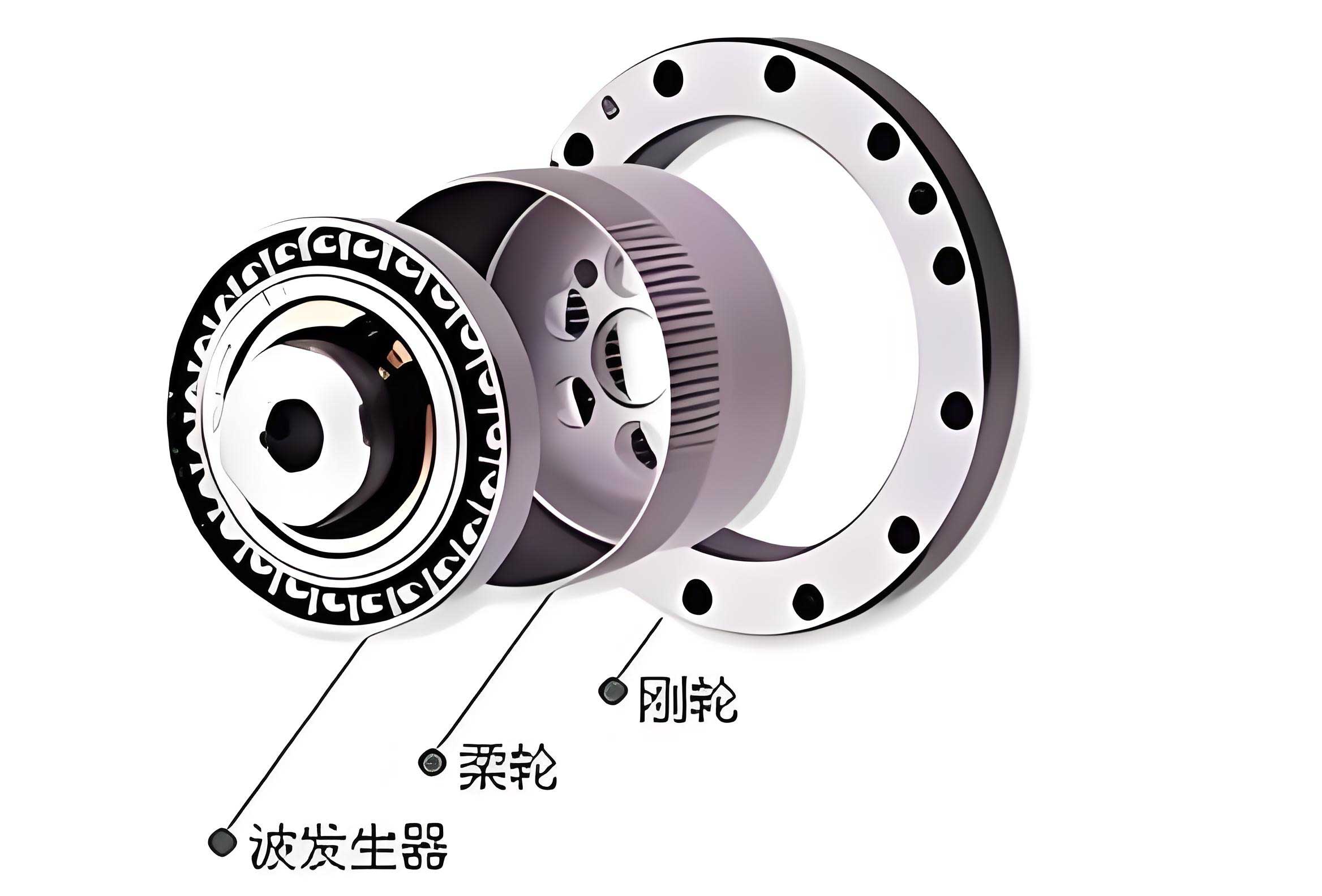
In loaded conditions, the non-uniform distribution of meshing forces between gear teeth varies with load torque, meshing parameters, and structural geometry. The non-linear deformation of the flexspline under load further complicates the performance analysis of strain wave gear drives. Experimental studies have successfully characterized non-linear torsional stiffness and hysteresis curves, revealing key performance metrics. The elastic hysteresis, which varies with load magnitude, is a primary source of vibration, noise, and reduced accuracy. While numerical simulations using Finite Element Analysis (FEA) provide detailed insights, they often lack the explanatory power of theoretical models regarding the influence of specific design parameters. Therefore, a combined theoretical and numerical approach is essential to dissect the factors affecting meshing point stiffness. This article proposes a comprehensive theoretical method for calculating the circumferential stiffness at the flexspline meshing point in a strain wave gear, analyzes the influence of structural parameters, and validates the findings through detailed finite element simulations.
Theoretical Framework for Circumferential Deformation Under Load
The operation of a strain wave gear is based on the flexspline’s pre-deformed state caused by the wave generator. The load deformation from the transmitted torque is superimposed onto this initial assembly deformation. A circumferential force at the meshing point induces deformation that propagates from the tooth contact all the way to the output connection at the cup bottom. The total circumferential displacement at the meshing point is influenced by the deformation of the tooth body, the gear ring, the cylindrical shell, and the cup bottom. These components have different geometries and deformation modes, so their effects cannot be simply added. They must be converted into equivalent circumferential displacements at the meshing point.
For analytical tractability, the cup-type flexspline is decomposed into two main parts: the cylinder body and the tooth body. The cylinder body is further subdivided into five distinct sections based on their deformation characteristics: the cup bottom, the fillet at the cup bottom, the smooth cylindrical shell (barrel), the arc transition section connecting the barrel to the gear ring, and the gear ring itself (with teeth conceptually removed for cylinder analysis). The tooth body is modeled as a cantilever beam.
Deformation of the Flexspline Cylinder Body
Under a transmitted torque \(T\), a circumferential force \(F\) acts at the meshing point near the tooth tip radius \(r_a\), related by \(T = 2F r_a\). This torque induces torsional deformation throughout the cylinder body. Each section’s contribution is derived using theories for thin-walled shells and plates.
1. Torsional Deformation of the Cup Bottom
Modeled as a thin, fixed circular plate of thickness \(\delta_1\), the shear strain \(\gamma_r\) at a radius \(r\) under torque \(T\) is given by:
$$\gamma_r = \frac{T}{2\pi G r^2 \delta_1}$$
where \(G = E/(2(1+\mu))\) is the shear modulus, \(E\) is Young’s modulus, and \(\mu\) is Poisson’s ratio. The circumferential displacement \(u_\theta\) relates to shear strain as \(\gamma_r = du_\theta/dr – u_\theta/r\). Solving with the boundary condition \(u_\theta=0\) at the inner fixing radius \(d_k/2\) gives the circumferential displacement \(v_a\) at the outer edge of the cup bottom (radius \(r_0\)):
$$v_a = \left( \frac{1}{d_k^2} – \frac{1}{4r_0^2} \right) \frac{T r_0}{\pi G \delta_1}$$
The corresponding angular displacement is \(\theta_a = v_a / r_0\).
2. Torsional Deformation of the Cup Bottom Fillet
This section is a quarter toroidal shell of constant thickness \(\delta_1\) and mid-surface radius \(r_1\). The strain energy method is applied. The strain energy \(U\) stored in the fillet and the work done by the torque \(W = \frac{1}{2} T \theta_c\) are equated to find the average twist angle \(\theta_c\) between its ends:
$$\theta_c = \frac{T r_1}{2 G \delta_1 \pi} \int_{0}^{\pi/2} \frac{1}{r^3} d\theta$$
where \(r = r_0 + r_1 \sin\theta\). The circumferential displacement \(v_c\) at the connection to the barrel (radius \(r_m\)) is \(v_c = r_m \theta_c\).
3. Torsional Deformation of the Smooth Cylindrical Shell (Barrel)
For a thin cylindrical shell of length \(l_1\), thickness \(\delta_2\), and neutral radius \(r_m\), the angle of twist \(\theta_t\) under torque \(T\) is:
$$\theta_t = \frac{T l_1}{G I_p}, \quad \text{where} \quad I_p = 2\pi \delta_2 r_m^3$$
The resulting circumferential displacement is \(v_t = r_m \theta_t\).
4. Torsional Deformation of the Arc Transition Section
This is a segment with a variable outer diameter, transitioning from the barrel to the gear ring. Its polar moment of inertia \(I_{pg}\) varies along its length \(l_2\):
$$I_{pg}(x) = \frac{\pi}{32} \left( D(x)^4 – d_s^4 \right), \quad D(x) = d_s + 2\left( \delta_2 + r_2 – \sqrt{r_2^2 – x^2} \right)$$
where \(d_s\) is the inner diameter, \(r_2\) is the transition arc radius, and \(x\) is the axial coordinate. The total twist \(\theta_g\) is found by integration:
$$\theta_g = \int_{0}^{l_2} \frac{T}{G I_{pg}(x)} dx$$
The circumferential displacement at the gear ring end (radius \(r_{m1}\)) is \(v_g = r_{m1} \theta_g\).
5. Torsional Deformation of the Gear Ring
The gear ring, considered as a cylindrical shell of thickness \(\delta_3\) (tooth removed), width \(b\), and neutral radius \(r_{m1}\), undergoes twist:
$$\theta_d = \frac{T b}{G I_{pd}}, \quad \text{where} \quad I_{pd} = 2\pi \delta_3 r_{m1}^3$$
The circumferential displacement is \(v_d = r_{m1} \theta_d\).
Deformation of the Flexspline Tooth Body
The tooth is subjected to the circumferential force \(F\) at its tip. Three deformation components are considered: bending and shear of the tooth itself, and rotation at the tooth root due to deformation of the gear ring wall.
1. Tooth Root Rotation
The force \(F\) applied at a height \(h\) (tooth height) creates a bending moment on the gear ring wall, causing a local rotation \(\theta_r\) at the tooth root. For a segment of the ring with axial length equal to the tooth width \(b\):
$$\theta_r = \frac{12 \pi m F h}{E b \delta_3^3}$$
where \(m\) is the gear module. The resulting circumferential displacement at the tooth tip is \(v_r = h \theta_r\).
2. Tooth Bending and Shear Deformation
The tooth is modeled as a variable-cross-section cantilever beam. Using the energy method, the circumferential displacement \(v_b\) at the tip due to bending is:
$$v_b = \int_{0}^{h} \frac{12 F x^2}{E b s_i^3} dx$$
where \(s_i\) is the tooth thickness at a distance \(x\) from the root. For an involute tooth profile with pressure angle \(\alpha\), modification coefficient \(x_1\), and base tooth thickness \(s = m(\pi/2 + 2 x_1 \tan \alpha)\), the thickness \(s_i\) at radius \(r_i\) is:
$$s_i = s \frac{r_i}{r} – 2 r_i \left( \text{inv}(\alpha_i) – \text{inv}(\alpha) \right), \quad \text{inv}(\phi) = \tan \phi – \phi$$
where \(r\) is the reference circle radius and \(\alpha_i\) is the pressure angle at \(r_i\).
The displacement \(v_s\) due to shear deformation is:
$$v_s = \int_{0}^{h} \frac{K}{G A(x)} dx, \quad \text{where} \quad A(x) = b s_i$$
and \(K\) is the shear factor (taken as 1.5 for a rectangular section).
Theoretical Circumferential Stiffness at the Meshing Point
The circumferential stiffness at the meshing point is defined as the magnitude of a pair of opposing circumferential forces required to produce a unit relative circumferential displacement at the two symmetric meshing points in a strain wave gear. The total compliance is the sum of the compliances from the cylinder body twist and the tooth body deformation. First, define the equivalent torsional stiffness values:
$$k_1 = \frac{T}{\theta_a + \theta_c + \theta_t + \theta_g + \theta_d}, \quad k_2 = \frac{F}{v_r + v_b + v_s}$$
The total torsional compliance at the meshing radius is \(1/k_\theta = 1/k_1 + 1/(2 k_2 r_a^2)\). Therefore, the circumferential stiffness \(k_\theta\) at the meshing point is:
$$k_\theta = \frac{2 k_1 k_2 r_a^2}{k_1 + 2 k_2 r_a^2} = k_1 \frac{1}{1 + k_1/(2 k_2 r_a^2)}$$
This formulation clearly shows that the overall meshing point stiffness is dominated by the weaker of the two stiffness paths: the cylinder torsional stiffness \(k_1\) and the tooth body stiffness reflected in \(k_2\).
Finite Element Simulation and Validation
To validate the theoretical formulations, a detailed 3D finite element model of a cup-type flexspline was developed using solid elements (SOLID185 in ANSYS). The model included accurate involute tooth profiles and key geometric features like fillets. The material properties and key dimensions are listed in the table below.
| Parameter | Value | Parameter | Value |
|---|---|---|---|
| Young’s Modulus, \(E\) | 210 GPa | Cup Bottom Thickness, \(\delta_1\) | 0.435 mm |
| Poisson’s Ratio, \(\mu\) | 0.3 | Barrel Thickness, \(\delta_2\) | 0.435 mm |
| Pressure Angle, \(\alpha\) | 20° | Gear Ring Thickness, \(\delta_3\) | 0.700 mm |
| Modification Coefficient, \(x_1\) | 2.1286 | Tooth Width, \(b\) | 12.780 mm |
| Module, \(m\) | 0.2536 mm | Fixation Hole Diam., \(d_k\) | 30.000 mm |
| Number of Teeth, \(z_1\) | 240 | Inner Shell Diam., \(d_s\) | 60.000 mm |
| Barrel Length, \(l_1\) | 15.18 mm | Fillet Radius, \(r_1\) | 0.6525 mm |
| Transition Length, \(l_2\) | 1.9693 mm | Transition Radius, \(r_2\) | 7.450 mm |
Three simulation conditions were defined to compare with theory and isolate the effect of assembly deformation:
- Cylinder – Unassembled Solution: A uniform circumferential force (with a resultant of 1 N) was applied to all tooth tips of the undeformed, circular flexspline model (fixed at the cup bottom). The average circumferential displacement of cylinder sections was computed.
- Cylinder – Assembled Solution: The wave generator was modeled to create the elliptical assembly deformation. A pair of unit circumferential forces was then applied at the tooth tips on the major axis. The load-induced circumferential displacement was calculated as the difference in displacements before and after applying the force.
- Tooth Body – Mean Solution: On the assembled model, a unit circumferential force was distributed across three sections (front, middle, rear) of a major-axis tooth. The average tooth tip displacement relative to the root was computed.
Validation of Cylinder Body Deformation
The table below compares the theoretical predictions with the FEA results for cylinder deformation under a unit resultant circumferential force (1 N·m torque).
| Cylinder Section | Theoretical Solution (nm) | FEA Unassembled (nm) | Relative Deviation (%) | Deformation Share (Theory) (%) |
|---|---|---|---|---|
| Cup Bottom | 13.78 | 13.84 | -0.4 | 63.3 |
| Smooth Barrel | 4.69 | 4.69 | 0.0 | 21.6 |
| Gear Ring | 2.44 | 2.15 | 13.5 | 11.2 |
| Arc Transition | 0.52 | 0.51 | 2.0 | 2.4 |
| Cup Fillet | 0.32 | 0.29 | 10.3 | 1.5 |
| Total | 21.75 | 21.48 | 1.3 | 100.0 |
The agreement for the total deformation is excellent (1.3% deviation). The cup bottom contributes the largest share (>63%) to the total torsional compliance of the cylinder, highlighting its critical role. The larger deviations for the gear ring and fillet are attributed to modeling simplifications (ignoring teeth) and coarse meshing in small features, respectively, but their overall impact is small.
The effect of assembly deformation is significant. In the assembled state, the load-induced displacement from FEA was lower than the theoretical (unassembled) prediction. The theoretical total displacement was 21.75 nm, while the FEA assembled solution averaged 19.64 nm, a reduction of approximately 10%. This indicates that the pre-stressing from the wave generator increases the effective circumferential stiffness of the flexspline cylinder body.
Validation of Tooth Body Deformation
The table below compares the tooth deformation components under a unit circumferential force.
| Deformation Type | Theoretical Solution (nm) | FEA Mean Solution (nm) | Relative Deviation (%) |
|---|---|---|---|
| Root Rotation, \(v_r\) | 7.05 | 7.74 | -9.9 |
| Tooth Bending & Shear, \(v_b+v_s\) | 29.47 | 28.00 | 5.3 |
| Total Tooth Deformation | 36.52 | 35.74 | 2.2 |
The total tooth deformation shows very good agreement (2.2% deviation), validating the theoretical model. The analysis reveals that tooth bending and shear constitute the dominant portion (~93%) of the total tooth body compliance, while root rotation accounts for only about 7%.
Calculation and Comparison of Meshing Point Stiffness
Using the deformation results, the stiffness components \(k_1\), \(k_2\), and the final meshing point circumferential stiffness \(k_\theta\) were calculated.
| Solution Type | Cylinder Stiffness, \(k_1\) (N·m/rad) | Tooth Body Stiffness, \(k_2\) (N·m/rad) | Meshing Point Stiffness, \(k_\theta\) (N·m/rad) |
|---|---|---|---|
| Theoretical | 85,489 | 53,221 | 32,801 |
| FEM (Assembled) | 94,513 | 54,383 | 34,520 |
| Relative Deviation | -9.5% | -2.1% | -5.0% |
The theoretical stiffness values are slightly lower than the FEA results, with a -5% deviation for the final meshing point stiffness \(k_\theta\). This is consistent and acceptable, considering the simplifications in the theoretical model (e.g., ignoring the stiffening effect of teeth on the gear ring in the cylinder model). The results confirm the validity of the proposed theoretical algorithm for calculating the circumferential stiffness in a strain wave gear.
A key observation from the stiffness values is that \(k_2\) (related to tooth body deformation) is significantly lower than \(k_1\) (related to cylinder torsion). According to the stiffness combination formula \(k_\theta = k_1 / (1 + k_1/(2 k_2 r_a^2))\), the lower \(k_2\) value acts as a bottleneck, limiting the overall meshing point stiffness \(k_\theta\). Therefore, to enhance the torsional performance and reduce elastic hysteresis in a strain wave gear, improving the tooth body stiffness is paramount.
Influence of Tooth Parameters on Tooth Body Stiffness
Given the critical role of tooth body stiffness, the influence of key tooth design parameters was analyzed using the theoretical model. Strain wave gears typically use a high pressure angle or positive profile shift to ensure sufficient clearance and avoid interference.
The following figure (conceptual) illustrates the impact of pressure angle \(\alpha\), profile shift coefficient \(x_1\), and tooth width \(b\) on the tooth body stiffness \(k_2\). The analysis shows:
- Pressure Angle (\(\alpha\)): Increasing the pressure angle significantly reduces tooth stiffness. A smaller pressure angle yields a thicker tooth root and more favorable force transmission angle, enhancing stiffness.
- Profile Shift Coefficient (\(x_1\)): A positive profile shift (increasing \(x_1\)) substantially increases tooth stiffness by thickening the tooth throughout its height, especially at the root.
- Tooth Width (\(b\)): Tooth stiffness increases linearly with tooth width, as expected from beam theory.
Among these, increasing the positive profile shift has the most pronounced effect on improving tooth body stiffness in a strain wave gear.
Conclusions
This study presents a comprehensive theoretical and numerical investigation into the circumferential stiffness at the meshing point of the flexspline in a strain wave gear drive. The main conclusions are as follows:
- A theoretical methodology has been successfully developed to calculate the circumferential deformation of both the cylinder body and tooth body of the flexspline under load. The derived formulas for the meshing point stiffness show good agreement with finite element simulation results, with a relative deviation of approximately -5%.
- The deformation analysis reveals that within the cylinder body’s total load-induced circumferential displacement, the cup bottom contributes the largest share (over 60%). Within the tooth body deformation, bending and shear of the tooth itself constitute the dominant portion (over 90%).
- The assembly deformation induced by the wave generator has a non-negligible stiffening effect on the flexspline cylinder body, reducing its load-induced circumferential deformation by about 10% compared to the unassembled state.
- A critical stiffness analysis shows that the tooth body stiffness path is the weaker link compared to the cylinder torsional stiffness. Therefore, the overall meshing point circumferential stiffness is primarily limited by the compliance of the tooth body.
- To enhance the torsional performance of the strain wave gear by increasing the meshing point stiffness, optimizing tooth parameters is essential. Specifically, reducing the pressure angle, increasing the positive profile shift coefficient, and increasing the tooth width are effective strategies to improve tooth body stiffness. Among these, increasing the profile shift coefficient has the most significant positive impact.
This work provides a foundational theoretical framework and practical insights for the design and optimization of strain wave gear drives, aiming at achieving higher transmission stiffness and lower elastic hysteresis, which are crucial for advanced precision motion control applications.