
In this paper, we present a comprehensive theoretical study on the stress state of meshing pairs in an oscillating tooth end face harmonic drive gear, a novel spatial transmission mechanism that combines the advantages of traditional harmonic drives and oscillating tooth systems. This harmonic drive gear not only retains the benefits of conventional harmonic gear transmissions, such as high reduction ratios and compact structure, but also significantly enhances power transmission capacity, making it suitable for heavy-duty applications in mining, machinery, metallurgy, and construction industries. Our research focuses on analyzing the meshing conditions and normal forces within the meshing pairs, investigating the variation patterns of the total meshing area, and deriving formulas for specific pressure. This work aims to provide a reliable foundation for the strength design of this innovative harmonic drive gear system, ensuring its durability and efficiency under high loads.
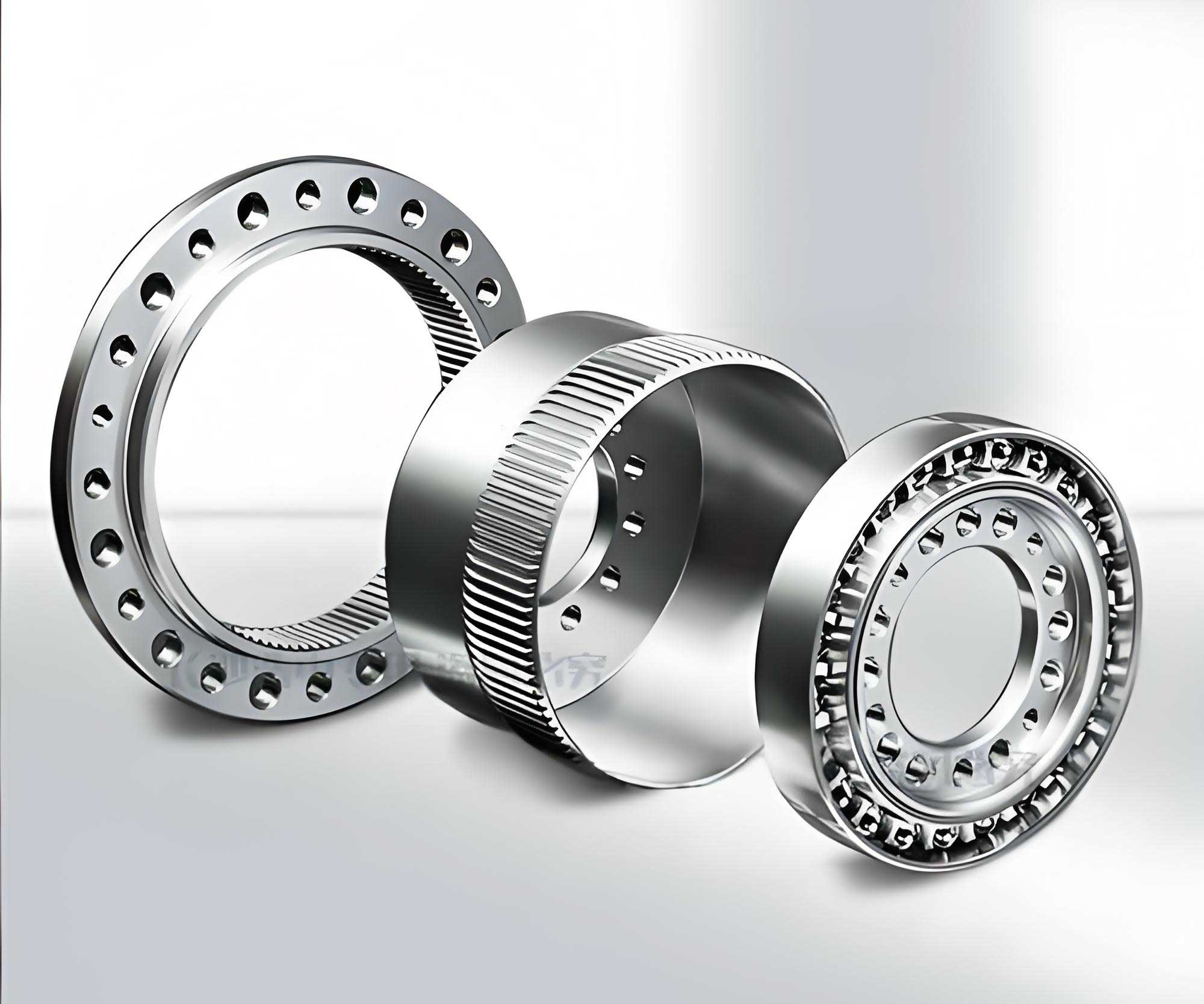
The harmonic drive gear operates through a unique mechanism where an input shaft drives a wave generator with an end face cam. As the wave generator rotates, it induces axial reciprocating motion in oscillating teeth housed within a slot wheel. The front ends of these oscillating teeth engage with an end face gear, transmitting motion and torque to the output shaft. This configuration allows for high torque transmission with minimal backlash, a hallmark of harmonic drive gear systems. In our analysis, we assume a single-sided transmission for simplicity, but the principles extend to multi-wave designs. The key to optimizing this harmonic drive gear lies in understanding the stress distribution across meshing pairs, particularly between the oscillating tooth fronts and the end face gear, which we refer to as meshing pair B. This meshing pair is critical because it experiences higher normal forces compared to the meshing pair between the oscillating tooth rears and the wave generator (meshing pair A), making it the limiting factor for load capacity in this harmonic drive gear.
To model the meshing behavior, we developed a geometric representation based on the circumferential expansion of the harmonic drive gear. In this model, the teeth profiles for both meshing pairs are designed as Archimedes spiral surfaces with straight-line generatrices perpendicular to the axis of rotation, simplifying manufacturing and analysis. For meshing pair B, we construct a virtual tooth shape by superimposing the tooth tip portions of oscillating teeth onto corresponding points of the end face gear, creating a clear visualization of engagement states. This geometric model reveals that the number of oscillating teeth in simultaneous engagement depends on the ratio of the theoretical total number of oscillating teeth \(z_O\) to the number of waves \(U\) in the wave generator. When \(z_O/U\) is an integer, the meshing pattern repeats uniformly across waves, a common design choice for harmonic drive gear systems to ensure smooth operation. Our study delves into how this ratio affects the total meshing area and, consequently, the stress levels within the harmonic drive gear.
The total meshing area \(\sum S_{ej}\) for meshing pair B varies periodically with the rotation angle \(\phi_W\) of the wave generator. This variation is crucial for assessing the harmonic drive gear’s performance under dynamic loads. We define the maximum total meshing area \(\sum S_{emax}\) and the minimum total meshing area \(\sum S_{emin}\), which correspond to instants when certain oscillating teeth are fully engaged or disengaged. The period \(T\) of this variation depends on whether the end face gear is fixed (\(T = 2\pi / z_E\)) or the slot wheel is fixed (\(T = 2\pi / z_O\)), where \(z_E\) is the number of teeth on the end face gear. This cyclical change in meshing area directly influences the contact pressure and wear characteristics of the harmonic drive gear, necessitating detailed analysis for reliable design.
We begin by deriving the maximum meshing area \(S_e\) for a single oscillating tooth when it is fully engaged with the end face gear. The tooth surface of the oscillating tooth front (for the rising engagement segment) is described by the parametric equations:
$$ x = r \cos \phi_O $$
$$ y = r \sin \phi_O $$
$$ z = -A \phi_O $$
where \(r\) is the radial coordinate ranging from the inner radius \(R_1\) to the outer radius \(R_2\) of the end face gear, \(\phi_O\) is the angular parameter from \(0\) to \(\pi / z_O\), and \(A = h z_E / \pi\) with \(h\) as the tooth height. The radii are given by:
$$ R_1 = \frac{m z_E (1 – 2 \phi_d)}{2}, \quad R_2 = \frac{m z_E}{2} $$
Here, \(m\) is the module at the outer end of the end face gear, and \(\phi_d\) is the tooth width coefficient. Using coordinate transformations and surface area integration, we obtain the expression for \(S_e\):
$$ S_e = \int_{0}^{\pi / z_O} d\phi_O \int_{R_1}^{R_2} \sqrt{r^2 + A^2} \, dr $$
Evaluating this integral yields:
$$ S_e = \frac{\pi}{z_O} \left[ \frac{R_2 \sqrt{R_2^2 + A^2}}{2} – \frac{R_1 \sqrt{R_1^2 + A^2}}{2} + \frac{A^2}{2} \ln \left( \frac{R_2 + \sqrt{R_2^2 + A^2}}{R_1 + \sqrt{R_1^2 + A^2}} \right) \right] $$
This formula provides the baseline meshing area for a single tooth pair in the harmonic drive gear, which is essential for subsequent calculations of total engagement areas.
Next, we analyze the total meshing area for all active meshing pairs in the harmonic drive gear. The behavior differs based on whether \(z_O/U\) is even or odd, affecting the number of oscillating teeth \(z_N\) that are simultaneously engaged. We summarize these cases in the following table to clarify the relationships:
| Case | Condition | Number of Engaged Teeth \(z_N\) | Maximum Total Area \(\sum S_{emax}\) | Minimum Total Area \(\sum S_{emin}\) |
|---|---|---|---|---|
| Even | \(z_O/U\) is even | \(z_N = z_O / (2U)\) | \(\sum S_{emax} = \frac{z_O + 2U}{4} S_e\) | \(\sum S_{emin} = \frac{z_O – 2U}{4} S_e\) |
| Odd | \(z_O/U\) is odd | \(z_N = (z_O + U) / (2U)\) | \(\sum S_{emax} = \frac{(z_O + U)^2}{4z_O} S_e\) | \(\sum S_{emin} = \frac{(z_O – U)^2}{4z_O} S_e\) |
These formulas show that the harmonic drive gear’s meshing area fluctuates between \(\sum S_{emax}\) and \(\sum S_{emin}\), with the amplitude determined by the design parameters. For instance, a higher number of waves \(U\) generally reduces the minimum meshing area, potentially increasing stress concentrations. This insight is vital for optimizing the harmonic drive gear to balance load distribution and material usage. The periodic variation in meshing area, as illustrated in our geometric model, underscores the dynamic nature of stress in harmonic drive gear systems, which must be accounted for in fatigue analysis.
Moving to the force analysis, we compute the normal forces acting on meshing pair B in the harmonic drive gear. Assuming negligible friction and oscillating tooth weight, and that forces are uniformly distributed along the radial direction, we analyze the equilibrium for a single oscillating tooth. Let \(q_{ENj}\) represent the normal force per unit length on the front end of the \(j\)-th oscillating tooth at radius \(r\). The total normal force for all engaged teeth is:
$$ \sum_{j=1}^{z_N} F_{ENj} = \sum_{j=1}^{z_N} \int_{R_1}^{R_2} q_{ENj} \, dr \cdot B_E $$
where \(B_E = \phi_d m z_E\) is the tooth width of the end face gear. By relating the forces at the front and rear ends through geometric constraints, we derive an expression involving the input torque \(T_i\). For the harmonic drive gear, the input torque is related to the input power \(P_i\) and speed \(n_i\) by:
$$ T_i = 9.55 \times 10^6 \frac{P_i}{n_i} \quad \text{N·mm} $$
Through integration and substitution of the spiral angle \(\theta\) and tooth profile angle \(\alpha\), which vary with radius as:
$$ \tan \theta = \frac{h U}{\pi r}, \quad \tan \alpha = \frac{\pi r}{h z_E}, \quad \sin \alpha = \frac{\pi r}{\sqrt{\pi^2 r^2 + z_E^2 h^2}} $$
we obtain the total normal force for meshing pair B:
$$ \sum_{j=1}^{z_N} F_{ENj} = \frac{2\pi^2 T_i}{h U \left( \sqrt{\pi^2 R_2^2 + z_E^2 h^2} – \sqrt{\pi^2 R_1^2 + z_E^2 h^2} \right)} $$
Substituting the expressions for \(R_1\), \(R_2\), and \(B_E\), this simplifies to:
$$ \sum_{j=1}^{z_N} F_{ENj} = \frac{1.91 \times 10^7 \phi_d m \pi^2 P_i}{n_i h U \left( \sqrt{\pi^2 m^2 + 4h^2} – \sqrt{\pi^2 m^2 (1-2\phi_d)^2 + 4h^2} \right)} $$
This formula quantifies the cumulative normal load on the engaged teeth in the harmonic drive gear, a key parameter for stress evaluation. The derivation highlights how design variables like module \(m\), tooth height \(h\), and wave number \(U\) influence force distribution, enabling targeted modifications to enhance the harmonic drive gear’s load capacity.
With the total normal force and meshing area established, we calculate the specific pressure \(\sigma\) (or contact pressure) for meshing pair B in the harmonic drive gear. Assuming uniform pressure distribution across all engaged pairs, the maximum specific pressure \(\sigma_{\text{max}}\) occurs when the total meshing area is at its minimum \(\sum S_{emin}\). Thus:
$$ \sigma_{\text{max}} = \frac{\sum F_{ENj}}{\sum S_{emin}} $$
Combining the earlier results, we derive explicit formulas for \(\sigma_{\text{max}}\) based on the parity of \(z_O/U\). For even \(z_O/U\):
$$ \sigma_{\text{max}} = \frac{7.64 \times 10^7 \phi_d m \pi^2 P_i}{n_i h U \left( \sqrt{\pi^2 m^2 + 4h^2} – \sqrt{\pi^2 m^2 (1-2\phi_d)^2 + 4h^2} \right) (z_O – 2U) S_e} $$
For odd \(z_O/U\):
$$ \sigma_{\text{max}} = \frac{7.64 \times 10^7 \phi_d m \pi^2 z_O P_i}{n_i h U \left( \sqrt{\pi^2 m^2 + 4h^2} – \sqrt{\pi^2 m^2 (1-2\phi_d)^2 + 4h^2} \right) (z_O – U)^2 S_e} $$
These equations provide a direct means to assess the contact stress in the harmonic drive gear under operating conditions. By limiting \(\sigma_{\text{max}}\) to allowable material stresses, designers can determine the maximum transmissible power or optimize geometric parameters to reduce pressure. This approach is integral to ensuring the longevity and reliability of harmonic drive gear systems in demanding applications.
To illustrate the practical implications, we present a numerical example comparing the harmonic drive gear with a standard spur gear transmission. Both systems use the same module \(m = 6 \, \text{mm}\), material (quenched and tempered 45 steel), input speed \(n_i = 1470 \, \text{r/min}\), and transmission ratio \(i = 24\). For the harmonic drive gear, additional parameters are: \(z_E = 50\), \(z_O = 48\), \(U = 2\), \(\phi_d = 0.15\), and end face gear tooth profile half-angle \(\alpha_2 = 30^\circ\). From geometry, the tooth height \(h = \pi m / (2 \tan \alpha_2) = 16.33 \, \text{mm}\). Using our formulas, we compute \(S_e = 853.4 \, \text{mm}^2\) and, assuming an allowable contact pressure \(\sigma_{\text{max}} = 10 \, \text{MPa}\) (based on dynamic load criteria for spline connections), we solve for the input power \(P_i\). The results are summarized in the table below, alongside calculations for a two-stage spur gear transmission with similar constraints.
| Parameter | Harmonic Drive Gear | Spur Gear Transmission |
|---|---|---|
| Module \(m\) (mm) | 6 | 6 |
| Material | 45 steel (quenched and tempered) | 45 steel (quenched and tempered) |
| Input Speed \(n_i\) (r/min) | 1470 | 1470 |
| Transmission Ratio \(i\) | 24 | 24 |
| Maximum Transmissible Power \(P_i\) (kW) | 66 | 4 |
| Key Design Features | Oscillating teeth, end face engagement, multiple waves | Two-stage design, standard involute teeth |
The harmonic drive gear demonstrates a significantly higher power capacity—over 16 times that of the spur gear system—underscoring its advantage for high-torque applications. This performance boost stems from the larger total meshing area and efficient force distribution inherent in the harmonic drive gear design. Such comparisons validate the potential of harmonic drive gear technology to replace conventional transmissions in heavy machinery, where space and weight constraints are critical.
Beyond the basic analysis, we explore the sensitivity of the harmonic drive gear’s stress state to parameter variations. For instance, increasing the wave number \(U\) can enhance torque ripple smoothing but may reduce \(\sum S_{emin}\), raising \(\sigma_{\text{max}}\). Similarly, adjusting the tooth width coefficient \(\phi_d\) affects both meshing area and force distribution. We model these relationships using the derived formulas, providing designers with a toolkit for iterative optimization. To facilitate this, we compile key symbols and their definitions in a reference table:
| Symbol | Description | Unit |
|---|---|---|
| \(z_E\) | Number of teeth on end face gear | – |
| \(z_O\) | Theoretical total number of oscillating teeth | – |
| \(U\) | Number of waves on wave generator | – |
| \(m\) | Module at outer end of end face gear | mm |
| \(h\) | Tooth height | mm |
| \(\phi_d\) | Tooth width coefficient | – |
| \(S_e\) | Maximum meshing area for a single tooth pair | mm² |
| \(\sum S_{emax}\) | Maximum total meshing area for all engaged pairs | mm² |
| \(\sum S_{emin}\) | Minimum total meshing area for all engaged pairs | mm² |
| \(P_i\) | Input power | kW |
| \(n_i\) | Input speed | r/min |
| \(\sigma_{\text{max}}\) | Maximum specific pressure (contact pressure) | MPa |
In addition to static stress analysis, we consider dynamic effects in the harmonic drive gear, such as impact loads during engagement and disengagement of oscillating teeth. These transient phenomena can cause stress peaks beyond the calculated \(\sigma_{\text{max}}\), necessitating safety factors in design. We propose that future work incorporate finite element analysis (FEA) simulations to validate our theoretical models and account for elastic deformations, which are particularly relevant in harmonic drive gear systems due to their compliant elements. Experimental testing on prototype harmonic drive gear units would further corroborate our findings, enabling refinement of the formulas for industrial applications.
The harmonic drive gear’s unique geometry also offers opportunities for noise reduction and efficiency improvement. By optimizing the tooth profiles—for example, using modified spiral surfaces to minimize sliding friction—we can enhance the harmonic drive gear’s performance in precision applications like robotics and aerospace. Moreover, the scalability of our analysis allows it to be applied to miniature harmonic drive gear systems for medical devices or large-scale ones for wind turbine generators, demonstrating the versatility of this transmission technology.
In conclusion, our theoretical study provides a foundational framework for analyzing the stress state in oscillating tooth end face harmonic drive gear meshing pairs. We derived analytical expressions for meshing area variation, normal forces, and specific pressure, highlighting the influence of key design parameters. The harmonic drive gear’s superior power transmission capability, as evidenced by our numerical example, makes it a compelling alternative to traditional gear systems. This work paves the way for advanced strength design methodologies, ensuring that harmonic drive gear systems can meet the demands of modern industrial applications while maintaining compactness and reliability. Continued research into material selection, lubrication, and thermal effects will further unlock the potential of harmonic drive gear technology, driving innovation in mechanical transmission systems worldwide.
To summarize the key formulas for quick reference, we list them below in LaTeX format:
$$ S_e = \frac{\pi}{z_O} \left[ \frac{R_2 \sqrt{R_2^2 + A^2}}{2} – \frac{R_1 \sqrt{R_1^2 + A^2}}{2} + \frac{A^2}{2} \ln \left( \frac{R_2 + \sqrt{R_2^2 + A^2}}{R_1 + \sqrt{R_1^2 + A^2}} \right) \right] $$
$$ \sum S_{emax} = \frac{z_O + 2U}{4} S_e \quad \text{(for even } z_O/U\text{)} $$
$$ \sum S_{emin} = \frac{z_O – 2U}{4} S_e \quad \text{(for even } z_O/U\text{)} $$
$$ \sum S_{emax} = \frac{(z_O + U)^2}{4z_O} S_e \quad \text{(for odd } z_O/U\text{)} $$
$$ \sum S_{emin} = \frac{(z_O – U)^2}{4z_O} S_e \quad \text{(for odd } z_O/U\text{)} $$
$$ \sum_{j=1}^{z_N} F_{ENj} = \frac{1.91 \times 10^7 \phi_d m \pi^2 P_i}{n_i h U \left( \sqrt{\pi^2 m^2 + 4h^2} – \sqrt{\pi^2 m^2 (1-2\phi_d)^2 + 4h^2} \right)} $$
$$ \sigma_{\text{max}} = \frac{7.64 \times 10^7 \phi_d m \pi^2 P_i}{n_i h U \left( \sqrt{\pi^2 m^2 + 4h^2} – \sqrt{\pi^2 m^2 (1-2\phi_d)^2 + 4h^2} \right) (z_O – 2U) S_e} \quad \text{(for even } z_O/U\text{)} $$
$$ \sigma_{\text{max}} = \frac{7.64 \times 10^7 \phi_d m \pi^2 z_O P_i}{n_i h U \left( \sqrt{\pi^2 m^2 + 4h^2} – \sqrt{\pi^2 m^2 (1-2\phi_d)^2 + 4h^2} \right) (z_O – U)^2 S_e} \quad \text{(for odd } z_O/U\text{)} $$
These equations encapsulate the core of our stress analysis for the harmonic drive gear. By integrating them into design software, engineers can rapidly prototype and optimize harmonic drive gear systems for specific operational requirements. We emphasize that the harmonic drive gear’s performance is highly dependent on precise manufacturing and assembly; thus, our theoretical models should be coupled with quality control practices to ensure real-world efficacy. As the demand for efficient and compact transmissions grows, the harmonic drive gear stands out as a promising solution, and our research contributes to its continued development and adoption across industries.