
In the context of advancing equipment automation and intelligence, along with the deepening application of power-by-wire across various industrial sectors, electromechanical servo actuation systems are evolving towards higher power density, greater integration, improved precision, and enhanced reliability. The planetary roller screw assembly has emerged as a critical component within these systems due to its superior load-bearing capacity, high stiffness, long service life, favorable dynamic performance, and ease of installation and maintenance. Its application prospects are extensive. However, research on the planetary roller screw assembly, both domestically and internationally, remains insufficiently deep, which constrains its widespread adoption and development. Therefore, based on the principles of helical surface meshing and fully considering the multi-point, multi-pair, and multi-body characteristics inherent to the planetary roller screw assembly, I have conducted a systematic and in-depth investigation into its meshing and kinematic behaviors. This research holds significant theoretical importance and engineering application value for developing high-performance planetary roller screw assemblies and promoting their use in mechanical equipment.
My work evolves the analytical meshing model of the planetary roller screw assembly from one based on helical curves to a more comprehensive model grounded in helical surfaces. Furthermore, I established a meshing model that accounts for thread profile errors, thread start errors, and component misalignments. I proposed a kinematic analysis method for the planetary roller screw assembly incorporating eccentricity errors, position errors, and thread start errors. I derived the dynamic equations considering six degrees of freedom for the moving components. Finally, I designed and constructed a comprehensive performance test bench for the planetary roller screw assembly, enabling experimental validation of the aforementioned kinematic and dynamic models. The primary achievements are as follows.
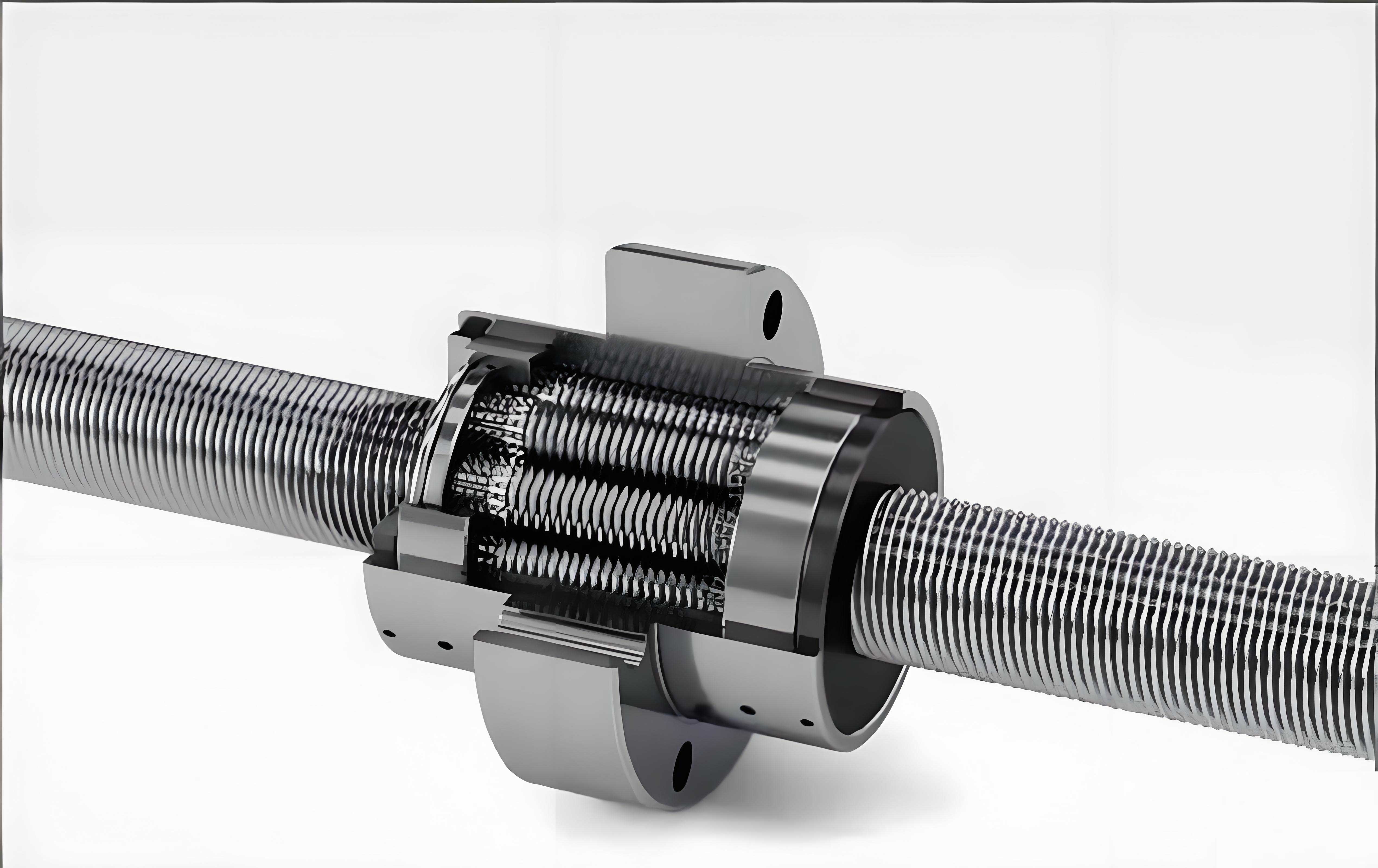
First, I derived and established a meshing model for the planetary roller screw assembly that encompasses the geometric characteristics and assembly relationships of the screw, roller, and nut helical surfaces. This model is capable of calculating contact positions, axial clearance, and their distribution. The fundamental geometry of a standard planetary roller screw assembly involves multiple rollers arranged around a central screw, engaging with an outer nut. The helical surfaces can be defined parametrically. For a right-handed screw, the surface coordinates can be expressed as:
$$
\begin{aligned}
x_s(u, \theta) &= R_s \cos(\theta + \phi_s(u)) \\
y_s(u, \theta) &= R_s \sin(\theta + \phi_s(u)) \\
z_s(u, \theta) &= P_s \cdot \frac{\theta}{2\pi} + u
\end{aligned}
$$
where \( R_s \) is the screw pitch radius, \( P_s \) is the screw lead, \( \theta \) is the rotation parameter, \( u \) is an axial parameter, and \( \phi_s(u) \) represents a possible phase variation. Similar equations apply for the roller and nut surfaces, with their respective radii and leads. The meshing condition requires that at any contact point, the surfaces share a common normal vector, and the relative velocity lies in the tangent plane. This leads to the meshing equation:
$$
(\mathbf{v}_{sr}^{(12)} \cdot \mathbf{n}) = 0
$$
where \( \mathbf{v}_{sr}^{(12)} \) is the relative velocity between screw and roller, and \( \mathbf{n} \) is the common unit normal. Solving these equations simultaneously for all engaging pairs yields the contact loci and the nominal axial clearance, which is crucial for backlash and stiffness assessment.
Second, I developed a computational method to determine the contact position and clearance for thread teeth in any arbitrary direction. This method is essential for analyzing the effects of manufacturing and assembly errors. The influence of thread profile error, thread start error (also known as index error), and component tilt (misalignment) on the meshing characteristics of the planetary roller screw assembly was systematically analyzed. For instance, a profile error \( \delta_p \) modifies the effective thread flank geometry, altering the contact pressure angle. A thread start error \( \Delta \psi \) among multiple starts causes uneven load distribution. A tilt error \( \alpha \) of a roller relative to the screw axis introduces skew contact. The table below summarizes these error types and their primary effects on meshing.
| Error Type | Symbol | Typical Source | Primary Effect on Meshing |
|---|---|---|---|
| Thread Profile Error | \( \delta_p \) | Manufacturing inaccuracy | Alters contact stress distribution, may cause edge loading. |
| Thread Start Error | \( \Delta \psi_i \) | Indexing error during threading | Causes uneven load sharing among threads, reducing fatigue life. |
| Component Tilt (Roller/Screw) | \( \alpha, \beta \) | Assembly misalignment, bearing clearance | Introduces skew contact, increases wear, affects smoothness. |
The generalized contact point calculation for an erroneous configuration involves modifying the ideal surface equations with error terms. For example, a profile error can be modeled as a radial deviation \( \Delta R(\theta, z) \) from the nominal surface. The contact condition then becomes a root-finding problem for the modified surfaces. I implemented numerical algorithms to solve for contact points under various error combinations, providing insights into clearance variations and potential jamming.
Third, I established a kinematic model for the planetary roller screw assembly that considers component eccentricity, position errors, and thread start errors. The kinematic relationship between the input rotation (typically of the screw) and the output translation (of the nut or screw, depending on configuration) is fundamental. In an ideal planetary roller screw assembly with \( n \) rollers, the transmission ratio is given by:
$$
\frac{V_{axial}}{\omega_{screw}} = \frac{P_s}{2\pi} \cdot \left(1 + \frac{P_r}{P_s} \cdot \frac{R_s}{R_r}\right)^{-1}
$$
where \( V_{axial} \) is the nut axial velocity, \( \omega_{screw} \) is the screw angular velocity, \( P_s \) and \( P_r \) are the screw and roller leads, and \( R_s \) and \( R_r \) are the pitch radii. However, errors perturb this ideal motion. Eccentricity errors \( e_s, e_r, e_n \) for the screw, roller, and nut respectively introduce periodic fluctuations in the output displacement. Position errors (e.g., radial runout of roller pockets) cause additional kinematic variations. Thread start errors lead to non-uniform engagement phases among rollers, resulting in composite error motions. The overall output error \( \Delta x(t) \) can be expressed as a superposition:
$$
\Delta x(t) = \sum_{i=1}^{n} A_i \cos(\omega_i t + \phi_i) + B_j \cos(\omega_s t / k + \psi_j)
$$
where \( A_i, \phi_i \) are amplitudes and phases related to roller-specific errors, \( \omega_i \) are frequencies related to roller orbit and rotation, \( B_j, \psi_j \) are amplitudes and phases from screw-related errors, \( \omega_s \) is the screw angular frequency, and \( k \) is a kinematic factor. I studied the influence patterns of these errors through parametric simulations, revealing that eccentricity errors often dominate the low-frequency error spectrum, while thread start errors contribute to higher-order harmonics.
Fourth, I derived a rigid-body dynamic model for the planetary roller screw assembly that incorporates six degrees of freedom for each moving part: three translational and three rotational. The model accounts for inertial forces, contact forces between components, friction at the thread engagements and roller ends, and external loads. The equations of motion are formulated using Lagrange’s method or Newton-Euler approach. For a system with \( N \) bodies (screw, n rollers, nut), the generalized coordinates vector \( \mathbf{q} \) has \( 6N \) elements. The kinetic energy \( T \) and potential energy \( V \) (from elastic contact deformations) are expressed, and the Lagrangian \( L = T – V \) is formed. Non-conservative forces from friction \( Q_{fric} \) and external loads \( Q_{ext} \) are included via the generalized force vector. The resulting equations are:
$$
\frac{d}{dt}\left(\frac{\partial L}{\partial \dot{\mathbf{q}}}\right) – \frac{\partial L}{\partial \mathbf{q}} = \mathbf{Q}_{fric} + \mathbf{Q}_{ext}
$$
The contact forces are modeled using nonlinear spring-damper elements based on Hertzian contact theory for the thread interfaces. Friction at the helical interfaces is critical and modeled using a modified Coulomb law that includes Stribeck effects for low velocities. The friction torque \( T_f \) on a roller due to screw-roller and roller-nut contacts is approximated by:
$$
T_f = \mu \cdot F_n \cdot r_m \cdot \text{sign}(\omega_{rel}) + f_v \cdot \omega_{rel}
$$
where \( \mu \) is the friction coefficient, \( F_n \) is the normal contact force, \( r_m \) is the mean friction radius, \( \omega_{rel} \) is the relative angular speed, and \( f_v \) is a viscous friction coefficient. I investigated the influence patterns of friction coefficient, operating conditions (load, speed), and structural parameters (lead, number of rollers, pitch diameter) on the dynamic characteristics of the planetary roller screw assembly, such as natural frequencies, vibration modes, transmission efficiency, and dynamic response to fluctuating loads. The table below shows a sample parametric study on the effect of key parameters on the first axial natural frequency and efficiency.
| Parameter | Baseline Value | Variation | Effect on 1st Nat. Freq. (Axial) | Effect on Efficiency |
|---|---|---|---|---|
| Number of Rollers, \( n \) | 6 | Increase to 10 | Increases (~15%) | Slight increase (~2%) |
| Screw Lead, \( P_s \) | 5 mm | Increase to 10 mm | Decreases (~20%) | Decreases (~8%) |
| Friction Coeff., \( \mu \) | 0.05 | Increase to 0.10 | Negligible change | Significant decrease (~15%) |
| Axial Preload, \( F_{pre} \) | 100 N | Increase to 500 N | Increases (~30%) | Slight decrease (~3%) |
Fifth, I independently designed and constructed a comprehensive performance test bench for the planetary roller screw assembly. The test bench is capable of measuring no-load transmission accuracy, efficiency, and retainer (cage) rotational speed under various operating conditions. The main components include a servo motor drive system, torque and speed sensors, high-precision linear encoders for axial displacement measurement, load application unit (using a programmable brake or secondary actuator), and a data acquisition system. The planetary roller screw assembly specimen is mounted with appropriate fixtures, and alignment is carefully adjusted to minimize extrinsic errors. Tests were conducted on fabricated prototype planetary roller screw assemblies.
The no-load transmission accuracy test involves driving the screw at a constant low speed and measuring the nut’s axial position with a high-resolution encoder. The positional error over one or more strokes is recorded. The plot of error versus displacement reveals periodic components corresponding to various error sources. The transmission efficiency is measured by comparing input mechanical power (from torque and speed of the motor) to output mechanical power (from axial force and velocity of the nut). The efficiency \( \eta \) is calculated as:
$$
\eta = \frac{F_{out} \cdot V_{out}}{T_{in} \cdot \omega_{in}} \times 100\%
$$
where \( F_{out} \) is the output axial force, \( V_{out} \) is the output axial velocity, \( T_{in} \) is the input torque, and \( \omega_{in} \) is the input angular speed. Measurements are taken at different loads and speeds to map the efficiency characteristics. The retainer speed is measured using a non-contact tachometer, and its relationship with the screw speed provides a check on the internal kinematics and potential slippage.
The experimental results validated the theoretical kinematic and dynamic models. For instance, the measured transmission error spectrum matched well with predictions from the kinematic model incorporating measured eccentricity and thread start errors. The dynamic model’s predictions of natural frequencies were within 8% of experimental modal test results (using impact hammer testing). The efficiency trends with respect to load and speed aligned with simulations that included realistic friction models. These validations confirm the robustness and applicability of the developed models for the design and analysis of planetary roller screw assemblies.
In conclusion, my research provides a comprehensive framework for analyzing the meshing and kinematic characteristics of planetary roller screw assemblies. The developed helical surface-based meshing model offers a more accurate representation than previous curve-based models. The inclusion of various manufacturing and assembly errors in both meshing and kinematic analyses reflects real-world conditions, enabling designers to predict performance and specify tolerances more effectively. The six-degree-of-freedom dynamic model captures essential rigid-body behaviors, facilitating the study of vibration and dynamic response. The experimental test bench and validation work bridge the gap between theory and practice. This systematic investigation addresses key gaps in the understanding of planetary roller screw assemblies and paves the way for their optimized design and reliable application in high-performance electromechanical servo systems.
Future work could extend these models to include thermo-elastic effects, detailed elastohydrodynamic lubrication analysis at the contacts, and fatigue life prediction based on dynamic load spectra. Additionally, the application of advanced materials, such as composites or high-strength alloys, in planetary roller screw assemblies could be explored using the foundational models established here. The continuous improvement of the planetary roller screw assembly will undoubtedly contribute to the advancement of precision motion control across aerospace, robotics, automotive, and industrial automation fields.