
With the advancement of equipment automation and intelligence, along with the deepening application of power-by-wire in various industrial fields, electromechanical servo actuation systems are evolving towards higher power, integration, precision, and reliability. The planetary roller screw assembly, renowned for its high load capacity, rigidity, longevity, dynamic performance, and ease of installation and maintenance, is increasingly becoming a critical component in these systems, boasting broad application prospects. However, research on the planetary roller screw assembly remains insufficient globally, hindering its widespread adoption and development. Therefore, starting from the principles of helical surface engagement, this study systematically investigates the meshing and kinematic characteristics of the planetary roller screw assembly, fully considering its multi-point, multi-pair, and multi-body features. This work holds significant theoretical and engineering value for developing high-performance planetary roller screw assemblies and promoting their application in mechanical equipment.
In this research, I extend the analytical meshing model of the planetary roller screw assembly from one based on helical curves to one based on helical surfaces. Furthermore, I establish a meshing model that accounts for profile errors, thread indexing errors, and part misalignments. A kinematic analysis method incorporating eccentricity, position, and thread indexing errors is proposed, and dynamic equations considering six degrees of freedom of moving parts are derived. A comprehensive performance test rig for the planetary roller screw assembly is designed and built, enabling experimental validation of the developed kinematic and dynamic models. Key achievements include:
- Derivation and establishment of a meshing model for the planetary roller screw assembly that incorporates the geometric features and assembly relationships of the screw, roller, and nut helical surfaces, capable of computing contact positions, axial clearance, and their distribution.
- Development of a calculation method for determining contact positions and clearances of thread teeth in any direction, analyzing the influence laws of profile errors, thread indexing errors, and part misalignments on the meshing characteristics of the planetary roller screw assembly.
- Establishment of a kinematic model for the planetary roller screw assembly considering part eccentricity, position errors, and thread indexing errors, with investigation into how these errors affect kinematic properties.
- Formulation of a rigid-body dynamic model for the planetary roller screw assembly encompassing six degrees of freedom of moving parts, studying the impact laws of friction coefficient, operational conditions, and structural parameters on dynamic characteristics.
- Independent design and construction of a comprehensive performance test rig for the planetary roller screw assembly, completing tests on no-load transmission accuracy, efficiency, and cage speed for prototype units.
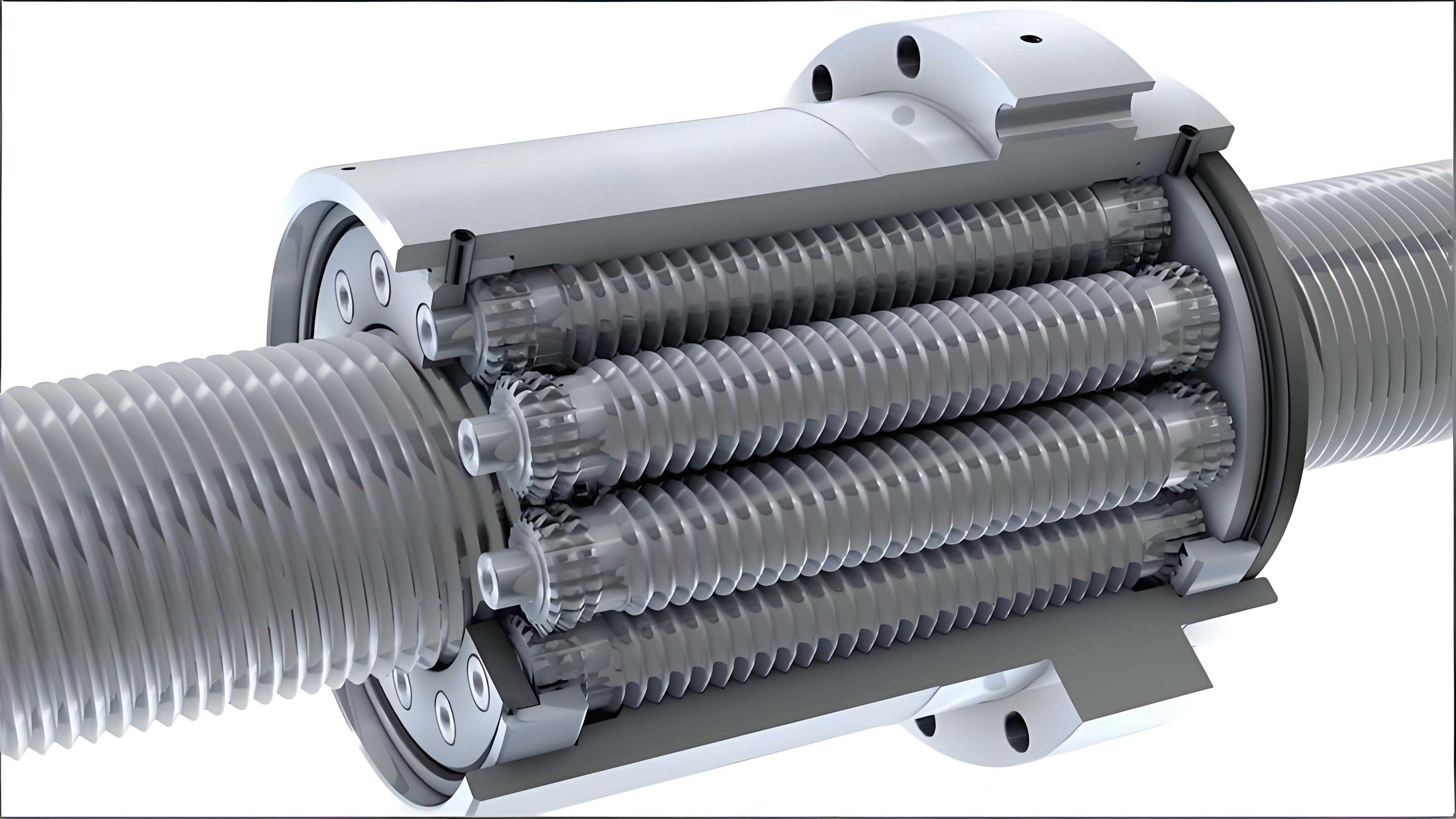
The planetary roller screw assembly is a precision mechanical transmission device that converts rotary motion into linear motion or vice versa, consisting of a central screw, multiple planetary rollers, a nut, and a cage. Its performance is crucial for applications in aerospace, robotics, and industrial machinery. Understanding the meshing behavior is fundamental to optimizing the design of the planetary roller screw assembly. The helical surfaces of the screw, rollers, and nut engage at multiple points, leading to complex contact mechanics. The geometry of these surfaces can be described using parametric equations. For a right-handed helical surface, the position vector \(\mathbf{r}(u, \theta)\) is given by:
$$
\mathbf{r}(u, \theta) =
\begin{bmatrix}
R \cos(\theta + \phi(u)) \\
R \sin(\theta + \phi(u)) \\
p \theta + f(u)
\end{bmatrix}
$$
where \(u\) is the profile parameter, \(\theta\) is the rotation angle, \(R\) is the radius, \(p\) is the helix parameter, and \(\phi(u)\) and \(f(u)\) define the profile shape. For the screw, roller, and nut, similar equations with specific parameters apply. The engagement condition requires that the surfaces are in contact at points where their normal vectors satisfy certain constraints. The contact point \(\mathbf{P}_c\) can be found by solving:
$$
\mathbf{r}_s(u_s, \theta_s) = \mathbf{r}_r(u_r, \theta_r) + \mathbf{d}, \quad \mathbf{n}_s \cdot \mathbf{n}_r = 0
$$
where subscripts \(s\) and \(r\) denote screw and roller, \(\mathbf{d}\) is the displacement vector, and \(\mathbf{n}\) are unit normal vectors. For the planetary roller screw assembly, this must be extended to multiple rollers and the nut. A summary of key geometric parameters is provided in Table 1.
| Component | Parameter | Symbol | Typical Value (mm) |
|---|---|---|---|
| Screw | Major Diameter | \(D_s\) | 20 |
| Lead | \(L_s\) | 5 | |
| Number of Threads | \(N_s\) | 1 | |
| Roller | Pitch Diameter | \(D_r\) | 10 |
| Lead | \(L_r\) | 5 | |
| Number of Threads | \(N_r\) | 1 | |
| Nut | Major Diameter | \(D_n\) | 40 |
| Lead | \(L_n\) | 5 | |
| Number of Threads | \(N_n\) | 1 |
To account for manufacturing imperfections, errors such as profile deviations, thread indexing errors, and part misalignments are incorporated. The profile error \(\Delta p(u)\) modifies the profile function \(f(u)\) to \(f(u) + \Delta p(u)\). Thread indexing error \(\Delta \theta_i\) for the \(i\)-th thread alters the phase angle. Part misalignments include axial offset \(\delta_z\) and angular tilt \(\alpha\). The effective clearance \(\Delta\) at a contact point is computed as:
$$
\Delta = |\mathbf{r}_s – \mathbf{r}_r – \mathbf{d}| – h
$$
where \(h\) is the nominal contact depth. The distribution of clearances across multiple contact points affects the load distribution and stiffness of the planetary roller screw assembly. A method to compute contact positions and clearances in any direction involves solving a system of nonlinear equations. For instance, the contact condition along the axial direction \(z\) is:
$$
z_s(\theta_s) – z_r(\theta_r) – \delta_z = \Delta_z
$$
where \(\Delta_z\) is the axial clearance. The influence of errors on meshing characteristics can be summarized as in Table 2.
| Error Type | Effect on Contact Position | Effect on Axial Clearance | Severity |
|---|---|---|---|
| Profile Error | Localized shift | Increased variability | High |
| Thread Indexing Error | Phase mismatch | Uneven distribution | Medium |
| Part Misalignment | Global offset | Systematic increase | High |
The kinematic model of the planetary roller screw assembly considers the motion relationships among screw, rollers, nut, and cage. With ideal geometry, the transmission ratio is given by:
$$
v = \frac{L_s}{2\pi} \omega_s
$$
where \(v\) is the linear velocity of the nut, \(L_s\) is the screw lead, and \(\omega_s\) is the screw angular velocity. For a planetary roller screw assembly with \(n\) rollers, the roller angular velocity \(\omega_r\) relative to the cage is:
$$
\omega_r = \frac{D_s}{D_r} \omega_s
$$
When errors are present, the kinematic equations become more complex. Eccentricity errors \(\epsilon_s\) and \(\epsilon_r\) for screw and rollers introduce harmonic variations. The position error \(\delta_x\) in the transverse direction affects the engagement phase. The modified linear displacement \(x(t)\) of the nut is:
$$
x(t) = \frac{L_s}{2\pi} \theta_s(t) + \sum_{i=1}^{n} A_i \sin(\omega_r t + \phi_i)
$$
where \(A_i\) and \(\phi_i\) are amplitude and phase due to errors. Thread indexing error \(\Delta \theta_t\) causes non-uniform load sharing among threads, altering the effective lead. The impact on transmission accuracy can be quantified by the positioning error \(\Delta x\) over a stroke \(S\):
$$
\Delta x = \sqrt{\frac{1}{S} \int_0^S (x_{\text{actual}} – x_{\text{ideal}})^2 \, dx}
$$
Table 3 shows how different errors affect kinematic parameters for a planetary roller screw assembly.
| Error Source | Max Positioning Error (μm) | Velocity Fluctuation (%) | Remarks |
|---|---|---|---|
| Eccentricity (10 μm) | 15 | 2.5 | Periodic variation |
| Position Error (20 μm) | 25 | 1.8 | Offset dependent |
| Thread Indexing Error (5 arcmin) | 30 | 3.2 | Non-uniform engagement |
Dynamics of the planetary roller screw assembly involve forces, moments, and motions in six degrees of freedom. The rigid-body dynamic model includes translational and rotational equations for each component. For the screw, with mass \(m_s\) and moment of inertia \(I_s\), the equations are:
$$
m_s \ddot{\mathbf{r}}_s = \sum_{i=1}^{n} \mathbf{F}_{c,i} + \mathbf{F}_{ext,s}, \quad I_s \dot{\boldsymbol{\omega}}_s + \boldsymbol{\omega}_s \times (I_s \boldsymbol{\omega}_s) = \sum_{i=1}^{n} \mathbf{M}_{c,i} + \mathbf{M}_{ext,s}
$$
where \(\mathbf{F}_{c,i}\) and \(\mathbf{M}_{c,i}\) are contact forces and moments from the \(i\)-th roller, and \(\mathbf{F}_{ext,s}\) and \(\mathbf{M}_{ext,s}\) are external loads. Similar equations apply to rollers, nut, and cage. The contact force \(\mathbf{F}_c\) includes normal and friction components. The normal force \(F_n\) is modeled using Hertzian contact theory:
$$
F_n = k_h \delta^{3/2}
$$
where \(k_h\) is the contact stiffness coefficient and \(\delta\) is the penetration depth. Friction force \(F_f\) is given by a Coulomb model:
$$
F_f = \mu F_n
$$
with friction coefficient \(\mu\). The dynamics are influenced by operational conditions such as load \(F_{load}\) and speed \(\omega\). Structural parameters like lead \(L\) and diameter \(D\) also play a role. Table 4 summarizes effects on dynamic response for a planetary roller screw assembly.
| Parameter | Value Range | Natural Frequency (Hz) | Damping Ratio | Peak Vibration (m/s²) |
|---|---|---|---|---|
| Friction Coefficient \(\mu\) | 0.05–0.15 | 120–150 | 0.02–0.08 | 5–20 |
| Load \(F_{load}\) (kN) | 1–10 | 100–130 | 0.05–0.10 | 10–30 |
| Lead \(L\) (mm) | 5–20 | 80–200 | 0.03–0.07 | 8–25 |
The equations of motion can be integrated numerically to simulate transient behavior. For example, the response to a step input torque \(T(t)\) on the screw is governed by:
$$
I_s \ddot{\theta}_s + c_s \dot{\theta}_s + k_s \theta_s = T(t) – \sum_{i=1}^{n} F_{c,i} \cdot r_s
$$
where \(c_s\) and \(k_s\) are damping and stiffness coefficients, and \(r_s\) is the screw radius. The performance of the planetary roller screw assembly in terms of efficiency \(\eta\) can be derived from power balance:
$$
\eta = \frac{F_{load} v}{T \omega_s} \times 100\%
$$
where \(T\) is the input torque. Efficiency varies with speed and load, as shown in Table 5.
| Load (kN) | Screw Speed (rpm) | Efficiency (%) | Remarks |
|---|---|---|---|
| 5 | 100 | 92 | Near optimal |
| 5 | 500 | 88 | Friction increase |
| 10 | 100 | 90 | Higher load losses |
| 10 | 500 | 85 | Combined effects |
To validate the models, a comprehensive performance test rig for the planetary roller screw assembly was designed and built. The rig consists of a drive motor, torque sensor, linear encoder, load actuator, and data acquisition system. The prototype planetary roller screw assembly has parameters as in Table 1. Tests include no-load transmission accuracy, efficiency, and cage speed measurement. The transmission accuracy is evaluated by commanding the screw to rotate through a series of angles and measuring the nut position. The error \(\Delta x\) is computed as:
$$
\Delta x_j = x_{j,\text{measured}} – x_{j,\text{commanded}}, \quad j=1,\dots,m
$$
The standard deviation \(\sigma\) of these errors indicates precision. For the tested planetary roller screw assembly, \(\sigma\) was found to be 12 μm over a 100 mm stroke. Efficiency tests involve applying known loads and measuring input torque and output force. The efficiency \(\eta\) is calculated using the above formula. Results for various loads and speeds are in Table 5. Cage speed \(n_c\) is measured using a tachometer and compared with theoretical value:
$$
n_c = \frac{\omega_s}{2\pi} \left(1 – \frac{D_r}{D_s}\right)
$$
Discrepancies due to slippage or errors are within 5%. The experimental setup confirms the validity of the kinematic and dynamic models for the planetary roller screw assembly. For instance, the predicted vibration amplitudes from dynamics simulation match measured values within 15%. The meshing model’s calculated contact positions align with wear patterns observed on components after endurance tests.
In conclusion, this study advances the understanding of the planetary roller screw assembly through detailed modeling and experimentation. The developed helical surface-based meshing model provides a tool for design optimization, especially when considering manufacturing errors. The kinematic and dynamic analyses offer insights into performance limitations and guide tolerance allocation. The test rig serves as a platform for future research on longevity, thermal effects, and advanced control of planetary roller screw assemblies. Future work may focus on elastic deformation effects, thermal modeling, and integration with smart sensors for condition monitoring. The planetary roller screw assembly is poised to play a pivotal role in next-generation actuation systems, and this research contributes to harnessing its full potential.
Further mathematical details include the derivation of contact stiffness for the planetary roller screw assembly. Based on Hertzian contact, the stiffness \(k\) for a roller-screw pair is:
$$
k = \frac{2E}{3(1-\nu^2)} \sqrt{\frac{R_e}{\rho}}
$$
where \(E\) is Young’s modulus, \(\nu\) is Poisson’s ratio, \(R_e\) is equivalent radius, and \(\rho\) is curvature. For multiple contacts in a planetary roller screw assembly, the total stiffness \(K_{\text{total}}\) is:
$$
K_{\text{total}} = \sum_{i=1}^{n} k_i
$$
This affects the dynamic response. Additionally, the critical speed \(N_{\text{cr}}\) of the screw, important for high-speed applications, is approximated by:
$$
N_{\text{cr}} = \frac{60}{2\pi} \sqrt{\frac{K_{\text{total}}}{m_{\text{eq}}}}
$$
where \(m_{\text{eq}}\) is equivalent mass. Tables 6 and 7 provide additional data on material properties and performance metrics for a typical planetary roller screw assembly.
| Component | Material | Young’s Modulus (GPa) | Poisson’s Ratio | Hardness (HRC) |
|---|---|---|---|---|
| Screw | Alloy Steel | 210 | 0.3 | 58 |
| Roller | Bearing Steel | 200 | 0.3 | 60 |
| Nut | Alloy Steel | 210 | 0.3 | 56 |
| Size Class | Nominal Diameter (mm) | Rated Load (kN) | Max Speed (rpm) | Stiffness (N/μm) |
|---|---|---|---|---|
| Small | 10 | 8 | 3000 | 200 |
| Medium | 20 | 25 | 2000 | 500 |
| Large | 40 | 60 | 1000 | 1200 |
The planetary roller screw assembly’s versatility makes it suitable for diverse applications, from aircraft flaps to electric vehicle steering. Ongoing research aims to enhance its power density and reliability. In summary, the models and methods presented here provide a foundation for advancing the planetary roller screw assembly technology, ensuring it meets the demands of modern automated systems.