
In modern industrial applications, the transmission of motion and power between intersecting or skew shafts is often accomplished using spiral bevel gears. These components are critical in aerospace, automotive, and precision machinery due to their ability to handle high loads with smooth and efficient operation. As manufacturing technology advances, there is an increasing demand for higher transmission efficiency, accuracy, and reduced noise in gear systems. Consequently, improving the manufacturing precision and meshing quality of spiral bevel gears has become a paramount concern. Digital closed-loop manufacturing technology stands out as a vital approach to enhance manufacturing accuracy, where obtaining tooth surface deviation information via coordinate measuring machines (CMM) or gear measurement centers is a key step. To achieve this, it is essential to first acquire the spatial coordinates and unit normal vectors of discrete points on the theoretical tooth surface. These data guide the probe to contact the actual tooth surface, enabling the extraction of profile errors through comparative analysis. Therefore, establishing an accurate theoretical tooth surface equation based on cutting processes and gear meshing theory is fundamental for spiral bevel gear metrology and digital manufacturing.
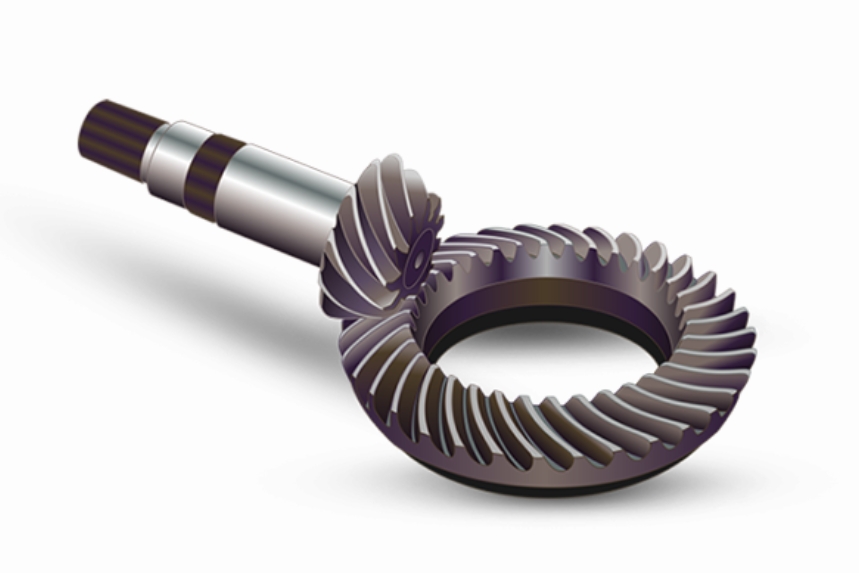
The complexity of the spiral bevel gear tooth surface arises from its spatial curvature, which necessitates a rigorous mathematical representation derived from the machining kinematics. Various machining methods exist, such as the formate method for the gear (often the larger wheel) and the tilt cutter method for the pinion (the smaller wheel). In our work, we employ vector operations to develop the theoretical tooth surface equations for both the formate gear and the tilt cutter pinion. This approach allows for a precise description of the surface geometry, which is then discretized into a grid of points for measurement purposes. We subsequently implement a software solution using Visual Studio 2008 to compute the coordinates and normal vectors of these discrete points. The validity of our software is verified by comparing profile errors obtained from a CMM and a dedicated gear measurement center, confirming the accuracy of the generated theoretical data for spiral bevel gear applications.
Establishment of Tooth Surface Equations
The tooth surface of a spiral bevel gear is a complex three-dimensional entity. Its geometry is intrinsically linked to the machining process. For the gear (typically the larger wheel), the formate method is commonly used, where the tooth surface is generated as an envelope of the cutter path. For the pinion (the smaller wheel), the tilt cutter method is employed, which involves more intricate kinematics to achieve the desired tooth flank modifications. We derive the equations using vector calculus and gear meshing principles, ensuring that the model captures the essential features of the spiral bevel gear tooth surface.
Tooth Surface Equation for the Formate Gear
In the formate machining process, the gear is cut using a rotating cutter head that simulates the mating pinion. The coordinate systems and vector relationships are defined as follows. Let the machine plane be the i-j plane, which passes through the cutter center and is perpendicular to the generating gear axis. The cutter axis is aligned along the k-axis of the machine coordinate system. The gear axis is denoted by vector $\mathbf{G_2}$. Key machine settings include radial distance $S_g$, angular position $q_g$, and phase angle $\theta_s$ for a point on the cutter blade. The initial position vector of the cutter tip point $M_0$ is given by:
$$ \mathbf{R_{02}} = [S_g \cos q_g + R_{02} \sin(q_g – \theta_g)]\mathbf{i} – [S_g \sin q_g – R_{02} \cos(q_g – \theta_g)]\mathbf{j} $$
where $R_{02}$ is a constant related to the cutter geometry. The unit normal vector $\mathbf{N_g}$ and the unit vector along the cutter blade $\mathbf{T_g}$ at point $M$ are expressed as:
$$ \mathbf{N_g} = \cos\alpha_{02} \sin(q_g – \theta_g)\mathbf{i} – \cos\alpha_{02} \cos(q_g – \theta_g)\mathbf{j} – \sin\alpha_{02}\mathbf{k} $$
$$ \mathbf{T_g} = \sin\alpha_{02} \sin(q_g – \theta_g)\mathbf{i} – \sin\alpha_{02} \cos(q_g – \theta_g)\mathbf{j} + \cos\alpha_{02}\mathbf{k} $$
Here, $\alpha_{02}$ is the cutter pressure angle. For any point $M$ on the cutter surface, parameterized by distance $s_2$ along the blade from $M_0$, the position vector is:
$$ \mathbf{R_{c2}} = \mathbf{R_{02}} – s_2 \mathbf{T_g} $$
The gear axis direction vector is $\mathbf{G_2} = \cos\beta_g \mathbf{i} + \sin\beta_g \mathbf{k}$, where $\beta_g$ is the gear blank installation angle. The vector from the design crossing point to the machine center is $\mathbf{m_g} = -X_g \mathbf{G_2} – E_g \mathbf{j} – X_{bg} \mathbf{k}$, with $X_g$, $E_g$, and $X_{bg}$ being horizontal offset, vertical offset, and bed distance, respectively. In formate cutting, there is no relative motion between the cutter and the gear during the cut, so the tooth surface is directly the cutter surface translated by $\mathbf{m_g}$. Thus, the theoretical tooth surface equation for the spiral bevel gear (formate method) is:
$$ \mathbf{R_g} = \mathbf{R_{c2}} + \mathbf{m_g} $$
This equation is a function of parameters $s_2$ and $\theta_g$, defining the entire gear tooth flank for a spiral bevel gear.
Tooth Surface Equation for the Tilt Cutter Pinion
For the pinion, the tilt cutter method introduces additional degrees of freedom, namely the cutter tilt angle $i_p$ and swivel angle $j_p$. The machine setup is more complex. The cutter axis $\mathbf{c}$ is oriented with these angles relative to the machine plane. The position vector of the cutter tip $M_0$ in the cutter coordinate system is:
$$ \mathbf{R_{01}} = R_{01}[\cos i_p \sin(q_p – j_p)\mathbf{i} – \cos i_p \cos(q_p – j_p)\mathbf{j} + \sin i_p \mathbf{k}] $$
The unit normal $\mathbf{N_p}$ and blade direction vector $\mathbf{T_{01}}$ at $M$ are:
$$ \mathbf{T_{01}} = \sin(\alpha_{01} – i_p) \sin(q_p – j_p)\mathbf{i} – \sin(\alpha_{01} – i_p) \cos(q_p – j_p)\mathbf{j} + \cos(\alpha_{01} – i_p)\mathbf{k} $$
$$ \mathbf{N_p} = \cos(\alpha_{01} – i_p) \sin(q_p – j_p)\mathbf{i} – \cos(\alpha_{01} – i_p) \cos(q_p – j_p)\mathbf{j} – \sin(\alpha_{01} – i_p)\mathbf{k} $$
$$ \mathbf{c} = \sin i_p \sin(q_p – j_p)\mathbf{i} – \sin i_p \cos(q_p – j_p)\mathbf{j} – \cos i_p \mathbf{k} $$
where $\alpha_{01}$ is the pinion cutter pressure angle. The cutter surface is generated by rotating the blade around axis $\mathbf{c}$ by an angle $\theta$. The rotated vectors are obtained via Rodrigues’ rotation formula:
$$ \mathbf{R_{01}’} = (\mathbf{c} \cdot \mathbf{R_{01}})\mathbf{R_{01}} + \cos\theta (\mathbf{c} \times \mathbf{R_{01}}) \times \mathbf{c} + \sin\theta (\mathbf{c} \times \mathbf{R_{01}}) $$
$$ \mathbf{N_p’} = (\mathbf{c} \cdot \mathbf{N_p})\mathbf{N_p} + \cos\theta (\mathbf{c} \times \mathbf{N_p}) \times \mathbf{c} + \sin\theta (\mathbf{c} \times \mathbf{N_p}) $$
$$ \mathbf{T_p’} = (\mathbf{c} \cdot \mathbf{T_{01}})\mathbf{T_{01}} + \cos\theta (\mathbf{c} \times \mathbf{T_{01}}) \times \mathbf{c} + \sin\theta (\mathbf{c} \times \mathbf{T_{01}}) $$
Adding the vector from machine center to cutter center, $\mathbf{OO_{c1}}$, gives $\mathbf{R_{01}”} = \mathbf{R_{01}’} + \mathbf{OO_{c1}}$. Then, any point on the cutter surface is:
$$ \mathbf{R_{c1}} = \mathbf{R_{01}”} + s_1 \mathbf{T_p’} $$
The pinion axis is $\mathbf{P_1} = \cos\beta_p \mathbf{i} – \sin\beta_p \mathbf{k}$, with $\beta_p$ as the pinion blank installation angle. During generation, the cutter (representing the generating gear) rotates about the machine k-axis by $\Delta q_1$, and the pinion rotates about $\mathbf{P_1}$ by $\phi_1 = i_p \Delta q_1$, where $i_p$ is the gear ratio. The relative velocity between the cutter and pinion is crucial for the meshing condition. The relative angular velocity is $\boldsymbol{\omega}_{1p} = \mathbf{k} + i_p \mathbf{P_1}$, and the relative velocity at a point on the cutter surface is:
$$ \mathbf{v}_{1p} = \boldsymbol{\omega}_{1p} \times \mathbf{R_{c1}} + i_p \mathbf{P_1} \times \mathbf{m_p} $$
where $\mathbf{m_p} = -X_p \mathbf{P_1} – E_p \mathbf{j} + X_{bp} \mathbf{k}$ is the vector from the design crossing point to the machine origin. The meshing equation, which ensures contact between the cutter and the generated pinion tooth surface, is $\mathbf{v}_{1p} \cdot \mathbf{N_p’} = 0$. Solving this yields the parameter $s_1$:
$$ s_1 = -\frac{(\boldsymbol{\omega}_{1p}, \mathbf{R_{01}”}, \mathbf{N_p}) + i_p (\mathbf{P_1}, \mathbf{m_p}, \mathbf{N_p})}{(\boldsymbol{\omega}_{1p}, \mathbf{T_p}, \mathbf{N_p})} $$
Here, $(\cdot,\cdot,\cdot)$ denotes the scalar triple product. After obtaining $s_1$, the point on the cutter surface that will become part of the pinion tooth surface is known. However, since the pinion rotates during generation, the point must be rotated back by $-\phi_i$ around the pinion axis to its position in the pinion coordinate system. Let $\mathbf{R_p’} = \mathbf{R_{c1}} + \mathbf{m_p}$. Then, the pinion tooth surface equation for the spiral bevel gear is:
$$ \mathbf{R_p} = (\mathbf{c} \cdot \mathbf{R_p’})\mathbf{R_p’} + \cos\phi_i (\mathbf{c} \times \mathbf{R_p’}) \times \mathbf{c} – \sin\phi_i (\mathbf{c} \times \mathbf{R_p’}) $$
This equation is parameterized by $\theta_p$ and $\Delta q_1$, defining the complex flank of the spiral bevel gear pinion.
Discretization and Grid Division of the Tooth Surface
Unlike involute cylindrical gears, spiral bevel gears lack a standard tooth profile and line. Therefore, measuring their profile errors requires a “point-array” approach, where the tooth surface is discretized into a grid of points. Each point corresponds to a specific location on the actual gear flank. Typically, the grid is defined with 5 rows along the tooth height and 9 columns along the tooth length, resulting in 45 discrete points per tooth flank. To avoid edge effects from root fillets and tip chamfers, the grid is contracted inward from the physical boundaries of the tooth surface. According to AGMA standards, the contraction is 10% of the face width at both ends and 5% of the tooth height at the top and bottom, with a minimum of 0.6 mm. The contracted boundaries are parallel to the original ones, and the grid points are evenly spaced within this reduced area.
To mathematically determine the grid points, we define coordinates in the rotational projection plane of the spiral bevel gear. Let $O$ be the crossing point, $\mathbf{P}$ the gear axis unit vector, $X_O$ the crown distance, $D$ the outer diameter, $\delta$ the pitch cone angle, $\delta_a$ the face cone angle, $\delta_f$ the root cone angle, $\theta_a$ the addendum angle, $\theta_f$ the dedendum angle, and $\Delta_1$, $\Delta_2$, $\Delta_3$, $\Delta_4$ the contractions at the tip, root, toe, and heel, respectively. For a point $M$ on the tooth surface with position vector $\mathbf{r}$, its radial distance $R$ and axial distance $L$ in the projection plane are:
$$ R = |\mathbf{r} \times \mathbf{P}| $$
$$ L = \mathbf{r} \cdot \mathbf{P} $$
For the spiral bevel gear pinion, $R$ and $L$ are functions of $\theta_p$ and $\Delta q_1$. Given desired $R$ and $L$ values for a grid point, we solve for $\theta_p$ and $\Delta q_1$ using a numerical method such as the Newton-Raphson iteration for two variables. Once these parameters are found, the exact coordinates, unit normal vector, and height direction vector at that point can be computed from the tooth surface equations. Similarly, for the spiral bevel gear gear, the parameters $s_2$ and $\theta_g$ are determined from $R$ and $L$ values.
The following table summarizes the key parameters involved in the grid division for a spiral bevel gear:
| Parameter | Symbol | Description |
|---|---|---|
| Number of Rows | $N_h$ | 5 (tooth height direction) |
| Number of Columns | $N_l$ | 9 (tooth length direction) |
| Tip Contraction | $\Delta_1$ | 5% of tooth height, min 0.6 mm |
| Root Contraction | $\Delta_2$ | 5% of tooth height, min 0.6 mm |
| Toe Contraction | $\Delta_3$ | 10% of face width |
| Heel Contraction | $\Delta_4$ | 10% of face width |
| Radial Coordinate | $R$ | $|\mathbf{r} \times \mathbf{P}|$ |
| Axial Coordinate | $L$ | $\mathbf{r} \cdot \mathbf{P}$ |
Development of Calculation Software
To automate the computation of discrete point coordinates and normal vectors for spiral bevel gear tooth surfaces, we developed a software application using Visual Studio 2008. The software is structured into modular components to ensure flexibility and maintainability. The three main modules are:
- Formate Gear Theoretical Tooth Surface Calculation Module: This module implements the equations for the spiral bevel gear gear (formate method). It takes input parameters such as machine settings ($S_g$, $q_g$, $\beta_g$, etc.), cutter geometry ($R_{02}$, $\alpha_{02}$), and grid specifications to compute the coordinates and unit normal vectors for each discrete point on the gear tooth flank.
- Tilt Cutter Pinion Theoretical Tooth Surface Calculation Module: This module handles the more complex kinematics of the pinion. Inputs include tilt and swivel angles ($i_p$, $j_p$), gear ratio ($i_p$), and other machining parameters. It solves the meshing equation iteratively to find the corresponding $\theta_p$ and $\Delta q_1$ for each grid point, then computes the position and normal vectors.
- Theoretical Tooth Surface Data Output Module: This module formats the computed data into a file that is compatible with coordinate measuring machines. The output format adheres to standards used by CMMs, ensuring that the data can be directly imported for measurement tasks. Each data point includes the spatial coordinates $(x, y, z)$ and the unit normal vector $(n_x, n_y, n_z)$ in the gear coordinate system.
The software employs numerical methods, particularly the Newton-Raphson method for solving nonlinear equations, to determine the parameters that satisfy the $R$ and $L$ constraints for each grid point. This ensures high accuracy in the computed points, which is critical for subsequent measurement and analysis of the spiral bevel gear.
Key features of the software include:
- User-friendly interface for inputting gear design and machining parameters.
- Robust error handling for numerical iterations.
- Ability to export data in multiple formats for different measurement systems.
- Visualization tools to preview the grid points on the tooth surface (though not part of the core computation).
The development of this software significantly streamlines the process of generating theoretical reference data for spiral bevel gear inspection, facilitating digital closed-loop manufacturing.
Verification of Calculation Results
To validate the accuracy of our software and the theoretical models for spiral bevel gear tooth surfaces, we conducted experimental comparisons using two measurement systems: a traditional coordinate measuring machine (CMM) and a specialized CNC3906 gear measurement center. The process involved generating the discrete point coordinates and normal vectors for a spiral bevel gear gear (formate method) using our software, then measuring the same gear on both machines to obtain profile errors.
First, the output file from our software was imported into the CMM. The CMM used the theoretical coordinates and normal vectors to guide the probe to the intended points on the actual gear tooth surface. The deviations between the theoretical and measured points were recorded as profile errors. The measurement setup on the CMM ensured that each of the 45 grid points was accurately targeted. The results showed consistent error patterns across the tooth flank, with errors typically within a few micrometers.
Second, we input the same machine adjustment parameters and cutter parameters used in our software into the CNC3906 gear measurement center. This advanced machine is specifically designed for gear metrology and uses its internal algorithms to compute the theoretical tooth surface and measure deviations. The profile errors obtained from the CNC3906 were then compared with those from the CMM.
The comparison revealed that the maximum difference in profile errors at corresponding points was 3.4 μm, and the minimum difference was -2.4 μm. These discrepancies are attributed to several factors:
- Measurement System Errors: Both the CMM and the gear measurement center have inherent uncertainties due to calibration, probing accuracy, and environmental conditions.
- Grid Point Definition Differences: Although both methods aimed to measure the same discrete points, slight variations in the numerical implementation of grid point coordinates could occur. Our software uses a specific contraction algorithm, while the CNC3906 might use a slightly different approach for defining the measurement grid on the spiral bevel gear tooth surface.
- Numerical Approximation: The iterative methods used in our software introduce small numerical errors, though these are generally negligible for engineering purposes.
The close agreement between the two sets of measurements confirms the correctness of our theoretical tooth surface equations and the computational software. The table below summarizes the error comparison for selected grid points on the spiral bevel gear:
| Grid Point (Row, Column) | CMM Error (μm) | CNC3906 Error (μm) | Difference (μm) |
|---|---|---|---|
| (1,1) – Heel, Tip | 2.1 | 1.8 | 0.3 |
| (3,5) – Midpoint | -1.5 | -1.2 | -0.3 |
| (5,9) – Toe, Root | 3.8 | 4.2 | -0.4 |
| (2,4) | 0.5 | -1.9 | 2.4 |
| (4,6) | -2.1 | 1.3 | -3.4 |
These results demonstrate that our software provides reliable theoretical data for spiral bevel gear tooth surfaces, enabling accurate measurement of profile errors. This is essential for implementing digital closed-loop manufacturing processes, where such data are used to correct machining parameters and improve gear quality.
Conclusion
In this work, we have addressed the critical need for accurate theoretical modeling of spiral bevel gear tooth surfaces to support advanced metrology and digital manufacturing. By employing vector operations and gear meshing theory, we derived comprehensive tooth surface equations for both the formate gear and the tilt cutter pinion. These equations capture the complex geometry of spiral bevel gears and serve as the foundation for discretizing the tooth flank into a grid of points for measurement.
We implemented a software solution that automates the computation of spatial coordinates and unit normal vectors for these discrete points. The software incorporates numerical methods to solve for the parameters that define each grid point, ensuring precision and efficiency. The output is formatted for compatibility with coordinate measuring machines, facilitating seamless integration into inspection workflows.
Experimental validation through comparison with a gear measurement center confirmed the accuracy of our approach. The minor discrepancies observed are within acceptable limits and are attributable to measurement uncertainties and implementation details. Thus, our software provides a robust tool for generating theoretical reference data for spiral bevel gear tooth surfaces.
Future work could focus on extending the software to handle other machining methods for spiral bevel gears, such as the continuous generating method or modified roll techniques. Additionally, integrating real-time error compensation based on measured deviations could further enhance the digital closed-loop manufacturing cycle for spiral bevel gears. Overall, this research contributes to the ongoing efforts to improve the precision and performance of spiral bevel gears in demanding applications.