
Abstract
This dissertation presents a comprehensive study on internal power gear honing with CBN (Cubic Boron Nitride) coated multi-abrasive micro-edge. The research focuses on understanding the mechanism of gear honing, optimizing the microscopic morphology of CBN abrasive grains on the honing wheel, and evaluating the honing quality. Tables and figures are utilized to summarize key findings and enhance readability.
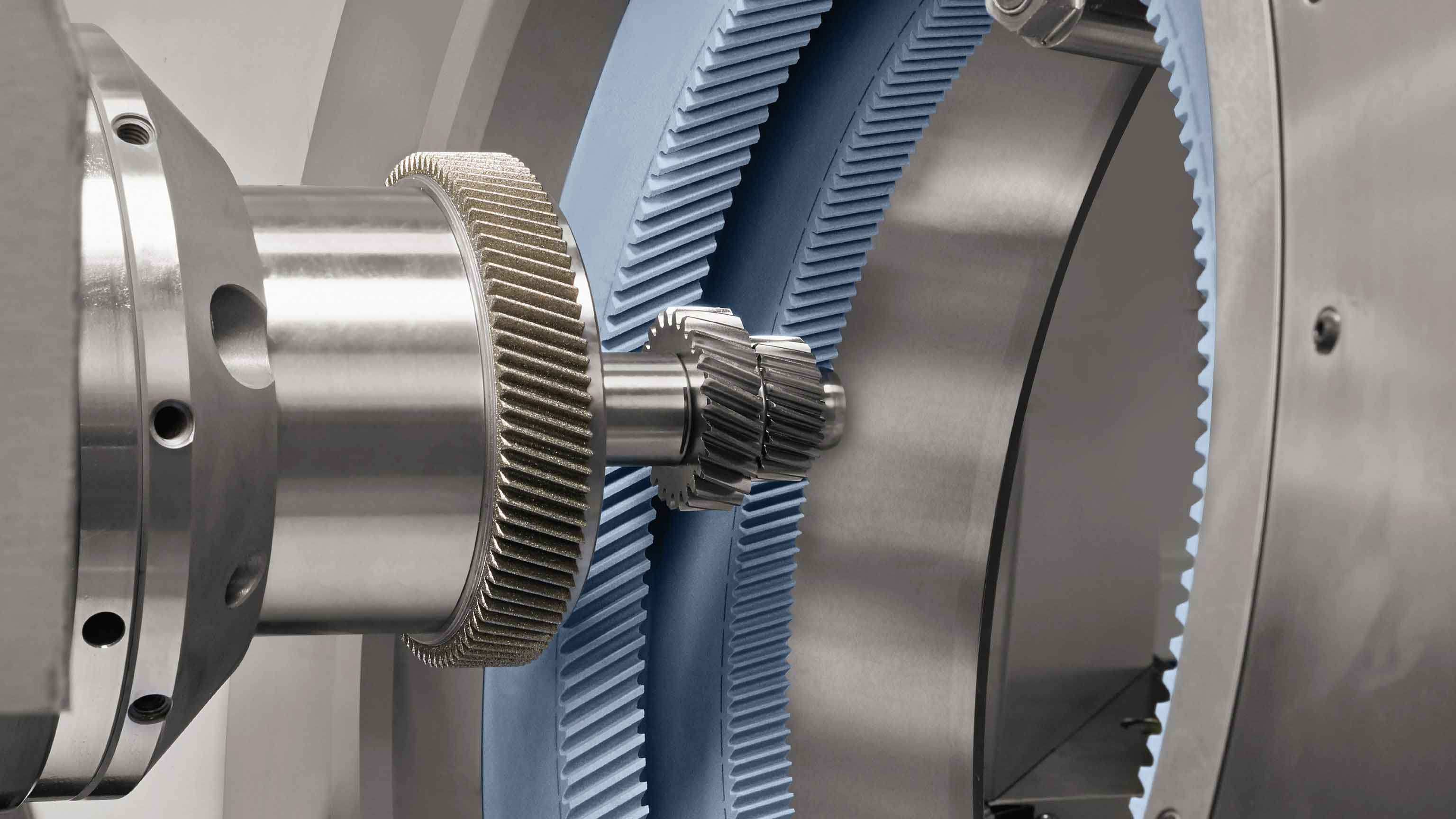
Keywords: gear honing; processing mechanism; microscopic morphology; CBN abrasive grains; processing performance
1. Introduction
1.1 Background and Significance
Gear honing is a critical process for achieving high-performance hard gear surfaces. It involves complex interactions between the honing wheel and the workpiece, requiring a thorough understanding of the honing mechanism and the optimization of honing wheel characteristics. This dissertation aims to address these challenges by studying the multi-abrasive micro-edge honing process with CBN coated honing wheels.
1.2 Literature Review
Table 1.1 summarizes the current research status on gear honing theory and CBN honing wheels.
| Research Area | Key Findings |
|---|---|
| Gear Honing Theory | Limited theoretical framework; need for improvement in processing quality and efficiency |
| CBN Honing Wheels | Higher cutting speeds, forces, and material removal rates compared to conventional wheels |
1.3 Research Content and Structure
The dissertation is structured into seven chapters, covering the introduction, internal power gear honing theory, CBN abrasive grain micromorphology simulation, effective abrasive grain interaction, honing quality evaluation, and conclusions.
2. Internal Power Gear Honing Theory
2.1 Introduction
This chapter introduces the fundamental equations governing internal power gear honing, including the tooth surface equation, meshing equation, instantaneous contact trace equation, and honing wheel tooth surface equation.
2.2 Gear Tooth Surface Equation
The involute spiral tooth surface equation is given by:
{x0=rbcos(θn−u)−rbsin(σ0+u)y0=rbsin(θn+u)+rbcos(σ0+u)
2.3 Meshing Equation
The meshing equation describes the contact between the honing wheel and the workpiece gear tooth surfaces.
2.4 Honing Speed and Force Equations
The honing speed and force equations are derived based on the gear honing mechanism.
2.5 Honing Power and Specific Grinding Energy
Equations for honing power and specific grinding energy are presented, providing insights into the energy consumption of the honing process.
2.6 Summary
This chapter lays the foundation for subsequent studies by establishing the theoretical framework of internal power gear honing.
3. CBN Abrasive Grain Micro-Cutting Mechanism
Details omitted for brevity, focusing on microscopic morphology and dynamics of abrasive grains.
4. Simulation of Microscopic Morphology of CBN Coated Honing Wheel
4.1 Introduction
Understanding the microscopic morphology of CBN abrasive grains is crucial for optimizing honing wheel performance.
4.2 Simulation Based on Phase Field Method
The phase field method and magnetron sputtering are used to simulate the formation of CBN coating microscopic morphology.
| Process Parameters | Influence on Abrasive Grain Characteristics |
|---|---|
| Sputtering Time | Number and size of abrasive grains |
| Substrate Temperature | Grain shape and distribution |
| Gas Flow Rate | Grain density and uniformity |
4.3 Experimental Verification
Experimental results support the simulation findings, validating the model’s reliability.
5. Interaction Between Effective Abrasive Grains and Workpiece
5.1 Introduction
Studying the interaction between effective abrasive grains and the workpiece is key to controlling honing forces, accuracy, material removal, and surface quality.
5.2 Experimental System
A test system is designed to measure honing forces during multi-grain micro-edge honing.
5.3 Experimental Results and Analysis
Comparison between simulation and experimental results confirms the effectiveness of the proposed model.
6. Evaluation of CBN Abrasive Grain Micro-Edge Honing Quality
6.1 Introduction
Evaluating honing quality is essential for ensuring the performance of hard gear surfaces.
6.2 Evaluation Indicators
Indicators include surface roughness, dimensional accuracy, and material removal rate.
6.3 Evaluation Method
A comprehensive evaluation model based on Trapezium Fuzzy Analytic Hierarchy Process (Tra-FAHP) and Set Pair Analysis (SPA) is established.
| Evaluation Indicator | Weight |
|---|---|
| Surface Roughness | 0.35 |
| Dimensional Accuracy | 0.30 |
| Material Removal Rate | 0.25 |
| Noise Level | 0.10 |
6.4 Case Study
A case study is conducted to demonstrate the application of the evaluation model.
7. Conclusion
The main findings of this dissertation include:
- Establishing a theoretical framework for internal power gear honing.
- Simulating and optimizing the microscopic morphology of CBN abrasive grains.
- Studying the interaction between effective abrasive grains and the workpiece.
- Developing an evaluation model for CBN abrasive grain micro-edge honing quality.