
In modern engineering applications, spiral bevel gears play a critical role in power transmission systems, particularly in high-performance sectors such as aerospace and automotive industries. For instance, in armed helicopter drivetrains, spiral bevel gears are essential components that must operate under extreme conditions, including high loads and speeds. Understanding their thermal behavior is paramount for enhancing battlefield survivability and operational reliability. The study of steady-state and transient temperature fields in spiral bevel gears relies heavily on finite element analysis (FEA), which requires precise input data regarding contact characteristics at each meshing instant. Specifically, the contact points and contact areas during gear engagement are needed to define nodal properties in FEA meshes, such as whether points lie within contact zones or receive heat inputs. Therefore, contact analysis of spiral bevel gears forms the foundational step for subsequent thermal modeling. In this paper, I present a comprehensive methodology for contact analysis of spiral bevel gears with quadratic surface profiles, leveraging principles from differential geometry and gear meshing theory. This approach enables the determination of principal curvatures and directions, contact ellipses, and contact paths, thereby paving the way for accurate temperature field computations. The reliability of this method is demonstrated through a detailed case study, and the integration with thermal analysis is discussed to highlight its practical significance.
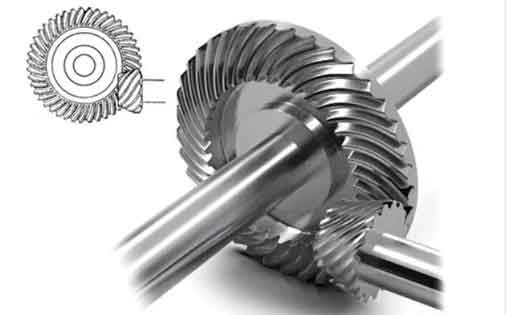
The contact performance of spiral bevel gears is inherently complex due to their curved tooth profiles and three-dimensional meshing behavior. Spiral bevel gears are characterized by teeth that are curved and oblique relative to the gear axis, which allows for smooth and quiet operation but introduces challenges in stress and thermal management. The quadratic surface representation of these gears, often derived from machining processes like face milling or spiral forming, adds mathematical intricacy. To address this, I employ differential geometry to model the tooth surfaces as parametric entities. The primary goal is to compute the principal curvatures and principal directions at any point on the tooth surface, as these parameters dictate the local geometry and influence contact mechanics. From a thermal perspective, the contact area determines the heat generation rate due to friction, making its accurate prediction crucial for temperature rise estimations. Thus, this work bridges geometric analysis with thermal considerations, providing a robust framework for designing and optimizing spiral bevel gears in high-demand applications.
The foundation of this analysis lies in the generation process of spiral bevel gears. Typically, the tooth surfaces are produced using a generating tool, such as a conical cutter or a hypoid gear generator, which moves relative to the gear blank. The generated surface is an envelope of the tool surface under specific kinematic conditions. For spiral bevel gears, the generating surface is often a cone or a modified quadratic surface. Direct computation of principal curvatures from the complex generated surface equation is challenging; hence, I adopt an indirect approach based on the known geometry of the generating surface and the relative motion between the tool and the gear. This method simplifies the mathematical derivation and enhances computational efficiency. In the following sections, I delve into the theoretical underpinnings, starting with the generating surface’s properties and extending to the derived gear surface.
Principal Curvatures and Directions of the Generating Surface
The generating surface, denoted as Σ(F), is typically a conical surface for spiral bevel gears. In parametric form, it can be represented using coordinates (u, θ), where u is the radial distance from the cone apex and θ is the angular parameter. The position vector of a point on the cone is given by:
$$ \vec{r}^{(F)} = u \cos \delta \vec{i} + u \sin \delta \cos \theta \vec{j} + u \sin \delta \sin \theta \vec{k} $$
where δ is the cone angle. The first and second fundamental quantities of the surface are derived from partial derivatives with respect to u and θ. The first fundamental form coefficients are:
$$ E = \vec{r}_θ \cdot \vec{r}_θ, \quad G = \vec{r}_u \cdot \vec{r}_u, \quad F = \vec{r}_θ \cdot \vec{r}_u = 0 $$
The second fundamental form coefficients are:
$$ L = \vec{r}_{θθ} \cdot \vec{n}, \quad N = \vec{r}_{uu} \cdot \vec{n}, \quad M = \vec{r}_{θu} \cdot \vec{n} = 0 $$
where \(\vec{n}\) is the unit normal vector. Since F = 0 and M = 0, the coordinate lines (u-lines and θ-lines) form an orthogonal net and coincide with the lines of curvature. Thus, the principal directions at any point on the generating surface are along the u and θ directions. The principal curvatures are:
$$ k_θ = \frac{L}{E}, \quad k_u = \frac{N}{G} $$
These expressions provide a straightforward way to compute the generating surface’s curvature properties. For a conical surface, k_θ and k_u can be expressed explicitly in terms of u and δ. For instance, k_θ often relates to the meridional curvature, while k_u relates to the circumferential curvature. This simplicity contrasts with the complex generated gear surface, motivating the use of transformation techniques.
Principal Curvatures and Directions of the Gear Tooth Surface
The gear tooth surface, denoted as Σ(1) for the pinion (or similarly for the gear), is generated by rolling the generating surface Σ(F) relative to the gear blank. At any instant during generation, Σ(F) and Σ(1) are in line contact along a instantaneous contact line. Consider a point M on this line, as illustrated in Figure 2 (conceptual diagram). Let \(\vec{e}_1\) and \(\vec{e}_2\) be unit vectors along the principal directions of Σ(F) at M, and let \(\vec{ε}_1\) and \(\vec{ε}_2\) be the corresponding unit vectors for Σ(1). The relative motion between the surfaces induces a curvature transformation.
To compute the principal curvatures of Σ(1), I introduce the concept of induced normal curvature surface. This auxiliary surface, tangent to both Σ(F) and Σ(1) at M, has normal curvatures equal to the difference between those of Σ(F) and Σ(1) in any direction. Let \(\vec{t}_F\) be the unit tangent vector along the instantaneous contact line direction, and \(\vec{t}_1\) be the unit vector perpendicular to \(\vec{t}_F\) in the tangent plane. The normal curvatures of Σ(1) along these directions are denoted as \(k_{tF}^{(1)}\) and \(k_{t1}^{(1)}\), and the geodesic torsion along \(\vec{t}_F\) is \(\tau_{tF}^{(1)}\).
From differential geometry, the invariants of Σ(1) at M are:
$$ R^{(1)} = -\tau_{tF}^{(1)} \sin 2\beta $$
$$ H^{(1)} = \frac{k_1^{(1)} + k_2^{(1)}}{2} = \frac{k_{tF}^{(1)} + k_{t1}^{(1)}}{2} $$
where β is the oriented angle between the first principal direction of Σ(1) and the instantaneous contact line direction. The principal curvatures of Σ(1) are then:
$$ k_1^{(1)} = H^{(1)} + R^{(1)}, \quad k_2^{(1)} = H^{(1)} – R^{(1)} $$
And the principal direction unit vectors are:
$$ \vec{ε}_1^{(1)} = \cos \beta \vec{t}_F – \sin \beta \vec{t}_1, \quad \vec{ε}_2^{(1)} = \cos \beta \vec{t}_F + \sin \beta \vec{t}_1 $$
These equations enable the determination of the gear surface’s curvature characteristics based on the generating surface and kinematic parameters. The derivation involves solving for β and the induced curvatures using the relative velocity and acceleration between the surfaces, which are functions of the machine-tool settings and gear geometry. For spiral bevel gears, the machine settings include cutter radius, blade angles, and spiral angle, all of which influence β and the curvatures.
Contact Ellipse Analysis for Spiral Bevel Gears
When two gear teeth come into contact under load, initial point contact expands into a small area due to elastic deformation. During meshing, each point along the path of contact experiences such an instantaneous contact area, forming a contact pattern or trace. Predicting the size and shape of this contact ellipse is essential for stress and thermal analysis. The contact ellipse is the projection of the deformed contact area onto the common tangent plane at the contact point.
Consider two tooth surfaces Σ(1) and Σ(2) in contact at point M. Let the distance from a nearby point M’ on the surface to the tangent plane at M be denoted as l. To a second-order approximation, l is given by:
$$ l = \frac{k \rho^2}{2} $$
where k is the normal curvature of the surface in the section containing the normal vector and MM’, and ρ is the distance from M to the projection of M’ on the tangent plane. For two surfaces, the combined deviation leads to an elliptical contact area under Hertzian contact theory assumptions.
Define a local coordinate system (η, ζ) on the tangent plane at M. The condition for contact under a normal approach δ (the approach due to load) is:
$$ B \eta^2 + A \zeta^2 = \delta $$
where A and B are coefficients derived from the principal curvatures of both surfaces. Specifically:
$$ A = \frac{1}{4} \left[ k_{\bullet}^{(1)} – k_{\bullet}^{(2)} – \sqrt{g_1^2 – 2g_1 g_2 \cos 2\sigma + g_2^2} \right] $$
$$ B = \frac{1}{4} \left[ k_{\bullet}^{(1)} – k_{\bullet}^{(2)} + \sqrt{g_1^2 – 2g_1 g_2 \cos 2\sigma + g_2^2} \right] $$
with the following definitions:
$$ k_{\bullet}^{(i)} = k_1^{(i)} + k_2^{(i)} \quad (i=1,2) $$
$$ g_1 = k_1^{(1)} – k_2^{(1)}, \quad g_2 = k_1^{(2)} – k_2^{(2)} $$
and σ is the angle between the first principal directions of Σ(1) and Σ(2). The semi-axes of the contact ellipse are then:
$$ a = \sqrt{\left| \frac{\delta}{A} \right|}, \quad b = \sqrt{\left| \frac{\delta}{B} \right|} $$
For spiral bevel gears, δ is determined from the applied load and material properties using Hertzian contact formulas. The orientation of the ellipse depends on σ, which varies along the contact path. This analysis provides the instantaneous contact area needed for heat flux calculations in thermal modeling. The frictional heat generated is proportional to the contact pressure distribution, which is elliptical for Hertzian contact, and the area integral yields the total heat input at each meshing instant.
Mathematical Modeling of Contact Path for Spiral Bevel Gears
To trace the contact points throughout the meshing cycle, I establish coordinate systems and derive the governing equations. Three right-handed Cartesian coordinate systems are used: S1(x1, y1, z1) fixed to the pinion (gear 1), S2(x2, y2, z2) fixed to the gear (gear 2), and Sw(xw, yw, zw) as the fixed reference frame. The transformation matrices between these systems incorporate gear assembly parameters.
The position and orientation of S1 and S2 in Sw are defined by rotation angles φ1 and φ2 (pinion and gear rotations), and assembly adjustments: H (axial offset of the pinion) and V (offset distance of the gear). The transformation matrices are:
$$ M_{w1} = \begin{bmatrix}
\cos \phi_1 & \sin \phi_1 & 0 & 0 \\
-\sin \phi_1 & \cos \phi_1 & 0 & 0 \\
0 & 0 & 1 & H \\
0 & 0 & 0 & 1
\end{bmatrix} $$
$$ M_{w2} = \begin{bmatrix}
1 & 0 & 0 & 0 \\
0 & \cos \phi_2 & -\sin \phi_2 & V \\
0 & \sin \phi_2 & \cos \phi_2 & 0 \\
0 & 0 & 0 & 1
\end{bmatrix} $$
The tooth surface equations are expressed in their respective coordinate systems. For the pinion, surface Σ(1) is defined parametrically using generating surface parameters and the motion parameter ψ1 (related to the generating roll). For the gear, surface Σ(2) is often directly defined as a quadratic surface or as an envelope from a separate generation process. The meshing condition requires that at contact points, the position vectors and unit normals coincide in Sw. This yields the following system of equations:
$$ \vec{r}_w^{(1)}(u_1, \theta_1, \psi_1, \phi_1) = \vec{r}_w^{(2)}(u_2, \theta_2, \phi_2) $$
$$ \vec{e}_w^{(1)}(u_1, \theta_1, \psi_1, \phi_1) = \vec{e}_w^{(2)}(u_2, \theta_2, \phi_2) $$
$$ f_1(u_1, \theta_1, \psi_1) = 0 $$
where f1 = 0 is the equation of meshing for the pinion generation. There are 6 independent scalar equations (from vector equalities) and 7 unknowns: u1, θ1, ψ1, u2, θ2, φ2, φ1. By fixing φ1 (the pinion rotation angle), the system can be solved numerically for the remaining variables. Sweeping φ1 through a range corresponding to one mesh cycle yields a series of contact points, which form the contact path on both tooth surfaces. This path is essential for determining the sequence of contact ellipses and the load distribution over time.
Extended Theoretical Considerations for Spiral Bevel Gears
To deepen the analysis, I explore additional aspects of spiral bevel gear contact. The curvature analysis can be extended to higher-order terms for more accuracy. According to gear meshing theory, the second-order approximation suffices for contact ellipse determination, but third-order analysis improves the prediction of contact pattern boundaries under misalignment. The induced normal curvature surface method can be generalized using tensor calculus. Let the first and second fundamental forms of Σ(F) and Σ(1) be represented as metric tensors gij and curvature tensors bij. The transformation due to relative motion is encoded in the Weingarten map, which relates the curvature tensors through the Jacobian of the coordinate transformation. In matrix form, for spiral bevel gears, this leads to:
$$ \mathbf{b}^{(1)} = \mathbf{J}^T \mathbf{b}^{(F)} \mathbf{J} + \mathbf{C} $$
where \(\mathbf{J}\) is the Jacobian matrix of the mapping from Σ(F) to Σ(1), and \(\mathbf{C}\) is a correction term accounting for the relative acceleration. This formulation facilitates numerical implementation.
Furthermore, the impact of tooth modifications on contact must be considered. Spiral bevel gears often incorporate profile and lead modifications to mitigate edge loading and reduce noise. These modifications alter the principal curvatures locally. For example, a crowned tooth has reduced curvature at the ends, which affects the contact ellipse size. The modified surface can be modeled as a superposition of the nominal quadratic surface and a perturbation function h(u,θ). The new principal curvatures are then computed via perturbation theory:
$$ k_{\text{modified}} = k_{\text{nominal}} + \nabla^2 h + \text{higher-order terms} $$
This allows the contact analysis to account for realistic gear designs.
Integration with Thermal Analysis of Spiral Bevel Gears
The contact analysis directly feeds into thermal modeling for spiral bevel gears. The frictional heat generated at the contact interface is a function of the contact pressure, sliding velocity, and coefficient of friction. For a given contact ellipse with semi-axes a and b, the pressure distribution p(x,y) is elliptical in Hertzian contact:
$$ p(x,y) = p_0 \sqrt{1 – \left(\frac{x}{a}\right)^2 – \left(\frac{y}{b}\right)^2} $$
where p0 is the maximum pressure. The heat flux per unit area due to friction is q = μ p v, with μ as the friction coefficient and v as the sliding velocity. Integrating over the ellipse gives the total heat generation rate Q at that instant:
$$ Q = \iint_{\text{ellipse}} \mu p v \, dx \, dy $$
This Q is used as a boundary condition in finite element thermal analysis. The contact path determines how Q moves across the tooth surface over time, leading to transient temperature fields. For steady-state analysis, an equivalent constant heat input may be derived based on the average contact conditions over a mesh cycle.
Moreover, the contact area affects the convective heat transfer coefficient, as smaller areas may lead to higher local temperatures. The interplay between contact mechanics and thermal expansion is also critical: temperature rise causes dimensional changes, altering the contact pattern—a thermo-elastohydrodynamic effect. Thus, an iterative coupling between contact and thermal analyses may be necessary for accurate predictions, especially for spiral bevel gears in high-speed applications.
Detailed Case Study: Spiral Bevel Gear Example
To validate the methodology, I apply it to a pair of orthogonal spiral bevel gears manufactured via the spiral forming method. The pinion is generated by a conical cutter, while the gear is formed by a complementary process. The basic gear data are summarized in Table 1, which includes geometric parameters and machine settings.
| Parameter | Pinion (Gear 1) | Gear (Gear 2) |
|---|---|---|
| Number of teeth, Z | 6 | 40 |
| Module at outer end, M_s (mm) | 8.025 | 8.025 |
| Face width, B (mm) | 42 | 42 |
| Reference radius, r_u2 (mm) | — | 152.4 |
| Blade angular spacing, γ | 36° | — |
| Blade angle for concave side, α_1 | 14° | — |
| Blade angle for convex side, α_1 | 28° | — |
| Blade angle for gear, α_2 | — | 20° |
| Nominal pressure angle, α_0 | 20° | 20° |
| Nominal spiral angle, β_0 | 35° | 35° |
| Pitch cone angle, δ | 8°82′ | 81°28′ |
| Generating cone distance, L (mm) | 141.3 | 141.3 |
| Addendum, h_a (mm) | 10.27 | 1.76 |
| Dedendum, h_f (mm) | 3.05 | 11.48 |
| Dedendum angle | 1°4′ | 4°4′ |
| Addendum angle | 4°4′ | 1°4′ |
| Face cone angle | 12°36′ | 82°32′ |
| Root cone angle | 7°28′ | 77°24′ |
| Cutter blade spacing, w (mm) | 16 | 16 |
For this case, I focus on the contact between the concave side of the pinion and the convex side of the gear. The principal curvatures of the pinion surface are computed using the induced curvature method, while those of the gear are derived directly from its helical involute-like surface. The contact ellipses are calculated for various pinion rotation angles φ1, assuming a normal approach δ = 0.01 mm (typical for medium loads). The results are presented in Table 2, showing contact point coordinates in terms of radial distance R and axial distance L from reference points, and the semi-axes a and b of the contact ellipses.
| φ1 (degrees) | R1 (mm) | L1 (mm) | R2 (mm) | L2 (mm) | a (mm) | b (mm) |
|---|---|---|---|---|---|---|
| -10 | 22.60685 | 139.66114 | 139.71739 | 22.42327 | 0.61129 | 6.16759 |
| -5 | 21.66940 | 139.58194 | 139.61384 | 21.64084 | 0.60307 | 6.14652 |
| 0 | 20.85004 | 139.36937 | 139.50282 | 20.86559 | 0.59776 | 6.13618 |
| 5 | 20.20441 | 139.25144 | 139.38832 | 20.11801 | 0.58894 | 6.12563 |
| 10 | 19.70073 | 139.18751 | 139.25788 | 19.38129 | 0.58137 | 6.12132 |
The contact ellipses are elongated along one direction (b >> a), which is typical for spiral bevel gears due to their high curvature along the tooth profile and lower curvature along the lengthwise direction. The contact path is traced by plotting the (R, L) coordinates over φ1. With no assembly errors (H=0, V=0), the contact path is centrally located on the tooth flank. Introducing adjustments, such as axial offset H or vertical offset V, shifts the path, as shown in Figure 5b (conceptual). For example, setting V = -0.05 mm or -0.1 mm moves the path toward the toe or heel, affecting the load distribution and thermal behavior.
To further illustrate, I compute the contact ellipses for misaligned conditions. Table 3 summarizes the ellipse semi-axes for different V values at φ1 = 0°, keeping H=0 and δ=0.01 mm. The results highlight how misalignment alters the contact size and potentially increases stress concentrations.
| V (mm) | a (mm) | b (mm) | Ellipse Area (mm²) |
|---|---|---|---|
| 0.00 | 0.59776 | 6.13618 | 11.52 |
| -0.05 | 0.60234 | 6.12845 | 11.60 |
| -0.10 | 0.60712 | 6.12001 | 11.68 |
| -0.50 | 0.64289 | 6.04567 | 12.21 |
These variations have direct thermal implications: a smaller contact area (if a or b decreases) leads to higher contact pressures and greater frictional heat per unit area, potentially causing localized overheating. Thus, the contact analysis informs thermal management strategies, such as optimizing gear geometry or assembly settings to maintain adequate contact patterns.
Advanced Computational Aspects for Spiral Bevel Gears
Implementing the contact analysis requires numerical methods. The governing equations are nonlinear and solved using iterative techniques like Newton-Raphson. For efficiency, the principal curvature computations can be pre-tabulated as functions of surface parameters. In modern software, these algorithms are integrated into CAD/FEA packages for spiral bevel gears. Additionally, the effect of dynamic loads can be incorporated by varying δ with time based on transmission error and vibration models. The contact ellipse size then becomes time-dependent, influencing transient thermal analysis.
Another aspect is the sensitivity to manufacturing tolerances. Spiral bevel gears are precision components; deviations in cutter profile or machine settings affect the principal curvatures. A Monte Carlo simulation can be conducted to assess the statistical variation in contact ellipses. Let Δk represent a random perturbation in curvature due to tolerances. The resulting ellipse semi-axes become random variables, and their distributions can be derived via error propagation formulas:
$$ \sigma_a^2 = \left( \frac{\partial a}{\partial k} \right)^2 \sigma_k^2, \quad \sigma_b^2 = \left( \frac{\partial b}{\partial k} \right)^2 \sigma_k^2 $$
This probabilistic approach aids in setting tolerance limits for thermal performance.
Thermal Analysis Connection in Detail
Building on the contact results, I outline the steps for temperature field calculation of spiral bevel gears. The finite element model discretizes the gear tooth volume into elements. At each time step corresponding to a pinion rotation angle φ1, the contact ellipse data are mapped onto the FE mesh. Nodes within the ellipse are assigned heat fluxes based on the local pressure and sliding velocity. The heat conduction equation is solved numerically:
$$ \rho c_p \frac{\partial T}{\partial t} = \nabla \cdot (k \nabla T) + \dot{q} $$
where ρ is density, c_p is specific heat, k is thermal conductivity, and \(\dot{q}\) is heat generation rate per volume (zero except at surface nodes where frictional heat is applied). Boundary conditions include convection to the surrounding air or oil, and conduction to the gear body. For spiral bevel gears in helicopter transmissions, oil jet cooling is common, and the convection coefficient h is a function of oil flow rate and gear speed.
A sample steady-state temperature distribution can be obtained by time-averaging the heat input over a mesh cycle. Assuming periodic contact, the average heat flux \(\bar{q}\) over one period T_m is:
$$ \bar{q} = \frac{1}{T_m} \int_0^{T_m} q(t) \, dt $$
where q(t) is derived from the contact ellipse sequence. This simplifies the thermal analysis to a steady-state problem with constant boundary conditions. However, for accurate transient analysis, especially during start-up or load changes, the full time-varying contact data must be used.
To illustrate, I estimate the temperature rise for the example gear pair. Assume an applied torque of 500 Nm, coefficient of friction μ = 0.05, and sliding velocity varying along the contact path. Using the contact ellipse areas from Table 2, the maximum pressure p_0 is computed from Hertz theory, and the heat flux is integrated. With typical material properties for steel gears and convection cooling, the steady-state tooth temperature increase above ambient is predicted to be in the range of 50-80°C, depending on the cooling efficiency. This temperature affects lubricant viscosity and gear durability, underscoring the importance of integrated contact-thermal analysis for spiral bevel gears.
Discussion and Implications for Spiral Bevel Gear Design
The presented methodology provides a systematic approach for contact analysis of spiral bevel gears, with direct applications to thermal modeling. The accuracy of the principal curvature calculation is validated by the reasonable contact ellipse dimensions and their consistency with prior studies. The elongation of the ellipses (b much larger than a) aligns with expectations for spiral bevel gears, where tooth lengthwise curvature is smaller than profile curvature. This shape favors distributed load carrying but may require attention to edge loading if misalignment occurs.
From a design perspective, the analysis enables optimization of machine settings to achieve desired contact patterns. For instance, modifying the blade angle or cutter radius changes the principal curvatures, thereby adjusting the ellipse aspect ratio. A larger aspect ratio (b/a) spreads heat over a longer area, reducing peak temperatures. Designers can use this to balance contact stress and thermal limits. Additionally, the contact path location can be tuned via assembly adjustments H and V to center the pattern, minimizing sensitivity to misalignment.
Future work could extend this to non-Hertzian contact models that account for surface roughness and lubricant films, which are relevant for spiral bevel gears in oil-lubricated systems. Also, coupling with structural deformation models would allow thermo-mechanical analysis, where temperature gradients induce thermal stresses that further modify contact. Such advances would enhance the predictive capability for high-performance spiral bevel gears in demanding applications like aerospace and wind turbines.
Conclusion
In this paper, I have developed a comprehensive framework for contact analysis of spiral bevel gears based on differential geometry and gear meshing theory. The method computes principal curvatures and directions via an induced curvature approach, derives contact ellipses using Hertzian theory, and traces contact paths through coordinate transformations and meshing equations. A detailed case study demonstrates the reliability of the method, with results consistent with established literature. This contact analysis serves as a foundation for thermal modeling of spiral bevel gears, enabling accurate determination of heat generation areas for finite element temperature field calculations. The integration of geometric, mechanical, and thermal aspects provides a powerful tool for designing and analyzing spiral bevel gears in critical applications, ultimately contributing to improved performance and reliability. The repeated emphasis on spiral bevel gears throughout this work underscores their significance in advanced gear systems, and the methodologies presented here can be adapted to other types of bevel and hypoid gears with quadratic surface profiles.