
The analysis of thermal characteristics—specifically temperature distribution, thermally induced stresses, and deformation—is a critical aspect of ensuring the reliability and performance of high-power transmission systems. Among these, the spiral bevel gear stands out due to its capacity for smooth, high-torque, and high-speed power transmission between intersecting shafts. The complex spatial conjugate contact and sliding inherent in spiral bevel gear meshing generate significant frictional heat. This heat flux, if not properly managed, leads to a non-uniform temperature field within the gear body, subsequently inducing thermal stresses and deformations. These thermal effects can drastically alter the contact pattern, increase noise and vibration, accelerate surface failures like pitting and scuffing, and ultimately lead to premature gear failure. Therefore, a profound understanding of the coupled thermal-structural behavior of spiral bevel gears is indispensable for advanced design, manufacturing, and operational strategies.
Previous research has extensively covered the thermal analysis of spur and helical gears, often utilizing single-tooth models for computational efficiency. However, the unique geometry and multi-tooth contact characteristics of spiral bevel gears demand a more sophisticated approach. Studies focusing specifically on spiral bevel or hypoid gears have primarily investigated steady-state bulk temperature fields using simplified models. A significant gap exists in the open literature concerning the fully coupled thermo-mechanical analysis that links the calculated temperature field directly to the resulting stress and deformation states in a multi-tooth configuration. This study aims to bridge this gap by developing a comprehensive three-dimensional finite element methodology to simulate the steady-state thermal characteristics of a multi-tooth spiral bevel gear pair under load.
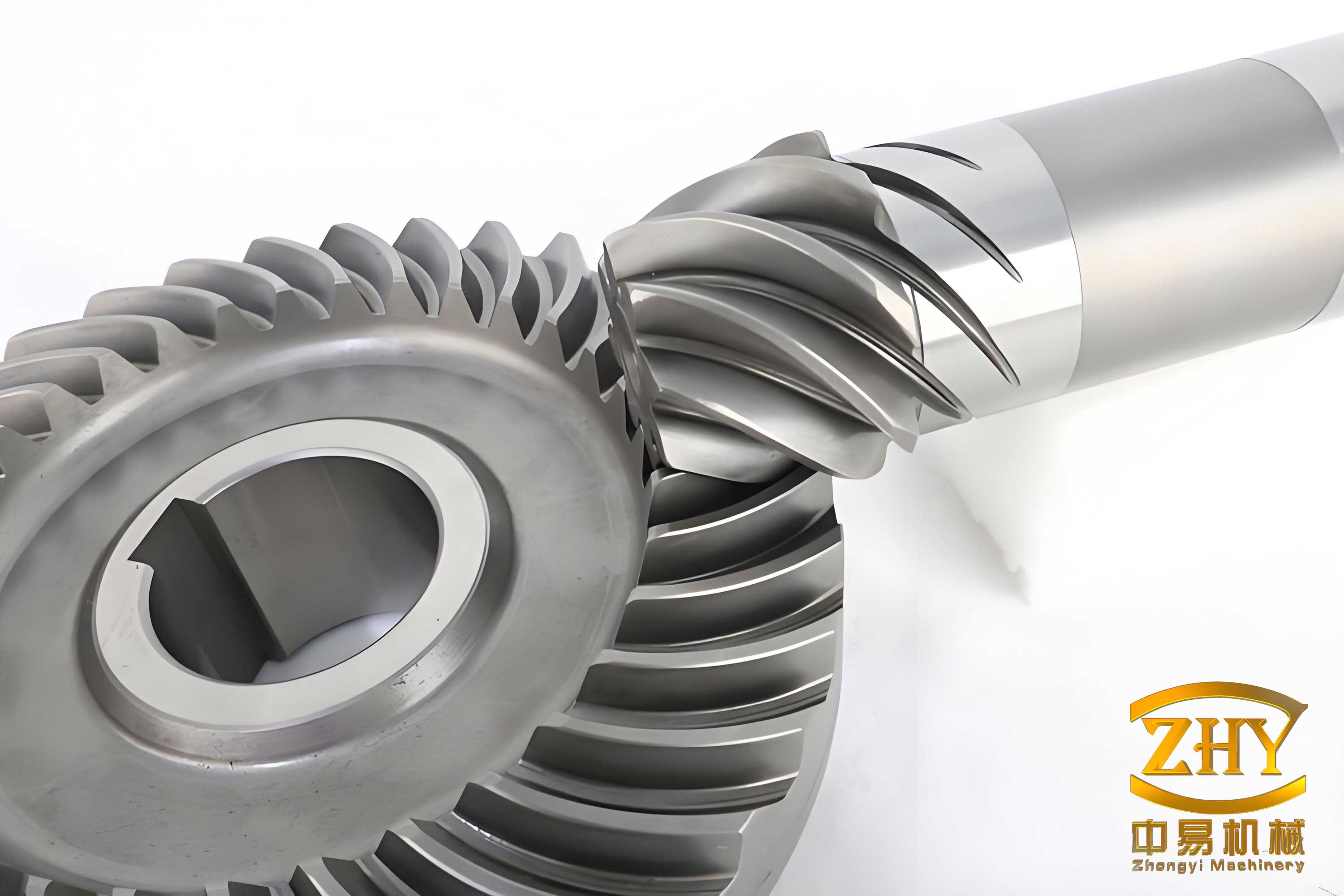
Geometric and Mathematical Modeling of Spiral Bevel Gears
The foundation of any accurate mechanical analysis lies in a precise geometric model. For spiral bevel gears, which are a special case of hypoid gears with zero offset, the tooth surfaces are complex spatial curves generated via a cradle-style machining process. The mathematical formulation begins with defining the coordinate systems involved in the gear generation.
Let us consider the gear generation process. A coordinate system $\Sigma_r = {O_r; i_r, j_r, k_r}$ is attached to the gear blank. The cutter head (generating surface) is described in its own coordinate system $\Sigma_{cr} = {O_{cr}; i_{cr}, j_{cr}, k_{cr}}$. The geometric vectors of the generating surface at the cutter tip point $P$ can be expressed as:
$$
\begin{aligned}
\mathbf{u}_{cr}^{(cr)} &= (\sin i \sin j,\ -\sin i \cos j,\ -\cos i) \\
\mathbf{R}_{cr}^{(cr)} &= R_{cr} (-\cos i \sin j,\ \cos i \cos j,\ -\sin i) \\
\mathbf{t}_{cr}^{(cr)} &= (-\sin r \sin j,\ -\sin r \cos j,\ -\cos r) \\
\mathbf{n}_{r}^{(cr)} &= (\cos r \sin j,\ -\cos r \cos j,\ -\sin r)
\end{aligned}
$$
where $\mathbf{u}_{cr}^{(cr)}$ is the unit vector collinear with the cutter axis, $\mathbf{R}_{cr}^{(cr)}$ is the position vector of the cutter tip $P$, $\mathbf{t}_{cr}^{(cr)}$ and $\mathbf{n}_{r}^{(cr)}$ are the unit tangent and normal vectors on the cutter surface at $P$, respectively. The angles $i$, $j$, and $r$ represent the basic machine tool settings: cutter tilt angle, swivel angle, and the angle between the cutter blade and the cradle axis.
The position vector $\mathbf{R}_r^{(r)}$, unit normal $\mathbf{n}_r^{(r)}$, and unit tangent $\mathbf{t}_r^{(r)}$ for any contact point $P$ on the gear tooth surface in the gear coordinate system $\Sigma_r$ are derived through a series of coordinate transformations:
$$
\begin{aligned}
\mathbf{R}_r^{(r)} &= \mathbf{D}_{rr}^{(r)} + \mathbf{A}_{cr}^{(r)} – b_{tr} \mathbf{t}_r^{(r)} \\
\mathbf{n}_r^{(r)} &= \mathbf{M}(\Gamma_m, j_r) \mathbf{M}(q_r, k_r) \mathbf{M}(\mathbf{u}_{cr}^{(cr)}, \theta_{cr}) \mathbf{M}(-j, k_r) \mathbf{M}(i, i_r) \mathbf{n}_{cr}^{(cr)} \\
\mathbf{t}_r^{(r)} &= \mathbf{M}(\Gamma_m, j_r) \mathbf{M}(q_r, k_r) \mathbf{M}(\mathbf{u}_{cr}^{(cr)}, \theta_{cr}) \mathbf{M}(-j, k_r) \mathbf{M}(i, i_{r}) \mathbf{t}_{cr}^{(cr)}
\end{aligned}
$$
Here, $\mathbf{D}_{rr}^{(r)}$ is the vector from the gear axis intersection point to $O_r$, $b_{tr}$ is the distance from the cutter tip along $\mathbf{t}_r$, and $\mathbf{M}(\cdot)$ denotes rotation transformation matrices. The parameters $X_r$, $X_{br}$, $E_{mr}$ are machine settings for gear generation.
The pinion surface is determined by the conjugate condition relative to the gear. For a left-hand pinion, the condition of continuous contact requires that the position vectors coincide and the relative velocity at the contact point is orthogonal to the common surface normal. This is encapsulated in the following system:
$$
\begin{aligned}
\mathbf{R}_l &= \mathbf{R}_e + \mathbf{R}_r \\
\mathbf{V}_{rl} \cdot \mathbf{n}_r &= 0
\end{aligned}
$$
where $\mathbf{R}_e$ is the offset vector, $\mathbf{V}_{rl}$ is the relative sliding velocity, and $\mathbf{n}_r$ is the common normal. Solving this system yields the pinion tooth surface coordinates $\mathbf{R}_l^{(l)}$, $\mathbf{n}_l^{(l)}$, and $\mathbf{t}_l^{(l)}$ in the pinion coordinate system after applying the shaft angle transformation $\mathbf{M}(-\Sigma, j_r)$.
Using these mathematical equations, a “bottom-up” solid modeling approach is employed. Discrete points calculated from the meshing equations are used to create keypoints. These are then connected into spline curves, which are subsequently skinned to form surfaces. Finally, enclosed surfaces are used to generate a solid model of a single tooth, which is then patterned circumferentially to create the complete three-dimensional model of the spiral bevel gear. This accurate model is essential for subsequent finite element analysis.
Finite Element Modeling for Thermal Analysis
The thermal behavior of a spiral bevel gear during meshing is governed by the laws of heat conduction. The transient heat conduction equation in three dimensions, assuming no internal heat generation within the bulk material, is given by:
$$
\rho c \frac{\partial T}{\partial \tau} = \lambda \left( \frac{\partial^2 T}{\partial x^2} + \frac{\partial^2 T}{\partial y^2} + \frac{\partial^2 T}{\partial z^2} \right) \quad \text{(in domain } \Omega \text{)}
$$
where $\rho$ is material density, $c$ is specific heat capacity, $T$ is temperature, $\tau$ is time, $\lambda$ is thermal conductivity, and $\Omega$ is the spatial domain of the gear body. Initially, the temperature field is non-stationary. However, for continuous operation, the system reaches a thermal equilibrium where the temperature distribution becomes steady-state, independent of time. This steady-state condition simplifies the equation to Laplace’s form:
$$
\lambda \left( \frac{\partial^2 T}{\partial x^2} + \frac{\partial^2 T}{\partial y^2} + \frac{\partial^2 T}{\partial z^2} \right) = 0
$$
The solution requires appropriate boundary conditions. For the spiral bevel gear finite element model, which typically includes a segment of three teeth to accurately capture load sharing and thermal interaction, the boundaries are classified as follows:
| Boundary Region | Type | Mathematical Condition | Description |
|---|---|---|---|
| Tooth Flank (M Zone) | Mixed (Robin) | $- \lambda \frac{\partial T}{\partial n} = \alpha_t (T – T_0) – q$ | Meshing zone with frictional heat flux $q$ input and convection. |
| Non-meshing Surfaces (N Zone) | Convection (Robin) | $- \lambda \frac{\partial T}{\partial n} = \alpha_t (T – T_0)$ | Tooth faces, tip, and non-contact root areas. |
| Gear Side Faces (S Zone) | Convection (Robin) | $- \lambda \frac{\partial T}{\partial n} = \alpha_s (T – T_0)$ | Lateral sides of the gear body with higher convection. |
| Symmetry/Core Sections (d Zone) | Insulated (Neumann) | $\frac{\partial T}{\partial n} = 0$ | Assumed adiabatic boundaries deep in the gear core. |
In these equations, $\alpha_t$ and $\alpha_s$ are convective heat transfer coefficients, $T_0$ is the ambient/sump temperature, $q$ is the heat flux due to friction, and $n$ denotes the outward normal direction.
The critical load for thermal analysis is the frictional heat flux $q$ generated at the contact ellipse. It is calculated based on the work done by sliding friction:
$$
q = R_w \frac{f F_n V}{J b}
$$
where $R_w$ is the heat partition coefficient (often taken as 0.5 for similar materials), $f$ is the sliding friction coefficient (typically 0.045–0.065 for lubricated gear contacts), $F_n$ is the normal tooth load, $V$ is the relative sliding velocity, $J$ is the mechanical equivalent of heat, and $b$ is the Hertzian contact width.
The finite element method discretizes the governing equation. Using the variational principle, the functional for the steady-state problem is minimized, leading to a system of linear equations:
$$
\mathbf{[K]} \mathbf{\{T\}} = \mathbf{\{Q\}}
$$
where $\mathbf{[K]}$ is the global thermal conductivity matrix, $\mathbf{\{T\}}$ is the vector of nodal temperatures, and $\mathbf{\{Q\}}$ is the global nodal heat flux vector incorporating boundary conditions. An eight-node hexahedral isoparametric element is chosen for its accuracy in modeling the curved geometry of the spiral bevel gear teeth.
Coupled Thermal-Structural Analysis Methodology
The steady-state temperature field $\mathbf{\{T\}}$ computed from the thermal analysis serves as a thermal load for the subsequent structural analysis. This one-way, or indirect, coupling is valid as the temperature field influences the stress/deformation field significantly, while the mechanical deformations have a negligible effect on the thermal field for this application. The thermal strain $\varepsilon_{th}$ induced at any point is given by:
$$
\boldsymbol{\varepsilon_{th}} = \alpha \Delta T \mathbf{[I]}
$$
where $\alpha$ is the coefficient of linear thermal expansion, $\Delta T$ is the temperature change from a stress-free reference state, and $\mathbf{[I]}$ is the identity matrix for the normal strain components. These thermal strains act as initial strains in the mechanical constitutive law. For linear elastic isotropic material, the total strain $\boldsymbol{\varepsilon}$ is the sum of elastic strain $\boldsymbol{\varepsilon_e}$ and thermal strain $\boldsymbol{\varepsilon_{th}}$:
$$
\boldsymbol{\sigma} = \mathbf{[D]} (\boldsymbol{\varepsilon} – \boldsymbol{\varepsilon_{th}})
$$
Here, $\boldsymbol{\sigma}$ is the stress vector and $\mathbf{[D]}$ is the elastic constitutive matrix. The equivalent (von Mises) stress $\sigma_{vm}$, which is commonly used to assess yielding, is calculated from the principal stresses ($\sigma_1, \sigma_2, \sigma_3$):
$$
\sigma_{vm} = \sqrt{ \frac{1}{2} \left[ (\sigma_1 – \sigma_2)^2 + (\sigma_2 – \sigma_3)^2 + (\sigma_1 – \sigma_3)^2 \right] }
$$
The structural finite element equation, incorporating thermal loads, is:
$$
\mathbf{[K_s]} \mathbf{\{u\}} = \mathbf{\{F\}} + \mathbf{\{F_{th}\}}
$$
where $\mathbf{[K_s]}$ is the global stiffness matrix, $\mathbf{\{u\}}$ is the nodal displacement vector, $\mathbf{\{F\}}$ is the vector of mechanical loads (e.g., tooth contact force), and $\mathbf{\{F_{th}\}}$ is the thermal load vector derived from the initial thermal strains:
$$
\mathbf{\{F_{th}\}} = \sum_{elements} \int_{V_e} \mathbf{[B]^T [D]} \boldsymbol{\varepsilon_{th}} \, dV
$$
where $\mathbf{[B]}$ is the strain-displacement matrix. In this analysis, we primarily focus on the deformations caused solely by the thermal field, thus setting $\mathbf{\{F\}} = 0$ to isolate the thermal distortion $\mathbf{\{u_{th}\}}$.
Instance Study: Parameters and Finite Element Simulation
To demonstrate the application of the developed methodology, a case study of a spiral bevel gear pair is conducted. The analysis focuses on the pinion (driver). The key parameters and material properties are summarized below:
| Category | Parameter | Symbol | Value |
|---|---|---|---|
| Gear Geometry | Pinion Teeth | $z_1$ | 15 (Right-hand) |
| Gear Teeth | $z_2$ | 46 (Left-hand) | |
| Shaft Angle | $\Sigma$ | 90° | |
| Face Width | $b$ | 57.15 mm | |
| Operating Conditions | Pinion Speed | $n_1$ | 5600 rpm |
| Normal Load | $F_n$ | 34060 N | |
| Ambient Temp. | $T_0$ | 50 °C | |
| Material (20CrMoTi) | Thermal Conductivity | $\lambda$ | 40 W/(m·K) |
| Specific Heat | $c$ | 460 J/(kg·K) | |
| Density | $\rho$ | 7850 kg/m³ | |
| Convection (Tooth) | $\alpha_t$ | 500 W/(m²·K) | |
| Convection (Side) | $\alpha_s$ | 1100 W/(m²·K) | |
| Expansion Coeff. | $\alpha$ | 1.12e-5 /K | |
| Friction & Partition | Friction Coefficient | $f$ | 0.055 |
| Heat Partition Ratio | $R_w$ | 0.5 |
A three-dimensional finite element model of three pinion teeth is constructed using eight-node hexahedral elements, with a refined mesh in the potential contact regions near the tooth surface. The steady-state thermal analysis is performed by applying the calculated frictional heat flux $q$ to the active flank of the primarily loaded tooth, while other boundaries receive the convection conditions defined earlier.
The resulting steady-state temperature field reveals distinct patterns. The maximum temperature is not uniformly distributed but is concentrated in the central region of the active tooth flank, corresponding to the area of maximum sliding and heat input. The temperature gradient is steeper from the contact zone towards the tooth tip compared to the gradient towards the root, due to the smaller conduction path and higher convection on the tip. The presence of adjacent teeth shows a thermal interaction, with their temperatures slightly elevated near the meshing region but significantly lower than the active tooth. The specific temperature range for a meshing position near the heel was found to be between 71.5 °C and 80.9 °C, with the peak at the contact center.
Subsequently, this temperature field is imported as a body load into a structural analysis using the same mesh topology (with appropriate element type change). The thermal stress and deformation fields are computed without applying mechanical tooth loads to isolate the thermal effects.
Thermal Stress Distribution: The von Mises equivalent stress field shows that the maximum thermal stress does not coincide with the point of highest temperature. Instead, the most critical area appears at the tooth root fillet region adjacent to the loaded flank. This phenomenon occurs because the root area, while slightly cooler than the contact surface, is subjected to strong constraints from the massive gear body, inhibiting free thermal expansion and thus generating high compressive and bending stresses. The stress magnitude diminishes rapidly away from the heated zone towards the gear core.
Thermal Deformation Analysis: The total displacement field resulting from thermal expansion reveals the pattern of tooth distortion. The maximum deformation occurs at the tooth tip region close to the heated flank, as this area has the least structural constraint and experiences a significant temperature rise. This distortion manifests as a bulging of the tooth profile. Analysis of displacement components shows that:
- Along the face width (Profile direction): The expansion is non-uniform, causing the tooth to bulge outward, creating a slight crowning effect that could potentially improve contact localization under combined thermal-mechanical load.
- Along the tooth thickness (Lengthwise direction): The expansion is asymmetrical, causing a shift of the effective contact pattern towards the tooth heel or toe (depending on the meshing position), which can negatively alter the load distribution and reduce gear mesh efficiency.
The magnitude of thermal deformation, though seemingly small (on the order of micrometers), is comparable to the elastic deflections caused by mechanical loading and the design profile modifications. Therefore, it is a critical factor that must be considered in the design of high-performance spiral bevel gears, especially for applications involving high speeds and loads. Proactive thermal profile modification, or “thermo-elastic correction,” may be necessary to compensate for this predictable distortion and maintain optimal contact under operating temperatures.
Conclusion
This study establishes an integrated finite element-based methodology for analyzing the coupled thermal-structural behavior of spiral bevel gears. The key findings from the instance analysis are summarized as follows:
- The steady-state temperature field in a multi-tooth spiral bevel gear model shows a localized high-temperature zone at the meshing center of the primarily loaded tooth, with heat dissipating more rapidly towards the tooth tip than the root.
- The induced thermal stress field has its maximum value not at the hottest point but at the constrained tooth root fillet area. This highlights the root as a critical region for thermo-mechanical fatigue failure, necessitating careful design and material selection.
- Thermal deformation is most pronounced at the tooth tip near the contact zone. The resulting distortion pattern includes a beneficial bulging along the profile and a potentially detrimental shift of the contact path along the lengthwise direction. This underscores the necessity of incorporating predicted thermal deformations into the tooth surface design phase.
- The complex interaction between the temperature field, material properties, and gear geometry dictates that the locations of maximum temperature, stress, and deformation do not coincide. A fully coupled analysis is therefore essential for accurate prediction.
The insights gained from this thermal characteristics analysis provide a solid foundation for the design, manufacturing, and operational optimization of spiral bevel gears. Future work may involve transient thermal analysis, full thermo-elastohydrodynamic lubrication coupling, and experimental validation to further refine the models and enhance the predictive capability for this vital machine element.