
The operational performance and service life of gear transmissions are critically influenced by thermal effects generated during meshing. For spiral bevel gears, which are fundamental components in applications requiring the transmission of power between intersecting shafts—such as in automotive differentials, aerospace transmissions, and heavy industrial machinery—understanding these thermal aspects is paramount. The complex spatial conjugate contact, combined with high sliding velocities under heavy loads, leads to significant frictional heat generation. This heat induces a non-uniform temperature field within the gear body, which in turn causes thermal stresses and deformations. These thermo-mechanical phenomena directly affect the contact pattern, load distribution, lubrication conditions, and can ultimately lead to failure modes like scoring, pitting, or thermal fatigue.
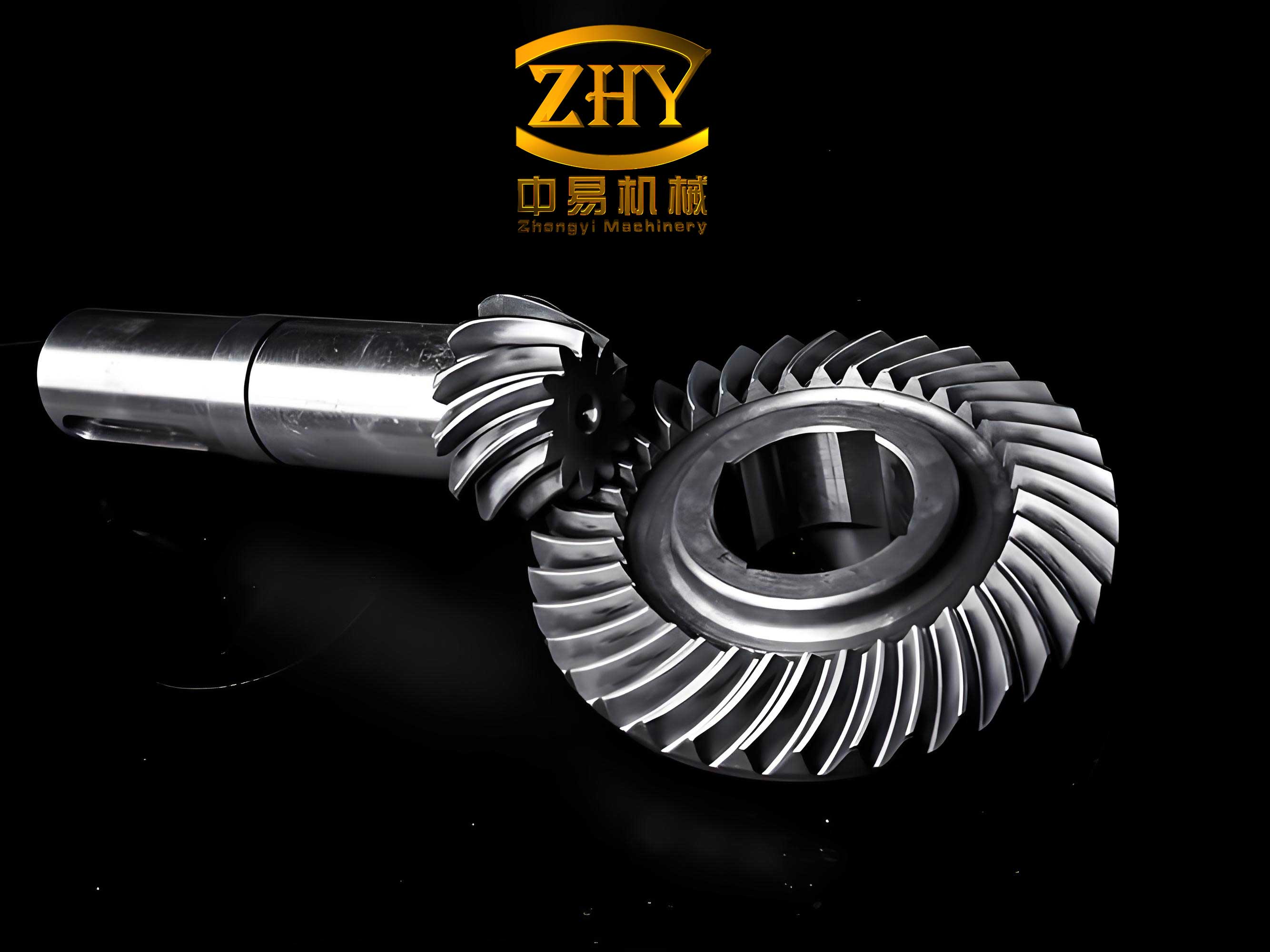
Traditional thermal analyses often simplify the problem by using two-dimensional models or single-tooth segments of spur or helical gears. However, the three-dimensional, multi-tooth contact nature of spiral bevel gears demands a more sophisticated approach. This article presents a comprehensive coupled thermal-structural finite element analysis (FEA) to investigate the steady-state temperature field, the resulting thermal stress distribution, and the consequential thermal deformation in meshing spiral bevel gears. The methodology encompasses the development of a precise geometrical model based on meshing theory, the establishment of a three-dimensional finite element model with multiple teeth, and the sequential coupling of thermal and structural physics to simulate real operating conditions.
Theoretical Foundations for Modeling
1. Geometric Model of Spiral Bevel Gears
The accurate geometric definition of the tooth flanks is the cornerstone of any meaningful analysis. Spiral bevel gears are typically generated using a face-milling process with a circular cutter. The mathematical model is derived from the theory of gearing and the kinematics of the generation process. The pinion and gear tooth surfaces are represented as conjugate surfaces derived from the tool geometry and the relative motion between the cutter and the workpiece.
The surface of the generated gear (often the larger wheel) can be described in a coordinate system attached to the gear. A point P on the gear tooth surface is defined by its position vector $\mathbf{R}^{(r)}_r$, its unit normal vector $\mathbf{n}^{(r)}_r$, and its unit tangent vector $\mathbf{t}^{(r)}_r$. These vectors are obtained through a series of coordinate transformations from the cutter coordinate system to the gear coordinate system, incorporating machine settings such as cutter tilt ($i$), swivel angle ($j$), and the phase angle of the cutter blade ($\theta_{cr}$). The fundamental equation for a point on the gear surface can be expressed as:
$$
\mathbf{R}^{(r)}_r = \mathbf{D}^{(r)}_{rr} + \mathbf{A}^{(r)}_{cr} – b_{tr} \mathbf{t}^{(r)}_r
$$
where $\mathbf{D}^{(r)}_{rr}$ and $\mathbf{A}^{(r)}_{cr}$ are transformation vectors accounting for machine offsets and cradle rotation, and $b_{tr}$ is the distance from the cutter tip along the tool profile.
The conjugate pinion surface is determined by satisfying the condition of continuous contact and the law of gearing. For a given gear rotation angle $\beta$, the pinion surface point in its own coordinate system ($\mathbf{R}^{(l)}_l$, $\mathbf{n}^{(l)}_l$, $\mathbf{t}^{(l)}_l$) that is in contact with the gear point $\mathbf{R}^{(r)}_r$ is found by solving the system:
$$
\begin{aligned}
\mathbf{R}_l &= \mathbf{R}_e + \mathbf{R}_r \\
\mathbf{V}_{rl} \cdot \mathbf{n}_r &= 0
\end{aligned}
$$
Here, $\mathbf{R}_e$ is the offset vector between gear and pinion axes, $\mathbf{V}_{rl}$ is the relative sliding velocity at the contact point, and the dot product condition ensures the common normal vector intercepts the instantaneous axis of rotation. This rigorous mathematical formulation allows for the generation of accurate, point-cloud-based digital models of the spiral bevel gear pair, which are essential for high-fidelity finite element analysis.
2. Governing Equations for Thermal Analysis
The thermal state of a gear during operation is governed by the fundamental laws of heat conduction. The transient, three-dimensional temperature field $T(x, y, z, t)$ within the gear body, assuming no internal heat generation apart from the surface flux, is described by the Fourier heat conduction equation:
$$
\rho c_p \frac{\partial T}{\partial t} = \lambda \left( \frac{\partial^2 T}{\partial x^2} + \frac{\partial^2 T}{\partial y^2} + \frac{\partial^2 T}{\partial z^2} \right)
$$
where $\rho$ is the material density, $c_p$ is the specific heat capacity, $\lambda$ is the thermal conductivity, and $t$ is time. For the analysis of steady-state operating conditions, where the temperature field has stabilized and no longer changes with time ($\partial T / \partial t = 0$), the equation simplifies to Laplace’s equation:
$$
\frac{\partial^2 T}{\partial x^2} + \frac{\partial^2 T}{\partial y^2} + \frac{\partial^2 T}{\partial z^2} = 0
$$
The solution to this equation requires the specification of boundary conditions (BCs) on all surfaces of the gear segment being analyzed. For a segment containing multiple teeth, the boundaries are categorized as follows:
| Boundary Region | Description | Mathematical Form (Convection + Flux) |
|---|---|---|
| M (Meshing Zone) | Tooth flanks actively in contact. | $-\lambda \frac{\partial T}{\partial n} = h_t (T – T_0) – q$ |
| N (Non-meshing Zone) | Tooth tips, non-contact flanks, hub side surfaces. | $-\lambda \frac{\partial T}{\partial n} = h_t (T – T_0)$ |
| S (Heat Sink Zone) | Gear back-face exposed to oil/air flow. | $-\lambda \frac{\partial T}{\partial n} = h_s (T – T_0)$ |
| d (Symmetry/Insulated) | Bottom cross-section of the segment. | $\frac{\partial T}{\partial n} = 0$ |
In the table, $h_t$ and $h_s$ are convective heat transfer coefficients for the tooth and sink regions respectively, $T_0$ is the ambient/bulk oil temperature, $n$ is the surface normal direction, and $q$ is the heat flux input due to friction in the meshing zone. The heat flux $q$ is a critical input and is calculated based on the frictional power loss at the contact interface.
Finite Element Modeling and Analysis Methodology
1. Finite Element Model Development
To capture the multi-tooth engagement characteristics of spiral bevel gears, a three-dimensional finite element model comprising three complete teeth is constructed. The modeling process follows these steps:
- Geometry Creation: Using the mathematical model described earlier, coordinates for points on the tooth surfaces are calculated. These points are used to construct Non-Uniform Rational B-Spline (NURBS) surfaces, which are then solidified to create a precise three-dimensional solid model of a gear segment with three teeth.
- Mesh Generation: The solid model is discretized using high-order hexahedral (brick) elements, specifically 8-node linear heat transfer solid elements (e.g., SOLID70 in ANSYS terminology for thermal analysis). Hexahedral elements are preferred for their better numerical accuracy and convergence behavior compared to tetrahedral elements for problems involving heat conduction and structural stress. A mapped meshing technique is employed in the tooth region to ensure a structured, high-quality grid that can accurately resolve steep temperature and stress gradients.
- Material Properties: The material is assumed to be isotropic. The properties required for the coupled analysis are listed below.
| Material Property | Symbol | Value | Units |
|---|---|---|---|
| Density | $\rho$ | 7900 | kg/m³ |
| Young’s Modulus | $E$ | 210 | GPa |
| Poisson’s Ratio | $\nu$ | 0.3 | – |
| Thermal Conductivity | $\lambda$ | 40 | W/(m·K) |
| Specific Heat Capacity | $c_p$ | 460 | J/(kg·K) |
| Coefficient of Thermal Expansion | $\alpha$ | 1.12 × 10⁻⁵ | 1/K |
2. Thermal Load Calculation: Frictional Heat Flux
The primary heat source is the sliding friction in the contact ellipse. The heat flux $q$ applied to the meshing surface (boundary M) is derived from the frictional power dissipation. It is assumed that the total frictional heat generated is partitioned equally between the two contacting gears (a common simplification), and that all this heat is conducted into the gear bodies (adiabatic condition at the interface). The heat flux is given by:
$$
q = \frac{P_{fric}}{A_{ellipse}} = \frac{\mu F_n v_s}{2 A_{ellipse}}
$$
Where:
$\mu$ = Coefficient of sliding friction (typically 0.045–0.065 for lubricated gears)
$F_n$ = Normal load at the contact point
$v_s$ = Sliding velocity at the contact point
$A_{ellipse}$ = Area of the Hertzian contact ellipse
For steady-state analysis of a multi-tooth system, it is assumed that the heat input per engagement cycle is constant for each tooth pair and that the contact moves sufficiently quickly relative to the thermal diffusion time. Therefore, a time-averaged heat flux can be applied to the potential contact zones on the tooth flanks corresponding to the path of contact.
3. Coupled Thermal-Structural Analysis Procedure
The analysis is performed using a sequential (indirect) coupling method:
- Steady-State Thermal Analysis: The finite element model, with the described boundary conditions and surface heat flux, is solved to obtain the steady-state temperature field $T(x, y, z)$ throughout the three-tooth segment.
- Physics Change and Load Transfer: The element types are switched from thermal to structural (e.g., from SOLID70 to SOLID185 in ANSYS). The nodal temperatures from the thermal solution are imported as a body load for the structural analysis.
- Structural Analysis: A static structural analysis is performed. The thermal load induces an initial strain $\boldsymbol{\varepsilon}_{th}$ at every point in the model:
$$
\boldsymbol{\varepsilon}_{th} = \alpha \Delta T [1, 1, 1, 0, 0, 0]^T
$$
where $\Delta T = T(x,y,z) – T_{ref}$. This thermal strain, when constrained by the material itself and the geometry, gives rise to thermal stress. The governing finite element equation for the displacement $\mathbf{u}$ is:
$$
\mathbf{K} \mathbf{u} = \mathbf{F}_{th}
$$
where $\mathbf{K}$ is the global stiffness matrix, and $\mathbf{F}_{th}$ is the thermal load vector calculated from the thermal strains:
$$
\mathbf{F}_{th} = \sum_{elements} \int_{V_e} \mathbf{B}^T \mathbf{D} \boldsymbol{\varepsilon}_{th} dV
$$
Here, $\mathbf{B}$ is the strain-displacement matrix and $\mathbf{D}$ is the elasticity matrix. - Result Extraction: The structural solution yields the displacement field (thermal deformation) and the stress field (thermal stress), typically evaluated using the von Mises equivalent stress criterion.
Results and Discussion
The following analysis is based on a case study of a hypoid gear pair (a generalized form of spiral bevel gears) with the following key operational parameters: Pinion teeth $Z_1=15$, Gear teeth $Z_2=46$, Pinion speed $n_1=5600$ rpm, Normal load $F_n=34.06$ kN, Ambient temperature $T_0=50^\circ$C.
1. Steady-State Temperature Field
The solved steady-state temperature field reveals critical insights into the thermal behavior of meshing spiral bevel gears. The analysis of the three-tooth model shows that during multi-tooth engagement, one tooth typically carries the highest load at a given instant, which is reflected in its temperature distribution.
- Maximum Temperature Location: The highest temperature on any single tooth is concentrated in the center of its active contact region. This zone corresponds to the area of maximum frictional heat input.
- Temperature Gradients: The temperature decreases radially from the contact point. The gradient is steeper towards the tooth tip than towards the tooth root and gear hub. This is due to the smaller cross-sectional area for heat conduction towards the tip and the heat-sink effect of the bulkier gear body and hub.
- Multi-Tooth Effect: The adjacent teeth show elevated temperatures in their respective contact zones, but at a lower magnitude than the primary loaded tooth, illustrating the load-sharing nature of spiral bevel gears.
The quantitative results for two distinct contact paths—one nearer to the toe (small end) and one nearer to the heel (large end)—are summarized below:
| Contact Path Location | Temperature Range | Peak Temperature Zone |
|---|---|---|
| Near Heel (Large End) | 71.5°C – 80.9°C | Center of contact ellipse |
| Near Toe (Small End) | 71.5°C – 77.0°C | Center of contact ellipse |
The higher peak temperature near the heel is expected due to the higher sliding velocities often associated with that region in hypoid and some spiral bevel gear designs.
2. Thermal Stress Distribution
The thermal stress field, represented by the von Mises equivalent stress, does not mirror the temperature field. A key finding is the spatial decoupling of maximum temperature and maximum stress.
- Maximum Stress Location: Contrary to intuition, the highest thermal stress does not occur at the point of highest temperature (the contact center). Instead, it manifests in the tooth root fillet region, slightly offset from the immediate area below the contact. This is a consequence of constrained thermal expansion. The hot material in the contact zone and the upper part of the tooth tries to expand freely but is severely restrained by the cooler, stiffer bulk of the gear body and the specific geometry of the root. This restraint induces high compressive stresses in the contact region itself and high tensile stresses in the root.
- Stress Gradients: The stress decreases rapidly away from the contact/root region. In the hub and portions of the tooth far from the heated zone, the thermal stress is negligible.
This result has significant implications for design. The tooth root, already a critical area for bending fatigue, is further burdened by cyclic thermal tensile stresses during operation. This thermo-mechanical loading can accelerate crack initiation and propagation, leading to fatigue failure. It underscores the necessity of considering thermal loads in the root design and fillet optimization of spiral bevel gears.
3. Thermal Deformation Analysis
The thermal expansion caused by the non-uniform temperature field leads to a distortion of the ideal tooth geometry. The analysis of the displacement field reveals distinct deformation patterns:
- Maximum Deformation Location: The largest magnitude of total thermal deformation is found at the tooth tip near the contact zone. This area has a high temperature and the least mechanical constraint, allowing it to expand more freely.
- Deformation along Tooth Length (Profile Direction): The expansion is non-uniform along the profile. The heated contact region bulges out, creating a slight convex crowning on the tooth flank. This unintentional “thermal crowning” can be beneficial as it might reduce edge loading and mitigate some impact at the start and end of engagement.
- Deformation along Tooth Thickness (Face Width Direction): The expansion across the tooth thickness is asymmetric due to the one-sided heat input (drive side vs. coast side). This causes the effective contact pattern to shift towards the off-flank side (the “heel” or “toe” depending on design and rotation). For the analyzed case, the X-direction displacement (across thickness) shows a range from -0.266 µm to +0.0105 µm, indicating a net shift. This shift can significantly alter the designed contact pattern, concentrating load on one edge and drastically reducing load capacity and increasing noise.
The comparison between the heel and toe contact paths shows that the higher temperature at the heel leads to proportionally larger thermal deformations in that region, exacerbating the contact pattern shift.
Conclusion
This comprehensive coupled thermal-structural finite element analysis of a three-tooth segment provides a detailed understanding of the thermal behavior in meshing spiral bevel gears. The key conclusions are:
- The steady-state temperature field in multi-tooth engagement features localized “hot spots” at the center of the active contact ellipse on each tooth, with the primarily loaded tooth reaching the highest temperature. The temperature gradient is steeper towards the tooth tip than the root.
- The maximum thermal stress occurs not at the point of highest temperature but in the tooth root fillet region. This is a critical finding as it identifies the root as a zone of combined mechanical and thermal stress concentration, which is vital for fatigue life prediction and design of spiral bevel gears.
- The maximum thermal deformation occurs at the tooth tip. The deformation pattern effectively modifies the tooth geometry: creating a slight beneficial crowning along the profile but causing a detrimental shift of the contact pattern across the face width. This shift can severely degrade transmission performance.
- The analysis demonstrates that the thermal effects (temperature, stress, deformation) are not co-located. Their distribution is a complex interplay between the localized heat input, the three-dimensional geometry of the spiral bevel gears, and the constraints imposed by the gear body.
These insights are crucial for the advanced design of spiral bevel gears. To compensate for the predicted thermal deformations, especially the face-width shift, proactive thermal correction or anti-deformation presetting must be incorporated into the tooth flank topography during the design and manufacturing stages. Furthermore, the root stress analysis must account for the additional thermal tensile stress to ensure long-term reliability under high-speed, high-load conditions. The methodology established here provides a powerful virtual tool for optimizing the performance and durability of these critical power transmission components.