
The pursuit of higher power density and reliability in transmission systems, particularly within demanding sectors like aerospace, has led to the increased adoption of high-contact-ratio (HCR) cylindrical gears. These spur gears are characterized by a contact ratio greater than 2, ensuring that at least two pairs of teeth are in mesh at any given time during operation. This design inherently increases the total length of the contact line, thereby reducing the average load per unit length and enhancing load-carrying capacity and operational smoothness. However, the very nature of their operation under high-speed and heavy-load conditions, typical in helicopter drivetrains, leads to significant power losses primarily dissipated as heat. Effective thermal management through methods like jet-oil lubrication becomes paramount, as excessive temperatures can precipitate failure modes such as scuffing and thermal fatigue, directly impacting the service life of the transmission.
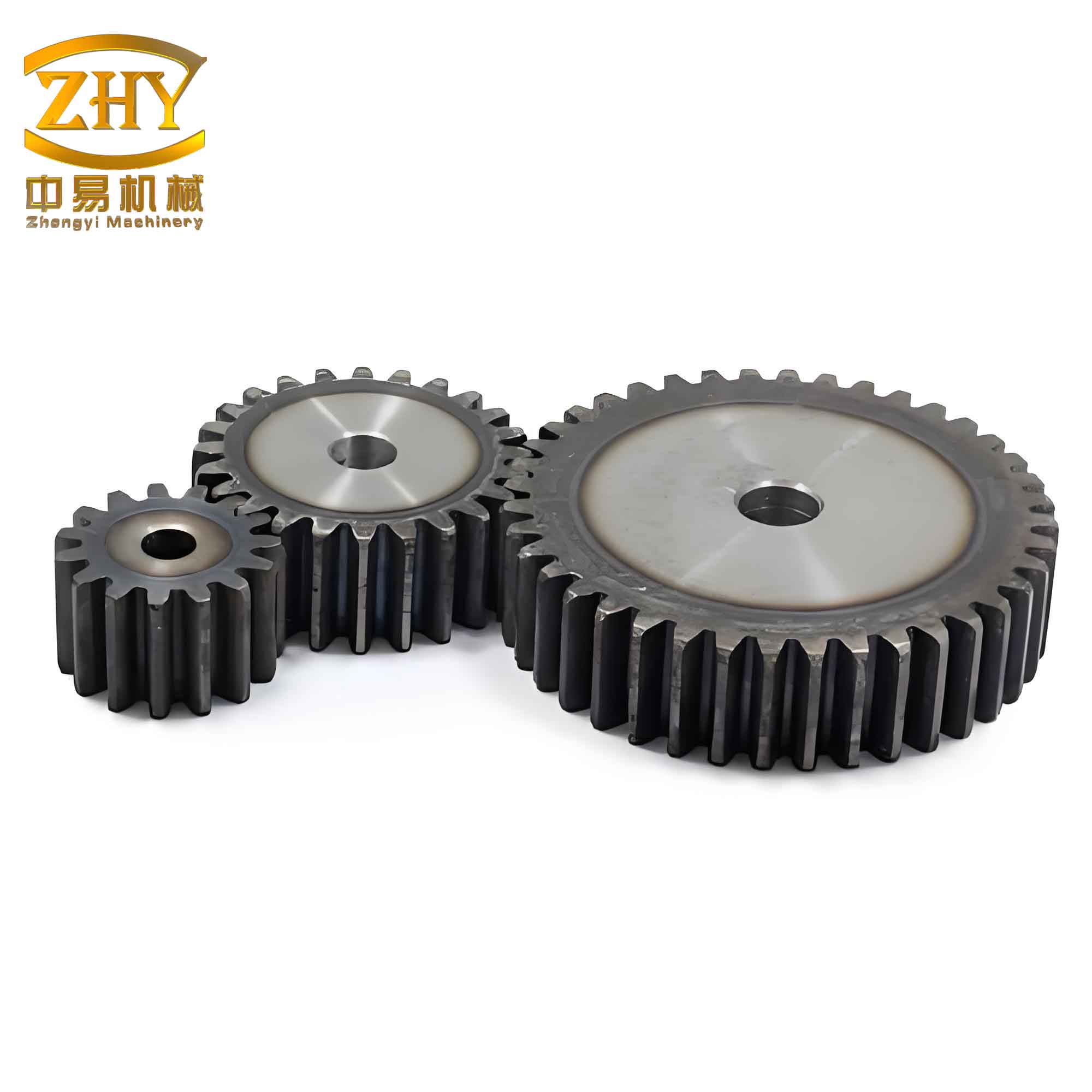
Understanding the temperature field within and around these cylindrical gears is therefore critical. Computational Fluid Dynamics (CFD) has emerged as a powerful tool for such thermo-fluid analyses, allowing for the detailed simulation of complex fluid flow, heat transfer, and their coupling with solid structures. This article presents a comprehensive investigation into the thermal characteristics of high-contact-ratio cylindrical gears under jet-oil lubrication. It begins by establishing the theoretical CFD foundation, including the governing equations and specific models for multiphase flow and moving domains. A detailed numerical model is then constructed and solved to obtain gear surface temperatures and convective heat transfer coefficients. A systematic parametric study explores the influence of lubricant properties, operational conditions, and geometric parameters of the cylindrical gears on their thermal state. Finally, experimental validation is conducted on a dedicated gear test rig, comparing measured temperatures with simulation predictions and contrasting the thermal performance of HCR cylindrical gears against standard designs.
Foundations of the CFD-based Thermal Analysis
The accurate prediction of the temperature field in a gearbox involves solving the coupled equations of fluid dynamics and heat transfer. The fluid flow, comprising air and oil, is governed by the fundamental conservation laws. The continuity equation ensures mass conservation:
$$
\frac{\partial \rho_f}{\partial t} + \nabla \cdot (\rho_f \vec{u}) = 0
$$
The momentum conservation is described by the Navier-Stokes equations:
$$
\frac{\partial (\rho_f u_i)}{\partial t} + \nabla \cdot (\rho_f u_i \vec{u}) = \nabla \cdot (\mu \nabla u_i) – \frac{\partial p}{\partial x_i} + S_i
$$
And the energy equation accounts for heat transfer:
$$
\frac{\partial (\rho_f T)}{\partial t} + \nabla \cdot (\rho_f \vec{u} T) = \nabla \cdot \left( \frac{k_f}{C_p} \nabla T \right) + S_T
$$
Where \( \rho_f \) is fluid density, \( \vec{u} \) is velocity vector, \( \mu \) is dynamic viscosity, \( p \) is pressure, \( T \) is temperature, \( k_f \) is thermal conductivity, \( C_p \) is specific heat, and \( S_i \), \( S_T \) are source terms.
To model the jet-oil lubrication involving two immiscible phases (oil and air), the Volume of Fluid (VOF) method is employed. This method tracks the volume fraction of each phase within each computational cell. For a two-phase system, the sum of volume fractions is unity:
$$
\alpha_{oil} + \alpha_{air} = 1
$$
The simulation of rotating cylindrical gears within a stationary housing is efficiently handled using the Multiple Reference Frame (MRF) approach. In this method, a rotating reference frame is applied to the fluid domains immediately surrounding each gear. The governing equations are solved in these rotating frames, and the solutions are coupled with the stationary frame of the rest of the gearbox through interfaces, avoiding the computational expense of transient sliding meshes for a steady-state thermal analysis.
A critical input for the thermal simulation is the heat generated at the meshing interfaces of the cylindrical gears. The total heat generation rate \( Q \) is the sum of sliding power loss \( P_s \), rolling power loss \( P_r \), and windage loss \( P_w \). These can be estimated using empirical models. The sliding and rolling losses are primary contributors and depend on gear geometry, load, speed, and lubrication conditions. The generated heat is partitioned between the driving and driven cylindrical gears based on their material properties and tangential velocities at the mesh point. The heat flux is then applied as a volumetric source to a thin layer on the tooth flanks of the cylindrical gears in the simulation.
Numerical Model Setup for Cylindrical Gears
The analysis focuses on a pair of high-contact-ratio cylindrical gears. The key geometric and operational parameters are summarized in the table below.
| Parameter | Driving Gear (Large) | Driven Gear (Small) |
|---|---|---|
| Normal Module, \( m_n \) (mm) | 3.25 | 3.25 |
| Number of Teeth, \( z \) | 32 | 25 |
| Face Width, \( b \) (mm) | 16.0 | 16.5 |
| Profile Shift Coefficient, \( \xi \) | -0.19 | -0.14 |
| Pressure Angle, \( \alpha \) (°) | 20 | 20 |
| Addendum Coefficient, \( h_a^* \) | 1.32 | 1.32 |
| Contact Ratio, \( \epsilon_{\alpha} \) | 2.2 | |
| Rotational Speed, \( n \) (rpm) | 1500 | 1920 |
| Load Level | Grade 9 | |
The computational domain includes the gearbox housing, the two cylindrical gears, and the oil jet nozzle. The gears are modeled with simplified features (removed small fillets) to ensure mesh quality, especially in the narrow meshing gap. An unstructured tetrahedral mesh is generated for the entire fluid domain, with refinement applied near the gear surfaces and the meshing zone. The MRF zones are defined around each gear. Boundary conditions are assigned as follows: velocity inlet for the oil jet, pressure outlet for the oil drain, coupled walls for the gear-fluid interfaces, and convective cooling for the external housing walls. The initial oil temperature is set to 60°C, with an ambient temperature of 26.85°C. The heat flux calculated from the power loss models is applied to the tooth surfaces.
Simulation Results and Parametric Influence Analysis
Temperature and Convective Heat Transfer Distribution
The steady-state temperature field on the surfaces of the cylindrical gears reveals distinct patterns. For both gears, the highest temperatures occur on the tooth flanks, particularly in the region from the pitch line towards the tooth tip. This aligns with areas of higher sliding velocity and concentrated frictional heat generation. The temperature distribution is symmetric about the mid-plane of the face width, with temperatures being highest at the center and gradually decreasing towards the ends due to better heat dissipation at the gear sides. The gear bodies (hubs and webs) show the lowest temperatures as they are only heated by conduction from the teeth.
The convective heat transfer coefficient (HTC) distribution provides insight into the cooling effectiveness. The driven gear (smaller, faster) generally exhibits higher HTC values than the driving gear, indicating more effective convective cooling due to its higher rotational speed. On the tooth faces, the HTC increases with radius, reaching a maximum near the tooth tip where the peripheral speed is highest. The meshing zone, being abundantly supplied with oil, shows locally elevated HTC values. The table below summarizes the typical range of results from the baseline simulation.
| Metric | Driving Cylindrical Gear | Driven Cylindrical Gear |
|---|---|---|
| Max. Tooth Surface Temperature | ~121°C | ~118°C |
| Min. Temperature (Gear Body) | ~65°C | ~63°C |
| Avg. Convective HTC on Flank (W/m²·K) | ~2800 | ~3500 |
Influence of Lubricant and Operational Parameters
A control-variable study was conducted to understand the sensitivity of the thermal state of the cylindrical gears to various parameters.
1. Lubricant Inlet Temperature: Increasing the oil inlet temperature linearly raises the bulk temperature of the cylindrical gears, as it adds more initial thermal energy to the system. However, the warmer oil has lower viscosity, which can slightly increase the convective HTC.
2. Oil Jet Flow Rate: Increasing the flow rate initially lowers gear temperatures significantly due to enhanced convective cooling. Beyond an optimal point (around 1.76 L/min in this study), the temperature reduction diminishes as additional oil increases churning losses, generating more heat.
3. Rotational Speed: Higher speeds increase frictional and windage losses, generally leading to higher gear temperatures. However, the relationship is non-linear; at very high speeds, the dramatic increase in convective cooling can sometimes mitigate the temperature rise or even cause a slight decrease compared to a medium-speed range.
4. Load: Increased transmitted load has the most direct and significant impact on raising the temperature of the cylindrical gears, as it proportionally increases the sliding friction power loss, the primary heat source.
| Parameter | Trend on Gear Temperature | Trend on Convective HTC | Primary Reason |
|---|---|---|---|
| Oil Temperature ↑ | Increases Linearly | Slight Increase | Higher system energy input; lower oil viscosity. |
| Oil Flow Rate ↑ | Decreases, then plateaus | Increases | Better cooling vs. increased churning loss. |
| Rotational Speed ↑ | Increases, potential plateau/decrease at very high speed | Significant Increase | Higher losses vs. dramatically improved convection. |
| Transmitted Load ↑ | Significant Increase | Minor Change | Direct increase in frictional heat generation. |
Influence of Cylindrical Gear Geometric Parameters
The geometry of the cylindrical gears themselves plays a crucial role in their thermal behavior.
1. Face Width: A wider face increases the heat generation area but also the heat dissipation surface. The simulation results indicate that the latter effect dominates, leading to a net decrease in maximum tooth temperature with increased face width.
2. Pressure Angle: A larger pressure angle improves the bending strength and reduces the specific sliding on the tooth flanks. This reduction in sliding friction leads to lower heat generation and consequently lower operating temperatures for the cylindrical gears.
3. Contact Ratio (via Addendum Coefficient): This is a key differentiator for HCR cylindrical gears. Increasing the addendum coefficient raises the contact ratio. While this improves load sharing, it also increases the length of the contact line undergoing sliding friction, leading to greater total frictional heat generation. Therefore, high-contact-ratio cylindrical gears tend to operate at higher temperatures than standard cylindrical gears under identical load and speed conditions. The higher addendum also increases the peripheral speed of the tooth tip, which can enhance convective cooling to some extent, but the net effect in the studied range was a temperature increase.
| Geometric Parameter | Trend on Gear Temperature | Underlying Mechanism |
|---|---|---|
| Face Width ↑ | Decreases | Increase in heat dissipation area outweighs increase in heat generation. |
| Pressure Angle ↑ | Decreases | Reduced specific sliding and frictional power loss. |
| Contact Ratio ↑ (HCR Gears) | Increases | Increased total contact line length leads to greater total frictional heat. |
Experimental Validation and Comparison
To validate the CFD findings, experimental tests were conducted on a CL-100 type closed-loop power circulating gear test rig. The test cylindrical gears (HCR design) were instrumented with embedded thermocouples near the tooth surfaces. The gearbox was fitted with a jet lubrication system, and tests were run under controlled conditions of speed, load, and oil inlet temperature.
The measured gear temperatures showed a characteristic rise before stabilizing at a steady-state value, typically within 25-30 minutes of operation. The steady-state temperatures were then compared against the CFD simulation results for various loads and two oil temperatures (60°C and 90°C). The comparison showed good agreement in trend, with both experiment and simulation confirming that gear temperature rises with increasing load. The absolute error between simulation and experiment diminished at higher loads, demonstrating the robustness of the CFD model for predicting the thermal behavior of cylindrical gears under loaded conditions.
| Condition (Oil Temp: 60°C) | Load Level | Experimental Temp. (°C) | CFD Sim. Temp. (°C) | Deviation |
|---|---|---|---|---|
| Driving Cylindrical Gear | Grade 7 | ~98 | ~104 | ~+6.1% |
| Grade 8 | ~108 | ~113 | ~+4.6% | |
| Grade 9 | ~118 | ~121 | ~+2.5% |
A pivotal finding from the experiments was the direct comparison between high-contact-ratio and standard cylindrical gears. Under identical operating conditions (speed, load, oil temperature), the HCR cylindrical gears consistently exhibited higher tooth temperatures. This temperature differential became more pronounced as the applied load increased, validating the simulation-based insight that the greater total frictional heat generation in HCR designs is a dominant thermal effect.
| Gear Type (Contact Ratio) | Load: Grade 7 Temp. | Load: Grade 8 Temp. | Load: Grade 9 Temp. |
|---|---|---|---|
| Standard Cylindrical Gears (~1.73) | ~91°C | ~100°C | ~108°C |
| High-Contact-Ratio Cylindrical Gears (~2.21) | ~98°C | ~108°C | ~118°C |
| Temperature Difference (HCR – Std) | +7°C | +8°C | +10°C |
Conclusion
This integrated study combining CFD simulation and experimental testing provides a detailed understanding of the thermal field in high-contact-ratio cylindrical gears under jet-oil lubrication. The CFD model, employing VOF and MRF methods, successfully predicts the characteristic temperature distribution where the highest temperatures occur on the tooth flanks near the tip region and decrease symmetrically towards the gear ends. The driven, smaller cylindrical gear typically experiences better convective cooling due to its higher rotational speed. The parametric study clarifies the influence of key factors: gear temperature increases with load, oil inlet temperature, and contact ratio, while it decreases with increased oil flow rate (up to a point), face width, and pressure angle. Rotational speed presents a complex, non-linear relationship due to competing effects on heat generation and convection.
The experimental validation confirms the general trends predicted by the simulation, particularly the load-dependent temperature rise. Most significantly, the tests empirically demonstrate that high-contact-ratio cylindrical gears operate at measurably higher temperatures than standard cylindrical gears under the same conditions, and this difference amplifies with increasing load. This finding is crucial for designers, indicating that the enhanced load capacity of HCR cylindrical gears comes with a thermal cost that must be actively managed through optimized lubrication system design, careful material selection, and appropriate cooling strategies to ensure long-term reliability.