
In modern manufacturing, dry gear hobbing machines represent a significant advancement in green manufacturing due to their elimination of cutting fluids, which reduces environmental impact. However, the absence of cooling fluids exacerbates thermal issues, leading to increased temperatures and thermal deformations that critically affect machining accuracy. Thermal errors account for 40% to 70% of total machining inaccuracies in precision equipment, making thermal management a pivotal concern. This study addresses the thermal characteristics of dry gear hobbing machines through a multi-source information fusion approach, integrating temperature and thermal deformation measurements to enhance thermal balance design. We develop a comprehensive testing methodology, implement data processing techniques, and validate the approach experimentally, providing a framework for improving the thermal stability of gear hobbing processes.
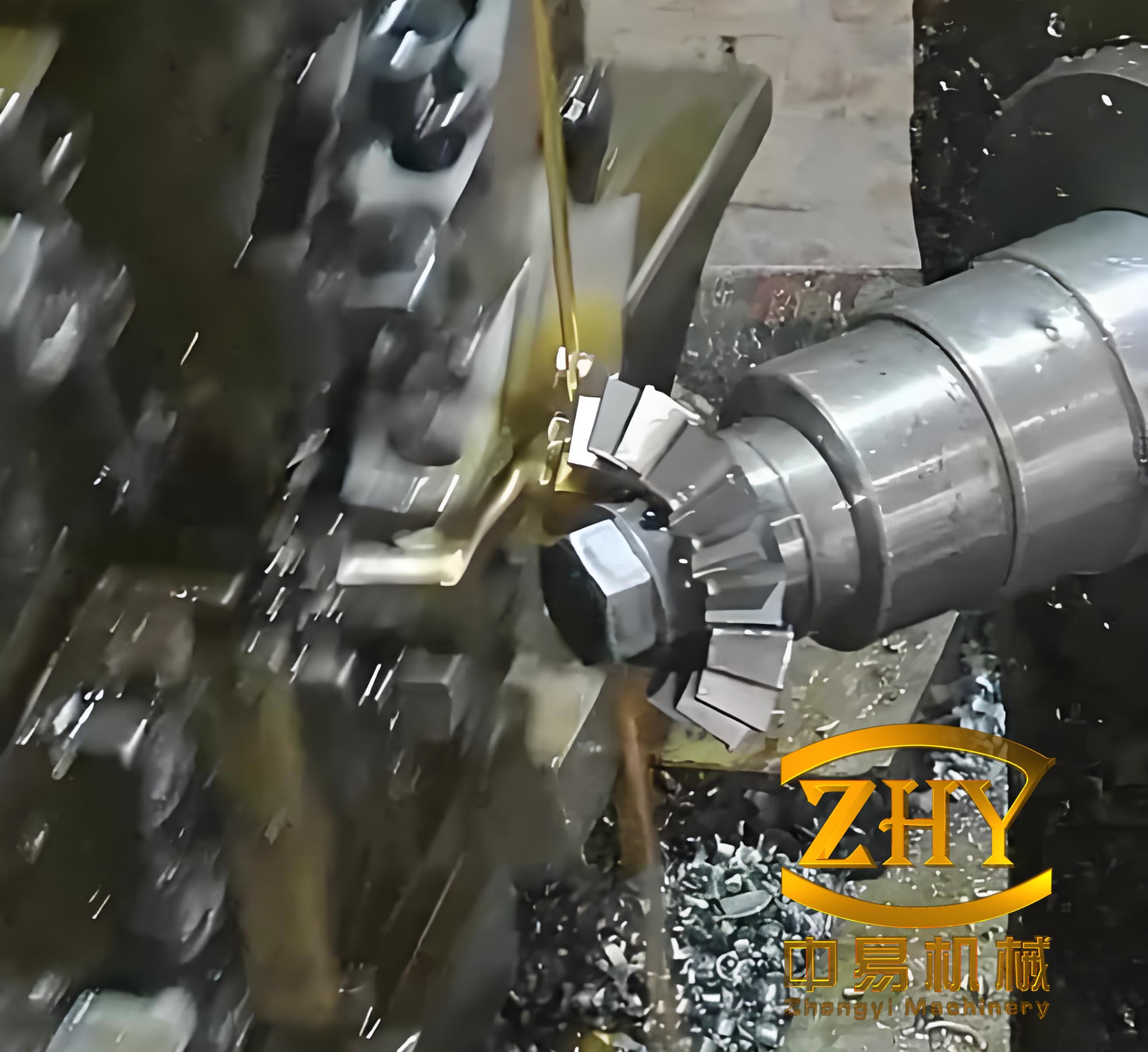
The structural layout of dry gear hobbing machines involves a vertical configuration with offset columns and horizontal sliding plates for radial feed motion. Dual main spindles—hob and worktable—are directly driven by built-in motors, contributing to unique thermal behaviors. Heat generation arises from multiple sources, including drive motors, friction at moving parts, cutting processes, hydraulic systems, and environmental fluctuations. The use of low-temperature compressed air for chip removal further complicates heat dissipation, often leading to uneven temperature distribution and complex thermal deformations in components like the bed, column, and worktable. To tackle this, we propose a multi-source information fusion testing scheme that captures temperature and deformation data from critical points, enabling precise analysis of thermal characteristics.
Our technical framework for thermal characteristics testing encompasses three layers: objective definition, functional implementation, and data analysis. The objective layer focuses on monitoring temperature and thermal deformation across key components, such as the column, worktable, spindles, and bed. The functional layer involves hardware selection and software development for data acquisition, while the analysis layer employs advanced signal processing techniques. This integrated approach ensures accurate measurement of multi-source thermal signals, accounting for the complex heat flow and structural dynamics of gear hobbing machines. By preserving interfaces for additional parameters like force and vibration, the system supports extended performance studies, enhancing its applicability in industrial settings.
For hardware implementation, we selected a 16-channel NI-9214 C-series temperature input module paired with K-type thermocouples, which offer linear response and a temperature range of 0–482°C. Thermal deformation measurements utilized an NI-9202 voltage input module with HG-C1030 CMOS laser displacement sensors, providing a repeatability of 10 μm and a ±5 mm range. These modules were housed in a cDAQ-9174 compact chassis, powered externally to ensure stable operation. Sensor placement was optimized based on preliminary infrared thermography to identify thermal hotspots, resulting in 16 measurement points covering motors, bearings, slides, and environmental zones. This setup facilitates synchronous data acquisition, minimizing interference and capturing the holistic thermal behavior of the gear hobbing machine.
Software development was conducted on the LabVIEW platform, featuring modular programs for temperature and deformation acquisition within independent While loops. This separation allows customized sampling rates and durations for each data type, preventing cross-talk. Real-time display modules include waveform graphs for dynamic visualization, data extraction for post-processing, and thermal curve plotting for trend analysis. A key innovation is the integration of Python tools via LabVIEW’s secondary development, enabling seamless data processing. The user interface incorporates path selection, channel configuration, and iterative processing options, streamlining the analysis of large datasets generated during prolonged gear hobbing operations.
Data processing follows an Input-Process-Output (IPO) model to handle the voluminous and noisy thermal data from gear hobbing machines. Input involves reading .tdms files into Python using NumPy arrays, while the process stage sequentially applies outlier replacement, moving average filtering, wavelet filtering, and data resampling. Output includes visualized graphs and .xlsx files for further analysis. For outlier replacement, we employ a standard deviation-based method where values exceeding ±3σ from the mean are replaced with adjacent averages, alongside upper and lower bound checks. Moving average filtering smooths data by computing windowed averages, defined for a window size \( n \) as:
$$ \text{AM}(i) = \frac{x_{i-n+1} + x_{i-n+2} + \ldots + x_{i-1} + x_i}{n} $$
where \( x_i \) represents the i-th data point. Wavelet filtering uses thresholding to denoise signals, with thresholds computed as:
$$ \lambda_s = \sqrt{2 \log N} $$
$$ \lambda_r = W_{\text{min}} $$
$$ \lambda_h = \begin{cases}
\lambda_s, & \text{if } \frac{\sum_{j=1}^N |W_j|^2 – N}{N} < \frac{1}{\sqrt{N}} \left( \frac{\ln N}{\ln 2} \right)^3 \\
\min(\lambda_s, \lambda_r), & \text{otherwise}
\end{cases} $$
Here, \( N \) is the number of wavelet coefficients, \( W_j \) denotes the j-th coefficient, and \( W_{\text{min}} \) is the minimum coefficient. Finally, data resampling reduces density by grouping data at specified frequencies and computing channel averages, refining the analysis of thermal trends in gear hobbing machines.
Validation experiments were conducted on a YE3115CNC dry gear hobbing machine, processing 95 gear blanks from an automotive transmission via up-cut hobbing. Cutting parameters included a module of 1.95 mm, 52 teeth, a helix angle of -27°, and a hob speed of 900 rpm with a feed rate of 36.058 mm/min. The machine underwent a warm-up phase followed by approximately 2 hours of continuous operation. Temperature sensors were positioned at 16 locations, such as the hob motor end, worktable bearing seat, and lubricant inlets, while deformation sensors targeted the hob and worktable spindles. This setup allowed comprehensive monitoring of thermal effects during gear hobbing.
| Sensor ID | Location | Description |
|---|---|---|
| N0 | Hob Motor End | Directly driven motor heat |
| N1 | Z-axis Screw Nut | Friction-induced heating |
| N2 | X-axis Upper Slide | Motion-related temperature rise |
| N3 | X-axis Lower Slide | Slide contact heat |
| N4 | Coolant Inlet | Water cooling input temperature |
| N5 | Coolant Outlet | Heat exchange monitoring |
| N6 | Z-axis Guide | Guideway friction heat |
| N7 | Nozzle Outlet | Compressed air temperature |
| N8 | Hob Front | Cutting zone proximity |
| N9 | Worktable Bearing | Bearing friction heat |
| N10 | Hob Middle Bearing | Intermediate support heat |
| N11 | Lubricant Inlet | Oil supply temperature |
| N12 | Lubricant Outlet | Oil return temperature |
| N13 | Hob Front Bearing | Primary bearing heat |
| N14 | Dryer Outlet | Air treatment output |
| N15 | Machine Environment | Ambient temperature reference |
Results from the temperature measurements at selected points, such as the hob motor end (N0) and hob front bearing (N13), revealed initial rapid temperature increases that gradually stabilized, indicating thermal equilibrium. The hob front bearing, with limited cooling, reached higher steady-state temperatures compared to the motor end, which benefited from internal cooling. X-axis slide temperatures (N2) rose slowly due to low motion speeds, while nozzle outlets (N7) maintained sub-ambient temperatures from compressed air. Lubricant inlets (N11) and outlets (N12) showed minimal fluctuations, with outlets consistently warmer due to heat absorption. Environmental temperatures (N15) ranged between 27–28°C, slightly declining over time, influencing overall machine thermal behavior. Thermal deformation analysis of the worktable spindle demonstrated an upward trend, peaking at around 14 μm after one hour and stabilizing, with environmental cooling slightly mitigating the deformation rate. These findings underscore the effectiveness of our multi-source fusion approach in capturing the dynamic thermal characteristics of gear hobbing machines.
In conclusion, this study establishes a robust methodology for multi-source information fusion testing and analysis of thermal characteristics in dry gear hobbing machines. By integrating hardware and software solutions with advanced data processing, we achieve accurate online measurement of temperature and deformation, facilitating thermal balance design. The IPO-based processing sequence—encompassing outlier handling, filtering, and resampling—ensures reliable data interpretation, validated through practical gear hobbing trials. Future work will focus on refining the system for real-time monitoring and optimizing thermal management strategies, ultimately enhancing the precision and sustainability of gear manufacturing processes. This approach not only addresses the unique challenges of dry gear hobbing but also sets a precedent for thermal analysis in advanced manufacturing systems.