
In modern industrial and defense applications, such as marine propulsion, aerospace, automotive, and wind power, gear transmission systems play a critical role as essential components. However, these systems are also primary sources of vibration and noise, which can compromise the stealth and stability of equipment, especially in high-speed and heavy-duty scenarios. Helical gears are widely used due to their smooth engagement and high load capacity, but under extreme operating conditions, thermal and elastic deformations become significant, leading to non-conjugate meshing and increased dynamic loads. To address this, gear modification techniques are employed to minimize transmission errors and reduce vibrations. Traditional methods often focus solely on elastic deformation, neglecting thermal effects, which can be substantial in high-performance helical gears. This study presents a comprehensive approach to three-dimensional modification of helical gears by integrating both thermal and elastic deformations, using finite element analysis, optimization algorithms, and experimental validation.
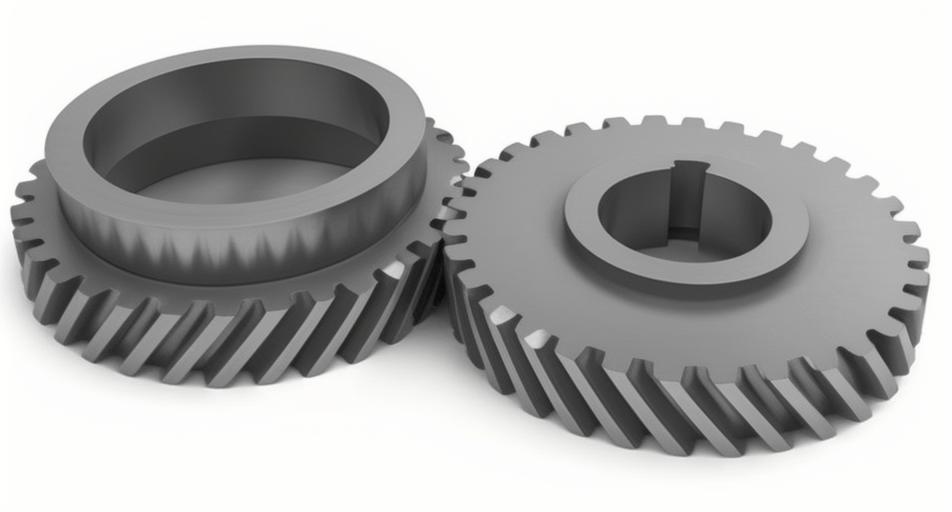
The importance of helical gears in transmission systems cannot be overstated; their helical tooth design allows for gradual engagement, reducing impact loads and noise compared to spur gears. However, as operational speeds and loads increase, the heat generated from friction and meshing losses causes temperature rises, leading to thermal expansion. This thermal deformation alters the tooth profile and alignment, exacerbating transmission errors and vibration. Previous research has extensively explored gear modification based on elastic deformation, but few studies have incorporated thermal effects into the modification design. In this work, we develop a finite element model to analyze the temperature distribution and thermal deformation of helical gear teeth. By combining these results with elastic deformation data, we optimize the modification parameters using genetic algorithms, resulting in a new three-dimensional modification scheme. Experimental tests demonstrate the effectiveness of this approach in significantly reducing vibration and noise, with transmission error amplitude decreasing by 47.08% and meshing line acceleration amplitude by 70.35%.
To begin, we establish a detailed finite element model for thermal analysis of helical gears. The gear parameters, including module, face width, pressure angle, helix angle, and number of teeth, are critical inputs. For instance, consider a helical gear pair with the following specifications, which are summarized in Table 1. These parameters are typical for high-speed applications, such as marine propulsion systems, where thermal effects are pronounced.
| Parameter | Value |
|---|---|
| Module (mm) | 6 |
| Face Width (mm) | 75 |
| Pressure Angle (°) | 20 |
| Helix Angle (°) | 9.9116 |
| Number of Teeth (Pinion/Gear) | 19/47 |
| Transmitted Power (kW) | 86.77 |
| Pinion Speed (rpm) | 2500 |
| Load Torque (Nm) | 800 |
The lubrication oil used in this study is L-TSA32 turbine oil, with properties at 40°C as shown in Table 2. These properties influence the heat transfer and friction conditions in the gear mesh, affecting the temperature field.
| Property | Value |
|---|---|
| Density (g/cm³) | 0.8825 |
| Kinematic Viscosity (mm²/s) | 32.34 |
| Thermal Conductivity (W/(m·K)) | 0.1277 |
| Specific Heat Capacity (J/(kg·K)) | 1920.2 |
The finite element analysis involves steady-state thermal simulation to determine the temperature distribution across the gear tooth surface. The model meshes the gear teeth with fine elements to capture gradients accurately. Heat generation is calculated based on friction losses and power transmission, with boundary conditions accounting for convection cooling from the lubricant. The temperature field results reveal that for helical gears, the highest temperatures do not necessarily occur at the pitch circle. Instead, temperature peaks are observed near the tooth tip and root regions along the profile, and at the mid-face width along the axial direction. This distribution is attributed to the sliding velocities and contact conditions in helical gear meshing. Mathematically, the heat generation rate per unit area can be expressed as:
$$ q = \mu \cdot p \cdot v_s $$
where \( q \) is the heat flux, \( \mu \) is the coefficient of friction, \( p \) is the contact pressure, and \( v_s \) is the sliding velocity. Integrating this over the contact zone allows us to compute the nodal temperatures in the finite element model.
After obtaining the temperature field, we proceed to structural analysis to extract thermal deformation. The thermal expansion is governed by the material’s coefficient of thermal expansion \( \alpha \), and the deformation \( \delta_T \) at a point is given by:
$$ \delta_T = \alpha \cdot \Delta T \cdot L $$
where \( \Delta T \) is the temperature rise relative to a reference state, and \( L \) is a characteristic length. In our model, we apply the temperature field as a body load and constrain the gear boundaries to simulate realistic mounting conditions. The resulting deformation cloud shows that thermal expansion causes tooth deflection primarily along the meshing direction. For a node on the tooth surface, the deformation components in the Cartesian coordinates \( (u_x, u_y, u_z) \) are transformed into the meshing line direction component \( \Delta s \) using:
$$ \Delta s = u_y \sin \theta_1 – u_x \cos \theta_1 $$
Here, \( \theta_1 \) is the pressure angle at that point, derived from the gear geometry. This transformation is crucial for aligning the deformation with the modification directions.
Next, we determine the gear modification parameters. Gear modification typically includes profile and lead corrections, which together form three-dimensional modification. For helical gears, profile modification involves altering the tooth shape along the height, while lead modification adjusts the tooth along the width. The modification curve is often a fourth-order parabola to ensure smooth transitions. The elastic modification parameters are optimized to minimize transmission error, which is a key indicator of gear performance. Transmission error \( TE \) is defined as the difference between the actual and theoretical positions of the driven gear, and it can be expressed as:
$$ TE(\phi) = \theta_2(\phi) – \frac{N_1}{N_2} \theta_1(\phi) $$
where \( \theta_1 \) and \( \theta_2 \) are the angular positions of the driving and driven gears, \( N_1 \) and \( N_2 \) are the numbers of teeth, and \( \phi \) is the rotation angle. Using genetic algorithms, we optimize the modification parameters to reduce the amplitude of transmission error. The optimization objective function is:
$$ \min f(Y) = \text{amplitude}(TE(Y)) $$
where \( Y \) represents the modification parameters, including profile and lead modification amounts and lengths. The initial elastic modification parameters obtained from optimization are listed in Table 3. All values are in meters.
| Parameter | Description | Value (m) |
|---|---|---|
| Y1 | Root profile modification amount | 1.04e-05 |
| Y2 | Tip profile modification amount | 1.26e-06 |
| Y3 | Root profile modification length | 1.6e-03 |
| Y4 | Tip profile modification length | 3.2e-03 |
| Y5 | Lead modification amount at entry | 8.5e-06 |
| Y6 | Lead modification amount at exit | 8.3e-06 |
| Y7 | Unmodified lead length | 3.5e-02 |
However, these parameters only account for elastic deformation. To incorporate thermal effects, we extract the thermal deformation components from the finite element analysis. Specifically, we focus on key points: at the pitch line along the face width for lead modification, and at the meshing points along the profile for profile modification. The thermal modification amounts are derived from the deformation \( \Delta s \) at these points, as shown in Table 4.
| Parameter | Description | Value (m) |
|---|---|---|
| Y1 (thermal) | Root profile thermal deformation | 1.65e-06 |
| Y2 (thermal) | Tip profile thermal deformation | 1.35e-06 |
| Y5 (thermal) | Lead thermal deformation at entry | 1.48e-06 |
| Y6 (thermal) | Lead thermal deformation at exit | 1.66e-06 |
By superimposing the elastic and thermal modification parameters, we obtain the final modification scheme for helical gears considering thermo-elastic deformation. The combined parameters are presented in Table 5. This integration ensures that the gear tooth surface is corrected for both mechanical loading and thermal expansion, leading to an optimized geometry under actual operating conditions.
| Parameter | Description | Value (m) |
|---|---|---|
| Y1 (combined) | Total root profile modification | 1.20e-05 |
| Y2 (combined) | Total tip profile modification | 1.00e-05 |
| Y3 | Root profile modification length | 1.6e-03 |
| Y4 | Tip profile modification length | 3.2e-03 |
| Y5 (combined) | Total lead modification at entry | 1.00e-05 |
| Y6 (combined) | Total lead modification at exit | 1.00e-05 |
| Y7 | Unmodified lead length | 3.5e-02 |
The modification surface for the pinion helical gear is generated based on these parameters, forming a three-dimensional curved surface that compensates for both elastic and thermal deformations. The surface equation can be described as a superposition of profile and lead modification functions. For profile modification along the tooth height \( h \), the curve is given by:
$$ P(h) = C_p \cdot \left( \frac{h}{H} \right)^4 $$
where \( C_p \) is the modification amount at the tip or root, and \( H \) is the total tooth height. For lead modification along the tooth width \( b \), the curve is:
$$ L(b) = C_l \cdot \left( \frac{b}{B} \right)^4 $$
where \( C_l \) is the modification amount at the entry or exit, and \( B \) is the face width. The combined modification surface \( S(h,b) \) is then:
$$ S(h,b) = P(h) + L(b) $$
This surface ensures smooth meshing by aligning the teeth under loaded and thermal conditions.
To validate the proposed modification method, we conduct gear performance tests using a mechanical closed-loop power circulation test rig. The setup includes a variable-speed motor, torque sensors, loading devices, test gearboxes, and measurement instruments such as optical encoders for transmission error and accelerometers for vibration. The helical gears manufactured with the thermo-elastic modification parameters are installed and run under conditions matching the analysis. The test results are compared with theoretical simulations to assess effectiveness.
The transmission error measurements show a significant reduction after modification. The amplitude of transmission error decreases from 8.3464 micrometers to 4.4168 micrometers, a reduction of 47.08%. This demonstrates that the modified helical gears achieve smoother meshing with less positional deviation. Similarly, the vibration in the meshing line direction, measured as acceleration amplitude, drops from 122.2663 m/s² to 36.2526 m/s², a reduction of 70.35%. These improvements confirm that the thermo-elastic modification effectively mitigates dynamic excitations in helical gear systems.
The success of this approach lies in the accurate modeling of thermal deformation. For helical gears, the temperature distribution is non-uniform due to the helical angle, which causes varying sliding velocities along the tooth face. The finite element model captures this complexity, allowing for precise deformation extraction. Furthermore, the optimization process using genetic algorithms ensures that the modification parameters are globally optimal, minimizing both transmission error and vibration. The genetic algorithm operates by evolving a population of parameter sets over generations, with fitness based on the objective function. The update rule for parameters can be expressed as:
$$ Y_{new} = Y_{old} + \eta \cdot \nabla f(Y) $$
where \( \eta \) is a learning rate, and \( \nabla f(Y) \) is the gradient of the objective function, though in practice, genetic algorithms use crossover and mutation operations rather than gradient descent.
In conclusion, this study presents a novel method for three-dimensional modification of helical gears that incorporates both thermal and elastic deformations. By developing a detailed finite element model for temperature field analysis, extracting thermal deformation components, and combining them with optimized elastic modification parameters, we derive a comprehensive modification scheme. Experimental tests on helical gears validate the method, showing substantial reductions in transmission error and vibration. This approach is particularly valuable for high-speed, heavy-duty applications where thermal effects are significant, such as in marine propulsion and aerospace systems. Future work could explore dynamic thermal-structural coupling or extend the method to other gear types, but the current results underscore the importance of integrated thermo-elastic analysis in gear design for enhanced stability and noise reduction.
The implications of this research are far-reaching for industries relying on precision gear systems. Helical gears, with their inherent advantages, can now be optimized further to meet stringent performance requirements. The methodology outlined here—combining finite element analysis, optimization algorithms, and experimental validation—provides a robust framework for gear modification that accounts for real-world operating conditions. As technology advances towards higher speeds and loads, such comprehensive approaches will become increasingly essential for ensuring reliability and efficiency in mechanical transmissions.