
In the realm of automotive engineering, the differential system plays a pivotal role in enabling smooth vehicle operation during turning maneuvers. At the heart of this system lies the bevel gear assembly, particularly the planetary and half-shaft bevel gears, which facilitate torque distribution and speed differentiation. Understanding the thermal behavior of these bevel gears under differential conditions is crucial for enhancing lubrication performance, preventing failures such as scuffing and pitting, and optimizing overall transmission efficiency. This study delves into the thermal elastohydrodynamic lubrication (TEHL) characteristics of straight bevel gears in a differential setup, employing a non-Newtonian fluid model to simulate real-world operating scenarios. By establishing an unsteady TEHL model, we analyze the temperature field variations influenced by gear geometry and operational parameters. The insights garnered aim to provide a theoretical foundation for advanced lubrication design in differential bevel gear systems, ensuring durability and reliability in automotive applications.
The differential mechanism typically consists of two half-shaft bevel gears and two planetary bevel gears, all arranged to allow wheels to rotate at different speeds during cornering. When transitioning from straight-line to differential operation, the planetary bevel gear undergoes rotation, engaging fully with the half-shaft bevel gears. This engagement generates significant frictional heat due to sliding and rolling contacts, which, if not managed properly, can lead to thermal distress and reduced gear life. Therefore, investigating the TEHL behavior under such conditions is paramount. Previous studies have explored temperature fields in bevel gears using finite element methods, often neglecting lubricant effects. However, in practice, bevel gears operate with lubrication, making TEHL analysis essential for accurate thermal characterization. This work bridges that gap by integrating thermal effects with elastohydrodynamic lubrication theory for straight bevel gears.
To model the TEHL of bevel gears, we consider an equivalent line contact configuration between the planetary and half-shaft bevel gears. This simplification allows for the application of classical lubrication equations while accounting for non-Newtonian fluid behavior. The key parameters for the bevel gears and lubricant are summarized in the following tables. These parameters are derived from typical automotive differential specifications and used throughout our numerical simulations.
| Parameter | Planetary Bevel Gear | Half-Shaft Bevel Gear |
|---|---|---|
| Number of Teeth, z | 10 | 16 |
| Pressure Angle, α (degrees) | 22.5 | 22.5 |
| Module, m (mm) | 3.74 | 3.74 |
| Pitch Cone Angle, ψ (degrees) | 32 | 58 |
| Outer Cone Distance, R (mm) | 35.291 | 35.291 |
| Pitch Diameter, d (mm) | 37.4 | 58.6 |
| Addendum Diameter, d_a (mm) | 43.91 | 60.87 |
| Dedendum Diameter, d_f (mm) | 32.55 | 53.78 |
| Face Width, b (mm) | 10 | 10 |
| Parameter | Value |
|---|---|
| Lubricant Viscosity at Ambient, η_0 (Pa·s) | 0.075 |
| Pressure-Viscosity Coefficient, α (Pa⁻¹) | 2.19 × 10⁻⁸ |
| Temperature-Viscosity Coefficient, β (K⁻¹) | 0.042 |
| Ambient Lubricant Density, ρ_0 (kg/m³) | 870 |
| Lubricant Specific Heat, c (J·kg⁻¹·K⁻¹) | 2000 |
| Gear Material Density, ρ (kg/m³) | 7850 |
| Gear Material Specific Heat, c_1, c_2 (J·kg⁻¹·K⁻¹) | 470 |
| Thermal Conductivity, k_1, k_2 (W·m⁻¹·K⁻¹) | 46 |
| Ambient Temperature, T_0 (K) | 313 |
The mathematical framework for our TEHL analysis is built upon several governing equations that describe fluid flow, film thickness, viscosity-pressure-temperature relations, density variations, energy transfer, and load balance. These equations are formulated for a non-Newtonian fluid, specifically the Ree-Eyring model, to capture realistic lubricant behavior in bevel gear contacts. Below, we present the core equations in LaTeX format, ensuring they are integral to understanding the thermal dynamics of bevel gears.
The generalized Reynolds equation for non-Newtonian fluids governs pressure distribution in the lubricant film:
$$\frac{\partial}{\partial x} \left[ \left( \frac{\rho}{\eta} \right)_e h^3 \frac{\partial p}{\partial x} \right] = 12U \frac{\partial (\rho^* h)}{\partial x} + 12 \frac{\partial (\rho_e h)}{\partial t}$$
where the equivalent terms are defined as:
$$\left( \frac{\rho}{\eta} \right)_e = 12(\eta_e \rho_e’ / \eta_e’ – \rho_e”)$$
$$\rho^* = [\rho_e’ \eta_e (U_b – U_a) + \rho_e U_a] / U$$
$$\rho_e = \frac{1}{h} \int_0^h \rho \, dz$$
$$\rho_e’ = \frac{1}{h^2} \int_0^h \rho \int_0^z \frac{dz’}{\eta^*} \, dz$$
$$\rho_e” = \frac{1}{h^3} \int_0^h \rho \int_0^z \frac{z’ \, dz’}{\eta^*} \, dz$$
$$\frac{1}{\eta_e} = \frac{1}{h} \int_0^h \frac{dz}{\eta^*}$$
$$\frac{1}{\eta_e’} = \frac{1}{h^2} \int_0^h \frac{z \, dz}{\eta^*}$$
The non-Newtonian fluid behavior is described by the Ree-Eyring constitutive equation:
$$\frac{\partial u}{\partial z} = \frac{\tau_0}{\eta} \sinh\left( \frac{\tau}{\tau_0} \right)$$
with the equivalent viscosity given by:
$$\eta^* = \eta \left( \frac{\tau}{\tau_0} \right) / \sinh\left( \frac{\tau}{\tau_0} \right)$$
Here, $p$ is the film pressure, $h$ is the film thickness, $U_a$ and $U_b$ are the surface velocities of the bevel gears, $U$ is the entrainment velocity, $\rho$ is density, $\eta$ is viscosity, $\tau$ is shear stress, and $\tau_0$ is the reference shear stress. The boundary conditions for pressure are set as $p(x_{\text{in}}, t) = 0$ and $p(x_{\text{out}}, t) = 0$, with $p \geq 0$ in the domain.
The film thickness equation accounts for geometric curvature and elastic deformation:
$$h(x,t) = h_{00}(t) + \frac{x^2}{2R} – \frac{2}{\pi E’} \int_{x_{\text{in}}}^{x_{\text{out}}} p(x’, t) \ln(x – x’)^2 \, dx’$$
where $R$ is the equivalent radius of curvature, and $E’$ is the reduced elastic modulus:
$$\frac{1}{E’} = \frac{1}{2} \left( \frac{1 – \mu_a^2}{E_a} + \frac{1 – \mu_b^2}{E_b} \right)$$
For bevel gears, $R$ varies along the face width, reflecting the conical geometry. This variation influences the lubrication characteristics significantly.
The viscosity-pressure-temperature relationship is expressed using the modified Roelands equation:
$$\eta = \eta_0 \exp \left\{ (\ln \eta_0 + 9.67) \left[ (1 + 5.1 \times 10^{-9} p)^{Z_0} \left( \frac{T – 138}{T_0 – 138} \right)^{-S_0} \right] \right\}$$
with:
$$Z_0 = \alpha / [5.1 \times 10^{-9} (\ln \eta_0 + 9.67)]$$
$$S_0 = \beta (T_0 – 138) / (\ln \eta_0 + 9.67)$$
This equation captures the dramatic increase in viscosity with pressure and its decrease with temperature, critical for TEHL in bevel gears.
The density-pressure-temperature equation is given by:
$$\rho = \rho_0 \left[ 1 + \frac{C_1 p}{1 + C_2 p} – C_3 (T – T_0) \right]$$
where $C_1 = 0.6 \times 10^{-9}$ Pa⁻¹, $C_2 = 1.7 \times 10^{-9}$ Pa⁻¹, and $C_3 = 0.00065$ K⁻¹. This accounts for compressibility and thermal expansion effects in the lubricant.
The energy equation for the lubricant film describes heat generation and transfer:
$$c \left( \rho \frac{\partial T}{\partial t} + \rho u \frac{\partial T}{\partial x} + \rho w \frac{\partial T}{\partial z} \right) – k \frac{\partial^2 T}{\partial z^2} = -\frac{T}{\rho} \cdot \frac{\partial \rho}{\partial T} \left( \frac{\partial p}{\partial t} + u \frac{\partial p}{\partial x} \right) + \tau \frac{\partial u}{\partial z}$$
with $w$ derived from continuity. The heat conduction equations for the bevel gear solids are:
$$c_a \rho_a \left( \frac{\partial T}{\partial t} + U_a \frac{\partial T}{\partial x} \right) = k_a \frac{\partial^2 T}{\partial z_a^2}$$
$$c_b \rho_b \left( \frac{\partial T}{\partial t} + U_b \frac{\partial T}{\partial x} \right) = k_b \frac{\partial^2 T}{\partial z_b^2}$$
The interface conditions ensure thermal flux continuity:
$$k \left. \frac{\partial T}{\partial z} \right|_{z=0} = k_a \left. \frac{\partial T}{\partial z_a} \right|_{z_a=0}$$
$$k \left. \frac{\partial T}{\partial z} \right|_{z=h} = k_b \left. \frac{\partial T}{\partial z_b} \right|_{z_b=0}$$
Boundary conditions include upstream temperature $T(0, z, t) = T_0$ for $u \geq 0$, and far-field temperatures $T|_{z_a = -d} = T_0$ and $T|_{z_b = -d} = T_0$, where $d = 3.15b$ is the thermal layer depth.
The load balance equation ensures equilibrium between fluid pressure and applied load:
$$\int_{x_{\text{in}}}^{x_{\text{out}}} p(x, t) \, dx = W$$
where $W$ is the load per unit length, derived from the torque transmitted by the bevel gears during differential operation.
Numerical solution of these coupled equations requires robust algorithms. We employ a column-by-column scanning method for temperature analysis, with grids aligned in the $z$, $z_a$, and $z_b$ directions. The computational domain discretizes the contact into nodes, solving for temperature simultaneously across layers. At each time step, pressure and temperature iterations proceed until convergence, typically within a tolerance of $10^{-4}$. The transient analysis captures the unsteady nature of bevel gear engagement, especially under varying differential speeds. The numerical scheme handles non-Newtonian effects by iteratively updating viscosity and shear rates, ensuring accuracy in predicting thermal fields for bevel gears.
Our results reveal intricate thermal behaviors in the planetary bevel gear under differential conditions. The film pressure, thickness, and mid-layer temperature distributions along the face width exhibit notable variations due to the conical geometry of bevel gears. At the small end of the bevel gear (near the apex), the film pressure is slightly higher, while the film thickness is lower compared to the mid-width and large end regions. This is attributed to reduced entrainment velocity at the small end, leading to increased shear heating. Consequently, the mid-layer temperature peaks at the small end, as shown by the following representative data extracted from simulations:
| Location Along Face Width | Maximum Dimensionless Pressure, $P$ | Minimum Dimensionless Film Thickness, $H$ | Maximum Dimensionless Temperature, $T$ |
|---|---|---|---|
| Small End | 1.05 | 0.85 | 1.25 |
| Mid-Width | 1.00 | 1.00 | 1.10 |
| Large End | 0.95 | 1.15 | 0.95 |
Here, dimensionless values are normalized with respect to Hertzian pressure $p_h$, central film thickness $h_c$, and ambient temperature $T_0$. The trends highlight that thermal effects are more pronounced at the small end of bevel gears, where lubrication is critical. Moreover, comparing isothermal and thermal solutions indicates that thermal effects reduce film thickness by approximately 10% at the small end, emphasizing the need for TEHL analysis in bevel gear design.
The influence of gear geometry on temperature is significant. For bevel gears, module and face width are key parameters. We analyzed temperature fields for modules of 20 mm and 24 mm, and face widths of 10 mm and 15 mm. The maximum body temperature of the planetary bevel gear decreases with increasing module, as summarized below:
| Module, m (mm) | Maximum Dimensionless Body Temperature |
|---|---|
| 20 | 1.30 |
| 24 | 1.15 |
This reduction stems from lower contact stresses and improved heat dissipation in larger-module bevel gears. Conversely, increasing face width raises the maximum temperature:
| Face Width, b (mm) | Maximum Dimensionless Body Temperature |
|---|---|
| 10 | 1.25 |
| 15 | 1.40 |
Wider bevel gears accumulate more frictional heat, and cooling becomes less efficient due to limited lateral heat flow. These findings underscore the trade-offs in bevel gear design, where geometry optimization must balance thermal and mechanical performance.
Differential operation involves speed variations, affecting thermal fields. We simulated three rotational speeds for the planetary bevel gear: 900 rpm, 950 rpm, and 1000 rpm, corresponding to decreasing speeds during differential action. The temperature distribution in the gear body intensifies with speed, as higher speeds increase shear rates and heat generation. The following table quantifies this effect:
| Rotational Speed (rpm) | Maximum Dimensionless Body Temperature |
|---|---|
| 900 | 1.10 |
| 950 | 1.20 |
| 1000 | 1.30 |
This trend highlights the importance of managing thermal loads in bevel gears during high-speed differential scenarios, such as aggressive cornering or off-road driving. The contact zone between planetary and half-shaft bevel gears experiences the highest temperatures, necessitating effective lubrication cooling strategies.
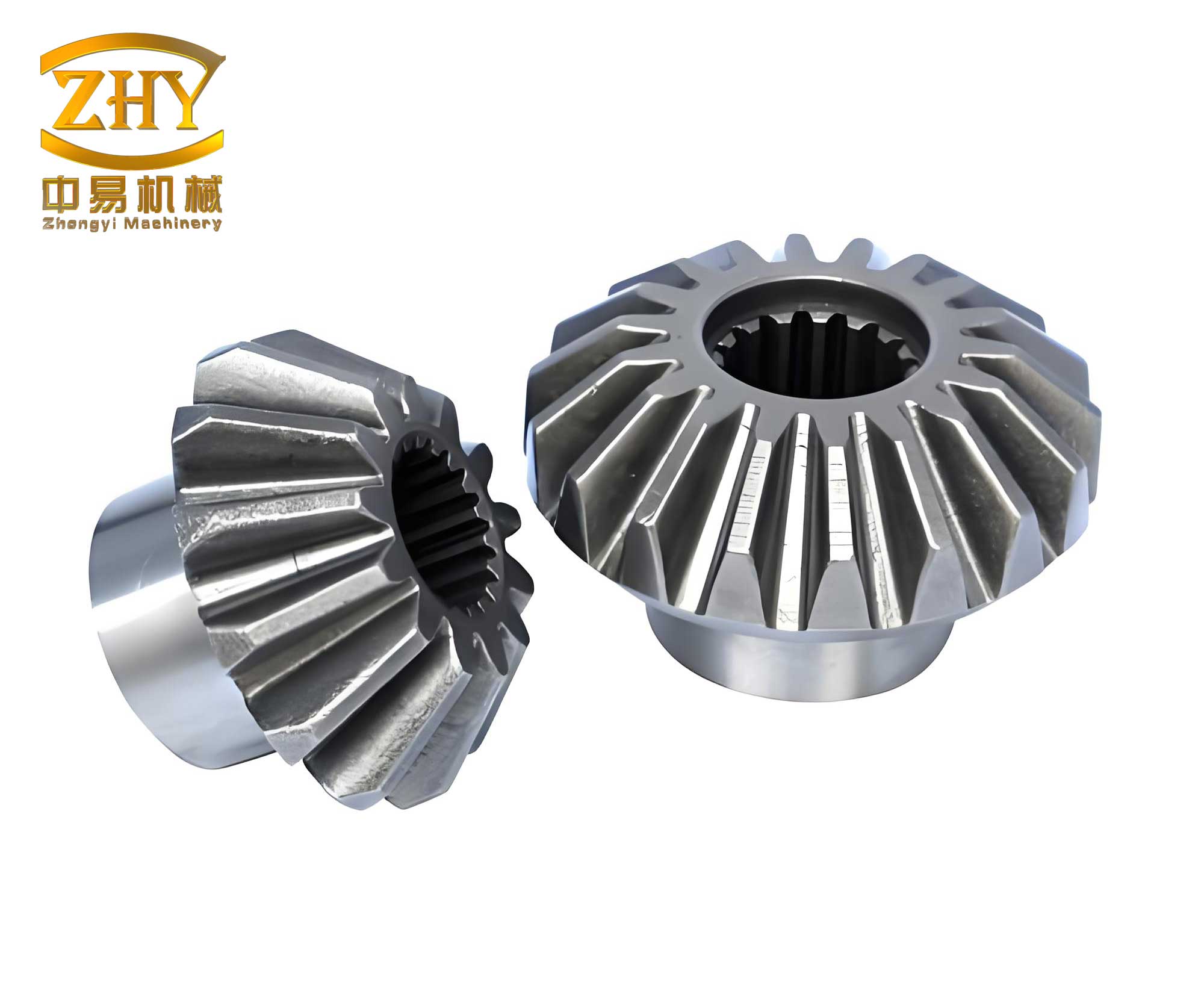
To visualize the engagement of bevel gears in a differential, consider the following illustration, which depicts typical straight bevel gears in mesh. This image underscores the complex contact geometry that drives our TEHL analysis.
The numerical methods employed ensure accurate resolution of temperature gradients. For instance, the temperature profile in the mid-layer of the lubricant film shows a peak near the outlet region, coinciding with film constriction. This can be expressed analytically for simplified cases: the maximum temperature rise $\Delta T_{\text{max}}$ scales with the shear rate and film thickness. For bevel gears, an approximate relation is:
$$\Delta T_{\text{max}} \propto \frac{\eta_0 U^2}{k h}$$
where $U$ is the sliding velocity and $h$ is the local film thickness. This underscores how gear geometry influences thermal effects; for bevel gears, varying curvature along the face width modifies $h$ and $U$, leading to non-uniform temperature distributions.
In conclusion, this study provides a comprehensive TEHL analysis of automotive differential bevel gears under differential conditions. The non-Newtonian fluid model reveals that temperature distributions vary significantly along the face width of bevel gears, with the small end experiencing higher temperatures due to thinner films and increased shear. Gear geometry plays a crucial role: larger modules reduce maximum temperatures, while wider face widths increase them, highlighting design considerations for bevel gears. Furthermore, rotational speed directly impacts thermal fields, with higher speeds elevating temperatures in the contact zone. These insights contribute to the optimization of lubrication systems for bevel gears, enhancing durability and performance in differential applications. Future work could explore spiral bevel gears or incorporate surface roughness effects to further refine TEHL predictions for bevel gears in automotive transmissions.