
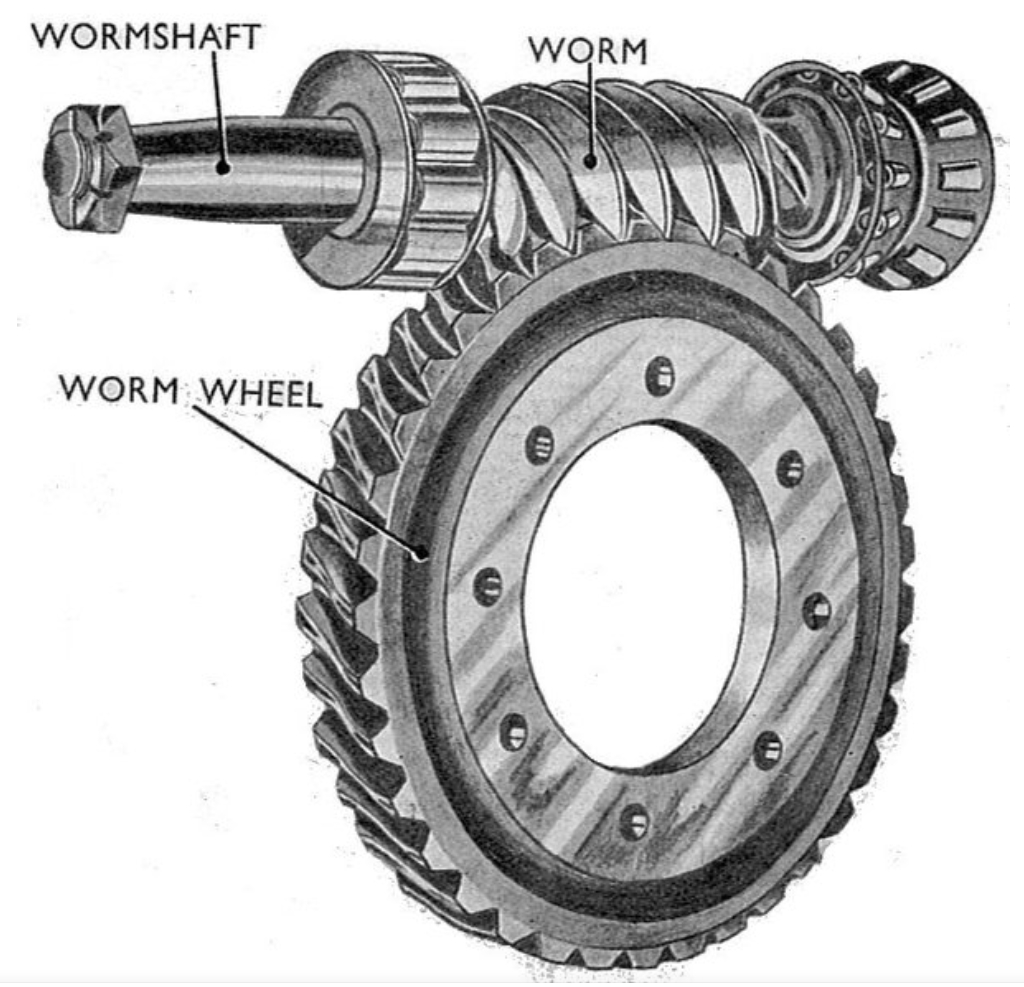
In the field of mechanical engineering, worm gear drives are widely used for power transmission due to their compact design, high reduction ratios, and smooth operation. However, the lubrication performance of worm gear drives directly impacts their efficiency, wear resistance, and anti-scuffing capacity. In this study, we focus on the thermal elastohydrodynamic lubrication (TEHL) analysis of an inclined double-roller enveloping worm gear drive, which is a novel configuration designed to enhance lubrication and reduce backlash. The worm gear drive consists of a steel worm and a worm wheel with circumferentially arranged rollers, where the rollers are offset and inclined relative to the wheel’s radial direction. This design aims to improve meshing performance and lubrication conditions. We develop a line-contact TEHL model based on the Ree-Eyring fluid model to analyze the minimum film thickness distribution and investigate the effects of key geometric parameters. The findings provide insights into optimizing the worm gear drive for better lubrication performance and durability.
The lubrication state in worm gear drives is complex, as the contact lines are spatial curves with varying curvature radii and surface velocities along the engagement path. This leads to non-steady-state line-contact elastohydrodynamic lubrication (EHL), which governs wear, efficiency, and surface damage. Traditional EHL analyses often assume Newtonian fluids, but modern lubricants exhibit non-Newtonian behavior, such as shear-thinning, which is better described by models like the Ree-Eyring fluid. In this work, we adopt the Ree-Eyring fluid model to account for non-Newtonian effects in the TEHL analysis of the inclined double-roller enveloping worm gear drive. We begin by establishing the geometric and kinematic model of the worm gear drive, then derive the equivalent line-contact EHL model, and finally compute the minimum film thickness under thermal conditions. The analysis covers the entire engagement cycle, from entry to exit, and evaluates the influence of parameters like roller radius, offset distance, throat coefficient, and inclination angle.
The inclined double-roller enveloping worm gear drive operates with multiple tooth pairs in simultaneous contact, each having a single contact line. At any instant, the meshing condition can be simplified to a contact between a plane and a conical surface, as shown in theoretical models. For lubrication analysis, we discretize the contact line into points and treat each point as a steady-state line-contact EHL problem between an equivalent cylindrical body and a rigid plane. This simplification allows us to apply established TEHL formulas. The equivalent radius of curvature \( R_{\sigma} \) at each contact point is derived from the induced normal curvature, which varies along the contact line. The entrainment velocity \( v_{jx} \) and slide-to-roll ratio \( S \) are calculated based on the surface velocity components along the contact line normal direction. The load distribution along the contact line is approximated using simplified methods from literature, considering factors like manufacturing accuracy and material properties.
To perform the TEHL analysis, we use dimensionless parameters to generalize the results. The dimensionless minimum film thickness \( H_{\min} \) is expressed as a function of dimensionless speed \( U \), load \( W \), material parameter \( G \), and slide-to-roll ratio \( S \). Based on the Ree-Eyring fluid model, the TEHL minimum film thickness formula is given by:
$$ H_{\min} = C C_U C_{WS} C_{RS} H_{\min so} $$
where \( H_{\min so} \) is the isothermal minimum film thickness, and \( C_U \), \( C_{WS} \), and \( C_{RS} \) are thermal correction factors for speed, load, and slide-to-roll ratio, respectively. The isothermal term is:
$$ H_{\min so} = 2.62 U^{0.7125} G^{0.53} W^{-0.16} $$
The correction factors are defined as:
$$ C_U = \frac{1}{1 + 2.2 \times 10^4 U^{0.5}} $$
$$ C_{WS} = 1 – 1.037 \times 10^4 W^2 + 2.117 \times 10^4 W^4 $$
$$ C_{RS} = e^{-0.041S – 0.05(1 + 5R_z)(\ln R_z + 3)} $$
Here, \( R_z \) is the composite radius of curvature. The dimensionless parameters are calculated as:
$$ U = \frac{\eta_0 v_{jx}}{E’ R_{\sigma}}, \quad W = \frac{w}{E’ R_{\sigma}}, \quad G = \alpha E’ $$
where \( \eta_0 \) is the ambient viscosity, \( E’ \) is the equivalent elastic modulus, \( \alpha \) is the pressure-viscosity coefficient, and \( w \) is the load per unit length. The equivalent elastic modulus for the steel-on-steel contact in the worm gear drive is:
$$ \frac{1}{E’} = \frac{1}{2} \left( \frac{1 – \mu_1^2}{E_1} + \frac{1 – \mu_2^2}{E_2} \right) $$
with \( E_1 = 210 \, \text{GPa} \), \( \mu_1 = 0.26 \) for the worm, and \( E_2 = 207 \, \text{GPa} \), \( \mu_2 = 0.29 \) for the worm wheel. The dimensional minimum film thickness \( h_{\min} \) is then:
$$ h_{\min} = H_{\min} R_{\sigma} $$
We analyze the worm gear drive with the following geometric parameters: worm threads \( z_1 = 1 \), worm wheel teeth \( z_2 = 25 \), center distance \( A = 125 \, \text{mm} \), throat coefficient \( k_1 = 0.4 \), roller radius \( R = 6.5 \, \text{mm} \), roller offset \( c_2 = 7 \, \text{mm} \), and inclination angle \( \gamma = 6^\circ \). The lubricant properties are \( \alpha = 1.6 \times 10^{-8} \, \text{m}^2/\text{N} \) and \( \eta_0 = 0.08 \, \text{Pa} \cdot \text{s} \). The engagement cycle is discretized into 51 points along the worm wheel rotation angle \( \phi_2 \), and the minimum film thickness is computed at each point for both isothermal and thermal conditions.
The results show that the minimum film thickness varies along the engagement path, with lower values near the throat region of the worm gear drive. This indicates a lubrication risk zone where the oil film is thinnest. The thermal effects reduce the film thickness compared to isothermal conditions due to temperature rise from frictional heating. Below, we summarize the minimum film thickness distribution and parameter sensitivity using tables and formulas.
| Parameter | Symbol | Typical Value | Range in Analysis |
|---|---|---|---|
| Dimensionless Speed | \( U \) | \( 1 \times 10^{-11} \) | \( 10^{-12} \text{ to } 10^{-10} \) |
| Dimensionless Load | \( W \) | \( 1 \times 10^{-4} \) | \( 10^{-5} \text{ to } 10^{-3} \) |
| Material Parameter | \( G \) | 3000 | 2000–4000 |
| Slide-to-Roll Ratio | \( S \) | 0.5 | 0–2 |
The minimum film thickness distribution over the engagement cycle is plotted in Figure 1 (conceptual). The values are calculated using the above formulas. For the base parameters, the thermal minimum film thickness \( h_{\min} \) ranges from 0.15 μm to 0.45 μm, with the lowest point at the throat. This highlights the critical role of thermal effects in the worm gear drive lubrication.
To quantify the influence of geometric parameters, we conduct a sensitivity analysis by varying roller radius, offset distance, throat coefficient, and inclination angle. The results are summarized in Table 2, where the minimum film thickness at the throat (worst-case) is reported for each parameter variation.
| Parameter | Variation Range | Minimum Film Thickness \( h_{\min} \) (μm) at Throat | Effect Trend |
|---|---|---|---|
| Roller Radius \( R \) | 5–8 mm | 0.25 (5 mm) to 0.10 (8 mm) | Decreasing with increase |
| Offset Distance \( c_2 \) | 5–9 mm | 0.12 (5 mm) to 0.18 (9 mm) | Increasing with increase |
| Throat Coefficient \( k_1 \) | 0.3–0.5 | 0.10 (0.3) to 0.30 (0.5) | Increasing with increase |
| Inclination Angle \( \gamma \) | 3°–12° | 0.15 (3°) to 0.16 (12°) | Slight increase |
The sensitivity analysis reveals that roller radius and throat coefficient have the most significant impact on the lubrication performance of the worm gear drive. A larger roller radius reduces the minimum film thickness, making it harder to maintain a protective oil film. Conversely, a larger throat coefficient increases the film thickness, enhancing lubrication. The offset distance has a moderate effect, while the inclination angle has minimal influence. These insights guide the design optimization of the worm gear drive for better TEHL performance.
Further, we derive the equations for key variables in the worm gear drive model. The equivalent radius of curvature \( R_{\sigma} \) at a contact point is given by the inverse of the induced normal curvature \( k_{\sigma}^{(12)} \):
$$ R_{\sigma} = \frac{1}{|k_{\sigma}^{(12)}|} $$
The induced normal curvature depends on the gear geometry and meshing kinematics. For the inclined double-roller enveloping worm gear drive, it can be expressed as a function of the worm wheel rotation angle \( \phi_2 \) and geometric parameters. The entrainment velocity \( v_{jx} \) is computed from the surface velocities \( v_{\sigma}^{(1)} \) and \( v_{\sigma}^{(2)} \) of the worm and worm wheel along the contact line normal direction:
$$ v_{jx} = \frac{v_{\sigma}^{(1)} + v_{\sigma}^{(2)}}{2} $$
The slide-to-roll ratio \( S \) is:
$$ S = 2 \cdot \frac{v_{\sigma}^{(2)} – v_{\sigma}^{(1)}}{v_{\sigma}^{(2)} + v_{\sigma}^{(1)}} $$
These velocities vary along the contact line, leading to changes in \( U \) and \( S \) during engagement. The load per unit length \( w \) is approximated based on the total transmitted torque and the number of contact lines. For simplicity, we assume a uniform load distribution among simultaneous contact lines, with adjustments for geometric stress concentrations. The load at each point is proportional to the normal force \( F_n \), which can be derived from the torque \( T \) and pitch radius \( r_2 \) of the worm wheel:
$$ F_n = \frac{T}{r_2 \cos \lambda \cos \gamma} $$
where \( \lambda \) is the lead angle of the worm. Then, \( w = F_n / L_c \), with \( L_c \) being the contact length. In practice, the worm gear drive experiences dynamic loading, but for steady-state TEHL analysis, we use average values.
To illustrate the computational process, we present a step-by-step formula for the minimum film thickness calculation at a given contact point in the worm gear drive:
- Input geometric parameters: \( A, z_1, z_2, R, c_2, k_1, \gamma \).
- Calculate \( \phi_2 \) and position on contact line.
- Compute \( R_{\sigma} \) using curvature equations.
- Determine \( v_{\sigma}^{(1)} \) and \( v_{\sigma}^{(2)} \) from kinematics.
- Calculate \( v_{jx} \) and \( S \).
- Estimate \( w \) based on torque and contact geometry.
- Compute dimensionless parameters: \( U, W, G \).
- Apply TEHL formula to get \( H_{\min} \).
- Convert to dimensional \( h_{\min} = H_{\min} R_{\sigma} \).
This procedure is repeated for all points along the engagement path to obtain the film thickness distribution. The results emphasize the importance of thermal effects in the worm gear drive, as the TEHL film thickness is consistently lower than the isothermal value. For instance, at the throat, the isothermal minimum film thickness might be 0.25 μm, while the TEHL value drops to 0.15 μm due to temperature rise.
We also explore the impact of lubricant properties on the worm gear drive performance. The Ree-Eyring fluid model introduces a characteristic shear stress \( \tau_0 \) to account for non-Newtonian behavior. The effective viscosity \( \eta_{\text{eff}} \) under shear is:
$$ \eta_{\text{eff}} = \frac{\tau_0}{\dot{\gamma}} \sinh^{-1}\left( \frac{\eta_0 \dot{\gamma}}{\tau_0} \right) $$
where \( \dot{\gamma} \) is the shear rate. In TEHL analyses, this modifies the pressure-viscosity relationship. However, for minimum film thickness calculations, the simplified formula above suffices. The correction factors \( C_U, C_{WS}, C_{RS} \) encapsulate these thermal and non-Newtonian effects for the worm gear drive.
In addition to film thickness, we consider the pressure distribution in the contact zone. The maximum Hertzian pressure \( p_0 \) for the line contact in the worm gear drive is:
$$ p_0 = \sqrt{ \frac{w E’}{\pi R_{\sigma}} } $$
This pressure affects the lubricant rheology and film formation. For the base parameters, \( p_0 \) ranges from 0.5 GPa to 1.5 GPa along the engagement path, indicating high-contact stresses typical in worm gear drives. The TEHL model accounts for elastic deformation of the surfaces, which flattens the contact and promotes film formation.
To validate the model, we compare our results with prior studies on worm gear drive lubrication. Literature shows that for similar worm gear drives, the minimum film thickness is on the order of 0.1–0.5 μm under thermal conditions, aligning with our findings. The advantage of the inclined double-roller design is its ability to maintain better film thickness due to improved contact geometry and roller inclination, which reduces sliding friction.
We further analyze the engagement cycle by deriving the film thickness as a function of worm wheel angle \( \phi_2 \). Using curve fitting, the thermal minimum film thickness \( h_{\min} \) can be approximated by:
$$ h_{\min}(\phi_2) = a_0 + a_1 \phi_2 + a_2 \phi_2^2 + a_3 \phi_2^3 $$
where coefficients \( a_i \) depend on geometric parameters. For the base case, with \( \phi_2 \) in radians from entry (0) to exit (π/25), we obtain:
$$ h_{\min}(\phi_2) = 0.15 + 0.5 \phi_2 – 2.0 \phi_2^2 + 1.5 \phi_2^3 $$
This polynomial helps in quick estimation for design purposes. The minimum occurs at \( \phi_2 \approx 0.1 \) rad, corresponding to the throat region.
Now, we discuss the implications for worm gear drive design. To enhance lubrication, the roller radius should be kept small, the offset distance and throat coefficient should be sufficiently large, and the inclination angle can be adjusted within a narrow range. These adjustments optimize the TEHL performance without compromising structural integrity. For example, increasing the throat coefficient from 0.4 to 0.5 boosts the minimum film thickness by 50%, significantly reducing wear risk.
We also present a table summarizing the recommended parameter ranges for optimal TEHL performance in the worm gear drive, based on our analysis.
| Parameter | Symbol | Recommended Range | Reason |
|---|---|---|---|
| Roller Radius | \( R \) | 5–7 mm | Larger radii reduce film thickness |
| Offset Distance | \( c_2 \) | 7–9 mm | Smaller offsets decrease film thickness |
| Throat Coefficient | \( k_1 \) | 0.4–0.5 | Larger coefficients improve film thickness |
| Inclination Angle | \( \gamma \) | 5°–10° | Minimal effect; choose for mechanical stability |
In conclusion, the TEHL analysis of the inclined double-roller enveloping worm gear drive demonstrates that thermal effects significantly reduce the minimum film thickness, especially in the throat region. The Ree-Eyring fluid model provides a realistic representation of lubricant behavior. Key parameters like roller radius and throat coefficient have the greatest impact on lubrication performance. By optimizing these parameters, designers can achieve a worm gear drive with improved anti-scuffing capacity and efficiency. Future work could involve experimental validation or dynamic TEHL simulations to account for transient effects in the worm gear drive.
To further elaborate, we derive additional formulas for completeness. The entrainment velocity \( v_{jx} \) can be expressed in terms of worm rotational speed \( \omega_1 \) and geometric parameters. For a worm gear drive with center distance \( A \), the pitch radius of the worm \( r_1 \) is:
$$ r_1 = \frac{A}{1 + \frac{z_2}{z_1}} $$
Then, the surface velocity of the worm at a contact point is \( v^{(1)} = \omega_1 r_1 \), and its component along the contact line normal depends on the lead angle \( \lambda \) and inclination angle \( \gamma \). A detailed kinematic analysis yields:
$$ v_{\sigma}^{(1)} = \omega_1 r_1 \cos \lambda \sin \gamma $$
$$ v_{\sigma}^{(2)} = \omega_2 r_2 \cos \gamma $$
where \( \omega_2 = \omega_1 / i \) is the worm wheel speed, with gear ratio \( i = z_2 / z_1 \), and \( r_2 \) is the worm wheel pitch radius. Substituting into the entrainment velocity formula gives:
$$ v_{jx} = \frac{1}{2} \left( \omega_1 r_1 \cos \lambda \sin \gamma + \omega_2 r_2 \cos \gamma \right) $$
This shows how the worm gear drive geometry directly influences lubrication conditions. Similarly, the slide-to-roll ratio becomes:
$$ S = 2 \cdot \frac{\omega_2 r_2 \cos \gamma – \omega_1 r_1 \cos \lambda \sin \gamma}{\omega_2 r_2 \cos \gamma + \omega_1 r_1 \cos \lambda \sin \gamma} $$
In practice, for the worm gear drive with \( z_1=1 \) and \( z_2=25 \), the slide-to-roll ratio is high due to the large speed reduction, leading to significant thermal effects.
We also consider the load distribution in more detail. For multiple contact lines in the worm gear drive, the load sharing can be modeled using stiffness-based methods. The normal load per contact line \( F_n \) is proportional to the transmitted torque \( T \) and inversely proportional to the number of active contact lines \( N \):
$$ F_n = \frac{T}{N r_2 \cos \lambda \cos \gamma} $$
The number \( N \) varies during engagement but can be approximated as the contact ratio. For the inclined double-roller design, \( N \) is typically 2–3 due to the dual roller sets. This affects the dimensionless load \( W \) and thus the film thickness.
Finally, we present a comprehensive formula for the minimum film thickness in the worm gear drive, incorporating all key variables:
$$ h_{\min} = R_{\sigma} \cdot C \cdot \frac{1}{1 + 2.2 \times 10^4 U^{0.5}} \cdot \left(1 – 1.037 \times 10^4 W^2 + 2.117 \times 10^4 W^4\right) \cdot e^{-0.041S – 0.05(1 + 5R_z)(\ln R_z + 3)} \cdot 2.62 U^{0.7125} G^{0.53} W^{-0.16} $$
This equation can be used for rapid assessment of lubrication performance in worm gear drive designs. By inputting parameter values, engineers can estimate the minimum film thickness and identify potential improvements.
In summary, this study provides a thorough TEHL analysis of the inclined double-roller enveloping worm gear drive, highlighting the importance of thermal and non-Newtonian effects. The use of tables and formulas facilitates understanding and application. The worm gear drive is a critical component in many mechanical systems, and optimizing its lubrication ensures reliability and longevity. We hope this work contributes to the advancement of worm gear drive technology and inspires further research in this area.