
In precision manufacturing, the accuracy of gear hobbing processes is critical, and deformations in the gear hobbing machine workbench due to thermal and mechanical loads significantly impact final product quality. As a researcher focused on advanced manufacturing technologies, I have investigated the coupled effects of thermal and force-induced deformations in CNC gear hobbing machines. This article presents a comprehensive analysis and a novel prediction model to address these deformations, leveraging data-driven approaches and optimization algorithms. Gear hobbing involves complex interactions between the tool and workpiece, where thermal expansion from friction, motor heat, and cutting forces can lead to substantial errors. By integrating thermal and mechanical factors, this work aims to enhance the precision of gear hobbing operations, which is essential for industries like automotive and aerospace. The proposed model utilizes a Subpopulation Adaptive Mind Evolution Algorithm-Back Propagation (SAMEA-BP) neural network, optimized to predict workbench deformations with high accuracy. Throughout this discussion, I will emphasize the importance of gear hobbing and gear hobbing machine dynamics, supported by equations, tables, and experimental data to illustrate key points.
Thermal deformation in a gear hobbing machine arises from multiple heat sources, including bearing friction, motor operations, and cutting heat. Although cutting fluid dissipates much of the cutting heat, residual thermal energy propagates through components like the bed and columns, causing the workbench to deform. This deformation depends on parameters such as spindle speed, feed rate, and workpiece material. To quantify this, consider the structural elements of a typical gear hobbing machine: the bed, large column, and small column. Assuming thermal expansion coefficients μ, ν, and ω for these components, and temperature differences Δt₀, Δt₁, and Δt₂ across their surfaces, the resultant deviation at the cutting point can be derived. For instance, the bed’s upward bending due to a temperature gradient leads to an angular displacement α, calculated as:
$$ \alpha = \frac{\mu l_0 \Delta t_0}{2h_0} $$
where l₀ and h₀ are dimensional parameters. The total thermal deviation ζ at the cutting point combines contributions from the bed, large column, and small column:
$$ \zeta = \zeta_1 + \zeta_2 + \zeta_3 = \frac{\mu l_0 h_1 \Delta t_0}{h_0} + \frac{\nu h_1^2 \Delta t_1}{2b_0} + \frac{\omega h_1^2 \Delta t_2}{2b_1} $$
Here, h₁, b₀, and b₁ represent heights and widths of the machine elements. This equation highlights how temperature variations directly influence workbench positioning errors during gear hobbing. In practice, monitoring these temperatures is challenging due to the multiple coupling effects, necessitating data reduction techniques for effective modeling.
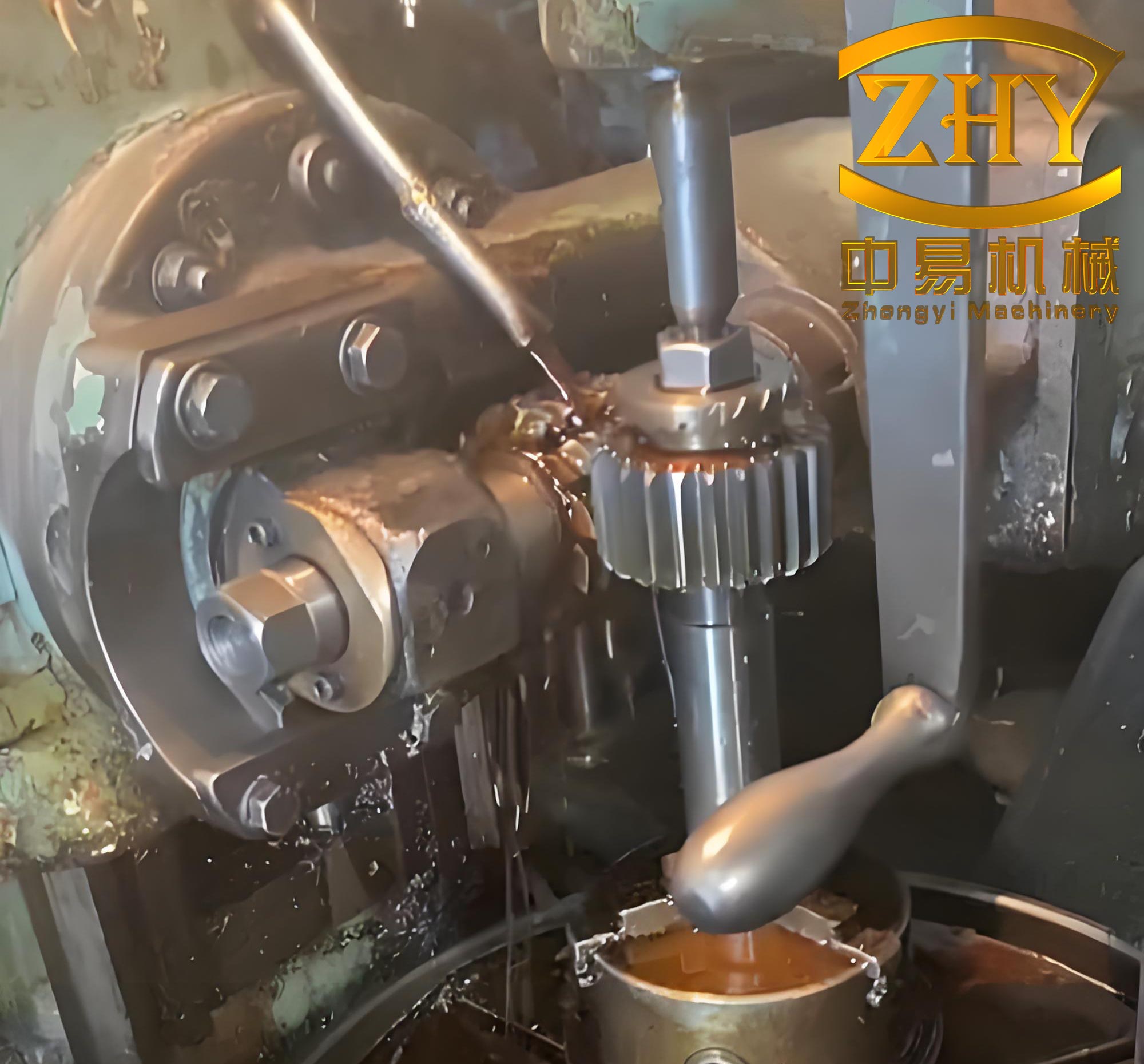
Force-induced deformation in gear hobbing machines results from cutting forces generated during the hobbing process. Calculating these forces involves analyzing the chip formation geometry and applying mechanical models. In the coordinate system of a gear hobbing machine, with workpiece and tool frames, the transformation matrix maps the hob’s position to the workpiece. The cutting force for a micro-element on the hob can be described using the Kienzle-Victor model:
$$ \begin{aligned}
dF_a^{(i,j)}(x_h, \phi) &= C_{ae} dl + C_{ac} h_{i,j}(x_h, \phi) dl \\
dF_t^{(i,j)}(x_h, \phi) &= C_{te} dl + C_{tc} h_{i,j}(x_h, \phi) dl \\
dF_r^{(i,j)}(x_h, \phi) &= C_{re} dl + C_{rc} h_{i,j}(x_h, \phi) dl
\end{aligned} $$
where dF_a, dF_t, and dF_r are the axial, tangential, and radial force components, respectively; C_{ae}, C_{te}, C_{re} are plowing force coefficients; C_{ac}, C_{tc}, C_{rc} are shear force coefficients; h_{i,j} is the undeformed chip thickness; and dl is the chip length. Summing these over all cutting edges gives the total cutting force components F_x^{total}, F_y^{total}, and F_z^{total}. These forces cause workbench deformations, including bending and compression, which can be modeled using beam theory equations. For example, bending deformation follows:
$$ \frac{d^2 y}{dx^2} = \frac{M(x)}{EI_a} $$
where M(x) is the bending moment, E is the elastic modulus, and I_a is the moment of inertia. Compression deformation is given by Δy = FL/EA, where F is the axial force, L is the length, and A is the cross-sectional area. However, direct force measurement in a rotating workbench of a gear hobbing machine is impractical. Instead, the spindle current I_rms is used as a proxy for cutting force, as it correlates with the torque and power consumption during gear hobbing. The root mean square current I_rms is computed from three-phase currents I₁, I₂, I₃:
$$ I_{rms} = \sqrt{\frac{I_1^2 + I_2^2 + I_3^2}{3}} $$
This approach simplifies data acquisition and integrates force effects into the deformation model.
To predict the coupled thermal-force deformations, I developed a SAMEA-BP neural network model. The BP neural network has a 4-16-2 architecture, with inputs including three temperature variables (selected from eight initial points) and the spindle current I_rms, and outputs as workbench deformations in X and Y directions. The SAMEA algorithm optimizes the BP network’s initial weights and thresholds by simulating human evolutionary processes, using subpopulations and adaptive strategies to avoid local minima and enhance convergence. The optimization involves generating initial populations, performing convergence and dissimilation operations, and iterating until the score function (inverse of mean squared error) is maximized. Key steps include:
- Initializing a population of size N and evaluating scores based on the objective function.
- Forming superior and temporary subpopulations around best individuals, with sizes adjusted adaptively based on scores:
$$ N_i = \text{ceil}\left(\frac{f_i N}{\sum_{i=1}^{M+T} f_i}\right) $$
where f_i is the score of individual i, M and T are subpopulation sizes, and ceil is the ceiling function. The variance for generating new individuals is adaptively adjusted using a coefficient α derived from score percentiles, ensuring refined searches around superior individuals. This optimization improves the BP network’s prediction accuracy and reduces training time. The neural network uses tansig and purelin activation functions, with trainlm as the training function, 70 iterations, a learning rate of 0.1, and a target error of 0.01. The SAMEA-BP model effectively handles the nonlinear relationships in gear hobbing machine deformations, making it suitable for real-time compensation.
Experimental validation was conducted on a YS3140CNC6 gear hobbing machine using wet cutting conditions. The workpiece material was 18CrMnBH, and the hob had M35 steel with TiN coating. Key geometric parameters are summarized in Table 1.
| Hob Parameters | Value | Workpiece Parameters | Value |
|---|---|---|---|
| Number of Starts | 2 | Normal Module (mm) | 5.08 |
| Hand of Helix | Left | Normal Pressure Angle (°) | 20 |
| Outer Diameter (mm) | 110 | Number of Teeth | 34 |
| Helix Angle | 5°34’30” | Tip Diameter (mm) | 192 |
| Number of Flutes | 10 | Helix Angle (°) | 13 |
| Flute Type | Straight | Face Width (mm) | 30 |
Temperature sensors (PT100) and displacement sensors (YTHN800) were installed at key locations, such as the small column, Z-axis slide, and spindle bearing, to collect data. The spindle current was monitored using a cDAQ-9185 system. Experiments varied machining parameters like spindle speed (n), feed rate (f), and depth of cut (a_p) over time intervals, as detailed in Table 2.
| Time (min) | Spindle Speed (r/min) | Feed Rate (mm/min) | Depth of Cut (mm) |
|---|---|---|---|
| 0-40 | 120 | 12 | 6 |
| 40-80 | 160 | 14 | 7 |
| 80-120 | 200 | 16 | 8 |
Data analysis showed significant temperature rises at the spindle bearing and tool side, with workbench deformations primarily in the X-direction. To reduce input dimensionality, I applied K-means clustering and grey relational analysis (GRA) to the eight temperature variables. K-means grouped the temperatures into three clusters, and GRA computed relational degrees between each temperature and deformation. The GRA coefficient ζ_i(j) is given by:
$$ \zeta_i(j) = \frac{\min_i \min_j |x_0(j) – x_i(j)| + \rho \max_i \max_j |x_0(j) – x_i(j)|}{|x_0(j) – x_i(j)| + \rho \max_i \max_j |x_0(j) – x_i(j)|} $$
where ρ is a resolution coefficient (0.5). The relational degree r(x₀, x_i) is the average of ζ_i(j) over all indices. This process selected three critical temperature points (T2, T5, T7) with the highest relational degrees, as shown in Table 3.
| Cluster | Temperature Variables | Grey Relational Degree | Selected Variable |
|---|---|---|---|
| 1 | T1, T2, T3 | 0.721, 0.939, 0.705 | T2 |
| 2 | T4, T7 | 0.688, 0.693 | T7 |
| 3 | T5, T6, T8 | 0.735, 0.694, 0.687 | T5 |
Using these inputs, the SAMEA-BP model was trained and tested. Comparative analyses with MEA-BP, PSO-BP, GA-BP, and a thermal-only model (SAMEA-BP2) demonstrated the superiority of the proposed approach. Prediction accuracy was evaluated using mean prediction accuracy and root mean square error (RMSE), defined as:
$$ \text{RMSE} = \sqrt{\frac{1}{m} \sum_{i=1}^{m} (y_i – \hat{y}_i)^2} $$
where y_i and ŷ_i are measured and predicted values, and m is the sample size. For the X-direction, SAMEA-BP achieved an average prediction accuracy of 94.8%, with RMSE of 0.3754, outperforming other models (e.g., MEA-BP: 91.7%, RMSE 0.5043). Similarly, for the Y-direction, SAMEA-BP reached 95.4% accuracy (RMSE 0.3391), indicating robust performance. The results, summarized in Table 4, highlight the model’s efficiency in terms of convergence time and iterations.
| Model | Direction | Iterations | Convergence Time (s) | R² | RMSE |
|---|---|---|---|---|---|
| SAMEA-BP | X | 22 | <0.001 | 0.9846 | 0.3754 |
| Y | 27 | <0.001 | 0.9703 | 0.3391 | |
| MEA-BP | X | 33 | <0.001 | 0.9634 | 0.5043 |
| Y | 27 | <0.001 | 0.9637 | 0.4854 | |
| PSO-BP | X | 57 | <0.01 | 0.9617 | 0.7248 |
| Y | 46 | <0.01 | 0.9564 | 0.7846 | |
| GA-BP | X | 62 | <0.01 | 0.9448 | 0.9202 |
| Y | 48 | <0.01 | 0.9495 | 0.8215 | |
| SAMEA-BP2 | X | 35 | <0.001 | 0.9854 | 0.5254 |
| Y | 25 | <0.001 | 0.9719 | 0.3545 |
Generalization tests using cross-validation on three data groups further confirmed the model’s robustness. For instance, when training on group 1 and testing on group 2, SAMEA-BP’s accuracy dropped by only 3.89% in the X-direction, compared to larger drops in other models. This underscores the model’s ability to handle varying conditions in gear hobbing applications.
In conclusion, the SAMEA-BP neural network provides an effective solution for predicting thermal-force deformations in CNC gear hobbing machine workbenches. By integrating temperature and force data through optimized algorithms, this model achieves high accuracy and generalization, essential for real-time error compensation in gear hobbing processes. Future work will focus on developing theoretical coupled models to further enhance predictive capabilities. This research underscores the importance of addressing both thermal and mechanical factors in precision gear hobbing, contributing to advancements in manufacturing technology.