
In modern mechanical transmissions, spur gears are widely employed due to their simplicity and efficiency. However, under high-speed and heavy-load conditions, spur gears often experience significant frictional heating at the meshing interfaces, leading to localized temperature rises. This thermal effect can induce thermo-elastic deformation and stress, which may compromise gear performance, accelerate scuffing failures, and reduce fatigue life. To address these issues, profile modification techniques, such as logarithmic crowning, have been developed to optimize contact pressure distribution and mitigate edge effects. In this study, I focus on the thermo-elastic behavior of spur gears with logarithmic modification, utilizing Fast Fourier Transform (FFT) and Inverse Fast Fourier Transform (IFFT) methods to compute temperature and thermo-elastic fields at arbitrary meshing positions. The influence of operational parameters like torque and rotational speed is also investigated. Through comprehensive analysis, I aim to demonstrate how logarithmic modification enhances the anti-scuffing capability, accuracy, and thermal fatigue resistance of spur gears.
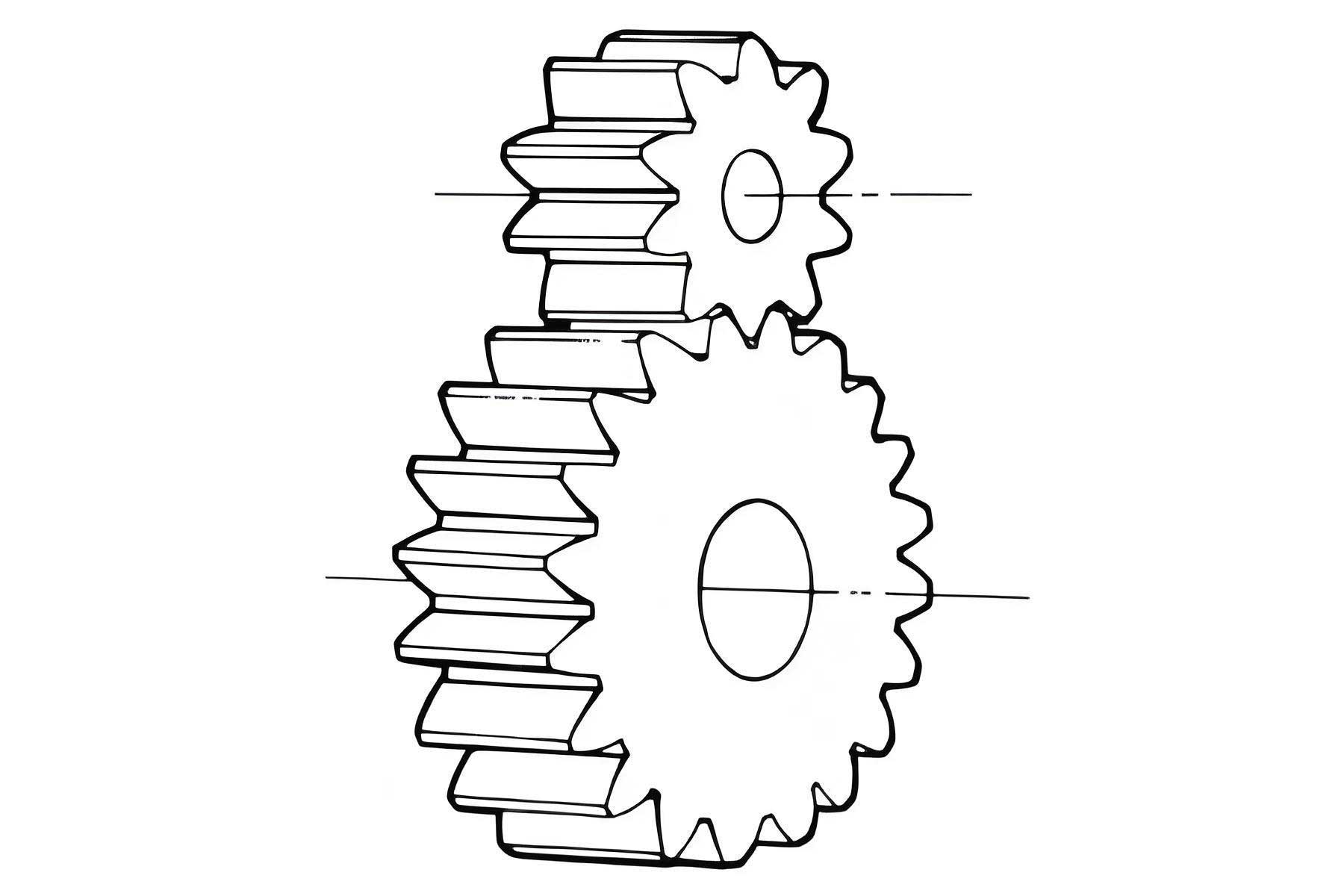
The engagement of spur gears can be modeled as the contact between two elastic cylinders, where non-Hertzian effects arise due to profile modifications. For a pair of spur gears, the relative sliding velocity at any meshing point is critical for frictional heat generation. Consider two spur gears in mesh: let the pinion (gear 1) and the gear (gear 2) have base radii \(r_{b1}\) and \(r_{b2}\), angular velocities \(\omega_1\) and \(\omega_2\), and let \(t\) denote time within a meshing cycle starting from the initial contact point. The relative sliding velocity \(V_g\) is given by:
$$V_g = V_1 – V_2$$
where \(V_1 = R_1 \omega_1\) and \(V_2 = R_2 \omega_2\), with \(R_1\) and \(R_2\) being the radii of curvature at the meshing point. These can be expressed as:
$$R_1 = N_1B_1 + r_{b1} \omega_1 t$$
$$R_2 = N_2B_1 – r_{b1} \omega_1 t$$
for \(t \in [0, \frac{B_1B_2}{r_{b1} \omega_1}]\). Here, \(N_1B_1\) and \(N_2B_1\) are geometric parameters derived from the involute profile, specifically:
$$N_2B_1 = r_{b2} \tan \alpha_{a2}$$
$$N_1B_1 = r_{b1} \tan \alpha’ – r_{b2} (\tan \alpha_{a2} – \tan \alpha’)$$
where \(\alpha_{a2}\) is the pressure angle at the gear tip, and \(\alpha’\) is the operating pressure angle. This formulation allows for tracking the sliding velocity throughout the meshing cycle, which is essential for heat source characterization in spur gears.
The contact region between spur gears under load forms due to elastic deformation, leading to a distributed heat source \(q\) from frictional sliding. For two contacting surfaces, the heat flux densities for the gear and pinion are:
$$q_2 = (1 – K) \mu P V_g$$
$$q_1 = K \mu P V_g$$
where \(\mu\) is the friction coefficient, \(P\) is the contact pressure obtained from numerical iteration of deformation compatibility and load equilibrium equations, and \(K\) is the heat partition coefficient. The heat partition coefficient is determined by:
$$\frac{K}{1 – K} = \sqrt{\frac{\rho_2 c_2 \lambda_2 V_2}{\rho_1 c_1 \lambda_1 V_1}}$$
Here, \(\lambda\) denotes thermal conductivity, \(\rho\) density, and \(c\) specific heat capacity. This accounts for the different material properties and sliding speeds of the spur gears, ensuring accurate thermal boundary conditions.
To analyze the temperature field in spur gears, I adopt a two-dimensional heat conduction model. Assuming constant torque and rotational speed, and that the gear teeth cool to ambient temperature \(T_0 = 25^\circ \text{C}\) before re-engagement, the heat conduction equation in a moving coordinate system attached to the heat source is:
$$\frac{\partial^2 T_{\Delta}(x, y)}{\partial x^2} + \frac{\partial^2 T_{\Delta}(x, y)}{\partial y^2} = \frac{1}{k} \frac{d T_{\Delta}(x, y)}{d t}$$
where \(T_{\Delta}\) is the temperature rise above ambient, and \(k = \lambda / (\rho c)\) is thermal diffusivity. By transforming coordinates such that \(x = \xi + V_g t\) and \(y = \eta\), the problem becomes steady-state. Applying Fourier transform in the \(\xi\)-direction yields the frequency-domain relation between heat source and temperature:
$$\hat{T}_s = \frac{\hat{q}}{\lambda (b – a i)}$$
$$\hat{T}_{\Delta} = \hat{T}_s e^{(a i – b) \eta}$$
with
$$a = \frac{\beta \omega}{2b}$$
$$b = \sqrt{\frac{\omega^2 + \sqrt{\omega^4 + \omega^2 \beta}}{2}}$$
where \(\beta = V_g / k\), \(\omega\) is angular frequency, and \(i\) is the imaginary unit. The surface temperature rise \(T_s\) and subsurface temperature \(T_{\Delta}\) can then be computed via FFT and IFFT operations, enabling efficient calculation of temperature fields at any meshing position for spur gears.
For the thermo-elastic analysis, I employ the fundamental equations of thermo-elasticity. By introducing a thermo-elastic displacement potential and utilizing Fourier transforms, the frequency-domain expressions for stresses and displacements are derived. The normal stresses \(\sigma_{\xi}\) and \(\sigma_{\eta}\), shear stress \(\sigma_{\xi \eta}\), and surface displacements \(v\) (normal) and \(u\) (tangential) can be obtained through IFFT. This approach allows for comprehensive evaluation of thermo-elastic fields induced by frictional heating in spur gears.
The geometric and material parameters for the spur gear pair under investigation are summarized in the following tables. These parameters are essential for numerical computations and reflect typical values for industrial spur gears.
| Parameter | Pinion (Gear 1) | Gear (Gear 2) |
|---|---|---|
| Number of Teeth, \(z\) | 16 | 24 |
| Profile Shift Coefficient, \(\chi\) | 0.182 | 0.171 |
| Rotational Speed, \(n\) (rpm) | 900 | 600 |
| Torque on Pinion, \(T_1\) (Nm) | 183.4 | – |
| Module, \(m\) (mm) | 4.5 | |
| Face Width, \(a\) (mm) | 14 | |
| Center Distance, \(d\) (mm) | 91.5 | |
| Friction Coefficient, \(\mu\) | 0.08 | |
| Property | Value |
|---|---|
| Material | 20MnCr5 |
| Young’s Modulus, \(E\) (GPa) | 209 |
| Yield Strength, \(\sigma_s\) (GPa) | 1.232 |
| Poisson’s Ratio, \(\nu\) | 0.28 |
| Thermal Conductivity, \(\lambda\) (W/(m·K)) | 48 |
| Density, \(\rho\) (kg/m³) | 7810 |
| Specific Heat Capacity, \(c\) (J/(kg·K)) | 450 |
The relative sliding velocity variation over a meshing cycle for the spur gear pair is depicted in the analysis. It shows that \(V_g\) is highest at the tooth root and tip, and minimal at the pitch point. This velocity distribution directly influences the heat generation and resulting temperature fields in spur gears.
For unmodified spur gears, the temperature field exhibits significant edge effects at the contact ends. At various meshing positions, such as the initial contact point \(B_1\) and the final contact point \(B_2\), surface temperature distributions are skewed opposite to the heat source movement due to high sliding speeds. The maximum temperatures occur at the tooth root regions where sliding velocity is high and heat partition favors the slower surface. For instance, at \(B_1\), the pinion experiences higher temperatures than the gear, while at \(B_2\), the opposite holds. The subsurface temperature distributions follow similar trends, with temperatures decaying with depth. The edge effects lead to localized hot spots, increasing the risk of scuffing in spur gears.
The thermo-elastic fields for unmodified spur gears are also intensified at the edges. Surface normal displacement \(v\) shows elastic deformation in cooler regions and thermal expansion in hotter zones, resulting in a convex tooth profile. Tangential displacement \(u\) aligns with the heat source direction. Stresses, including normal stresses \(\sigma_{\xi}\) and \(\sigma_{\eta}\), and shear stress \(\sigma_{\xi \eta}\), peak at or near the surface, with magnitudes higher at the edges due to stress concentration. Although these stresses do not exceed the yield limit, cyclic thermal loading can promote fatigue cracking, reducing the service life of spur gears.
| Position | Component | \(T_{\text{max}}\) (°C) | \(|v|_{\text{max}}\) (nm) | \(u_{\text{max}}\) (nm) | \(|\sigma_{\xi}|_{\text{max}}\) (MPa) | \(|\sigma_{\eta}|_{\text{max}}\) (MPa) | \(|\sigma_{\xi \eta}|_{\text{max}}\) (MPa) |
|---|---|---|---|---|---|---|---|
| \(B_1\) (Center) | Pinion | 146 | 75 | 491 | 232 | 13.6 | 21.4 |
| Gear | 82 | 35 | 231 | 109 | 6.4 | 10.0 | |
| \(B_1\) (Edge) | Pinion | 189 | 110 | 722 | 322 | 17.6 | 29.3 |
| Gear | 102 | 52 | 339 | 151 | 8.3 | 13.7 | |
| \(B_2\) (Edge) | Pinion | 101 | 61 | 398 | 156 | 7.4 | 13.4 |
| Gear | 159 | 108 | 701 | 274 | 13.0 | 23.6 |
Logarithmic modification is applied to the spur gears along the face width direction using a Lundburg curve. This modification aims to eliminate edge contact pressure concentration. For the design torque, the temperature field after modification shows a significant reduction at the edges. For example, at meshing position \(B_1\), the edge temperatures drop substantially, becoming even lower than at the center. This is because logarithmic modification redistributes contact pressure more uniformly, reducing heat source intensity at the edges. The subsurface temperatures and thermo-elastic fields follow suit, with decreased displacements and stresses at the edges. This improvement enhances the anti-scuffing performance and accuracy of spur gears.
The thermo-elastic analysis for logarithmically modified spur gears reveals that edge effects are effectively mitigated. Surface displacements and stresses are lower at the edges compared to unmodified gears, and in some cases, below the center values. This reduction in thermo-elastic deformation helps maintain tooth profile accuracy, while lower cyclic stresses improve thermal fatigue resistance in spur gears.
| Position | Component | \(T_{\text{max}}\) (°C) | \(|v|_{\text{max}}\) (nm) | \(u_{\text{max}}\) (nm) | \(|\sigma_{\xi}|_{\text{max}}\) (MPa) | \(|\sigma_{\eta}|_{\text{max}}\) (MPa) | \(|\sigma_{\xi \eta}|_{\text{max}}\) (MPa) |
|---|---|---|---|---|---|---|---|
| Center | Pinion | 163 | 89 | 579 | 267 | 15.1 | 24.5 |
| Gear | 90 | 61 | 255 | 193 | 7.0 | 11.0 | |
| Edge | Pinion | 115 | 34 | 329 | 168 | 10.6 | 15.6 |
| Gear | 67 | 23 | 154 | 79 | 5.0 | 7.3 |
To explore the impact of operational conditions, I analyze the modified spur gears under doubled torque (\(2T_1\)) and doubled rotational speed (\(2n\)). For doubled torque, the temperature and thermo-elastic fields intensify significantly, with edge values surpassing center values again, indicating the resurgence of edge effects. This suggests that the logarithmic modification amount must be redesigned for higher torques to maintain optimal performance in spur gears. In contrast, doubled rotational speed increases thermal fields uniformly without re-introducing edge effects, implying that the modification remains effective. Thus, the design of logarithmic modification for spur gears is torque-dependent rather than speed-dependent.
| Condition | Position | \(T_{\text{max}}\) (°C) | \(|v|_{\text{max}}\) (nm) | \(u_{\text{max}}\) (nm) | \(|\sigma_{\xi}|_{\text{max}}\) (MPa) | \(|\sigma_{\eta}|_{\text{max}}\) (MPa) | \(|\sigma_{\xi \eta}|_{\text{max}}\) (MPa) |
|---|---|---|---|---|---|---|---|
| \(2T_1\) | Center | 244 | 165 | 1085 | 443 | 22.3 | 38.9 |
| Edge | 280 | 141 | 1265 | 516 | 25.9 | 45.3 | |
| \(2n\) | Center | 220 | 89 | 587 | 412 | 17.6 | 33.8 |
| Edge | 153 | 50 | 335 | 263 | 12.9 | 22.6 |
The mathematical modeling of spur gears involves several key equations. The heat conduction equation in the moving coordinate system is central to temperature analysis. For a heat source moving at velocity \(V_g\), the transformed steady-state equation is:
$$\frac{\partial^2 T_{\Delta}}{\partial \xi^2} + \frac{\partial^2 T_{\Delta}}{\partial \eta^2} = -\frac{V_g}{k} \frac{\partial T_{\Delta}}{\partial \xi}$$
Applying Fourier transform with respect to \(\xi\), where \(\mathcal{F}\{T_{\Delta}(\xi, \eta)\} = \hat{T}_{\Delta}(\omega, \eta)\), yields:
$$-\omega^2 \hat{T}_{\Delta} + \frac{d^2 \hat{T}_{\Delta}}{d \eta^2} = -i \omega \frac{V_g}{k} \hat{T}_{\Delta}$$
Rearranging, we get:
$$\frac{d^2 \hat{T}_{\Delta}}{d \eta^2} = \left( \omega^2 – i \omega \frac{V_g}{k} \right) \hat{T}_{\Delta}$$
Solving this ordinary differential equation leads to the frequency-domain solutions mentioned earlier. For the thermo-elastic part, the governing equations include the equilibrium equations coupled with thermal strains. In two dimensions, for a linear isotropic material, the stress-strain relations with thermal expansion are:
$$\sigma_{\xi} = \frac{E}{1-\nu^2} \left( \epsilon_{\xi} + \nu \epsilon_{\eta} \right) – \frac{E \alpha T_{\Delta}}{1-\nu}$$
$$\sigma_{\eta} = \frac{E}{1-\nu^2} \left( \epsilon_{\eta} + \nu \epsilon_{\xi} \right) – \frac{E \alpha T_{\Delta}}{1-\nu}$$
$$\sigma_{\xi \eta} = \frac{E}{2(1+\nu)} \epsilon_{\xi \eta}$$
where \(\alpha\) is the coefficient of thermal expansion, and strains are related to displacements by \(\epsilon_{\xi} = \partial u / \partial \xi\), \(\epsilon_{\eta} = \partial v / \partial \eta\), and \(\epsilon_{\xi \eta} = \frac{1}{2} (\partial u / \partial \eta + \partial v / \partial \xi)\). Using the displacement potential method, these equations are solved in the frequency domain via FFT, providing efficient computation for spur gears.
In practice, the FFT and IFFT algorithms are implemented in programming environments like MATLAB. The steps include: discretizing the heat source distribution \(q(\xi)\), computing its Fourier transform \(\hat{q}(\omega)\), evaluating \(\hat{T}_s\) and \(\hat{T}_{\Delta}\) using the derived expressions, and then performing inverse transforms to obtain spatial domain temperatures. Similarly, for thermo-elastic fields, the transformed displacements and stresses are calculated and inverted. This numerical approach allows for rapid analysis of spur gears under various conditions.
The benefits of logarithmic modification in spur gears are multifaceted. By reducing edge temperatures, it directly combats scuffing, a common failure mode in heavily loaded spur gears. Lower thermal deformations preserve the involute profile accuracy, ensuring smooth transmission and reduced noise. Additionally, diminished thermo-elastic stresses at the edges extend the thermal fatigue life, making spur gears more reliable in demanding applications. These advantages highlight the importance of tailored profile modifications in the design of high-performance spur gears.
Further considerations for spur gears include the effect of lubrication. While this study assumes dry friction for simplicity, in real applications, lubricants can alter heat partition and cooling. The heat partition coefficient \(K\) may vary with lubricant properties, affecting temperature distributions in spur gears. Future work could incorporate elastohydrodynamic lubrication (EHL) models to refine the thermal analysis for spur gears.
In summary, this thermo-elastic analysis of spur gears with logarithmic modification demonstrates significant improvements over unmodified gears. The FFT-based method efficiently computes temperature and stress fields, revealing how modification mitigates edge effects. Operational parameters like torque and speed influence these fields, with torque being critical for modification design. These insights contribute to the optimization of spur gears for enhanced durability and performance in mechanical systems.
The mathematical formulations and numerical results presented here provide a framework for designers to evaluate and implement logarithmic modification in spur gears. By integrating thermal and mechanical analyses, engineers can better predict gear behavior under operational stresses, leading to more robust transmissions. As spur gears continue to be integral components in industries from automotive to aerospace, such advanced analyses will play a key role in pushing the boundaries of efficiency and reliability.