
In high-load gear transmission systems, helical gears generate substantial heat during operation, leading to increased environmental temperatures within the gearbox. The teeth are subjected not only to mechanical loads causing significant deformation but also to thermal expansion due to temperature rise, both of which critically influence the meshing performance of helical gears. This study investigates the contact characteristics of helical gears under thermo-elastic coupling conditions and explores the effects of tooth profile modification. We employ parametric modeling, finite element analysis, and theoretical calculations to analyze temperature distributions, deformations, stresses, and transmission errors. The goal is to provide insights into designing helical gears that account for thermal effects, thereby enhancing durability and efficiency.
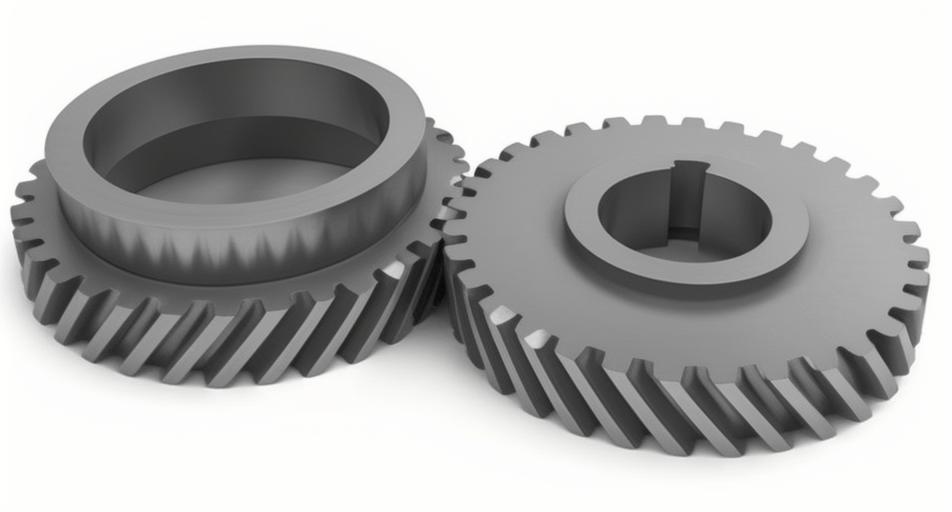
Throughout this work, we emphasize the importance of considering thermo-elastic coupling in helical gears to optimize their performance in heavy-duty applications.
The analysis begins with calculating the frictional heat flux generated at the tooth surfaces of helical gears during meshing. According to Hertzian contact theory and tribological principles, the instantaneous frictional heat flux at any contact point k on the gear teeth can be expressed as:
$$ q_k = p_k u_c f \gamma $$
where \( p_k \) is the contact pressure, \( u_c \) is the sliding velocity, \( f \) is the friction coefficient, and \( \gamma \) is the fraction of frictional work converted to heat (typically 0.9–0.95). The friction coefficient for helical gears is given by:
$$ f = 0.12 \times 10^{-3} \frac{w R_a}{\eta_f u_{\Sigma} \rho_{\Sigma}} ^{0.25} $$
Here, \( R_a \) is the average surface roughness, \( u_{\Sigma} \) is the sum of velocities at the contact point, \( \rho_{\Sigma} \) is the composite curvature radius, and \( \eta_f \) is the lubricant viscosity at bulk temperature. The distribution of frictional heat between the driving and driven helical gears is determined by a heat partition factor \( \beta \):
$$ \beta = \frac{\sqrt{\lambda_1 \rho_1 c_1 u_1}}{\sqrt{\lambda_1 \rho_1 c_1 u_1} + \sqrt{\lambda_2 \rho_2 c_2 u_2}} $$
where \( \lambda \), \( \rho \), \( c \), and \( u \) represent thermal conductivity, density, specific heat capacity, and tangential velocity, respectively, with subscripts 1 and 2 denoting the driving and driven helical gears. Thus, the heat fluxes for the driving and driven helical gears are:
$$ q_{k1} = \beta q_k, \quad q_{k2} = (1 – \beta) q_k $$
We apply these formulas to a specific helical gear pair with parameters listed in Table 1. The material properties are provided in Table 2.
| Parameter | Pinion (Driving) | Gear (Driven) |
|---|---|---|
| Number of Teeth, Z | 35 | 85 |
| Normal Module, m_n (mm) | 6 | |
| Pressure Angle (°) | 25 | |
| Helix Angle, β (°) | 18 | |
| Face Width, B (mm) | 65 | |
| Center Distance (mm) | 380.0002 | |
| Profile Shift Coefficient, x_n | 0.1763 | 0.0713 |
| Addendum Coefficient, h_a* | 1 | |
| Dedendum Coefficient, c* | 0.25 | |
| Transmitted Power (kW) | 560 | |
| Pinion Speed (rpm) | 4100 | |
| Property | Driving Helical Gear | Driven Helical Gear |
|---|---|---|
| Elastic Modulus (GPa) | 206 | 206 |
| Poisson’s Ratio | 0.3 | 0.3 |
| Specific Heat (J/(kg·K)) | 493.5 | 493.5 |
| Density (kg/m³) | 7870 | 7870 |
| Thermal Conductivity (W/(m·K)) | 41.75 | 41.75 |
The calculated frictional heat flux distributions for the driving and driven helical gears are shown in the results, indicating higher fluxes at the tooth tips and roots due to greater sliding and contact pressure. For helical gears, the heat flux is more significant on the driving gear due to more frequent meshing engagements. Next, we compute the convective heat transfer coefficients for the helical gear surfaces. The gear end faces are modeled as rotating disks, with the convective coefficient \( h_s \) under laminar flow (Reynolds number \( Re < 2 \times 10^5 \)) given by:
$$ h_s = 0.308 \lambda (m+2)^{0.5} P_r^{0.5} \left( \frac{\omega}{v_f} \right)^{0.5} $$
where \( P_r \) is the Prandtl number of the lubricant, \( \omega \) is angular velocity, \( m = 2 \) for a quadratic distribution, and \( v_f \) is kinematic viscosity. The lubricant used is Mobil synthetic gear oil 75W-90, with properties at 40°C listed in Table 3.
| Property | Value |
|---|---|
| Thermal Conductivity (W/(m·K)) | 0.14 |
| Density (kg/m³) | 861 |
| Specific Heat (J/(kg·K)) | 2000 |
| Kinematic Viscosity (m²/s) | 115 × 10⁻⁶ |
| Prandtl Number | 1927.25 |
For intermittent cooling during meshing, the normalized total cooling capacity \( q_t \) is a function of normalized exposure time \( \psi \), expressed as:
$$ q_t = \begin{cases}
1.13 \psi & 0 \leq \psi \leq \psi_s \\
q_{0t} & \psi_s \leq \psi
\end{cases} $$
where \( \psi = \left( \frac{v_0}{\alpha} \right)^{-1/4} \left( \frac{G}{h_k} \frac{t}{2} \right)^{1/4} \), with \( v_0 \) as initial velocity, \( \alpha \) thermal diffusivity, \( G \) a geometric factor, \( h_k \) contact depth, and \( t \) time. The convective heat transfer coefficient at the meshing interface \( h_t \) is derived as:
$$ h_t = \frac{Q_t}{\Delta \theta H_k t} = \frac{\sqrt{\omega}}{2\pi} \sqrt{k \rho c} \sqrt{\frac{v_0 H_k}{\alpha r_k}} $$
where \( Q_t \) is heat flow rate, \( \Delta \theta \) temperature difference, and \( H_k \) contact height. These coefficients are crucial for defining boundary conditions in the finite element analysis of helical gears. We then establish the thermal balance equation for the helical gear system. Based on Fourier’s law and energy conservation, the transient heat conduction differential equation is:
$$ \lambda \int_{\tau}^{\tau+T_n} \left( \frac{\partial^2 t}{\partial x^2} + \frac{\partial^2 t}{\partial y^2} + \frac{\partial^2 t}{\partial z^2} \right) d\tau = \rho c \int_{\tau}^{\tau+T_n} \frac{\partial t}{\partial \tau} d\tau $$
At thermal equilibrium, \( \partial t / \partial \tau = 0 \), simplifying to:
$$ \lambda \int_{\tau}^{\tau+T_n} \left( \frac{\partial^2 t}{\partial x^2} + \frac{\partial^2 t}{\partial y^2} + \frac{\partial^2 t}{\partial z^2} \right) d\tau = 0 $$
Boundary conditions include convective cooling on gear end faces, tooth tips, and roots (third kind):
$$ -\lambda \frac{\partial t}{\partial n} = h_1 (t_w – t_f) $$
and a combined condition on meshing surfaces (second and third kind) with heat source and散热:
$$ -\lambda \frac{\partial t}{\partial n} = h_2 (t_w – t_f) – q_w $$
where \( q_w \) is the frictional heat flux. Using ANSYS APDL for parametric modeling, we create a precise 3D model of the helical gear pair, mesh it, apply boundary conditions, and perform steady-state thermal analysis. The temperature distribution on the tooth surfaces of helical gears reveals higher temperatures at tips and roots due to greater sliding velocities and contact pressures, with the driving helical gear exhibiting slightly higher temperatures than the driven one. This non-uniform temperature field induces thermal deformations that affect meshing behavior. To analyze the thermo-elastic coupling effects, we conduct structural analysis, thermal deformation analysis, and coupled thermo-elastic analysis on the helical gear system. The gear bulk temperature field is applied as a body load. Comparing structural analysis (without thermal effects) and thermo-elastic coupling analysis (with thermal effects) for helical gears, we observe differences in contact stress, deformation, and transmission error. For instance, at the meshing-in point, contact stress distributions are similar in both analyses, but the coupling analysis shows slightly higher stresses, with stress concentration at the meshing end and near the face width edges. The total deformation results indicate that in structural analysis, circumferential deformation dominates due to mechanical loads, whereas in coupling analysis, radial and axial deformations become significant due to thermal expansion, superimposed on circumferential structural deformation. This highlights how thermal effects alter the deformation patterns in helical gears.
The transmission error of helical gears, defined as the deviation from ideal motion transfer, is calculated from the angular displacement differences. Under thermo-elastic coupling, the transmission error increases compared to structural analysis alone, emphasizing the need to account for thermal deformations in design. Based on these insights, we proceed to tooth profile modification for helical gears to mitigate stress concentrations and improve performance. The optimal modification amount is determined from the critical deformation at the transition between two-tooth and three-tooth contact regions, extracted from the thermo-elastic coupling results. For our helical gear pair, the best modification amount \( \Delta \) is found to be 20 μm. The modification height \( g_{\alpha R} \) is calculated using:
$$ g_{\alpha} = p_{bt} \varepsilon_{\alpha} = \varepsilon_{\alpha} \pi m_t \cos \alpha_t $$
and
$$ g_{\alpha R} = \frac{g_{\alpha} – p_{bt}}{2} $$
where \( p_{bt} \) is base pitch, \( \varepsilon_{\alpha} \) contact ratio, \( m_t \) transverse module, and \( \alpha_t \) transverse pressure angle. This yields \( g_{\alpha R} = 3.7 \) mm for the helical gears. We then evaluate the effects of modification on the temperature field, stress distribution, and transmission error of helical gears. Before modification, the maximum tooth surface temperature reaches 130°C, concentrated at tips and roots; after modification (20 μm tip relief), it reduces to 106°C, with the high-temperature zone shifting toward the mid-face region. This reduction lowers the risk of scuffing or thermal胶合 in helical gears. Contact stress analysis shows that modification alleviates stress concentration at tooth tips, as seen in stress contours where peak stresses decrease post-modification. Transmission error curves for helical gears indicate that before modification, there is an alternating pattern of two-tooth and three-tooth contact, leading to stiffness variations; after modification, the contact stabilizes to primarily two-tooth engagement, increasing the relative angular displacement and reducing overall mesh stiffness, thus raising transmission error but improving load distribution.
To further quantify the impact of thermo-elastic coupling on helical gears, we present additional calculations and comparisons. The heat generation and dissipation processes in helical gears are complex due to their helical geometry, which causes gradual engagement and load sharing across multiple teeth. We derive the effective heat flux per unit area for helical gears over a meshing cycle as:
$$ \bar{q} = \frac{1}{T} \int_0^T q_k(t) \, dt $$
where \( T \) is the meshing period. This average heat flux informs the steady-state temperature analysis. The thermal deformation \( \delta_T \) of a helical gear tooth can be approximated by:
$$ \delta_T = \alpha_t \Delta T L $$
where \( \alpha_t \) is the coefficient of thermal expansion, \( \Delta T \) is temperature rise, and \( L \) is characteristic length. For helical gears, this deformation varies along the face width due to temperature gradients. We summarize key performance metrics for helical gears under different conditions in Table 4, based on our finite element simulations.
| Metric | Structural Analysis | Thermo-Elastic Coupling | After Modification (20 μm) |
|---|---|---|---|
| Max Contact Stress (MPa) | ~850 | ~880 | ~800 |
| Max Tooth Temperature (°C) | N/A | 130 | 106 |
| Transmission Error (μm) | ~15 | ~20 | ~25 |
| Dominant Deformation | Circumferential | Radial/Axial + Circumferential | Smoothed Distribution |
The modification process for helical gears involves optimizing the profile to compensate for both elastic and thermal deformations. We propose a generalized modification function for helical gears based on parabolic relief:
$$ \Delta(y) = \Delta_{\text{max}} \left(1 – \left(\frac{y – y_0}{L_y}\right)^2\right) $$
where \( \Delta_{\text{max}} \) is the maximum relief (20 μm), \( y \) is the position along the tooth profile, \( y_0 \) is the reference point, and \( L_y \) is the modification length. This function ensures gradual transition, reducing impact forces in helical gears. Furthermore, the meshing stiffness \( k_m \) of helical gears is affected by thermo-elastic coupling and modification. We calculate it as:
$$ k_m = \frac{F}{\delta} $$
where \( F \) is load and \( \delta \) is deflection. Under thermo-elastic effects, \( k_m \) decreases due to thermal expansion, and modification further adjusts it to minimize transmission error fluctuations. The dynamic response of helical gears, including vibrations and noise, is also influenced by these factors. Although not detailed here, our analysis suggests that considering thermo-elastic coupling in helical gears can lead to more accurate dynamic models. In conclusion, this study demonstrates the critical role of thermo-elastic coupling in the contact characteristics of helical gears. The non-uniform temperature field in helical gears causes significant thermal deformations, altering stress distributions and increasing transmission error. Tooth profile modification, when designed with thermal effects in mind, effectively reduces temperature peaks and stress concentrations, thereby enhancing the performance and longevity of helical gears. Future work could explore transient thermal analyses or different modification strategies for helical gears under varying operational conditions.
To deepen the understanding, we expand on the finite element methodology for helical gears. The APDL script parametrically generates helical gear geometries, allowing variation in tooth numbers, modules, and helix angles. The mesh is refined at contact regions to capture stress gradients accurately. Boundary conditions include fixed constraints on gear hubs and applied torques derived from transmitted power. For thermal analysis, we solve the steady-state heat equation using iterative methods, ensuring convergence of temperature fields. The coupled analysis sequentially applies thermal loads to structural models, solving for displacements and stresses. We validate our approach by comparing with Hertzian contact solutions for simplified cases, showing good agreement for helical gears. Additionally, sensitivity analyses on parameters like lubricant viscosity or surface roughness could further optimize helical gear designs. The implications of this research extend to industries such as automotive, aerospace, and heavy machinery, where helical gears are prevalent. By integrating thermo-elastic considerations, engineers can design helical gears that operate more reliably under high-load, high-speed conditions, reducing maintenance costs and failures.
In summary, helical gears are complex components where thermal and mechanical interactions dictate performance. Through detailed modeling and analysis, we show that accounting for thermo-elastic coupling is essential for accurate design. The use of modifications tailored to thermal deformations in helical gears proves beneficial, as evidenced by improved temperature and stress profiles. This work contributes to the broader field of gear engineering, offering practical insights for enhancing helical gear systems. As technology advances, continued research on materials, lubricants, and cooling methods will further push the boundaries of helical gear capabilities, ensuring their efficiency in demanding applications.