
Planetary roller screw assemblies represent a class of high-precision mechanical actuators that convert rotary motion into linear motion. Compared to the standard design, the recirculating planetary roller screw assembly offers distinct advantages for applications demanding high speeds, compact spatial constraints, and extremely fine pitches. While significant research exists on the standard configuration, investigations into the specific thermal and mechanical behavior of the recirculating type are less common. This work focuses on analyzing the deformation and contact stress characteristics of the screw within a recirculating planetary roller screw assembly under combined axial load and thermal effects, employing a coupled thermo-mechanical simulation approach.
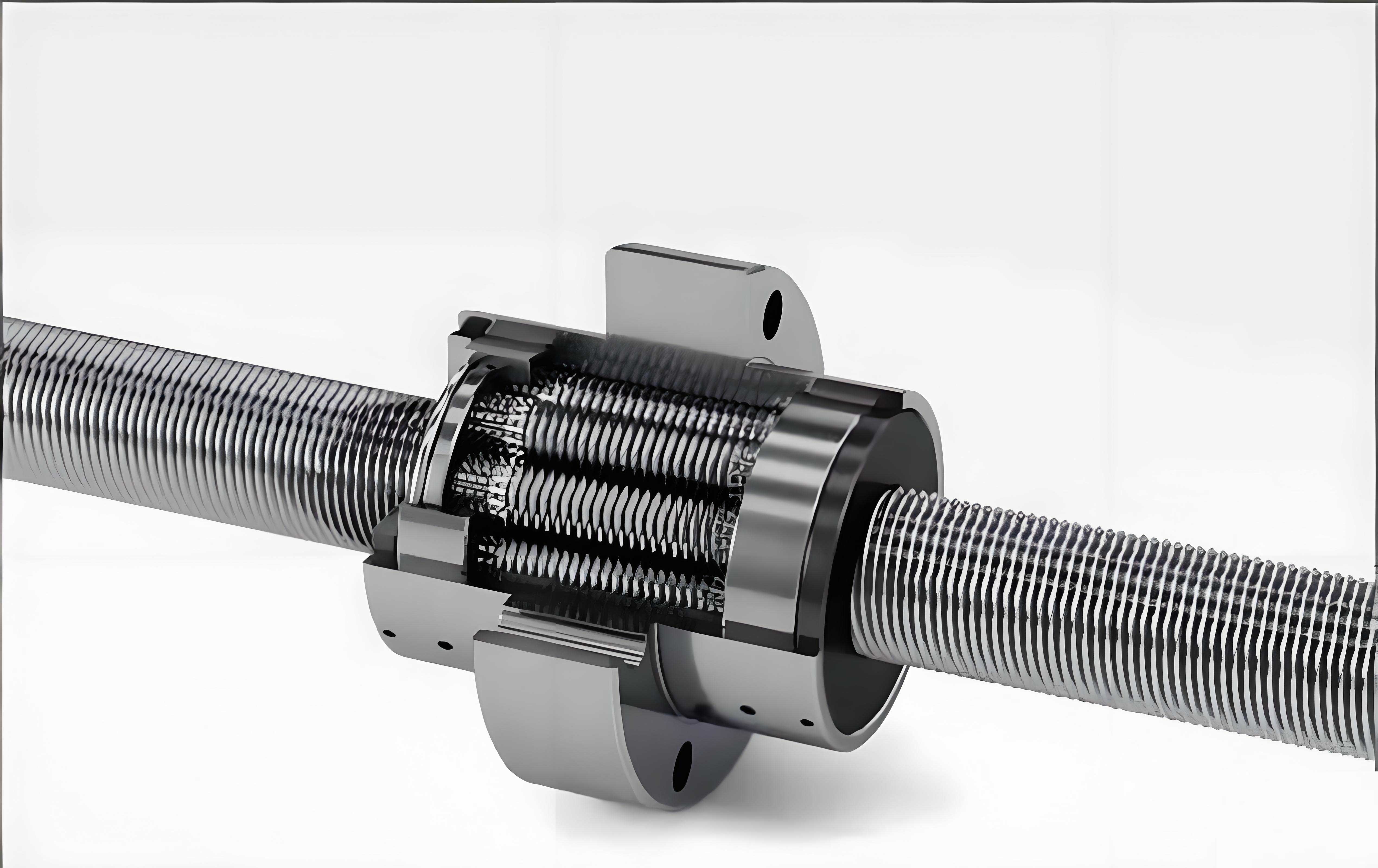
The operational principle of the recirculating planetary roller screw assembly differs from its standard counterpart. It typically consists of a central screw, a nut, a set of cylindrical rollers with annular grooves (lacking a helix angle), a carrier or cage to space the rollers, and a cam mechanism for recirculation. The rollers are distributed circumferentially within the carrier. The key kinematic difference lies in the rollers’ motion: they engage with the helical threads of the screw and nut through their grooves but do not possess a helical lead themselves. The recirculating cam guides the rollers along a closed path within the nut, allowing for continuous engagement over a long stroke without requiring lengthy rollers. The primary heat sources in this system stem from frictional contact at the screw-roller and roller-nut interfaces, where combined rolling and sliding occurs.
Understanding the thermal behavior is crucial for precision applications. The assembly dissipates heat to the environment primarily through convection. The convective heat transfer coefficient \( h \) is given by:
$$ h = \frac{\lambda N_u}{L} $$
where \( \lambda \) is the thermal conductivity of the medium (e.g., air), \( N_u \) is the Nusselt number, and \( L \) is a characteristic length. For a rotating screw enhancing air flow, the Nusselt number can be approximated by:
$$ N_u = 0.133 Re^{2/3} Pr^{1/3} $$
Here, \( Re \) is the Reynolds number \( Re = \frac{2\pi n d_s^2}{u_f} \) (with \( n \) as screw speed, \( d_s \) as screw pitch diameter, and \( u_f \) as the kinematic viscosity of air), and \( Pr \) is the Prandtl number. Temperature rise induces thermal expansion, leading to deformation and stress if constrained. The linear thermal deformation \( \Delta L \) of the screw can be estimated as:
$$ \Delta L = \alpha \cdot \Delta T \cdot L_s $$
where \( \alpha \) is the coefficient of thermal expansion, \( \Delta T \) is the temperature increase, and \( L_s \) is the original length of the screw.
To investigate the coupled effects, a finite element model of a segment of the recirculating planetary roller screw assembly was developed. The model focuses on one roller interacting with a section of the screw and nut, applying symmetry conditions to represent the full assembly. Key design parameters for the main components are summarized in Table 1.
| Component | Pitch Diameter (mm) | Number of Thread Starts | Thread Angle (°) | Pitch (mm) | Groove Spacing (mm) |
|---|---|---|---|---|---|
| Screw | Φ25 | 1 | 90 | 1 | – |
| Roller | Φ5.5 | – | 90 | – | 1 |
| Nut | Φ36 | 1 | 90 | 1 | – |
All components were modeled using GCr15 bearing steel. The material properties assigned for the thermo-mechanical analysis are listed in Table 2.
| Property | Value |
|---|---|
| Density, \( \rho \) (kg/m³) | 7810 |
| Poisson’s Ratio, \( \mu \) | 0.3 |
| Elastic Modulus, \( E \) (GPa) | 207 |
| Thermal Conductivity, \( k \) (W/(m·K)) | 36.72 |
| Coefficient of Thermal Expansion, \( \alpha \) (K⁻¹) | 13.6 × 10⁻⁶ |
The mesh was refined in the contact regions to accurately capture stress gradients. Contact pairs between the roller-screw and roller-nut were defined with a friction coefficient of 0.2. Boundary conditions simulated a fixed support at one end of the screw, an axial tensile load applied to the nut, and symmetry constraints on the cut faces. Thermal loads were applied as uniform temperature rises to the model, representing steady-state operational temperatures.
The analysis was conducted in three sequential stages: pure mechanical loading, pure thermal loading, and fully coupled thermo-mechanical loading. First, the effect of axial load alone was studied. Under a 5000 N load, the screw deformation was primarily axial (Z-direction), with maximum deformation at the free end. The maximum contact stress occurred near the fixed end at the screw-roller interface. The trends for varying axial loads are summarized in Table 3 and discussed below.
| Axial Load (N) | X-Dir. Deform. (×10⁻² mm) | Y-Dir. Deform. (×10⁻² mm) | Z-Dir. Deform. (×10⁻² mm) | Max. Contact Stress (MPa) |
|---|---|---|---|---|
| 1000 | 0.03 | 0.0009 | 0.31 | 1219.8 |
| 3000 | 0.06 | 0.0017 | 0.91 | 2220.3 |
| 5000 | 0.08 | 0.0027 | 1.48 | 2938.5 |
| 7000 | 0.10 | 0.0038 | 2.04 | 3441.2 |
| 9000 | 0.13 | 0.0048 | 2.60 | 3912.2 |
The results indicate that deformations in all directions increase linearly with axial load, with the Z-direction (axial) deformation being dominant. The maximum contact stress also increases with load, but the rate of increase diminishes. For instance, the contact stress rises by approximately 82% when the load increases from 1000 N to 3000 N, but only by about 13.1% when increasing from 7000 N to 9000 N. This suggests a nonlinear stiffening effect in the contact mechanics of the planetary roller screw assembly.
Second, the effect of a uniform temperature field was analyzed independently. At an applied temperature of 60°C (from a 20°C ambient), the temperature distribution was not uniform. The highest temperatures were localized at the screw-roller contact zones due to the simulated frictional heat concentration, while the screw ends remained closer to ambient temperature due to convective cooling. This temperature gradient directly induces thermal stress, with the maximum value also located at the contact region near the fixed end.
Finally, the coupled thermo-mechanical analysis was performed. Under a combined load of 5000 N and 60°C, the total deformation pattern shifted. The maximum total deformation was found at the free end of the screw, influenced strongly by thermal expansion, and was greater than the sum of deformations from the individual uncoupled analyses. The maximum contact stress remained at the fixed-end contact region but its magnitude was also affected by the thermal field. A comprehensive set of results for the coupled case is presented in Table 4 (deformation) and Table 5 (stress).
| Temp. (°C) | Axial Load = 1000 N | Axial Load = 3000 N | Axial Load = 5000 N | Axial Load = 7000 N | Axial Load = 9000 N |
|---|---|---|---|---|---|
| 20 | 0.261 | 0.834 | 1.406 | 1.966 | 2.522 |
| 40 | 1.148 | 1.157 | 2.130 | 2.700 | 3.264 |
| 60 | 2.186 | 2.566 | 2.976 | 3.493 | 4.056 |
| 80 | 3.225 | 3.602 | 3.993 | 4.404 | 4.844 |
| 100 | 4.267 | 4.645 | 5.027 | 5.420 | 5.831 |
| 120 | 5.314 | 5.692 | 6.072 | 6.454 | 6.852 |
| 140 | 6.363 | 6.742 | 7.121 | 7.503 | 7.888 |
The data in Table 4 shows that for a constant axial load, the Z-direction deformation increases with temperature. However, the incremental deformation per 20°C rise becomes smaller at higher temperatures, indicating a complex interaction. For example, at 5000 N, the deformation increase from 20°C to 40°C is about 51.5%, while from 120°C to 140°C it is only about 17.3%. Similarly, at a constant temperature, deformation increases with axial load.
| Temp. (°C) | Axial Load = 1000 N | Axial Load = 3000 N | Axial Load = 5000 N | Axial Load = 7000 N | Axial Load = 9000 N |
|---|---|---|---|---|---|
| 20 | 1183.6 | 2204.8 | 2856.9 | 3226.3 | 3641.4 |
| 40 | 1431.7 | 2372.9 | 2939.5 | 3278.5 | 3704.8 |
| 60 | 1727.0 | 2435.3 | 2954.8 | 3363.7 | 3808.2 |
| 80 | 2007.6 | 2530.4 | 2977.8 | 3417.6 | 3892.3 |
| 100 | 2303.7 | 2631.5 | 3022.7 | 3442.2 | 3920.8 |
| 120 | 2522.8 | 2741.5 | 3047.1 | 3472.7 | 3948.4 |
| 140 | 2739.1 | 2946.1 | 3134.0 | 3575.0 | 4002.2 |
Table 5 reveals the contact stress behavior under coupled loading. For a constant axial load, the maximum contact stress increases with temperature, but the rate of increase diminishes. At 1000 N, the stress increases by 21% from 20°C to 40°C, but only by 8.57% from 120°C to 140°C. For a constant temperature, stress increases with axial load. Crucially, the influence of temperature rise on contact stress becomes less pronounced as the axial load itself increases. At 9000 N, the stress increase from 120°C to 140°C is merely 1.36%.
In conclusion, this thermo-mechanical coupling analysis of a recirculating planetary roller screw assembly reveals several important trends. Both axial deformation and contact stress increase with rising axial load and operational temperature. Thermal effects have a more pronounced impact on the overall axial deformation of the screw, particularly moving the location of maximum deformation, while the axial load is the dominant factor governing the magnitude of the maximum contact stress. The coupled thermo-mechanical response is not a simple superposition of the individual effects; the interaction leads to more significant deformation and alters stress distributions in a non-linear manner. These findings underscore the importance of considering thermal loads alongside mechanical loads in the design and analysis of high-performance recirculating planetary roller screw assemblies, especially for precision applications where thermal expansion can critically affect positioning accuracy and load distribution.