
In the field of precision mechanical transmission, the planetary roller screw assembly stands out as a critical component for converting rotary motion into linear motion with high efficiency, high load capacity, and long service life. Its applications span across aerospace, deep-sea exploration, medical devices, and high-precision machine tools. However, a persistent challenge in the design and operation of planetary roller screw assemblies is the uneven distribution of loads among the engaged threads. This uneven load distribution can lead to premature fatigue failure, increased wear, and reduced overall lifespan, particularly under high-load conditions. In this article, I present a comprehensive study on a thread modification method aimed at achieving uniform load distribution in planetary roller screw assemblies. Through detailed mathematical modeling, finite element analysis, and statistical evaluation, I demonstrate how controlled modification of the roller threads can significantly improve load sharing, thereby enhancing the performance and durability of these assemblies.
The planetary roller screw assembly consists of several key components: a central screw, multiple planetary rollers, a nut, an internal gear ring, and a retainer. The rollers are positioned between the screw and the nut, with their threads engaging both the screw and nut threads. As the screw rotates, the rollers undergo both planetary motion and rotation, driving the nut along the linear axis. The load is transmitted through the contact interfaces between the roller threads and the threads of both the screw and the nut. Due to cumulative deformations—including Hertzian contact deformation, shaft segment deformation, and thread tooth deformation—the load tends to concentrate on specific threads, typically those near the fixed support or load application points. This non-uniformity is exacerbated by factors such as installation methods and loading conditions, making it a critical issue for high-performance applications.
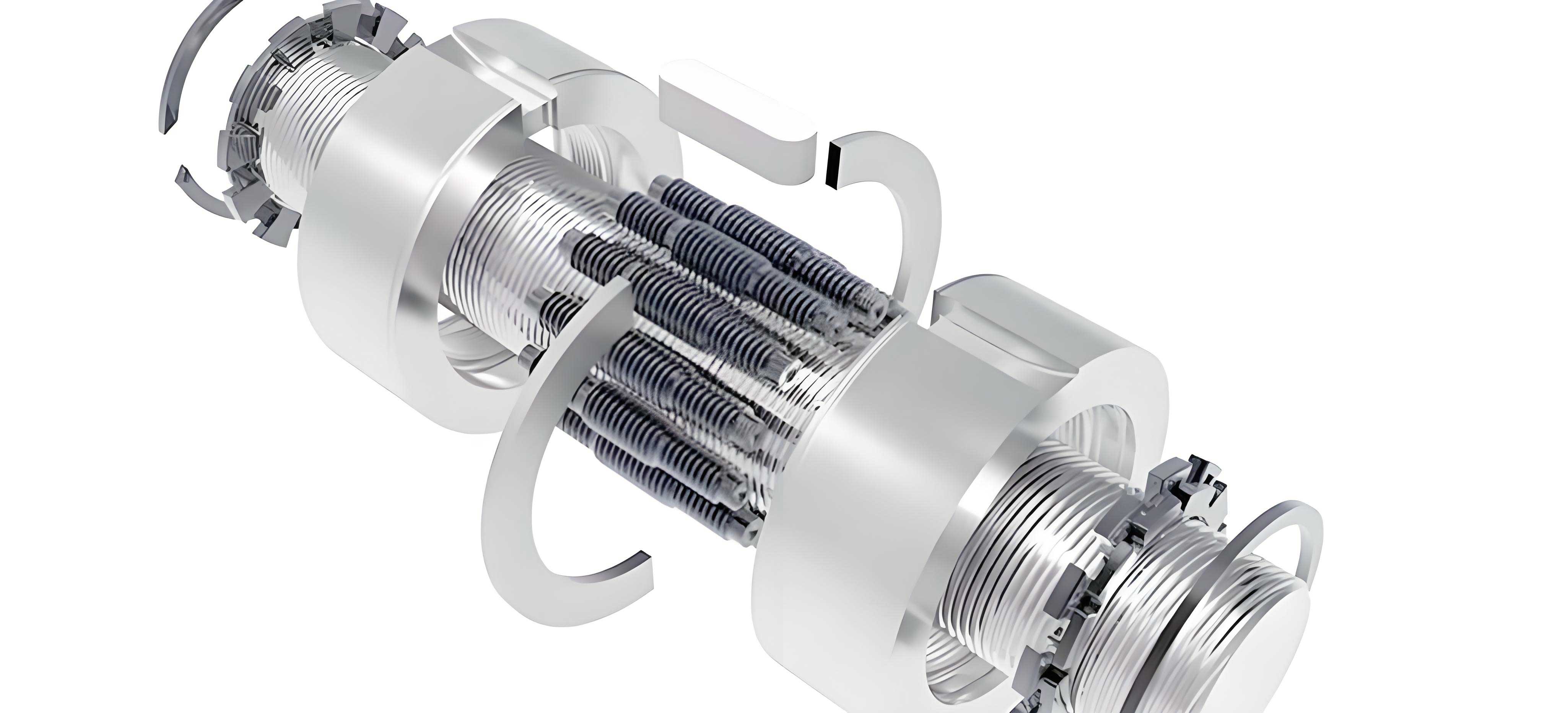
To address this, I propose a novel thread modification approach for the rollers in a planetary roller screw assembly. The core idea is to systematically alter the thread profile of the rollers to compensate for the cumulative deformations under load, thereby promoting even load distribution across all engaged threads. This modification is applied differentially to the screw-side and nut-side threads of the roller, recognizing that the load distribution characteristics and sensitivity to changes differ between these two interfaces. The modification involves linearly reducing the half-tooth thickness of the roller threads along the helical direction, starting from the free end towards the loaded end for each side. The maximum amount of reduction, termed the modification amount, is a key parameter optimized through analysis.
The theoretical foundation for this method lies in the relationship between load distribution and deformation in a planetary roller screw assembly. Under an axial load, the total deformation at each thread contact point is the sum of several components: the Hertzian contact deformation $\delta_c$, the axial deformation of the shaft segments (screw, roller, and nut) $\delta_s$, and the bending and shear deformation of the thread teeth $\delta_t$. For a given thread i on the roller engaging with either the screw or nut, the total deformation $\Delta_i$ can be expressed as:
$$ \Delta_i = \delta_{c,i} + \delta_{s,i} + \delta_{t,i} $$
where each component depends on the local load $F_i$, material properties, and geometry. The Hertzian contact deformation for a point contact can be approximated using classical Hertz theory. For two elastic bodies in contact, the deformation $\delta_c$ is related to the load $F$ by:
$$ \delta_c = \left( \frac{9F^2}{16E’^2 R} \right)^{1/3} $$
with $E’$ being the equivalent Young’s modulus and $R$ the equivalent radius of curvature. The shaft deformation $\delta_s$ is derived from axial stiffness considerations. For a cylindrical segment under axial load, the deformation is:
$$ \delta_s = \frac{F L}{A E} $$
where $L$ is the effective length, $A$ the cross-sectional area, and $E$ the Young’s modulus of the material. The thread tooth deformation $\delta_t$ is more complex, involving bending and shear; it can be modeled using beam theory or finite element methods. The cumulative effect of these deformations along the engagement length leads to a variation in the gap between mating threads, which in turn determines the load distribution. If the initial gap (or clearance) between threads is uniform, the load will be higher where the cumulative deformation is smaller, typically at the ends. Therefore, by intentionally introducing a non-uniform initial gap through thread modification—specifically, by increasing the gap where deformation is smaller—the load can be redistributed more evenly.
My modification strategy is to linearly vary the half-tooth thickness of the roller threads. Let $t_{0}$ be the nominal half-tooth thickness at the reference point. For the nut-side threads, the half-tooth thickness $t_{n}(z)$ at an axial position $z$ (measured from the nut free end) is given by:
$$ t_{n}(z) = t_{0} – \Delta_{n} \frac{z}{L_n} $$
where $\Delta_{n}$ is the maximum modification amount on the nut side, and $L_n$ is the effective engagement length on the nut side. Similarly, for the screw-side threads, the half-tooth thickness $t_{s}(z)$ at axial position $z$ (measured from the screw free end) is:
$$ t_{s}(z) = t_{0} – \Delta_{s} \frac{z}{L_s} $$
with $\Delta_{s}$ being the maximum modification amount on the screw side, and $L_s$ the engagement length on the screw side. This linear reduction effectively increases the axial clearance between the roller and the mating part (nut or screw) as one moves from the free end toward the loaded end, counteracting the deformation accumulation. The modification amounts $\Delta_{n}$ and $\Delta_{s}$ are design parameters to be optimized for uniform load distribution.
To analyze the effect of this modification, I developed a comprehensive finite element model of a planetary roller screw assembly. The model focuses on a single roller and its engagement with the screw and nut, taking advantage of symmetry and periodicity in a multi-roller assembly. The key parameters of the planetary roller screw assembly used in this study are summarized in Table 1. The material is GCr15 bearing steel, with Young’s modulus $E = 212$ GPa, Poisson’s ratio $\mu = 0.29$, and yield strength 1617 MPa.
| Component | Pitch Diameter (mm) | Major Diameter (mm) | Minor Diameter (mm) | Pitch (mm) | Number of Starts |
|---|---|---|---|---|---|
| Screw | 24 | 24.64 | 23.12 | 2 | 5 |
| Roller | 8 | 8.64 | 7.12 | 2 | 1 |
| Nut | 40 | 40.88 | 39.36 | 2 | 5 |
The finite element model incorporates detailed geometry of the threaded regions, with mesh refinement in the contact zones to accurately capture stress and deformation. Eight-node hexahedral elements (C3D8I) are used, and contact interactions are defined with appropriate friction properties. Boundary conditions simulate the actual installation and loading: the screw end is fixed, the nut is constrained to axial motion only, and an axial load of 5000 N is applied to the nut end face, corresponding to a total load capacity of 5 tons for an assembly with 10 rollers. This load is representative of high-demand applications for planetary roller screw assemblies. The model is solved using static analysis, and the contact forces on individual threads are extracted to determine load distribution.
Before applying modification, I validated the finite element model by comparing the load distribution results with established analytical solutions for different installation configurations. The results showed excellent agreement, confirming the accuracy of my modeling approach. For instance, in a configuration with opposite-side installation and both screw and nut under compression, the finite element predictions matched the analytical load distribution trends, with higher loads on threads near the fixed support and loaded ends.
With the validated model, I proceeded to investigate the effect of thread modification. A series of analyses were conducted with varying modification amounts $\Delta_{n}$ and $\Delta_{s}$, ranging from 0 to 0.014 mm in steps of 0.002 mm. For each case, the load on each thread—20 threads per side on the roller—was computed. To quantitatively assess load uniformity, I used statistical measures: the mean load $\bar{F}$, the standard deviation $S_F$, and the range (maximum and minimum). For a set of $n$ thread loads $F_i$, these are defined as:
$$ \bar{F} = \frac{1}{n} \sum_{i=1}^{n} F_i $$
$$ \delta_i = F_i – \bar{F} $$
$$ S_F = \sqrt{ \frac{1}{n} \sum_{i=1}^{n} \delta_i^2 } $$
A smaller $S_F$ indicates more uniform load distribution, as the loads are closer to the mean. The mean load is ideally equal to the average load per thread, which for a total axial load $F_{total}$ distributed over $N_r$ rollers and $n_t$ threads per roller side is:
$$ \bar{F}_{ideal} = \frac{F_{total}}{N_r \cdot n_t} $$
In our case, $F_{total} = 5000$ N, $N_r = 10$, $n_t = 20$, so $\bar{F}_{ideal} = 250$ N. Any deviation from this in the mean indicates load loss or gain due to modeling artifacts, but in practice, the computed mean should be close to this value.
The results for the nut-side load distribution under different modification amounts $\Delta_{n}$ (with $\Delta_{s} = 0$) are summarized in Table 2. As $\Delta_{n}$ increases, the load distribution changes significantly. Initially, without modification ($\Delta_{n} = 0$), the load increases monotonically from the free end to the loaded end, with a high standard deviation. At $\Delta_{n} = 0.004$ mm, the standard deviation minimizes, indicating improved uniformity. Further increase in $\Delta_{n}$ leads to a reversal of the trend, with loads decreasing from free to loaded end, and the standard deviation rises again. This demonstrates the sensitivity of the nut-side load distribution to modification.
| $\Delta_{n}$ (mm) | Max Load (N) | Min Load (N) | Mean Load $\bar{F}$ (N) | Standard Deviation $S_F$ (N) |
|---|---|---|---|---|
| 0.000 | 333.340 | 221.026 | 250.002 | 28.3262 |
| 0.002 | 308.483 | 234.971 | 250.002 | 17.8630 |
| 0.004 | 294.108 | 236.749 | 250.002 | 14.0054 |
| 0.006 | 284.147 | 235.816 | 250.002 | 14.0444 |
| 0.008 | 300.037 | 232.280 | 250.001 | 18.0623 |
| 0.010 | 313.667 | 226.420 | 250.002 | 23.7467 |
| 0.012 | 330.810 | 218.833 | 250.002 | 31.0582 |
| 0.014 | 345.747 | 211.355 | 250.002 | 37.8269 |
Similarly, for the screw-side load distribution, varying $\Delta_{s}$ (with $\Delta_{n} = 0$) yields the results in Table 3. Without modification, the screw-side load decreases sharply from the fixed end to the free end, with a large standard deviation. As $\Delta_{s}$ increases, the distribution becomes more uniform, with the standard deviation reaching a minimum at $\Delta_{s} = 0.012$ mm. Notably, the screw-side load distribution is less sensitive to small modification amounts compared to the nut side, but requires a larger modification for optimal uniformity. This difference arises from the differing axial stiffness of the screw and nut components; the nut typically has higher stiffness, leading to less deformation accumulation and thus a different response to modification.
| $\Delta_{s}$ (mm) | Max Load (N) | Min Load (N) | Mean Load $\bar{F}$ (N) | Standard Deviation $S_F$ (N) |
|---|---|---|---|---|
| 0.000 | 380.837 | 193.835 | 250.001 | 53.1049 |
| 0.002 | 356.837 | 211.593 | 250.001 | 41.7155 |
| 0.004 | 343.996 | 218.458 | 250.001 | 35.6355 |
| 0.006 | 332.353 | 223.816 | 250.001 | 29.8007 |
| 0.008 | 317.650 | 226.117 | 250.001 | 24.0972 |
| 0.010 | 303.643 | 228.789 | 250.001 | 19.8476 |
| 0.012 | 292.469 | 230.936 | 250.001 | 17.5002 |
| 0.014 | 295.605 | 230.752 | 250.001 | 17.8508 |
Based on these individual-side analyses, I identified candidate optimal modification amounts: $\Delta_{n} = 0.004$ mm or $0.006$ mm for the nut side, and $\Delta_{s} = 0.012$ mm for the screw side. To find the global optimum, I conducted combined modifications where both sides of the roller are modified simultaneously. Two cases were examined: Case A with $\Delta_{n} = 0.004$ mm and $\Delta_{s} = 0.012$ mm, and Case B with $\Delta_{n} = 0.006$ mm and $\Delta_{s} = 0.012$ mm. The resulting load distributions are shown in Figure 1 and Figure 2 (conceptual descriptions; actual data is tabulated). The statistical outcomes are compared in Table 4.
| Case | Side | Max Load (N) | Min Load (N) | Mean Load $\bar{F}$ (N) | Standard Deviation $S_F$ (N) |
|---|---|---|---|---|---|
| A: $\Delta_{n}=0.004$ mm, $\Delta_{s}=0.012$ mm | Nut | 302.953 | 235.419 | 250.002 | 16.4005 |
| Screw | 292.469 | 230.936 | 250.001 | 17.5002 | |
| B: $\Delta_{n}=0.006$ mm, $\Delta_{s}=0.012$ mm | Nut | 287.808 | 237.294 | 250.002 | 13.4826 |
| Screw | 292.469 | 230.936 | 250.001 | 17.5002 |
In Case B, the nut-side standard deviation is lower than in Case A, indicating better uniformity on the nut side, while the screw-side remains identical. Therefore, Case B ($\Delta_{n} = 0.006$ mm, $\Delta_{s} = 0.012$ mm) is identified as the optimal modification for this specific planetary roller screw assembly under the given loading and installation conditions. The load distribution becomes significantly more uniform, with the maximum thread load reduced from over 380 N to under 300 N, and the minimum load increased from below 200 N to above 230 N. This represents a substantial improvement, potentially extending the fatigue life and reliability of the assembly.
The underlying mechanics can be further elucidated through analytical expressions. The modification effectively introduces a pre-displacement that offsets the deformation accumulation. The total gap $g_i$ at thread i after modification and under load can be modeled as:
$$ g_i = g_{0,i} + \Delta_{mod,i} – \Delta_{def,i} $$
where $g_{0,i}$ is the initial manufacturing gap, $\Delta_{mod,i}$ is the gap increase due to modification (negative of half-tooth thickness reduction), and $\Delta_{def,i}$ is the deformation under load. For uniform load distribution, we desire $g_i$ to be constant across all threads, implying that $\Delta_{mod,i}$ should be tailored to cancel the variation in $\Delta_{def,i}$. Assuming linear deformation accumulation along the engagement length, we can derive the required modification profile. For a linear deformation gradient, the optimal modification amount $\Delta_{opt}$ at the loaded end relative to the free end is proportional to the total deformation difference. From our finite element results, the cumulative deformation difference between the first and last threads on the screw side is approximately 0.01297 mm, and on the nut side about 0.0081 mm. The optimal modification amounts found (0.012 mm and 0.006 mm) correlate well with these values, validating the conceptual approach.
Moreover, the implementation of this modification in manufacturing is feasible. Using a grinding process, the roller thread can be machined with a varying feed rate to achieve the linear half-tooth thickness reduction. The required feed velocity $v(t)$ as a function of time $t$ for grinding a roller with $n$ threads, pitch $P$, angular velocity $\omega$, and maximum modification amount $\Delta$ is derived as follows. The total axial displacement $s$ over $n$ revolutions is the sum of the nominal pitch advance and the modification-induced displacement:
$$ s = nP + \frac{n \Delta}{2} $$
The total time $t_{total}$ for $n$ revolutions is:
$$ t_{total} = \frac{2\pi n}{\omega} $$
The average feed velocity $\bar{v}$ is:
$$ \bar{v} = \frac{s}{t_{total}} = \frac{\omega}{2\pi} \left( P + \frac{\Delta}{2} \right) $$
The nominal feed velocity for standard thread grinding is $v_0 = P \omega / (2\pi)$. To achieve the linear modification, the feed velocity must increase linearly with time. The required acceleration $a$ is:
$$ a = \frac{\Delta \omega^2}{4 n \pi^2} $$
Thus, the feed velocity as a function of time is:
$$ v(t) = v_0 + a t = \frac{P \omega}{2\pi} + \frac{\Delta \omega^2}{4 n \pi^2} t $$
for $t$ in the interval $[0, 2\pi n / \omega]$. This formula provides a practical guideline for manufacturing the modified rollers for a planetary roller screw assembly.
The benefits of this thread modification method extend beyond load uniformity. By reducing peak loads on individual threads, the contact stresses are lowered, which decreases the risk of pitting, wear, and fatigue crack initiation. The modified planetary roller screw assembly can operate at higher loads or with extended lifespan. Additionally, the more uniform load distribution can lead to smoother motion, reduced vibration, and improved positional accuracy, which are critical in precision applications.
It is important to note that the optimal modification amounts are specific to the geometry, material, loading, and installation of the planetary roller screw assembly. For different designs, a similar analysis should be performed to determine the appropriate $\Delta_{n}$ and $\Delta_{s}$. Factors such as the number of rollers, thread count, pitch, and axial stiffness ratios will influence the results. However, the proposed methodology—combining deformation analysis, finite element modeling, and statistical optimization—provides a general framework for designing modified rollers for any planetary roller screw assembly.
In conclusion, I have presented a detailed thread modification method to achieve load balance in planetary roller screw assemblies. The method involves linearly reducing the half-tooth thickness of the roller threads on both the nut and screw sides, with differential modification amounts optimized through finite element analysis. For the example assembly studied, the optimal modification amounts are 0.006 mm on the nut side and 0.012 mm on the screw side. This modification significantly improves load uniformity, as evidenced by reduced standard deviations and more even load ranges. The approach is grounded in solid mechanics principles and offers a practical solution for enhancing the performance and durability of planetary roller screw assemblies. Future work could explore nonlinear modification profiles, dynamic loading effects, and experimental validation to further refine the method for diverse applications of planetary roller screw assemblies.