
In recent years, the demand for energy efficiency, green manufacturing, lightweight design, and advanced manufacturing processes has driven the development of cost-effective, high-efficiency, and environmentally friendly gear systems. The macroscopic performance characteristics of spur gears, such as load-carrying capacity, efficiency, and fatigue resistance, are heavily influenced by microscopic interfacial properties, including surface topography and elastohydrodynamic lubrication (EHL). Surface morphology and EHL are integral components of the interface behavior in spur gears. Previous studies have explored rough surface contact using numerical and finite element methods, investigated the nonlinear dynamic responses of gear-shaft-bearing systems under fractal surface conditions, and analyzed the effects of EHL on gear dynamics and time-varying mesh stiffness. However, a comprehensive three-dimensional EHL model that incorporates fractal surface roughness for spur gears remains underexplored. This study establishes a three-dimensional EHL model for involute spur gears by integrating geometric, physical, and microscopic effects to qualitatively investigate the lubrication state of engaged tooth surfaces and analyze the influence of key parameters.
The three-dimensional EHL model is based on the line contact characteristics of spur gears and the fundamental assumptions of hydrodynamic lubrication. The governing equation for finite-length line contact EHL is derived as follows:
$$ \frac{\partial}{\partial x} \left( \frac{\rho h^3}{\eta} \frac{\partial p}{\partial x} \right) + \frac{\partial}{\partial y} \left( \frac{\rho h^3}{\eta} \frac{\partial p}{\partial y} \right) = 12 u \frac{\partial (\rho h)}{\partial x} $$
where \( p \) represents the contact pressure, \( h \) is the oil film thickness, \( u \) is the entrainment velocity, \( \rho \) is the lubricant density, and \( \eta \) is the lubricant viscosity. The Newtonian fluid medium parameters are adopted, with the lubricant medium equations for density-pressure and viscosity-pressure relationships given by:
Density-pressure equation (D-H model):
$$ \rho = \rho_0 \left( 1 + \frac{0.6 \times 10^{-9} p}{1 + 1.7 \times 10^{-9} p} \right) $$
Viscosity-pressure equation (Roelands model):
$$ \eta = \eta_0 \exp \left\{ (\ln \eta_0 + 9.67) \left[ -1 + (1 + p / p_0)^z \right] \right\}, \quad z = \frac{\beta}{p_0 (\ln \eta_0 + 9.67)} $$
The film thickness equation accounts for surface deformation and roughness:
$$ h = h_0 + \frac{x^2}{2R} + v(x, y) + \delta(x, y), \quad v(x, y) = \frac{2}{\pi E} \int_{\Omega} \frac{p(s, t)}{\sqrt{(x-s)^2 + (y-t)^2}} \, ds \, dt $$
where \( h_0 \) is the initial central gap, \( R \) is the equivalent radius of curvature, \( v(x, y) \) is the two-dimensional elastic deformation, \( \delta(x, y) \) represents the surface topography, and \( E \) is the equivalent elastic modulus. The load balance equation ensures equilibrium:
$$ \int_{\Omega} p \, dx \, dy = w $$
where \( w \) is the applied load. The computational flowchart for the three-dimensional EHL model simulation involves iterative solving of these equations to converge on pressure and film thickness distributions, as illustrated in the following description: initial parameters are set, followed by solving the Reynolds equation, updating film thickness and deformation, and checking for load balance until convergence is achieved.
Surface fractal roughness is modeled using the continuous, non-differentiable, and self-affine W-M function to generate three-dimensional surface height distributions in a Cartesian coordinate system. The function is expressed as:
$$ \delta(x, y) = L \left( \frac{G}{L} \right)^{D-2} \sqrt{\frac{\ln \gamma}{M}} \sum_{m=1}^{M} \sum_{n=0}^{n_{\text{max}}} \gamma^{(D-3)n} \left[ \cos \phi_{m,n} – \cos \left( 2\pi \gamma^n \frac{\sqrt{x^2 + y^2}}{L} \cos \left( \tan^{-1} \left( \frac{y}{x} \right) – \frac{\pi m}{M} \right) + \phi_{m,n} \right) \right] $$
where \( D \) is the fractal dimension (with \( 2 < D < 3 \)), \( \gamma \) is a parameter related to the spectral density of the surface profile, \( G \) is the roughness height parameter, \( L \) is the sample length, \( M \) is the number of superposed ridges, and \( \phi_{m,n} \) is a random phase in the range [0, 2π]. Based on empirical data from machined surfaces of spur gears, an approximate relationship between roughness and fractal parameters is given by:
$$ R_a^{0.042} = 1.528^{D-1} = -\frac{5.26}{\lg G} $$
For simulation, isotropic roughness parameters are selected with \( R_a = 0.8 \, \mu m \), \( M = 10 \), \( \gamma = 1.5 \), \( L = 1 \times 10^{-5} \), and \( L_s = 1 \times 10^{-9} \). The resulting three-dimensional surface height distribution shows a dispersed and steep profile, indicating the complexity of rough surfaces in spur gears.
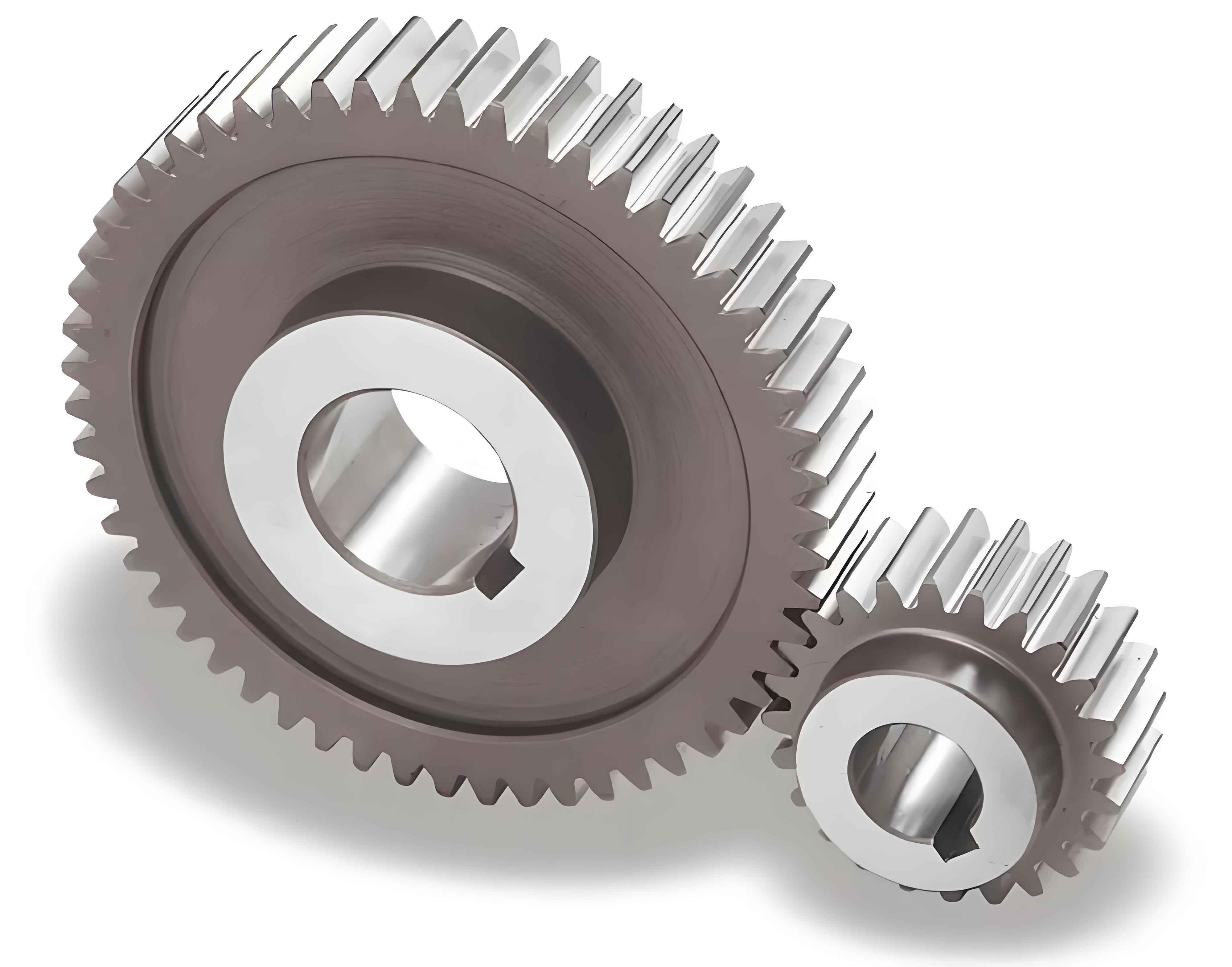
The meshing contact of spur gears is derived from kinematic relationships along the line of action. Key parameters such as the radius of curvature, tangential velocity, entrainment velocity, and slide-to-roll ratio are expressed as functions of the pressure angle. For a gear pair with contact ratio \( \varepsilon \) (where \( 1 < \varepsilon < 2 \)), the load distribution along the line of action from start to end of meshing is calculated. The equations are:
$$ R = \frac{R_p R_q}{R_p + R_q} = \frac{m \cos \alpha \, z_p z_q \tan \alpha_{pm} \tan \alpha_{qm}}{2 (z_p \tan \alpha_{pm} + z_q \tan \alpha_{qm})} $$
$$ u_e = \frac{u_p + u_q}{2} = \frac{m \pi \cos \alpha}{120} (n_p z_p \tan \alpha_{pm} + n_q z_q \tan \alpha_{qm}) $$
$$ S = 2 \frac{(u_p – u_q)}{u_p + u_q} = 2 \frac{(n_p z_p \tan \alpha_{pm} – n_q z_q \tan \alpha_{qm})}{n_p z_p \tan \alpha_{pm} + n_q z_q \tan \alpha_{qm}} $$
where \( m \) is the module, \( \alpha \) is the pressure angle, \( z_p \) and \( z_q \) are the numbers of teeth, \( n_p \) and \( n_q \) are rotational speeds, and subscripts \( p \) and \( q \) denote the driving and driven gears, respectively. The load distribution shows a linear relationship with the load curve, and contact pressure varies nonlinearly along the tooth profile, with concave increases and decreases in double-tooth and single-tooth contact regions, highlighting the complexity of load sharing in spur gears.
Simulations are conducted using parameters from a spur gear pair in a rolling contact fatigue test rig with a center distance of 160 mm. The gear parameters include: tooth numbers 24/25, module 6.5 mm, face width 36 mm, pressure angle 20°, material 18CrNiMo7-6 with elastic modulus 206 GPa, Poisson’s ratio 0.3, pressure-viscosity coefficient \( 2.19 \times 10^{-8} \), pressure coefficient \( 5.1 \times 10^{-9} \), and lubricant ISO VG220 with dynamic viscosity 125.4 mPa·s at 50°C. Under a constant torque of 1000 N·m, the effects of rotational speed on oil film pressure and thickness are analyzed. As speed increases, the secondary pressure peak shifts toward the inlet, and its magnitude rises; simultaneously, the oil film thickness increases overall, indicating that higher entrainment velocities enhance lubricant entrainment and film formation in spur gears.
The influence of surface roughness on lubrication is examined by comparing different fractal parameters. Rough surfaces cause slight fluctuations in oil film pressure and thickness, with more dispersed and steeper distributions for rougher fractals. For instance, at \( R_a = 0.8 \, \mu m \), the contact region exhibits full film lubrication, whereas at \( R_a = 3.2 \, \mu m \), the film thickness ratio decreases, leading to mixed lubrication conditions. As loads increase, the film thickness ratio further reduces, approaching boundary lubrication in some areas. This demonstrates that rougher surfaces in spur gears result in local oil film rupture, increased stress concentrations, and potential initiation of fatigue pitting.
The film thickness ratio \( \lambda \) is used to classify lubrication states: full lubrication (\( \lambda > 1.0 \)), mixed lubrication (\( 0.4 \leq \lambda \leq 1.0 \)), and boundary lubrication (\( \lambda \leq 0.4 \)). The distribution of \( \lambda \) under different parameters shows that for \( R_a = 0.8 \, \mu m \), the meshing zone is in full lubrication, but for \( R_a = 3.2 \, \mu m \), it transitions to mixed lubrication, with further reductions under higher loads. This underscores the importance of surface finish and adequate lubrication in maintaining optimal performance and fatigue resistance in spur gears.
To summarize the parameter effects, the following table provides a comparative analysis of key variables:
| Parameter | Effect on Oil Film Pressure | Effect on Oil Film Thickness | Impact on Lubrication State |
|---|---|---|---|
| Rotational Speed Increase | Secondary peak shifts inlet, magnitude rises | Overall thickness increases | Enhances full lubrication |
| Load Increase | Pressure peaks increase, distribution uneven | Thickness decreases | Promotes mixed/boundary lubrication |
| Roughness Increase (e.g., \( R_a = 3.2 \, \mu m \)) | Fluctuations and local stress concentrations | Reduced and variable thickness | Shifts to mixed lubrication |
Additionally, the relationship between fractal dimension \( D \) and roughness parameter \( G \) can be expressed as:
$$ D = 1 + \frac{\log_{10} R_a^{0.042}}{\log_{10} 1.528}, \quad G = 10^{-5.26 / (D-1)} $$
These equations facilitate the estimation of fractal parameters from measured roughness data for spur gears.
In conclusion, the three-dimensional EHL model for involute spur gears reveals that the lubricant outlet exhibits a distinct secondary pressure peak and necking phenomenon, with reduced film thickness at the ends. Increases in load and rotational speed significantly affect pressure distribution and film thickness; higher speeds improve film formation, while higher loads degrade it. Surface roughness induces fluctuations in pressure and thickness, with rougher fractals leading to more dispersed and steep profiles, transitioning lubrication from full to mixed or boundary states. This can cause local oil film rupture, stress rises, and fatigue crack initiation in spur gears. Therefore, ensuring adequate lubrication and high-precision manufacturing of tooth surfaces is crucial for enhancing the fatigue resistance and overall performance of spur gears. The findings emphasize the need for integrated approaches in gear design that account for microscopic surface effects in EHL analysis.