
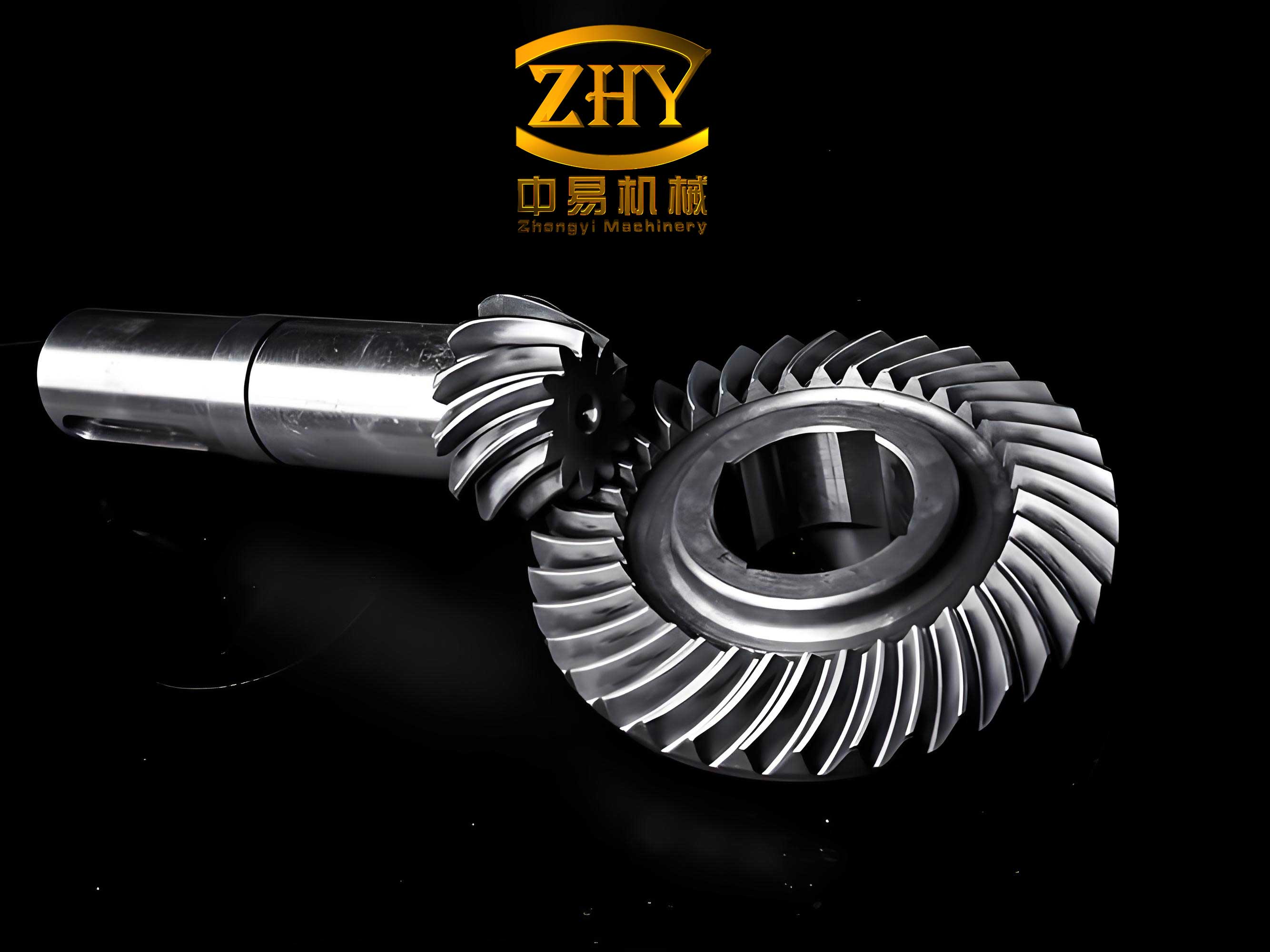
In the field of mechanical transmission, spiral bevel gears play a crucial role due to their high overlap ratio and smooth operation, making them widely used in industries such as shipbuilding, aviation, and precision machinery. Among spiral bevel gears, there are two primary forms based on tooth height:渐缩齿 (tapered tooth) and等高齿 (equal height tooth). This paper focuses on the latter, specifically the equal height tooth logarithmic spiral bevel gear, where the tooth height remains constant along the pitch cone generatrix, and the tooth trace follows a logarithmic spiral curve. The development of such gears addresses limitations in traditional spiral bevel gears, such as non-uniform spiral angles, which can lead to inefficiencies and reduced lifespan. Here, I present a comprehensive methodology for creating three-dimensional models of equal height tooth logarithmic spiral bevel gears using Pro/ENGINEER (Pro/E), a powerful CAD software. The process involves defining gear blank parameters, deriving the conical logarithmic spiral curve, and implementing detailed modeling steps to achieve accurate meshing. Throughout this work, the term ‘spiral bevel gear’ is emphasized to highlight its significance in modern engineering applications.
The concept of logarithmic spiral bevel gears is relatively novel, with previous research by our group establishing geometric parameters and 3D models for tapered tooth versions. Building on that, this study extends to the equal height tooth variant, leveraging design principles from cycloidal spiral bevel gears. The key advantage of using a logarithmic spiral lies in its constant spiral angle along the curve, which ensures uniform contact and improved transmission performance. This property is mathematically described by the conical logarithmic spiral equation, derived from spatial differential geometry. In this paper, I will elaborate on the parameter selection, modeling philosophy, and step-by-step construction in Pro/E, culminating in an assembled gear pair for validation. The goal is to provide a foundation for manufacturing and further analysis of these advanced spiral bevel gears.
To begin, the determination of gear blank parameters is essential for accurate modeling. Based on gear design handbooks and characteristics of equal height teeth, I carefully selected parameters that ensure functionality and avoid issues like narrow tooth tips at the small end. The following table summarizes the geometric parameters for a pair of equal height tooth logarithmic spiral bevel gears, designed for a shaft angle of 90 degrees. These parameters serve as the basis for all subsequent modeling steps.
| Parameter Name | Symbol | Value |
|---|---|---|
| Number of Teeth | z | z₁ = 17, z₂ = 28 |
| Shaft Angle (°) | Σ | 90 |
| Pitch Diameter (mm) | d | d₁ = 121, d₂ = 200 |
| Face Width (mm) | b | 34.9 |
| Module at Large End (mm) | m | 7.14 |
| Spiral Angle (°) | β | 35 |
| Pressure Angle (°) | α | 20 |
| Pitch Cone Angle (°) | δ | δ₁ = 31.2637, δ₂ = 58.7363 |
| Addendum Coefficient | hₐ* | 1 |
| Dedendum Coefficient | c* | 0.25 |
| Theoretical Tooth Thickness at Large End (mm) | s | 13 |
| Radial Modification Coefficient (mm) | xₕ | xₕ₁ = 0.24, xₕ₂ = -0.24 |
| Tangential Modification Coefficient (mm) | xₜ | 0 |
The selection of these parameters, particularly the modification coefficients, helps prevent the small end from becoming too narrow, a common challenge in equal height tooth spiral bevel gears. This ensures that the gear teeth maintain sufficient strength and proper meshing characteristics. The spiral angle of 35° is chosen to optimize performance, and the logarithmic spiral curve will be implemented to maintain this angle consistently across the tooth surface.
Central to this design is the conical logarithmic spiral curve, which serves as the tooth trace. In differential geometry, curves with a constant ratio of curvature to torsion are known as general helices. The conical logarithmic spiral is one such curve, characterized by a constant spiral angle relative to the cone’s generatrix. This property is crucial for spiral bevel gears, as it promotes even load distribution and reduces wear. The vector equation of the conical logarithmic spiral is given by:
$$ \mathbf{r}(\phi) = b e^{m\phi} (\sin\alpha \cos\phi \, \mathbf{i} + \sin\alpha \sin\phi \, \mathbf{j} + \cos\alpha \, \mathbf{k}) $$
where \( m = \sin\alpha \cot\beta \), \( b = e^c \), \( \alpha \) is the semi-cone angle (half of the pitch cone angle), \( \beta \) is the spiral angle, \( c \) is an integration constant, and \( \phi \) is the angle parameter. For our gear, \( \alpha = \delta \) for each gear, and \( \beta = 35^\circ \). The parametric equations derived from this are:
$$ x(\phi) = b e^{m\phi} \sin\alpha \cos\phi $$
$$ y(\phi) = b e^{m\phi} \sin\alpha \sin\phi $$
$$ z(\phi) = b e^{m\phi} \cos\alpha $$
These equations define the path along which the tooth profile will be swept. The constant \( b \) can be determined based on the gear’s pitch diameter, and \( \phi \) typically ranges from 0 to 360 degrees for a full rotation. The key advantage here is that the spiral angle \( \beta \) remains unchanged at every point on the curve, addressing a limitation in traditional spiral bevel gears where the spiral angle varies. This uniformity enhances the meshing quality of the spiral bevel gear, leading to smoother operation and longer service life.
The modeling philosophy for the equal height tooth logarithmic spiral bevel gear revolves around using this conical logarithmic spiral as a sweep trajectory. Since the tooth height is constant from the large end to the small end, the face cone angle, pitch cone angle, and root cone angle are all equal. This simplifies the geometry but introduces the challenge of insufficient tooth thickness at the small end. To mitigate this, I applied modification coefficients, as shown in the parameter table, which adjust the tooth thickness radially and tangentially. The Pro/E software is then used to create the 3D model through a series of steps: creating basic curves and circles, generating the logarithmic spiral, defining the tooth profile, performing sweep blends, and patterning the teeth. The process ensures accuracy and facilitates virtual assembly and interference checking.
The detailed modeling process in Pro/E begins with setting up the gear blank. First, I create reference planes and points to establish the coordinate system. The large end and small end circles, including the pitch circle, addendum circle, and dedendum circle, are drawn based on the parameters. For instance, the pitch diameter at the large end for the driven gear (z₂=28) is 200 mm, so the pitch circle radius is 100 mm. Using Pro/E’s sketch tool, I draw these circles on parallel planes separated by the face width of 34.9 mm. This forms the basis for the gear’s conical shape.
Next, the conical logarithmic spiral curve is generated. In Pro/E, I use the curve-from-equation feature, inputting the parametric equations in Cartesian coordinates. For the driven gear (right-hand spiral), the equations are implemented as follows, with \( \alpha = 58.7363^\circ \) and \( \beta = 35^\circ \):
$$ \text{theta} = t \times 360 $$
$$ x = \exp\left( \frac{\text{theta} \times \pi}{180} \times \sin(58.7363) / \tan(35) \right) \times \cos(\text{theta}) \times \sin(58.7363) $$
$$ y = \exp\left( \frac{\text{theta} \times \pi}{180} \times \sin(58.7363) / \tan(35) \right) \times \sin(\text{theta}) \times \sin(58.7363) $$
$$ z = \exp\left( \frac{\text{theta} \times \pi}{180} \times \sin(58.7363) / \tan(35) \right) \times \cos(58.7363) $$
Here, \( t \) is a Pro/E parameter ranging from 0 to 1. This creates a 360-degree logarithmic spiral that serves as the sweep path for the tooth. For the driving gear (left-hand spiral), the equations are similar but with \( \alpha = 31.2637^\circ \) and a negative sign for the y-component to reverse the spiral direction. The ability to precisely define this curve is a key strength of Pro/E, enabling the creation of complex geometries like logarithmic spiral bevel gears.
With the spiral trajectory ready, I proceed to create the tooth profile. The profile is based on an involute curve, which is standard for gear teeth to ensure proper meshing. I create involute curves at both the large and small ends using Pro/E’s equation-driven curve feature. For example, for the small end of the driven gear, the involute equations are:
$$ r = 123.579 $$
$$ \theta = t \times 60 $$
$$ x = r \times \cos(\theta) + r \times \sin(\theta) \times \theta \times \pi / 180 $$
$$ y = r \times \sin(\theta) – r \times \cos(\theta) \times \theta \times \pi / 180 $$
$$ z = 0 $$
The value \( r = 123.579 \) mm is the base circle radius calculated from the gear parameters. Similarly, for the large end, \( r = 181.061 \) mm. These involutes are then mirrored across the tooth centerline to form the complete tooth profile. To ensure the profiles align with the spiral trajectory, I rotate them using reference points and axes. This step is critical for maintaining the correct orientation of the tooth along the conical surface.
Now, I use the sweep blend feature in Pro/E to create the solid tooth. The sweep blend requires a trajectory and multiple sections. I select the conical logarithmic spiral as the trajectory, and the involute profiles at the large and small ends as sections. Pro/E interpolates between these sections along the spiral, generating a smooth tooth surface. This method effectively constructs the tooth as a swept volume, conforming to the equal height constraint—the tooth height remains constant because the sections have the same addendum and dedendum dimensions. The root fillet is added using Pro/E’s round feature to reduce stress concentration.
Once a single tooth is created, I pattern it around the gear axis. The number of instances equals the number of teeth (28 for the driven gear, 17 for the driving gear), with an angular increment of \( 360^\circ / z \). Pro/E’s pattern tool makes this straightforward, ensuring all teeth are identical and evenly spaced. After patterning, I add finishing touches like chamfers and blends to complete the gear body. The result is a detailed 3D model of the equal height tooth logarithmic spiral bevel gear, ready for assembly.
The driving gear model is created similarly, but with opposite spiral direction and adjusted parameters. The conical logarithmic spiral equation for the left-hand spiral is:
$$ \text{theta} = t \times 500 $$
$$ x = \exp\left( \frac{\text{theta} \times \pi}{180} \times \sin(31.2637) / \tan(35) \right) \times \cos(\text{theta}) \times \sin(31.2637) $$
$$ y = \exp\left( \frac{\text{theta} \times \pi}{180} \times \sin(31.2637) / \tan(35) \right) \times \sin(-\text{theta}) \times \sin(31.2637) $$
$$ z = \exp\left( \frac{\text{theta} \times \pi}{180} \times \sin(31.2637) / \tan(35) \right) \times \cos(31.2637) $$
Note the negative sign in the sine term for y, which reverses the spiral direction. The range of theta is extended to 500 degrees to ensure adequate length for the sweep. This results in a driving gear model that mirrors the driven gear but with fewer teeth and opposite handedness, essential for proper meshing in a spiral bevel gear pair.
After both gears are modeled, I assemble them in Pro/E’s assembly module. The assembly process involves defining constraints to simulate the actual gear mounting. First, I create a fixed axis for the driven gear and a perpendicular axis for the driving gear, corresponding to the shaft axes. Then, I import the gear models and use pin connections to allow rotation around these axes. The gears are positioned so that their pitch cones are tangent, and the shaft angle is 90 degrees. Pro/E’s constraint tools ensure accurate alignment, and I can adjust the meshing position by rotating the gears.
To validate the assembly, I perform interference analysis and motion simulation. Pro/E provides tools to check for collisions between components, ensuring that the teeth do not intersect improperly. I also run a kinematic analysis to observe the meshing motion, confirming that the gears rotate smoothly without jamming. The logarithmic spiral design promotes continuous contact, and the interference check verifies that there is minimal backlash and no geometric conflicts. This virtual validation is crucial before physical prototyping, reducing development time and cost for spiral bevel gear systems.
The successful modeling and assembly of these equal height tooth logarithmic spiral bevel gears demonstrate the feasibility of the design. The use of Pro/E enables precise control over geometry, from the logarithmic spiral trajectory to the involute tooth profile. The constant spiral angle offered by the logarithmic curve addresses a key limitation in traditional spiral bevel gears, potentially leading to improved performance in terms of noise reduction, load capacity, and durability. Moreover, the equal height tooth simplifies manufacturing processes compared to tapered teeth, as the tooling can be more consistent.
From a mathematical perspective, the conical logarithmic spiral curve is a powerful tool for gear design. Its general form can be extended to other gear types, such as hypoid gears or face gears. The equation parameters \( \alpha \), \( \beta \), and \( b \) offer flexibility to optimize for specific applications. For instance, in high-speed transmissions, a larger spiral angle might be chosen to increase overlap ratio, while in heavy-load scenarios, a smaller angle might enhance strength. The ability to model these variations in Pro/E allows for rapid iteration and optimization.
In terms of applications, spiral bevel gears are ubiquitous in automotive differentials, aerospace actuators, and industrial machinery. The equal height tooth logarithmic spiral bevel gear could find use in these areas, particularly where space constraints or efficiency demands are high. For example, in electric vehicle drivetrains, the reduced vibration from constant spiral angle meshing could improve energy efficiency and passenger comfort. The 3D models created here can be exported for CNC machining or additive manufacturing, bridging the gap between design and production.
To further illustrate the parameter relationships, I summarize key formulas used in the design. The pitch diameter \( d \) is related to the module \( m \) and number of teeth \( z \) by \( d = m z \). The pitch cone angle \( \delta \) for a shaft angle \( \Sigma = 90^\circ \) is given by \( \delta_1 = \arctan(z_1 / z_2) \) and \( \delta_2 = 90^\circ – \delta_1 \). The addendum \( h_a \) and dedendum \( h_f \) are calculated as \( h_a = h_a^* m \) and \( h_f = (h_a^* + c^*) m \), where \( h_a^* \) and \( c^* \) are coefficients. For the logarithmic spiral, the constant \( b \) can be derived from the pitch radius at a reference point, ensuring the curve passes through the gear’s pitch circle.
A critical aspect of spiral bevel gear design is the contact pattern, which affects load distribution. While this paper focuses on 3D modeling, future work could involve finite element analysis (FEA) to simulate contact stresses and tooth deflection. Using the Pro/E models, I can export meshes for FEA software to evaluate performance under various loads. The constant spiral angle of the logarithmic design is expected to produce a more uniform contact pattern compared to traditional arcs, reducing peak stresses and extending gear life. This analysis would provide quantitative validation for the benefits of logarithmic spiral bevel gears.
In conclusion, I have detailed the process of creating three-dimensional models for equal height tooth logarithmic spiral bevel gears using Pro/ENGINEER. Starting from parameter selection based on gear design principles, I derived the conical logarithmic spiral curve and implemented it in Pro/E to generate accurate tooth geometries. The modeling steps involve creating basic curves, generating logarithmic spirals, defining involute profiles, performing sweep blends, and patterning teeth. The assembled gear pair was validated through interference checking and motion simulation, confirming proper meshing. This work establishes a foundation for manufacturing and further research into logarithmic spiral bevel gears, offering potential improvements in transmission efficiency and durability. The integration of advanced CAD tools like Pro/E enables the realization of complex gear designs, pushing the boundaries of mechanical engineering.
The exploration of logarithmic spiral bevel gears opens new avenues for optimization. Future studies could investigate the impact of different spiral angles or pressure angles on performance, or explore hybrid designs combining logarithmic spirals with other tooth profiles. Additionally, the models can be used for educational purposes, helping students understand gear geometry and CAD techniques. As industry demands more efficient and reliable transmissions, innovations in spiral bevel gear design will continue to play a vital role. The methodology presented here provides a robust framework for such advancements, leveraging the power of Pro/E and mathematical modeling to create next-generation gear systems.