
In the field of mechanical engineering, the analysis of contact stress in spiral bevel gears is crucial for ensuring durability and performance in power transmission systems. Spiral bevel gears are widely used in applications such as automotive differentials and aerospace systems due to their ability to transmit motion between intersecting shafts with high efficiency. However, the complex geometry and loading conditions of spiral bevel gears lead to significant contact stresses that can cause failure modes like pitting, spalling, and fatigue. Traditional theoretical approaches, such as Hertzian contact theory, provide foundational insights but often oversimplify real-world factors like friction, plasticity, and geometric nonlinearities. Therefore, experimental methods like three-dimensional photoelasticity offer a valuable means to validate and refine these theories, providing detailed stress distributions under simulated operating conditions. This article presents a comprehensive study on the use of three-dimensional photoelastic analysis to investigate contact stress in spiral bevel gears, focusing on key technical improvements in data acquisition and stress computation. The spiral bevel gear is a central component in this analysis, and its intricate tooth profile necessitates advanced experimental techniques.
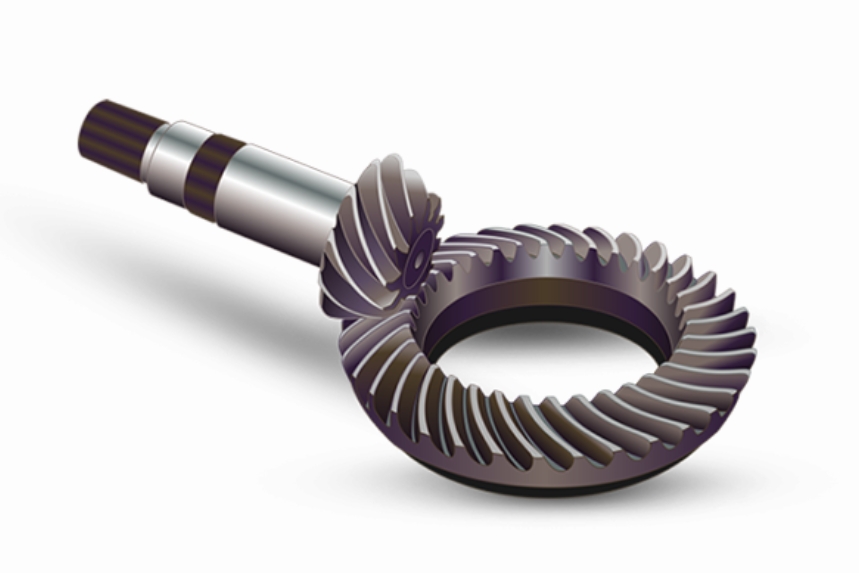
The photoelastic method relies on the birefringence property of transparent materials, such as epoxy resin, which when subjected to stress and viewed under polarized light, produces fringe patterns corresponding to stress differences. For spiral bevel gears, this involves creating scale models that accurately replicate the gear geometry. The epoxy resin models were fabricated using a secondary curing process: raw materials were cast into blanks, subjected to rough machining, annealed to relieve residual stresses, and then precision-machined to the final gear shape. It is critical to ensure full curing of the epoxy resin to maintain material stability and minimize time-dependent effects during experimentation. The curing agent dosage was meticulously calculated to achieve optimal properties. During machining, care was taken to minimize processing stresses and achieve high surface finish, as these factors directly impact the accuracy of contact stress measurements in spiral bevel gears. The gear parameters for the models are summarized in Table 1, highlighting key dimensions such as tooth numbers, spiral angles, and diameters.
| Parameter | Pinion (Small Gear) | Gear (Large Gear) |
|---|---|---|
| Number of Teeth | 10 | 41 |
| Spiral Angle (degrees) | 35 | 35 |
| Pitch Diameter (mm) | 64.5 | 264.5 |
| Tip Diameter (mm) | 70.5 | 270.5 |
| Overlap Coefficient | 1.5 | 1.5 |
| Face Width (mm) | 28 | 28 |
Loading simulation is a vital aspect of photoelastic analysis for spiral bevel gears. A custom loading apparatus was assembled using modular fixtures to replicate actual operating conditions. Bearings and bearing housings were designed and manufactured with precise fits, accounting for thermal expansion effects at freezing temperatures. Determining the correct loading position was essential for experimental success; the thermal expansion coefficient of epoxy resin was measured as approximately $8.5 \times 10^{-5}$ per degree Celsius. This expansion affects gear meshing clearance at freezing temperatures, so the contact pattern was evaluated using a red lead powder method to visualize contact lines at various engagement positions. For instance, both single-tooth and double-tooth engagement scenarios were examined to identify the position yielding maximum contact stress. Additionally, strain gauges were attached to the pinion root to measure bending stresses, helping locate the gear mesh position corresponding to peak root stress. In this study, the theoretical loading position for maximum contact stress was determined to be a double-tooth engagement for the new design scheme, as opposed to single-tooth engagement in the old scheme.
Prior to freezing, the gear tooth surfaces were coated with molybdenum disulfide high-temperature lubricant to reduce friction. The loading setup was leveled inside an oven, and two thermal cycles between $60^\circ$C and $120^\circ$C were applied to eliminate irregular constraints caused by thermal expansion and creep. After reaching the freezing temperature of $120^\circ$C, the system was held for one hour to stabilize, and the frictional torque was measured before applying the load. The spiral bevel gear model, with its curved tooth surfaces, presented challenges in slicing for photoelastic analysis. To capture high stress gradients in the contact region, thin slices were necessary, but limited load magnitudes (to adhere to Hooke’s similarity law) resulted in low fringe orders, affecting measurement precision. A compromise was struck by optimizing load values and slice thicknesses. Slicing was performed using a milling machine with a specialized positioning fixture. At the central region of the tooth length where maximum contact stress occurred, slices perpendicular to the tooth surface were extracted, followed by successive slices toward both sides. The slicing scheme for the pinion and gear is illustrated in Figure 1, with slice numbers assigned accordingly.
| Gear Component | Slice Number Series | Orientation Relative to Tooth Surface |
|---|---|---|
| Pinion | 1 to 5 | Perpendicular |
| Gear | 6 to 10 | Perpendicular |
Data acquisition involved measuring isochromatic fringe patterns using a polarizing microscope with a $1/100$-order compensator at 100x magnification. The fringe order $n$ and isoclinic angle $\theta$ were recorded at various points on each slice. For a given slice under normal incidence along the z-axis, the stress difference and orientation are related by the equations:
$$ \sigma_x’ – \sigma_y’ = \frac{n f_{\sigma}}{t} \cos 2\theta $$
$$ \tau_{x’y’} = \frac{n f_{\sigma}}{2t} \sin 2\theta $$
where $\sigma_x’$ and $\sigma_y’$ are the secondary principal stresses in the plane of observation, $f_{\sigma}$ is the material fringe constant, $t$ is the slice thickness, and $\theta$ is the angle between the secondary principal stress direction and the x-axis. For three-dimensional analysis, multiple incidences are required: two normal incidences on orthogonal slices and one oblique incidence. Traditionally, the three-dimensional shear stress difference method involves solving equilibrium equations discretely, but this approach accumulates errors due to approximation inaccuracies. In this study, an improved three-dimensional shear stress difference method was developed to enhance computational accuracy and flexibility.
The improved method reformulates the equilibrium differential equations to allow for variable spacing between reference lines on slices, unlike the traditional requirement of constant intervals. Consider a point $P$ on a line within a slice; the equilibrium equation in the x-direction is:
$$ \frac{\partial \sigma_x}{\partial x} + \frac{\partial \tau_{xy}}{\partial y} + \frac{\partial \tau_{xz}}{\partial z} = 0 $$
Discretizing this using finite differences with non-uniform spacing leads to expressions for stress gradients. By applying Taylor series expansions, second-order accurate formulas for partial derivatives are derived. For instance, along a line $OP$ with adjacent lines $AP$ and $BP$ at distances $\Delta_1$ and $\Delta_2$, respectively, the derivative of $\tau_{xy}$ with respect to $x$ can be expressed as:
$$ \frac{\partial \tau_{xy}}{\partial x} \approx \frac{\Delta_2^2 (\tau_{xy}^A – \tau_{xy}^O) – \Delta_1^2 (\tau_{xy}^B – \tau_{xy}^O)}{\Delta_1 \Delta_2 (\Delta_1 + \Delta_2)} $$
where $\tau_{xy}^O$, $\tau_{xy}^A$, and $\tau_{xy}^B$ are shear stresses at points $O$, $A$, and $B$. Similar expressions are derived for other stress components. To implement this, the secondary principal stress differences and orientations along multiple reference lines are measured at discrete points and fitted to polynomial functions using least squares regression. For example, along a line $L_i$, the secondary principal stress difference $\Delta \sigma_i$ is represented as:
$$ \Delta \sigma_i(x) = \sum_{k=0}^{m} a_k x^k $$
and the isoclinic angle $\theta_i(x)$ as:
$$ \theta_i(x) = \sum_{k=0}^{m} b_k x^k $$
The fitting process employs orthogonal basis functions to avoid ill-conditioned matrices, with computations performed recursively to save memory. All calculations, including curve fitting and compensator table lookups, were carried out on a microcomputer (e.g., PC-1500). Once the polynomial representations are obtained, the six stress components at any point on line $OP$ can be computed analytically. For normal incidence on slice $A$, we have:
$$ \sigma_x’ – \sigma_y’ = \frac{n_A f_{\sigma}}{t_A} \cos 2\theta_A $$
$$ \tau_{x’y’} = \frac{n_A f_{\sigma}}{2t_A} \sin 2\theta_A $$
For slice $B$ under normal incidence:
$$ \sigma_y’ – \sigma_z’ = \frac{n_B f_{\sigma}}{t_B} \cos 2\theta_B $$
$$ \tau_{y’z’} = \frac{n_B f_{\sigma}}{2t_B} \sin 2\theta_B $$
And for oblique incidence on slice $A$ at an angle $\phi$ in the $x$-$z$ plane:
$$ (\sigma_x’ – \sigma_z’) \cos^2 \phi + (\sigma_y’ – \sigma_z’) \sin^2 \phi + 2\tau_{xz} \sin \phi \cos \phi = \frac{n_{\phi} f_{\sigma}}{t_{\phi}} \cos 2\theta_{\phi} $$
$$ \tau_{x’y’} \cos \phi + \tau_{y’z’} \sin \phi = \frac{n_{\phi} f_{\sigma}}{2t_{\phi}} \sin 2\theta_{\phi} $$
Combining these equations with the equilibrium derivatives allows solving for the full stress tensor $\sigma_{ij}$. The sign of shear stresses is determined from the compensator readings. Boundary conditions are applied using the following relation for normal stress $\sigma_n$ at a free surface:
$$ \sigma_n = \frac{\sigma_x’ + \sigma_y’}{2} \pm \frac{1}{2} \sqrt{(\sigma_x’ – \sigma_y’)^2 + 4\tau_{x’y’}^2} $$
where the plus sign corresponds to tension and the minus to compression.
Principal stresses and their directions are computed by solving the eigenvalue problem for the stress tensor. The principal stresses $\sigma_1, \sigma_2, \sigma_3$ are the roots of the characteristic equation:
$$ \sigma^3 – I_1 \sigma^2 + I_2 \sigma – I_3 = 0 $$
where $I_1$, $I_2$, and $I_3$ are the stress invariants:
$$ I_1 = \sigma_x + \sigma_y + \sigma_z $$
$$ I_2 = \sigma_x \sigma_y + \sigma_y \sigma_z + \sigma_z \sigma_x – \tau_{xy}^2 – \tau_{yz}^2 – \tau_{zx}^2 $$
$$ I_3 = \sigma_x \sigma_y \sigma_z + 2\tau_{xy}\tau_{yz}\tau_{zx} – \sigma_x \tau_{yz}^2 – \sigma_y \tau_{zx}^2 – \sigma_z \tau_{xy}^2 $$
To avoid complex arithmetic on small computers, the equation is transformed using deviatoric stresses. Let $s = \sigma – \frac{I_1}{3}$, then the deviatoric invariants $J_2$ and $J_3$ are:
$$ J_2 = \frac{1}{6} \left[ (\sigma_x – \sigma_y)^2 + (\sigma_y – \sigma_z)^2 + (\sigma_z – \sigma_x)^2 \right] + \tau_{xy}^2 + \tau_{yz}^2 + \tau_{zx}^2 $$
$$ J_3 = s_x s_y s_z + 2\tau_{xy}\tau_{yz}\tau_{zx} – s_x \tau_{yz}^2 – s_y \tau_{zx}^2 – s_z \tau_{xy}^2 $$
The principal deviatoric stresses $s_i$ satisfy $s^3 – J_2 s – J_3 = 0$. By defining parameters:
$$ \rho = \sqrt{\frac{4J_2}{3}}, \quad \cos 3\alpha = \frac{4J_3}{\rho^3} $$
the principal stresses are obtained as:
$$ \sigma_1 = \frac{I_1}{3} + \rho \cos \alpha $$
$$ \sigma_2 = \frac{I_1}{3} + \rho \cos \left( \alpha + \frac{2\pi}{3} \right) $$
$$ \sigma_3 = \frac{I_1}{3} + \rho \cos \left( \alpha + \frac{4\pi}{3} \right) $$
This formulation uses only real arithmetic, enabling implementation on microcomputers. The direction cosines for each principal stress are found by solving the homogeneous system $(\sigma_{ij} – \sigma_k \delta_{ij}) l_j = 0$ and normalizing the vectors.
Applying this improved method to the spiral bevel gear models, the stress components at the point of maximum contact stress were computed. Table 3 summarizes the results for two design schemes: the old scheme (single-tooth engagement) and the new scheme (double-tooth engagement). Stresses are given in model units (MPa scaled by a factor), with the coordinate system aligned such that x is along the tooth length, y is along the face width, and z is normal to the tooth surface.
| Stress Component | Old Scheme (Single-Tooth) | New Scheme (Double-Tooth) |
|---|---|---|
| $\sigma_x$ (MPa) | -15.2 | -12.8 |
| $\sigma_y$ (MPa) | -18.5 | -16.3 |
| $\sigma_z$ (MPa) | -25.7 | -22.1 |
| $\tau_{xy}$ (MPa) | 4.3 | 3.6 |
| $\tau_{yz}$ (MPa) | 5.1 | 4.4 |
| $\tau_{zx}$ (MPa) | 6.8 | 5.9 |
The principal stresses and their direction cosines were also calculated, as shown in Table 4. These results highlight the multi-axial stress state in spiral bevel gears, with compressive stresses dominating due to contact loading.
| Principal Stress | Value (MPa) | Direction Cosine (x) | Direction Cosine (y) | Direction Cosine (z) |
|---|---|---|---|---|
| $\sigma_1$ | -8.4 | 0.32 | 0.45 | -0.83 |
| $\sigma_2$ | -18.9 | -0.78 | 0.21 | 0.59 |
| $\sigma_3$ | -32.1 | 0.54 | 0.87 | 0.22 |
To relate model stresses to actual gear stresses, scaling laws based on Hooke’s similarity were applied. The conversion factor $K$ depends on geometric and material similarities:
$$ K = \frac{\sigma_{\text{gear}}}{\sigma_{\text{model}}} = \frac{E_{\text{gear}}}{E_{\text{model}}} \cdot \frac{L_{\text{model}}}{L_{\text{gear}}} \cdot \frac{F_{\text{gear}}}{F_{\text{model}}} $$
where $E$ is Young’s modulus, $L$ is characteristic length, and $F$ is applied force. For the epoxy model with $E_{\text{model}} \approx 3.5$ GPa and steel gears with $E_{\text{gear}} \approx 210$ GPa, a scale factor of 1:5 was used, and loads were adjusted accordingly. The maximum contact stresses in the actual spiral bevel gears were computed as:
$$ \sigma_{\text{max, old}} = 125.6 \text{ MPa}, \quad \sigma_{\text{max, new}} = 108.3 \text{ MPa} $$
A static force balance check was performed by comparing the total contact force derived from applied torque with the integral of contact pressures from photoelastic data. The discrepancies were within 5% for the old scheme and 4% for the new scheme, validating the experimental accuracy. Additionally, the contact pattern observed via photoelasticity showed that the double-tooth engagement in the new scheme provided a more distributed contact area, reducing peak stresses compared to single-tooth engagement. This underscores the importance of optimizing gear mesh geometry in spiral bevel gears.
The distribution of secondary principal stress differences along the tooth length was also analyzed, revealing peak values near the center of contact. Figure 2 illustrates a typical curve for slice number 3 in the pinion, where stress concentration is evident at the midpoint. Such data can inform design modifications to alleviate stress risers in spiral bevel gears.
In conclusion, three-dimensional photoelastic analysis proves to be an effective experimental technique for investigating contact stress in spiral bevel gears. The improved three-dimensional shear stress difference method enhances computational precision by accommodating non-uniform data spacing and utilizing polynomial fitting, all implementable on modest computing resources. The results demonstrate that double-tooth engagement schemes can lower maximum contact stresses by approximately 14% compared to single-tooth engagement, offering a pathway for improved durability. Future work could integrate this method with digital image correlation or finite element analysis for hybrid validation. Ultimately, understanding the stress behavior in spiral bevel gears through such detailed experimental analysis contributes to more reliable and efficient gear design in demanding applications.
Throughout this study, the spiral bevel gear served as the focal point, with its complex geometry driving innovations in photoelastic methodology. The ability to capture full-field stress distributions non-invasively makes photoelasticity a powerful tool for advancing the engineering of spiral bevel gears and similar mechanical components. By leveraging these insights, designers can optimize tooth profiles, loading conditions, and material selections to enhance performance and longevity.