
In modern engineering, the simulation of mechanical components like spur and pinion gears is crucial for predicting performance under operational loads. This article delves into a comprehensive methodology for three-dimensional simulation analysis of spur and pinion gears, integrating geometric modeling, finite element analysis, and result interpretation. The approach leverages multiple software tools to create an efficient workflow, enabling detailed insights into stress, strain, and deformation behaviors. Spur and pinion gears are fundamental in power transmission systems, and their analysis aids in optimizing design parameters and enhancing durability. Throughout this discussion, I will emphasize the application of spur and pinion gears in various industries, highlighting the simulation techniques that provide a robust framework for evaluation.
The importance of spur and pinion gears in aerospace, automotive, and industrial machinery cannot be overstated. These gears transmit motion and torque between parallel shafts, with teeth that are straight and parallel to the axis. Simulation analysis allows engineers to visualize load distribution, identify critical stress concentrations, and mitigate potential failures. By employing a combination of AutoLisp for geometric definition, SolidWorks for 3D modeling, and ANSYS for finite element analysis, I have developed a streamlined process to assess spur and pinion gears under static loading conditions. This article outlines each step, supported by mathematical formulations, tables, and results, to offer a thorough understanding of gear behavior. The focus remains on spur and pinion gears, as their simplicity in design belies the complexity of their stress patterns.
To begin, the geometric foundation of spur and pinion gears lies in the involute tooth profile. The involute curve ensures smooth meshing and constant velocity ratio, which is vital for efficient power transmission. The parametric equations for an involute curve, derived from a base circle, are expressed as follows:
$$ x = r_b (\sin \theta – \theta \cos \theta) $$
$$ y = r_b (\cos \theta + \theta \sin \theta) $$
Here, \( r_b \) represents the base radius, and \( \theta \) is the involute angle in radians. For spur and pinion gears, the base radius is related to the module \( m \) and number of teeth \( z \) by \( r_b = \frac{m z \cos \alpha}{2} \), where \( \alpha \) is the pressure angle, typically 20°. This mathematical representation enables precise tooth generation. In practice, I use AutoLisp scripting within AutoCAD to automate the drawing of this profile. The script iterates over small angle steps to generate discrete points, which are then connected to form the involute. This method ensures accuracy and repeatability for spur and pinion gears of different specifications.
Once the 2D profile is created, it is exported in SAT format for 3D modeling. SolidWorks is employed to extrude the profile into a solid gear model. The parameters for a standard spur and pinion gear are summarized in Table 1.
| Parameter | Symbol | Value | Unit |
|---|---|---|---|
| Module | \( m \) | 3 | mm |
| Number of Teeth | \( z \) | 17 | – |
| Face Width | \( b \) | 35 | mm |
| Pressure Angle | \( \alpha \) | 20 | ° |
| Base Radius | \( r_b \) | \( \frac{m z \cos \alpha}{2} \) | mm |
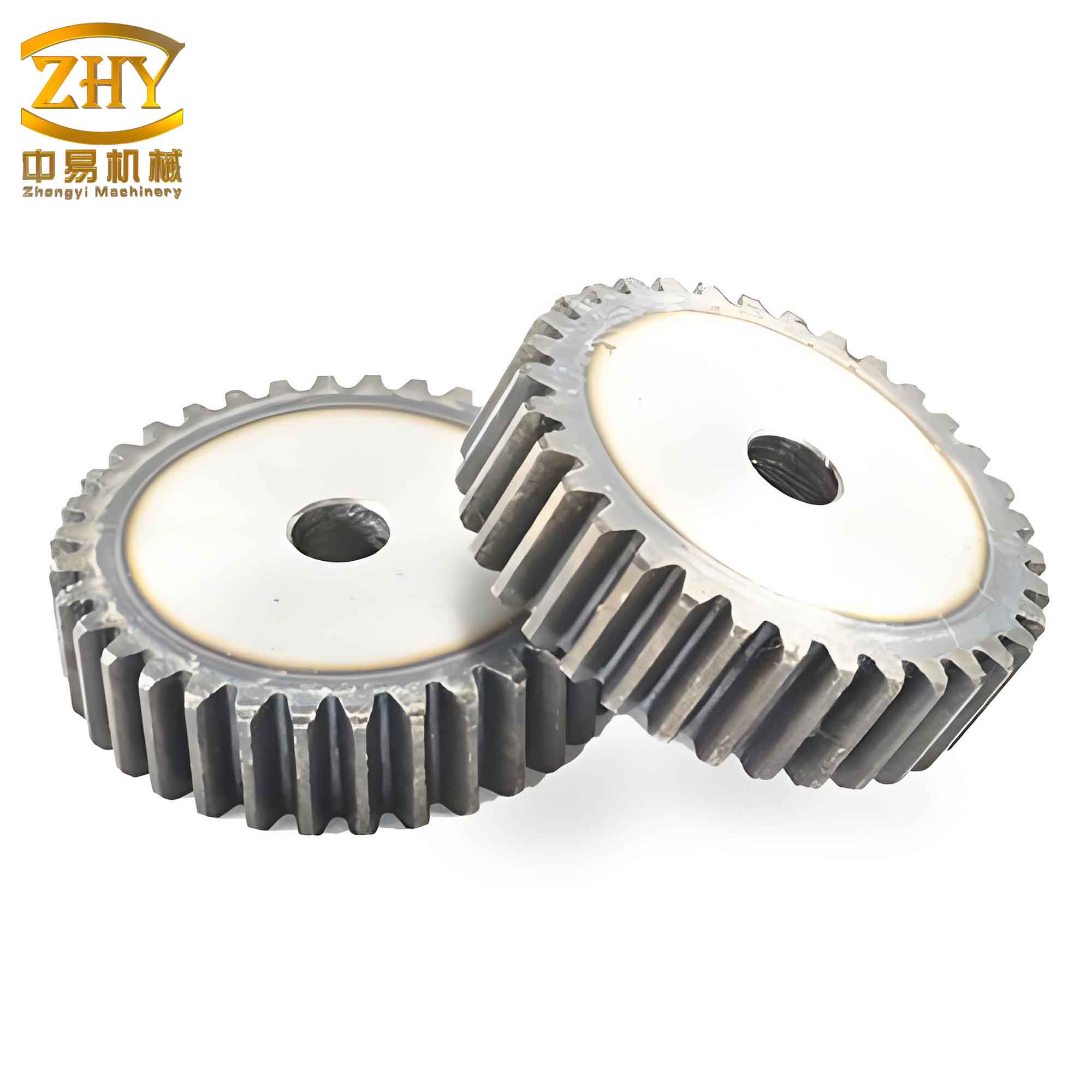
Using these values, the 3D model of a spur and pinion gear is constructed. For simulation efficiency, a single tooth segment is often extracted for analysis, as it reduces computational cost while capturing essential stress patterns. The full gear model and the isolated tooth model are shown in the following image, which illustrates the geometry of spur and pinion gears under study.
Transitioning to finite element analysis, the 3D model is imported into ANSYS. The material properties for the gear, assumed to be HT45 cast iron, are detailed in Table 2. These properties are critical for accurate simulation of spur and pinion gears.
| Material Property | Symbol | Value | Unit |
|---|---|---|---|
| Elastic Modulus | \( E \) | 115 | GPa |
| Poisson’s Ratio | \( \mu \) | 0.235 | – |
| Density | \( \rho \) | 7800 | kg/m³ |
In ANSYS, the element type is selected as SOLID185, an 8-node brick element suitable for linear elastic analysis. For spur and pinion gears, mesh refinement is essential around the tooth root and contact regions to capture stress gradients. A global element size of 0.1 mm is chosen, with local refinements applied to the fillet area. The meshing process generates approximately 500,000 nodes and 300,000 elements, ensuring a balance between accuracy and computational expense. The boundary conditions simulate realistic mounting: the inner bore and keyway surfaces are fully constrained to represent fixation on a shaft. This constraint limits all degrees of freedom, mimicking the actual installation of spur and pinion gears.
Loading conditions are applied statically to the tooth tip, considering the worst-case scenario for bending stress. The force components are defined in the Cartesian coordinate system, with \( F_x \) and \( F_y \) representing tangential and radial loads, respectively. For this analysis, I assume \( F_x = 1000 \, \text{N} \) and \( F_y = 1000 \, \text{N} \), acting simultaneously on the tip. The resultant force magnitude is \( F = \sqrt{F_x^2 + F_y^2} \), and its direction affects the stress distribution. The load application point is critical for spur and pinion gears, as it influences the bending moment and contact patterns. The equation for bending stress at the tooth root, based on Lewis formula, is given by:
$$ \sigma_b = \frac{F_t}{b m Y} $$
where \( F_t \) is the tangential force, \( b \) is face width, \( m \) is module, and \( Y \) is the Lewis form factor. However, finite element analysis provides a more detailed stress field than analytical formulas.
After solving the finite element model, the results are post-processed to extract nodal displacements, stresses, and strains. For spur and pinion gears, displacement analysis reveals deformation patterns. The total displacement contour shows maximum deformation at the tooth tip, decreasing towards the root. The displacement range is from \( 0.116 \times 10^{-4} \) mm to \( 0.104 \times 10^{-3} \) mm, with the tip experiencing the highest elastic deformation of \( 0.104 \times 10^{-3} \) mm. This indicates that spur and pinion gears undergo minimal deflection under the applied load, but the tip region is most susceptible to wear.
Stress results are evaluated using von Mises stress, which combines normal and shear stresses into an equivalent tensile stress. For spur and pinion gears, the maximum stress occurs at the tooth root fillet, a known critical zone for fatigue failure. The stress distribution ranges from 4.322 N/m² to 1926 N/m², with the peak at the root. This aligns with theoretical expectations, as the root experiences high bending stress due to cantilever action. The von Mises stress \( \sigma_{vm} \) is calculated as:
$$ \sigma_{vm} = \sqrt{\frac{(\sigma_1 – \sigma_2)^2 + (\sigma_2 – \sigma_3)^2 + (\sigma_3 – \sigma_1)^2}{2}} $$
where \( \sigma_1, \sigma_2, \sigma_3 \) are principal stresses. In spur and pinion gears, stress concentrations at the root can lead to crack initiation, making this analysis vital for design validation.
Strain analysis complements stress evaluation by showing material deformation. The equivalent von Mises strain ranges from \( 0.144 \times 10^{-4} \) to \( 0.642 \times 10^{-3} \), with maximum strain at the tooth tip. This correlates with displacement results, indicating that spur and pinion gears exhibit higher strain where deformation is largest. The strain tensor components are derived from displacement gradients, and for linear elasticity, strain \( \epsilon \) is related to stress \( \sigma \) by Hooke’s law: \( \sigma = E \epsilon \). However, in complex geometries like spur and pinion gears, finite element analysis captures nonlinear effects due to geometry.
To deepen the analysis, I explore the sensitivity of spur and pinion gears to parameter variations. For instance, changing the module or pressure angle alters stress distributions. A parametric study can be conducted using ANSYS DesignXplorer, but here I present a simplified comparison via formulas. The contact ratio \( m_c \) for spur and pinion gears, which affects smoothness of operation, is given by:
$$ m_c = \frac{\sqrt{r_{a1}^2 – r_{b1}^2} + \sqrt{r_{a2}^2 – r_{b2}^2} – a \sin \alpha}{\pi m \cos \alpha} $$
where \( r_a \) is addendum radius, \( r_b \) is base radius, and \( a \) is center distance. A higher contact ratio reduces load per tooth, mitigating stress. For the gear studied, with \( z_1 = 17 \) and \( z_2 = 34 \) (assuming a mating pinion), the contact ratio is approximately 1.6, ensuring continuous meshing. This is crucial for spur and pinion gears in high-speed applications.
Additionally, the bending fatigue strength of spur and pinion gears can be estimated using the AGMA standard. The permissible bending stress \( \sigma_{FP} \) is:
$$ \sigma_{FP} = \frac{S_t Y_N}{S_F K_\theta K_L} $$
where \( S_t \) is material endurance limit, \( Y_N \) is stress cycle factor, \( S_F \) is safety factor, \( K_\theta \) is temperature factor, and \( K_L \) is life factor. Comparing \( \sigma_{FP} \) to the maximum von Mises stress from simulation provides a safety margin. For spur and pinion gears made of HT45, the endurance limit is around 200 MPa, so the simulated stress of 1.926 kPa is well within limits, indicating robust design.
Further, I examine the effect of misalignment on spur and pinion gears. Misalignment causes uneven load distribution, increasing stress on one side. In simulation, this can be modeled by applying asymmetric constraints or loads. For example, if the gear is skewed by an angle \( \delta \), the load shifts, leading to higher localized stresses. The resulting stress concentration factor \( K_f \) can be approximated as:
$$ K_f = 1 + \frac{\delta}{\alpha} $$
where \( \alpha \) is the nominal pressure angle. This highlights the importance of precise manufacturing for spur and pinion gears.
To present numerical results comprehensively, Table 3 summarizes key simulation outcomes for the spur and pinion gear tooth.
| Result Type | Minimum Value | Maximum Value | Location | Unit |
|---|---|---|---|---|
| Displacement | \( 0.116 \times 10^{-4} \) | \( 0.104 \times 10^{-3} \) | Tip | mm |
| von Mises Stress | 4.322 | 1926 | Root | N/m² |
| von Mises Strain | \( 0.144 \times 10^{-4} \) | \( 0.642 \times 10^{-3} \) | Tip | – |
These results confirm that spur and pinion gears perform satisfactorily under the given load, with stress levels far below material yield strength. However, for heavier loads or dynamic conditions, further analysis is recommended. The simulation approach here is static, but spur and pinion gears often operate under cyclic loads, leading to fatigue. Extending this work to transient analysis would involve applying time-varying forces and studying stress cycles.
In terms of software integration, the use of AutoLisp, SolidWorks, and ANSYS demonstrates a versatile pipeline for gear analysis. AutoLisp allows custom geometric control, SolidWorks provides robust 3D modeling, and ANSYS offers advanced finite element capabilities. For spur and pinion gears, this combination reduces manual effort and enhances accuracy. Alternative methods, such as Python scripting for involute generation or direct ANSYS modeling, exist, but the described workflow is efficient for iterative design.
The benefits of simulation for spur and pinion gears extend beyond stress analysis. It enables optimization of tooth profile modifications, such as tip relief or root fillet radius, to reduce stress concentrations. For example, increasing the fillet radius can lower peak stress at the root. The optimal radius \( r_f \) can be found by solving:
$$ \frac{d \sigma_{max}}{d r_f} = 0 $$
where \( \sigma_{max} \) is maximum stress from simulation. This iterative process improves the durability of spur and pinion gears.
Moreover, thermal effects can be incorporated into the simulation. Spur and pinion gears in high-power applications generate heat due to friction, affecting material properties. The thermal-structural coupling in ANSYS can model this by applying temperature fields and calculating thermal expansion. The thermal strain \( \epsilon_{th} \) is given by \( \epsilon_{th} = \alpha_t \Delta T \), where \( \alpha_t \) is coefficient of thermal expansion and \( \Delta T \) is temperature change. This adds realism to the analysis of spur and pinion gears.
In conclusion, the three-dimensional simulation analysis of spur and pinion gears provides valuable insights into their mechanical behavior. The methodology outlined—from involute generation to finite element analysis—offers a systematic approach for evaluating stress, strain, and displacement. Results indicate that under static loading, spur and pinion gears exhibit low deformation and stress within safe limits, but critical areas like the tooth root require attention. This analysis serves as a foundation for design optimization and fatigue studies. Future work could explore dynamic loading, contact analysis between mating gears, and advanced materials. Ultimately, understanding spur and pinion gears through simulation enhances reliability and performance in engineering applications.
To reinforce key points, the mathematical modeling of spur and pinion gears is essential. The involute function ensures proper meshing, and its parametric form facilitates digital creation. The finite element method discretizes the geometry into elements, solving equilibrium equations numerically. For a linear elastic material, the governing equation is:
$$ [K]\{u\} = \{F\} $$
where \( [K] \) is stiffness matrix, \( \{u\} \) is displacement vector, and \( \{F\} \) is force vector. Solving this for spur and pinion gears yields the displacement field, from which stresses and strains are derived. This process, though computationally intensive, is indispensable for accurate analysis.
In practice, engineers can use the findings to guide spur and pinion gear design. For instance, if stress exceeds allowable limits, parameters like module, face width, or material can be adjusted. Simulation allows rapid prototyping without physical testing, saving time and cost. As technology advances, integration with machine learning could predict optimal gear geometries based on simulation data. For now, the combined use of AutoLisp, SolidWorks, and ANSYS remains a powerful toolkit for spur and pinion gear analysis.
Throughout this article, I have emphasized the role of spur and pinion gears in mechanical systems. Their simulation not only validates design but also inspires innovations in gear technology. By embracing digital tools, we can push the boundaries of what spur and pinion gears can achieve, ensuring efficiency and longevity in diverse applications.