
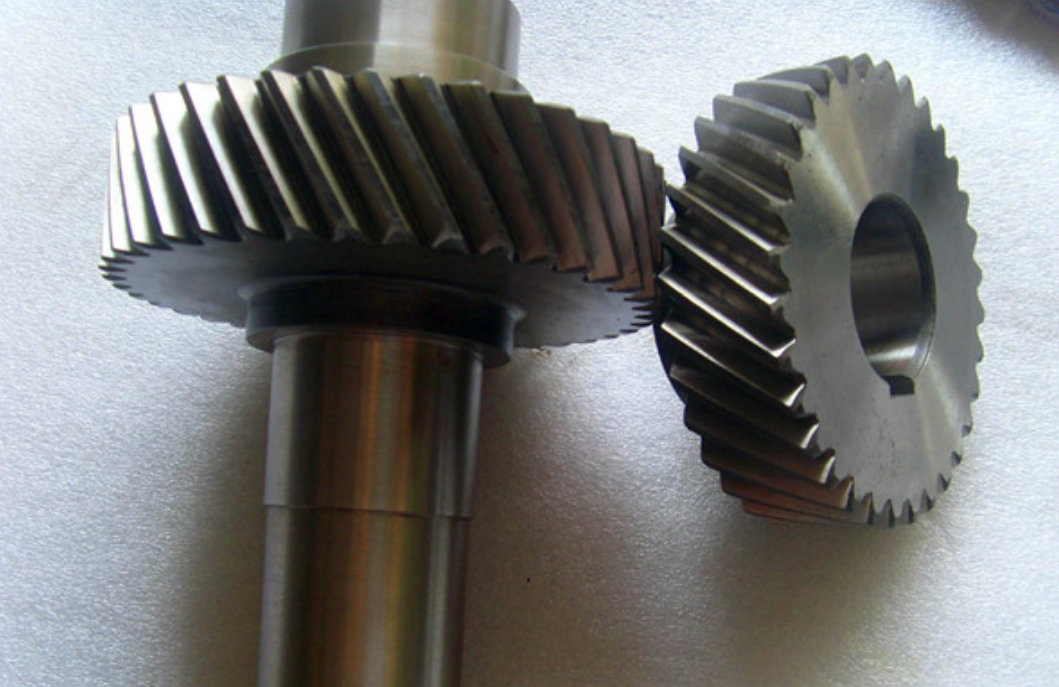
The dynamic performance and vibrational excitations in gear transmission systems are predominantly governed by their time-varying mesh stiffness (TVMS). Accurately calculating this parameter is therefore fundamental for noise, vibration, and durability analysis. Helical gears, with their gradual engagement characteristics and higher load capacity, are extensively used in high-speed and heavy-duty applications. However, the meshing process of helical gears inevitably involves sliding friction between contacting tooth surfaces, which influences the load distribution, energy dissipation, and consequently, the effective mesh stiffness. While numerous studies have focused on TVMS calculation for ideal, frictionless conditions, incorporating the effect of friction, particularly time-varying friction, remains a complex and less explored area. This article presents a comprehensive analytical methodology to calculate the TVMS of helical gear pairs by integrating a time-varying friction model derived from elastohydrodynamic lubrication (EHL) theory into a modified potential energy method. The influence of various operational and design parameters on the friction-induced TVMS is investigated in detail.
Analytical Framework: The Slicing Method and Potential Energy Principle
The fundamental challenge in modeling helical gears lies in their progressive contact along the tooth face width, unlike spur gears where contact occurs simultaneously across the full width. To address this, the slicing method is employed. The helical gear tooth is discretized along its face width into a finite number (N) of thin, independent spur gear slices. Each slice is treated as a spur gear micro-element with a slight axial shift in its contact timing relative to adjacent slices. The total TVMS is then obtained by integrating the contribution of all slices in contact at a given meshing instant. The stiffness for each spur gear slice is calculated using the potential energy method, which considers the elastic strain energy stored in the gear tooth under load. The total potential energy \( U_{total} \) for a tooth slice subjected to a force \( F \) along the line of action comprises several components:
$$ U_{total} = U_h + U_b + U_s + U_a + U_f $$
where:
- \( U_h \): Hertzian contact energy,
- \( U_b \): Bending energy,
- \( U_s \): Shear energy,
- \( U_a \): Axial compressive energy,
- \( U_f \): Fillet foundation deflection energy.
The corresponding stiffness components are derived from the relationship \( U_i = F^2 / (2k_i) \), where \( i \) denotes the energy type. Therefore, the mesh stiffness for a single tooth pair from a single slice is given by the series combination of these compliances:
$$ \frac{1}{k_{slice}} = \frac{1}{k_{b1}} + \frac{1}{k_{s1}} + \frac{1}{k_{a1}} + \frac{1}{k_{f1}} + \frac{1}{k_{b2}} + \frac{1}{k_{s2}} + \frac{1}{k_{a2}} + \frac{1}{k_{f2}} + \frac{1}{k_h} $$
Subscripts 1 and 2 refer to the pinion and gear, respectively. The expressions for each stiffness component for a spur gear slice, based on beam theory, are well-established. For a slice of thickness \( \Delta y = B/N \), they are as follows:
Bending Stiffness \( k_b \):
$$ k_b = \sum_{i=1}^{N} \frac{\Delta y}{\int_{\alpha_1}^{\alpha_2} \frac{3\{1+\cos\alpha’_y[(\alpha_2-\alpha)\sin\alpha – \cos\alpha]\}^2 (\alpha_2 – \alpha) \cos\alpha}{2E[\sin\alpha + (\alpha_2-\alpha)\cos\alpha]^3} \, d\alpha} $$
Shear Stiffness \( k_s \):
$$ k_s = \sum_{i=1}^{N} \frac{\Delta y}{\int_{\alpha_1}^{\alpha_2} \frac{1.2(1+\nu)(\alpha_2 – \alpha) \cos\alpha \cos^2\alpha’_y}{E[\sin\alpha + (\alpha_2-\alpha)\cos\alpha]} \, d\alpha} $$
Axial Compressive Stiffness \( k_a \):
$$ k_a = \sum_{i=1}^{N} \frac{\Delta y}{\int_{\alpha_1}^{\alpha_2} \frac{(\alpha_2 – \alpha) \cos\alpha \sin^2\alpha’_y}{2E[\sin\alpha + (\alpha_2-\alpha)\cos\alpha]} \, d\alpha} $$
Hertzian Contact Stiffness \( k_h \):
This component is constant along the line of action and for a slice is given by:
$$ k_h = \frac{\pi E \Delta y}{4(1-\nu^2)} $$
Fillet Foundation Stiffness \( k_f \):
This accounts for the deflection of the gear body near the tooth root. A widely used formula based on a curve-fitted solution from finite element analysis is:
$$ k_f = \frac{E \Delta y \cos^2\alpha’_y}{L^*\left(\frac{u_f}{S_f}\right)^2 + M^*\left(\frac{u_f}{S_f}\right) + P^* + Q^*\tan^2\alpha’_y} $$
where \( L^*, M^*, P^*, Q^* \) are dimensionless coefficients dependent on the geometry of the tooth root. \( u_f \) and \( S_f \) are defined as per the standard fillet foundation model.
Finally, the total TVMS \( K_t(\theta) \) for the helical gear pair at a rotational position \( \theta \) is the sum of the stiffnesses from all tooth pairs that are in simultaneous contact (governed by the contact ratio \( \varepsilon_{\gamma} \)):
$$ K_t(\theta) = \sum_{j=1}^{n_p(\theta)} \left( \sum_{i=1}^{N_{active}} k_{slice, j, i}(\theta) \right) $$
where \( n_p(\theta) \) is the number of tooth pairs in contact (typically 2 or 3 for helical gears), and \( N_{active} \) is the number of slices of a given tooth that are in contact at that instant.
Incorporating Time-Varying Tooth Surface Friction
The key innovation in this model is the integration of a time-varying friction coefficient \( \mu(t) \). The friction force \( F_f = \mu(t) F_n \), where \( F_n \) is the normal load, introduces additional moments and force components that alter the internal stress distribution within the tooth. This affects the bending, shear, and axial energy components. The direction of \( F_f \) reverses at the pitch point, where the relative sliding velocity changes sign.
The modified stiffness components, incorporating the friction force decomposed along the tooth profile, are presented below. For a slice in the approach phase (before the pitch point), the friction force opposes the motion, and the stiffness formulas are modified as follows:
Bending Stiffness with Friction \( k_{b,f} \):
$$ k_{b,f} = \sum_{i=1}^{N} \frac{\Delta y}{\int_{\alpha_1}^{\alpha_2} \frac{3\{1+f(\alpha) – M_b\}^2 (\alpha_2 – \alpha) \cos\alpha}{2EA^3} \, d\alpha} $$
Shear Stiffness with Friction \( k_{s,f} \):
$$ k_{s,f} = \sum_{i=1}^{N} \frac{\Delta y}{\int_{\alpha_1}^{\alpha_2} \frac{1.2(1+\nu)(\alpha_2 – \alpha) \cos\alpha (\cos\alpha’_y – M_s)^2}{EA} \, d\alpha} $$
Axial Compressive Stiffness with Friction \( k_{a,f} \):
$$ k_{a,f} = \sum_{i=1}^{N} \frac{\Delta y}{\int_{\alpha_1}^{\alpha_2} \frac{(\alpha_2 – \alpha) \cos\alpha (\sin\alpha’_y + M_a)^2}{2EA} \, d\alpha} $$
Where:
\( A = \sin\alpha + (\alpha_2-\alpha)\cos\alpha \)
\( f(\alpha) = \cos\alpha’_y[(\alpha_2-\alpha’_y) \sin\alpha – \cos\alpha] \)
\( M_b = \mu[\alpha’_y + \alpha_2 + \sin\alpha’_y((\alpha_2-\alpha)\sin\alpha – \cos\alpha)] \)
\( M_s = \mu \sin\alpha’_y \)
\( M_a = \mu \cos\alpha’_y \)
\( \alpha’_y = \alpha_y + (\gamma – \alpha_y)(i/N) \) is the pressure angle at the contact point for the i-th slice.
For the recess phase (after the pitch point), the signs before \( M_b, M_s, \) and \( M_a \) in the equations for \( k_{b,f} \) and \( k_{a,f} \) are reversed, while the sign in \( k_{s,f} \) becomes \( (\cos\alpha’_y + M_s)^2 \). The Hertzian contact stiffness \( k_h \) and fillet foundation stiffness \( k_f \) are assumed unaffected by friction.
Modeling the Time-Varying Friction Coefficient
The friction coefficient \( \mu \) is not constant but varies during the mesh cycle due to changes in contact pressure, sliding velocity, and lubrication regime. An empirical model based on non-Newtonian thermal EHL simulations is adopted here:
$$ \mu = e^{f(SR, P_h, \eta_0, R_a)} P_h^{b_2} |SR|^{b_3} V_e^{b_6} \eta_0^{b_7} R^{b_8} $$
with
$$ f(SR, P_h, \eta_0, R_a) = b_1 + b_4 |SR| P_h \log_{10}(\eta_0) + b_5 e^{-|SR| P_h \log_{10}(\eta_0)} + b_9 e^{R_a} $$
where:
- \( SR \): Slide-to-roll ratio \( (V_1 – V_2) / V_e \)
- \( P_h \): Maximum Hertzian contact pressure
- \( V_e \): Entrainment velocity \( (V_1 + V_2)/2 \)
- \( \eta_0 \): Ambient dynamic viscosity
- \( R \): Equivalent radius of curvature at contact
- \( R_a \): Composite surface roughness
- \( b_1 … b_9 \): Regression coefficients.
This model captures the complex dependence of friction on operational conditions. The key parameters for a baseline helical gear pair are listed below.
| Parameter | Symbol | Value |
|---|---|---|
| Number of Teeth (Pinion/Gear) | \( Z_1 / Z_2 \) | 40 / 40 |
| Normal Module | \( m_n \) | 3.5 mm |
| Normal Pressure Angle | \( \alpha_n \) | 20° |
| Helix Angle | \( \beta \) | 15° |
| Face Width | \( B \) | 35 mm |
| Input Torque | \( T_{in} \) | 1000 Nm |
| Input Speed | \( n_{in} \) | 1000 rpm |
| Young’s Modulus | \( E \) | 206 GPa |
| Poisson’s Ratio | \( \nu \) | 0.3 |
| Surface Roughness | \( R_a \) | 1.6 μm |
Parametric Influence on Time-Varying Friction and Mesh Stiffness
Using the developed analytical model, the effects of various parameters on the time-varying friction coefficient and the resulting TVMS of the helical gear pair are systematically analyzed. The baseline condition is compared with variations in surface roughness, input torque, input speed, and face width.
1. Influence on Time-Varying Friction Coefficient
The time-varying friction coefficient \( \mu \) during a mesh cycle typically shows a characteristic “friction curve”: it is high at the start of engagement (high sliding), decreases towards a minimum (often near the pitch point where sliding is zero), and then increases again during recess. The parametric studies yield the following trends:
| Parameter | Trend of Friction Coefficient \( \mu \) | Primary Reason |
|---|---|---|
| Surface Roughness \( R_a \) ↑ | Significant Increase | Increased asperity interaction and mixed/boundary lubrication effects. |
| Input Torque \( T_{in} \) ↑ | Moderate Increase | Higher contact pressure \( P_h \) leads to increased friction in the EHL regime. |
| Input Speed \( n_{in} \) ↑ | Decrease | Higher entrainment velocity \( V_e \) promotes formation of a thicker, more effective lubricant film. |
| Face Width \( B \) ↑ | Slight Increase | For constant torque, contact pressure decreases slightly, but the effect on the empirical friction model is complex and net increase is observed. |
2. Influence on Time-Varying Mesh Stiffness (TVMS)
The presence of friction modifies the TVMS profile. Under a constant, high friction coefficient, the overall TVMS decreases because the friction-induced moments effectively reduce the gear tooth’s resistance to deflection. The single-tooth stiffness is reduced in the approach phase and increased in the recess phase due to the reversal of the friction force direction, but the combined effect over multiple teeth lowers the average mesh stiffness. More importantly, under time-varying friction, the stiffness modulation is dynamic and parameter-dependent.
| Parameter | Trend of TVMS Magnitude | Explanation |
|---|---|---|
| Surface Roughness \( R_a \) ↑ | Decreases | Higher average friction coefficient (Table 2) leads to greater stiffness reduction throughout the mesh cycle. |
| Input Torque \( T_{in} \) ↑ | Increases | While friction increases slightly, the dominant effect is the increased load, which reduces the relative impact of the friction-induced compliance. The stiffness-load relationship is non-linear. |
| Input Speed \( n_{in} \) ↑ | Increases | Lower average friction coefficient (Table 2) diminishes the friction-induced stiffness reduction effect. |
| Face Width \( B \) ↑ | Significant Increase | The primary effect is geometric: more slices in contact leads to a higher total stiffness. The slight friction increase has a negligible relative impact. |
3. Influence on Load Sharing and Transmission Error
The time-varying mesh stiffness directly affects the load sharing among simultaneously engaged tooth pairs and the static transmission error (LSTE), a key excitation source for gear dynamics. The transmission error is approximately calculated as \( \text{LSTE} = F_n / K_t(\theta) \). The parametric influences on LSTE are generally inverse to those on TVMS.
| Parameter | Trend of LSTE Magnitude | Correlation |
|---|---|---|
| Surface Roughness \( R_a \) ↑ | Increases | Inversely proportional to the decreasing TVMS. |
| Input Torque \( T_{in} \) ↑ | Decreases | Inversely proportional to the increasing TVMS (though the relationship is not perfectly inverse due to non-linear deflection). |
| Input Speed \( n_{in} \) ↑ | Decreases | Inversely proportional to the increasing TVMS. |
| Face Width \( B \) ↑ | Significant Decrease | Inversely proportional to the significantly increasing TVMS. |
Conclusions and Engineering Implications
This study establishes a robust analytical framework for calculating the time-varying mesh stiffness of helical gear pairs, explicitly accounting for the critical effect of time-varying tooth surface friction. The integration of the slicing method, a modified potential energy formulation, and an empirical EHL-based friction model provides a comprehensive tool for high-fidelity gear analysis. The key findings are:
- Friction Reduces Effective Stiffness: The presence of friction, whether constant or time-varying, consistently reduces the overall TVMS of helical gears compared to the frictionless ideal case, altering the dynamic excitation characteristics.
- Parametric Sensitivity: The time-varying friction and TVMS are highly sensitive to surface roughness, operating torque, and speed. Smoother surfaces, higher speeds (improving lubrication), and higher torques (within design limits) tend to increase the effective mesh stiffness, which is beneficial for reducing transmission error and vibration.
- Dominance of Geometric Effects: Changes in face width have the most pronounced direct effect on TVMS due to the change in the total contact length, overshadowing the secondary friction-related effects.
- Dynamic Excitation: The modulation of TVMS by time-varying friction introduces an additional layer of complexity to the mesh excitation, which should be considered in advanced dynamic models of helical gear transmissions, especially for noise-sensitive applications.
This methodology offers a valuable design and analysis tool for optimizing helical gear performance, guiding selections for surface finish, lubrication, and operational parameters to achieve desired stiffness and dynamic behavior.