
The reliable and efficient operation of heavy-duty mechanical systems, from mining equipment like armored face conveyors and storage bunker conveyors to precision gearboxes, hinges on the integrity of their power transmission components. Among these, the spur gear pair stands as a fundamental and ubiquitous element. Its performance is intrinsically linked to the dynamic forces generated during operation, which are, in turn, profoundly influenced by a key parameter: the time-varying mesh stiffness (TVMS). Accurate prediction of this stiffness is paramount for dynamic modeling, noise-vibration-harshness (NVH) analysis, and remaining useful life prognosis for gear systems. This article delves into a detailed analytical methodology for calculating the TVMS of spur gear pairs, employing fundamental engineering mechanics and numerical techniques to build a comprehensive and accurate model.
The meshing process of a spur gear pair is characterized by a cyclic variation in the number of teeth in contact. As the gears rotate, the load is shared between one and two (or more, for high-contact-ratio gears) pairs of teeth. This continuous change in the load path and the geometry of the loaded tooth segment leads to a periodic fluctuation in the overall stiffness of the gear mesh. This time-varying stiffness acts as a parametric excitation within the system, potentially giving rise to significant vibration and dynamic loads even under constant input torque. Therefore, developing a precise analytical model for spur gear time-varying mesh stiffness is a cornerstone for advanced gear dynamics.
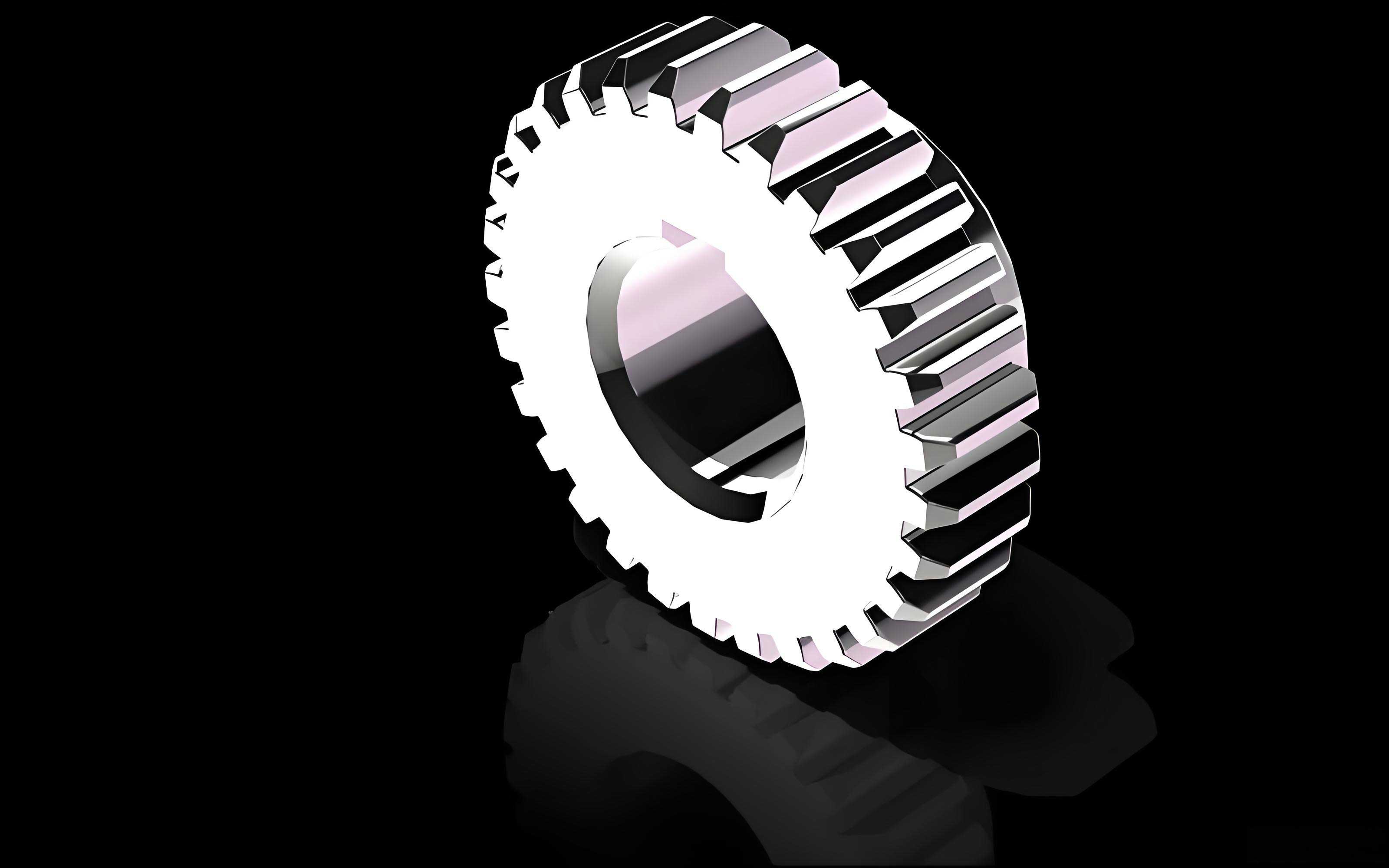
The total deflection of a spur gear tooth under load comprises several elastic components. An accurate analytical model decomposes the overall compliance (the inverse of stiffness) into these constituent parts. The primary components considered are: the bending deflection, shear deflection, axial compression of the tooth profile, the deflection of the gear foundation or body, and the localized Hertzian contact deformation at the point of contact. The total mesh stiffness for a single tooth pair is then modeled as these individual stiffnesses acting in series. For a spur gear pair where two pairs of teeth are in contact simultaneously, the total effective mesh stiffness is the sum of the individual pair stiffnesses acting in parallel.
The following table summarizes the compliance components and their physical origins for a spur gear tooth modeled as a non-uniform cantilever beam:
| Stiffness Component | Symbol | Physical Origin |
|---|---|---|
| Bending Stiffness | $$k_B$$ | Resistance to deflection due to bending moments caused by the normal contact force. |
| Shear Stiffness | $$k_S$$ | Resistance to deflection due to shear forces. |
| Axial Compressive Stiffness | $$k_A$$ | Resistance to shortening of the tooth along the line of the force component. |
| Foundation Stiffness | $$k_F$$ | Resistance to deformation of the gear body material surrounding the tooth root. |
| Hertzian Contact Stiffness | $$k_H$$ | Localized elastic deformation at the contact point between the two mating spur gear teeth. |
To compute these components analytically, the tooth profile is discretized into a series of small, finite segments or slices. Each segment ‘i’ at a distance $$x_i$$ from the tooth root has a thickness $$dx$$, a cross-sectional area $$A_i$$, and an area moment of inertia $$I_i$$. The force $$F$$ is applied at a point on the tooth profile defined by parameters such as the distance from the root $$S$$, the load angle $$\beta$$, and the moment arm. The compliance for each component is calculated by integrating the effect of the force along the tooth from the root to the point of contact.
The formulas for calculating the compliance (inverse of stiffness) for each component for a single spur gear tooth are given below. Here, $$E$$ is the Young’s modulus, $$\nu$$ is Poisson’s ratio, $$B$$ is the face width, and $$L_f$$ and $$H_f$$ are geometric parameters related to the gear body.
1. Axial Compressive Compliance:
$$\frac{1}{k_A} = \int_{0}^{S} \frac{\sin^2 \beta_i}{E A(x)} dx \approx \sum_{i=1}^{n} \frac{\Delta L_i \sin^2 \beta_i}{E A_i}$$
2. Bending Compliance:
$$\frac{1}{k_B} = \int_{0}^{S} \frac{[ (S – x_i)\cos\beta_i – \mu \sin\beta_i ]^2}{E I(x)} dx \approx \sum_{i=1}^{n} \frac{ [ (S – x_i)\cos\beta_i – \mu \sin\beta_i ]^2 \Delta L_i}{E I_i}$$
where $$\mu$$ accounts for the direction of force decomposition.
3. Shear Compliance:
$$\frac{1}{k_S} = \int_{0}^{S} \frac{1.2 \cos^2 \beta_i}{G A(x)} dx \approx \sum_{i=1}^{n} \frac{1.2 \Delta L_i \cos^2 \beta_i}{G A_i}$$
where the shear modulus $$G = \frac{E}{2(1+\nu)}$$ and the factor 1.2 is for a rectangular cross-section.
4. Foundation Compliance: Several empirical formulas exist. For a standard spur gear tooth, a commonly used expression is:
$$\frac{1}{k_F} = \frac{\cos^2 \beta}{E B} \left[ L^* \left( \frac{u_f}{S_f} \right)^2 + M^* \left( \frac{u_f}{S_f} \right) + P^* (1 + Q^* \tan^2 \beta) \right]$$
where $$L^*, M^*, P^*, Q^*$$ are constants derived from curve fitting to finite element results, and $$u_f$$ and $$S_f$$ describe the geometry of the tooth root region.
5. Hertzian Contact Compliance: For two parallel cylinders (representing the contact line of spur gear teeth), the compliance is:
$$\frac{1}{k_H} = \frac{4(1-\nu^2)}{\pi E B}$$
This represents the combined compliance of both contacting spur gear teeth.
The total compliance for a single meshing tooth pair on a spur gear is the sum of the compliances from both the driving and driven gears (excluding the shared Hertzian term once):
$$\frac{1}{k_{pair}} = \left( \frac{1}{k_{A1}}+\frac{1}{k_{B1}}+\frac{1}{k_{S1}}+\frac{1}{k_{F1}} \right) + \left( \frac{1}{k_{A2}}+\frac{1}{k_{B2}}+\frac{1}{k_{S2}}+\frac{1}{k_{F2}} \right) + \frac{1}{k_{H}}$$
When two pairs of spur gear teeth are in contact, as is the case for most of the meshing cycle in standard gears, the total mesh stiffness is the sum of the stiffnesses of the individual pairs:
$$k_{total}(\theta) = k_{pair1}(\theta) + k_{pair2}(\theta)$$
where $$\theta$$ is the gear rotation angle. This summation captures the essential time-varying nature of the spur gear mesh stiffness.
A critical step in this analytical procedure is the precise determination of the contact point on the tooth profile for every incremental rotation of the spur gear. While formulas exist for standard involute profiles, a more robust and general-purpose numerical algorithm is preferred, especially if tooth modifications like tip or root relief are to be considered. A highly effective method is the variable-increment infinite approximation algorithm.
The algorithm works as follows for a given angular position of the driving spur gear:
- Initialize the position of the driven gear.
- Rotate the driven gear profile by a relatively large angular step towards the fixed driving gear profile.
- Check for intersection between the two profiles. If an intersection (contact) is detected, reverse the rotation direction.
- Reduce the angular step size by a factor (e.g., 10).
- Repeat steps 2-4, each time reversing direction upon finding/losing contact and reducing the step.
- The iteration stops when the angular step falls below a predefined tolerance. The final intersection point is the accurate meshing point.
This algorithm rapidly converges to the true line of action for the spur gear pair and maps every meshing point onto the individual tooth profiles of both gears, providing the necessary geometric parameters (S, β, etc.) for the compliance calculations at each step.
To demonstrate the method, consider a standard spur gear pair with the following parameters for calculation:
| Parameter | Symbol | Value |
|---|---|---|
| Number of Teeth (Pinion & Gear) | $$z_1, z_2$$ | 20 |
| Module | $$m$$ | 3 mm |
| Pressure Angle | $$\alpha$$ | 20° |
| Face Width | $$B$$ | 20 mm |
| Young’s Modulus | $$E$$ | 206.8 GPa |
| Poisson’s Ratio | $$\nu$$ | 0.25 |
Implementing the variable-increment algorithm and the compliance formulas yields the stiffness variation over a single meshing period (from the start to the end of contact for one tooth pair). The following results are typical:
- The stiffness rises sharply as contact begins at the lowest point of single tooth contact (LPSTC).
- It reaches a maximum near the pitch point.
- When a second tooth pair enters contact, the total stiffness jumps to a higher value (sum of two pairs).
- As the first pair approaches the highest point of single tooth contact (HPSTC), its stiffness decreases, but the total remains roughly constant due to the second pair carrying more load.
- A sudden drop occurs when the first tooth pair loses contact.
The calculated time-varying mesh stiffness for the example spur gear pair shows this characteristic rectangular waveform with rounded corners and a discontinuity.
To validate the analytical model based on cantilever beam theory and the variable-increment algorithm, comparisons are made with other established methods. A common alternative analytical approach is the potential energy method, which uses elastic strain energy principles (tension, bending, shear, and foundation) to derive tooth deflection. Furthermore, international standards like ISO 6336-1 (or its national equivalents) provide empirical formulas for calculating the mean mesh stiffness for load capacity ratings.
The table below shows a comparison of maximum single-tooth-pair stiffness values calculated by different methods for three different spur gear pairs:
| Gear Pair (z1=z2) | Module (mm) | Cantilever Beam Method (N/m) | Potential Energy Method (N/m) | ISO/Standard Formula (N/m) |
|---|---|---|---|---|
| 20 | 3.0 | 2.56 × 10⁸ | 2.45 × 10⁸ | 2.36 × 10⁸ |
| 42 | 2.0 | 2.73 × 10⁸ | 2.68 × 10⁸ | 2.80 × 10⁸ |
| 60 | 1.5 | 2.82 × 10⁸ | 2.78 × 10⁸ | 2.96 × 10⁸ |
The results show excellent agreement between the cantilever beam method described here and the potential energy method, with minor deviations typically within a few percent. The comparison with the standard formula also shows reasonable correlation, though standard formulas often aim for a conservative mean value for safety factors in design, not the precise instantaneous maximum. The small percentage differences confirm the validity and accuracy of the presented analytical approach for calculating spur gear time-varying mesh stiffness.
A more detailed error analysis can be structured as follows:
| Comparison Basis | Observation | Probable Reason |
|---|---|---|
| Cantilever vs. Potential Energy Method | Very close agreement, cantilever results slightly higher. | Different handling of shear coefficient and foundation model details. The cantilever model’s discretization and integration are highly sensitive to mesh density. |
| Analytical Methods vs. ISO Standard | Good general agreement, some variance. | ISO formulas are simplified, closed-form solutions for average stiffness under specific conditions, not for instantaneous TVMS. |
| Effect of Gear Parameters (z, m) | Stiffness increases with more teeth/smaller module for constant center distance. | Smaller module/larger teeth number leads to thicker, shorter teeth relative to their base, increasing overall stiffness, which is correctly captured by the model. |
In conclusion, the analytical calculation of time-varying mesh stiffness for spur gears using fundamental cantilever beam theory, combined with a robust variable-increment algorithm for contact point determination, provides a powerful and accurate tool. This method systematically accounts for all major sources of elastic deformation in a spur gear tooth: bending, shear, axial compression, foundation deflection, and Hertzian contact. The step-by-step numerical integration along the tooth profile offers flexibility to incorporate complex tooth geometries, including modifications like profile shift, tip relief, or root fillet optimization. The validation against the potential energy method and established standard formulas confirms the reliability of the results. Accurate knowledge of the spur gear time-varying mesh stiffness is indispensable for high-fidelity dynamic modeling, enabling engineers to predict vibration responses, diagnose faults, and design quieter, more reliable, and more efficient gear-driven systems across a vast range of industrial applications, from heavy machinery to precision instruments.