
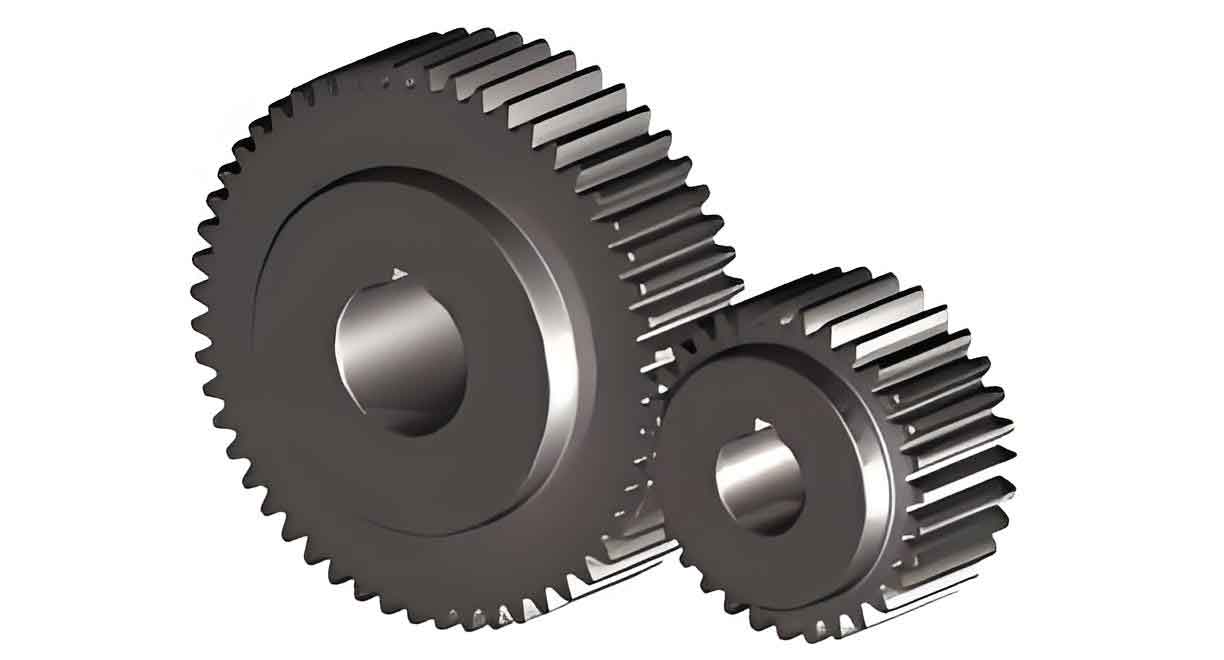
This paper addresses the critical challenge of accurately calculating time-varying meshing stiffness (TVMS) for spur gears with tooth numbers exceeding 41, particularly under root crack conditions. Traditional energy-based methods often oversimplify gear geometry by conflating the involute starting point and base circle intersection, leading to significant errors in large-tooth-count spur gear systems. By integrating cutting geometry principles and transition curve parameterization, we develop an enhanced analytical framework that rigorously models crack propagation effects while maintaining computational efficiency.
1. Geometric Refinements for Large-Tooth-Count Spur Gears
For spur gears with \( N > 41 \), the base circle radius \( r_b \) becomes smaller than the root circle radius \( r_f \):
$$
r_b = \frac{mN \cos \alpha_0}{2}, \quad r_f = \frac{mN}{2} – (h_a^* + c^*)m
$$
The transition curve parameterization for rack-type cutter generated teeth is:
$$
\begin{cases}
y = r \sin \phi – \left( \frac{a}{\sin \gamma} + \rho \right) \cos (\gamma – \phi) \\
x = r \cos \phi – \left( \frac{a}{\sin \gamma} + \rho \right) \sin (\gamma – \phi)
\end{cases}
$$
where \( \gamma \in (\alpha_0, \pi/2) \), \( \phi = (a \tan \gamma + b)/r \), and \( \rho = c^*m/(1 – \sin \alpha_0) \). This formulation accurately distinguishes between the involute starting point (\( r_G \)) and base circle intersection (\( r_{Gb} \)) through:
$$
r_G = \sqrt{r^2 + \left( \frac{a}{\sin \alpha_0} + \rho \right)^2 – 2r(a + \rho \sin \alpha_0)}
$$
2. Crack Modeling Framework
Four crack propagation scenarios are modeled based on crack depth \( h_c \) relative to critical thresholds:
| Scenario | Condition | Effective Section |
|---|---|---|
| 1 | \( h_{c1} \geq h_r \), \( \alpha_1 > \alpha_g \) | Piecewise variable section |
| 2 | \( h_{c1} < h_r \) or \( \alpha_1 \leq \alpha_g \) | Uniform reduced section |
| 3 | \( h_{c2} < h_r \) | Asymmetric reduction |
| 4 | \( h_{c2} \geq h_r \), \( \alpha_1 > \alpha_g \) | Full separation |
The modified stiffness components account for crack-induced section loss:
$$
\frac{1}{k} = \sum_{i=1}^2 \left( \frac{1}{k_{h,i}} + \frac{1}{k_{b,i}} + \frac{1}{k_{s,i}} + \frac{1}{k_{a,i}} + \frac{1}{k_{f,i}} \right)
$$
3. Effective Tooth Thickness Reduction Models
Three reduction limit line configurations are evaluated for spur gear crack modeling:
| Model | Description | Complexity |
|---|---|---|
| Linear | Parallel to tooth centerline | Low |
| Parabolic | Stress-gradient matched curve | High |
| Oblique | Diagnal connection of key points | Medium |
The oblique model demonstrates superior practicality with minimal accuracy loss:
$$
\text{Slope: } \frac{x – x_A}{y – y_A} = \frac{x_K – x_A}{y_K – y_A}
$$
4. Computational Results and Validation
Using the spur gear parameters below, we compare TVMS calculation methods:
| Parameter | Driving Gear | Driven Gear |
|---|---|---|
| Teeth | 75 | 55 |
| Module (mm) | 2 | |
| Pressure Angle | 20° | |
| Face Width (mm) | 20 | |
Key findings from crack level (CL) analysis:
| CL (%) | Uncorrected Model | Corrected Model | FEM Reference |
|---|---|---|---|
| 0 | 3.121×10⁸ N/m | 3.252×10⁸ N/m | 3.322×10⁸ N/m |
| 20 | -1.93% | -1.23% | -3.88% |
| 60 | -12.50% | -12.61% | -13.66% |
The oblique reduction line model shows superior performance in high-CL scenarios:
$$
\text{Relative Error} = \begin{cases}
1.71\% \text{ (CL=40\%, Linear)} \\
0.55\% \text{ (CL=40\%, Oblique)} \\
12.14\% \text{ (CL=60\%, Linear)} \\
2.09\% \text{ (CL=60\%, Oblique)}
\end{cases}
$$
5. Practical Implementation Guidelines
For spur gear maintenance systems:
- Adopt geometric-corrected models for \( N > 41 \) spur gears
- Use linear reduction lines when \( \text{CL} \leq 40\% \)
- Implement oblique models for \( \text{CL} > 40\% \) applications
- Prioritize computational efficiency with hybrid modeling:
$$
k_{final} = \eta k_{oblique} + (1-\eta)k_{linear}, \quad \eta = \min\left(1, \frac{\text{CL}}{40\%}\right)
$$
This comprehensive approach enables accurate TVMS prediction for damaged spur gears while maintaining practical computational loads, particularly crucial for condition monitoring systems in heavy-duty gear transmissions.