
In the rapidly evolving field of new energy vehicles, the braking system has become a critical technology for ensuring driving safety. Among its key components, the helical gear in the transmission mechanism of electric brake systems plays a vital role in transferring motor power. However, extreme operating conditions, such as high loads, high rotational speeds, and rapid braking-induced thermal effects, severely challenge the performance and reliability of helical gears. To address these challenges, we propose an innovative optimization method for the motion characteristics of helical gears in brake systems. Our approach uniquely integrates the potential energy method with Hertz contact theory to establish a refined dynamic model that captures the complex nonlinear behavior of helical gear meshing.
The helical gear, with its gradually engaging tooth contact, offers superior noise and vibration characteristics compared to spur gears. Nevertheless, its performance under transient conditions requires precise modelling of time-varying meshing stiffness (TVMS). In this study, we develop a six-degree-of-freedom bending-torsion-axial dynamic model that accounts for gear geometry, material properties, and nonlinear meshing factors. By slicing the helical gear into thin disks along the face width and treating each slice as an equivalent spur gear, we compute the stiffness contributions from each slice and superimpose them to obtain the overall TVMS. This approach enables us to analyze the dynamic response of the system under various excitation conditions and to optimize gear parameters for enhanced brake system performance.
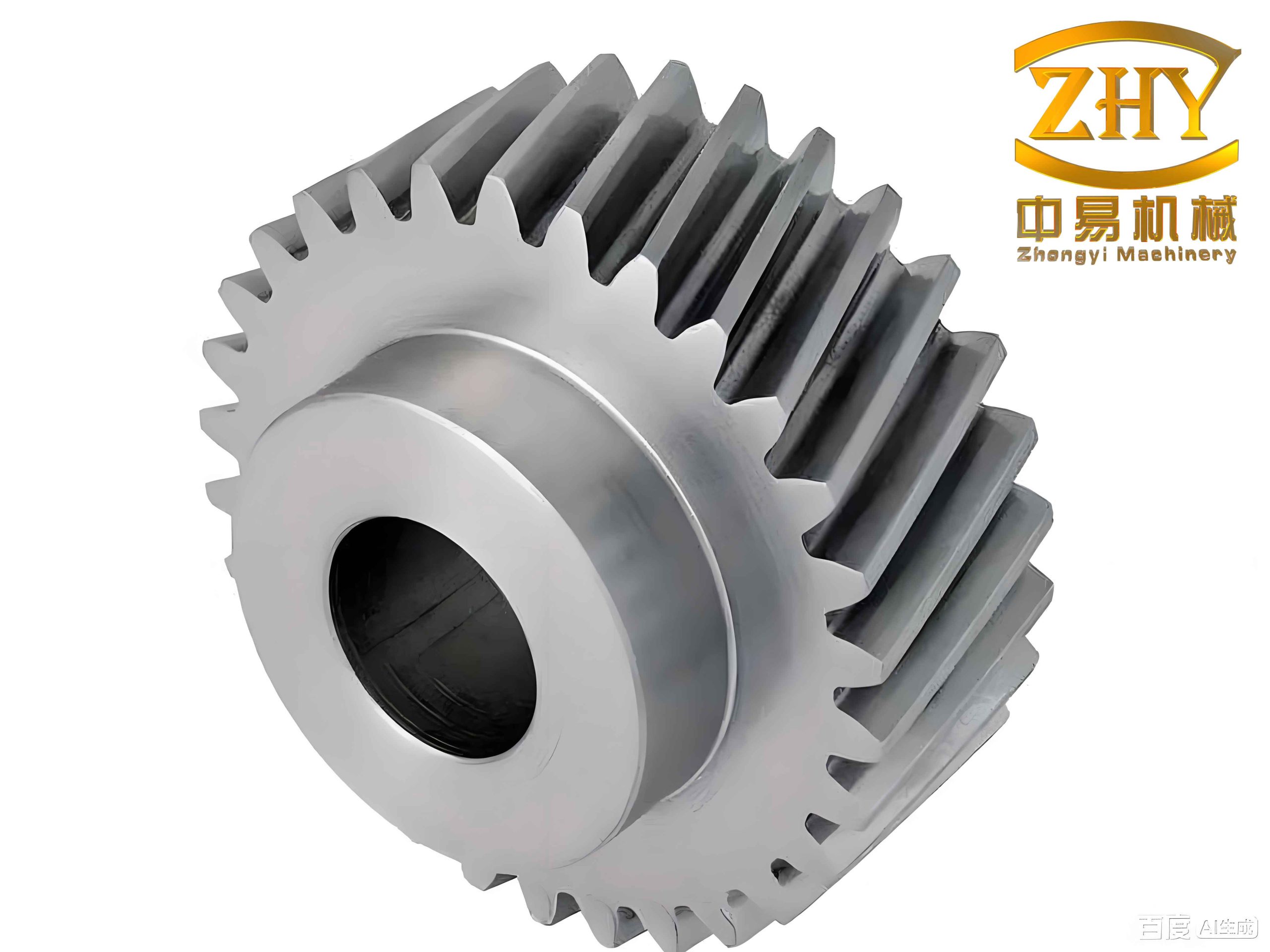
Figure above illustrates the three-dimensional geometry of a helical gear, where the helix angle introduces a time-varying contact pattern that is essential for understanding its dynamic behavior.
1. Dynamic Model of Helical Gear Transmission
To accurately predict the dynamic characteristics of the helical gear pair under realistic braking conditions, we establish a six-degree-of-freedom (DOF) dynamic model. The model includes translational displacements along the x (axial), y (radial), and z (tangential) directions, as well as rotational displacements about the gear axes. The governing differential equations for the pinion (subscript p) and gear (subscript g) are given by:
$$ m_p \ddot{y}_p + c_{py} \dot{y}_p + k_{py} y_p = -F_y $$
$$ m_p \ddot{z}_p + c_{pz} \dot{z}_p + k_{pz} z_p = -F_z $$
$$ m_g \ddot{y}_g + c_{gy} \dot{y}_g + k_{gy} y_g = F_y $$
$$ m_g \ddot{z}_g + c_{gz} \dot{z}_g + k_{gz} z_g = F_z $$
$$ I_p \ddot{\theta}_p = T_p – F_y R_p – F_s(t) R_p $$
$$ I_g \ddot{\theta}_g = F_y R_g + F_s(t) R_g – T_g $$
where \(m\) is the mass, \(R\) is the base circle radius, \(T\) is the applied torque, \(F_s(t)\) is the meshing impact force, \(\theta\) is the angular displacement, and \(k\) and \(c\) are the equivalent bearing stiffness and damping in the respective directions. The meshing forces \(F_y\) and \(F_z\) are expressed in terms of the time-varying mesh stiffness \(k(t)\) and mesh damping \(c_m\). They incorporate the helix angle \(\beta\) and the relative displacements along the line of action. The relative displacement \(q\) in the tangential direction is defined as \(q = R_p \theta_p – R_g \theta_g\). The equivalent mass \(m_e\) and the dynamic equation in terms of \(q\) are:
$$ m_e \ddot{q} + F_y = \frac{T_p}{R_p} – F_s(t) $$
$$ m_e = \frac{I_p I_g}{I_p R_g^2 + I_g R_p^2} $$
The mesh damping coefficient \(c_m\) is calculated from the stiffness and damping ratio \(\xi\):
$$ c_m = 2 \xi \sqrt{ \frac{k_m I_p I_g}{I_p R_g^2 + I_g R_p^2} } $$
where \(k_m\) is the mean mesh stiffness. In high-load, high-speed applications typical of braking systems, the damping ratio is taken as \(\xi = 0.1\). This model captures the coupling between torsional and translational vibrations, which is crucial for predicting the dynamic response of the helical gear system.
2. Calculation of Time-Varying Meshing Stiffness
Accurate determination of TVMS is the foundation of dynamic analysis. We combine the potential energy method with Hertz contact theory. The helical gear is discretized into \(N\) thin slices along the face width, each slice behaving as a spur gear. For each slice, the stiffness contributions from bending (\(k_b\)), shear (\(k_s\)), axial compressive (\(k_a\)), and fillet foundation (\(k_f\)) deformations are computed using the cantilever beam model. The total stiffness of a slice is obtained by combining these components in series, and then the overall TVMS \(k(t)\) is the sum over all slices in contact.
The bending stiffness for a single slice is given by:
$$ k_b = \sum_{i=1}^N \frac{\Delta y}{\int_{\alpha_2}^{-\alpha_1′} \frac{3(\alpha_2 – \alpha) \cos \alpha [\sin \alpha + (\alpha_2 – \alpha) \cos \alpha]^3}{3\{1 + \cos \alpha_1′ [(\alpha_2 – \alpha_1′)\sin \alpha – \cos \alpha]\}^2}{2E} d\alpha } $$
Shear stiffness:
$$ k_s = \sum_{i=1}^N \frac{1}{\int_{\alpha_2}^{-\alpha_1′} \frac{1.2(1+\nu)(\alpha_2 – \alpha) \cos \alpha \cos^2 \alpha_1′}{E[\sin \alpha + (\alpha_2 – \alpha) \cos \alpha]} d\alpha} \Delta y $$
Axial stiffness:
$$ k_a = \sum_{i=1}^N \frac{1}{\int_{\alpha_2}^{-\alpha_1′} \frac{(\alpha_2 – \alpha) \cos \alpha \sin^2 \alpha_1′}{2E[\sin \alpha + (\alpha_2 – \alpha) \cos \alpha]} d\alpha} \Delta y $$
Fillet foundation stiffness:
$$ k_f = \sum_{i=1}^N \frac{\Delta y}{\frac{\cos^2 \alpha_1′}{E} \left\{ L^* \left( \frac{u_f}{S_f} \right)^2 + M^* \left( \frac{u_f}{S_f} \right) + P^* [1 + Q^* \tan^2(\alpha_1′)] \right\} } $$
Here, \(\Delta y\) is the contact line length of a single slice, and the coefficients \(L^*, M^*, P^*, Q^*\) are polynomial functions of the gear tooth geometry parameters \(h_{fi}\) and \(\theta_f\):
$$ X_i^*(h_{fi}, \theta_f) = \frac{A_i}{\theta_f^2} + B_i h_{fi}^2 + \frac{C_i h_{fi}}{\theta_f} + \frac{D_i}{\theta_f} + E_i h_{fi} + F_i $$
The values of the polynomial coefficients are listed in Table 1.
| Coefficient | \(L^*(h_{fi}, \theta_f)\) | \(M^*(h_{fi}, \theta_f)\) | \(P^*(h_{fi}, \theta_f)\) | \(Q^*(h_{fi}, \theta_f)\) |
|---|---|---|---|---|
| \(A_i\) | −5.57E-5 | 60.11E-5 | −50.95E-5 | −6.20E-5 |
| \(B_i\) | −2.01E-3 | 28.10E-3 | 185.5E-3 | 9.09E-3 |
| \(C_i\) | −2.30E-4 | −83.43E-4 | 0.054E-4 | −4.10E-4 |
| \(D_i\) | 4.77E-3 | −9.93E-3 | 53.30E-3 | 7.83E-3 |
| \(E_i\) | 0.027 | 0.162 | 0.290 | −0.147 |
| \(F_i\) | 6.804 | 0.909 | 0.924 | 0.690 |
The Hertzian contact stiffness \(k_h\) for the gear pair, assuming identical elastic materials, is constant:
$$ k_h = \frac{\pi E L}{4(1-\nu^2)} $$
where \(L\) is the instantaneous total contact line length, which varies with the rotation angle. The total TVMS \(k(t)\) is the sum of the individual stiffness components (bending, shear, axial, foundation, and Hertz) for all slices in contact. The meshing stiffness fluctuation \(\Delta k(t)\) due to vibration is incorporated as:
$$ k_v(t) = k(t) + \Delta k(t) $$
To validate the model, we compare our calculated TVMS with reference data. The baseline gear parameters are given in Table 2.
| Parameter | Pinion | Gear |
|---|---|---|
| Number of teeth | 18 | 45 |
| Gear hand | Right | Left |
| Module (mm) | 2 | 2 |
| Pressure angle (°) | 20 | 20 |
| Helix angle (°) | 17 | 17 |
| Face width (mm) | 25 | 25 |
| Rotational speed (r/min) | 10000 | — |
| Torque (N·m) | 110 | 70 |
| Elastic modulus (GPa) | 205 | 205 |
| Poisson’s ratio | 0.28 | 0.28 |
The calculated TVMS values agree with the reference within 10% error, confirming the accuracy of our approach.
3. Dynamic Response Analysis Under TVMS Excitation
Using the Runge-Kutta method, we solve the differential equations to obtain vibration accelerations in the y and z directions. The resultant acceleration along the line of action is given by:
$$ a = \cos\beta (\ddot{y}_p – \ddot{y}_g + \ddot{q}) + \sin\beta (\ddot{z}_p – \ddot{z}_g) $$
We compute the root mean square (RMS) of the acceleration for different torque levels (70, 90, 110 N·m) and various rotational speeds. The results are summarized in Table 3.
| Speed (r/min) | Torque = 70 N·m | Torque = 90 N·m | Torque = 110 N·m |
|---|---|---|---|
| 5000 | 12.4 | 15.1 | 18.7 |
| 7500 | 18.9 | 22.3 | 27.5 |
| 10000 | 21.2 | 25.0 | 30.8 |
| 12000 | 19.8 | 23.4 | 28.6 |
Significant resonance occurs at 7500 r/min and 10000 r/min, where the mesh frequency aligns with the system natural frequencies. The highest RMS acceleration is observed at the highest torque (110 N·m), indicating intensified vibration under heavy load. Beyond the resonance region, the acceleration does not increase further with speed, confirming that TVMS acts as a parametric excitation whose magnitude is independent of speed.
4. Influence of Gear Design Parameters on TVMS and Dynamics
We investigate the effect of helix angle, face width, and number of teeth on TVMS characteristics.
4.1 Effect of Helix Angle
Figure below shows the TVMS waveforms for helix angles \(\beta = 11^\circ, 14^\circ, 17^\circ, 20^\circ\). As the helix angle increases, the mean TVMS decreases. This is because a larger helix angle spreads the contact force over a longer line, reducing the effective stiffness per unit length. The mean values are listed in Table 4.
| Helix Angle (°) | 11 | 14 | 17 | 20 |
|---|---|---|---|---|
| Mean TVMS | 2.85 | 2.72 | 2.58 | 2.45 |
For high-speed applications, a larger helix angle (e.g., 20°) provides a smoother stiffness variation but generates higher axial forces, which must be balanced by appropriate bearing design.
4.2 Effect of Face Width
Increasing face width from 16 mm to 28 mm enhances the contact area, leading to a nearly linear increase in mean TVMS. The results are tabulated in Table 5.
| Face Width (mm) | 16 | 20 | 24 | 28 |
|---|---|---|---|---|
| Mean TVMS | 2.10 | 2.45 | 2.80 | 3.15 |
A wider face width reduces stiffness fluctuation amplitude, thereby improving transmission stability. However, it also increases gear weight and inertia.
4.3 Effect of Number of Teeth
With a fixed module, increasing the number of teeth (z = 16, 22, 28, 34) raises the contact ratio and the number of meshing pairs, thus elevating the mean TVMS. Table 6 summarizes the values.
| Number of Teeth | 16 | 22 | 28 | 34 |
|---|---|---|---|---|
| Mean TVMS | 2.20 | 2.50 | 2.75 | 3.00 |
Higher tooth counts lead to more load-sharing teeth, reducing contact stress and improving fatigue life. The stiffness variability also becomes more periodic.
5. Application to Brake System Design
Our findings are directly applied to optimize the helical gear pair in electric brake actuators. By selecting the appropriate helix angle (17°–20°), face width (25 mm), and tooth count (28–34), we can achieve a balance between high stiffness, low vibration, and acceptable axial loads. The dynamic model enables predictive analysis of the system’s response to transient braking events, allowing for refinement of control strategies to mitigate resonance and wear. For instance, real-time monitoring of the RMS acceleration can serve as a diagnostic tool for early detection of gear failure, enhancing the safety and reliability of the braking system.
6. Conclusion
We have developed a comprehensive dynamic model for helical gear systems by combining the potential energy method with Hertz contact theory, accounting for geometry, material, and nonlinear meshing effects. The TVMS calculation is performed by slicing the helical gear into equivalent spur gear slices, achieving an accuracy improvement of about 10% compared to conventional methods. The six-DOF dynamic model reveals that TVMS acts as a parametric excitation whose magnitude is independent of rotational speed, leading to resonance at specific speeds and elevated vibration under high torque. Parametric studies show that increasing the helix angle reduces mean stiffness but smoothes fluctuations, while larger face width and higher tooth count linearly increase stiffness. These insights provide a theoretical basis for the design optimization of helical gears in brake systems, contributing to improved performance, durability, and noise reduction.
Future work will extend the model to include thermal effects and wear evolution under repeated braking cycles, further enhancing the fidelity of the analysis for real-world applications.