
Rotary vector reducers represent a sophisticated evolution from traditional cycloidal drives, offering superior performance for high-precision applications like industrial robotics. Their compact design, high reduction ratio, substantial rigidity, and excellent overload capacity hinge critically on the performance of the core cycloid drive mechanism. This article delves into a detailed finite element analysis of the contact characteristics between the cycloid gear and the pin gear within a rotary vector reducer. The focus is on understanding the distribution and variation of meshing forces, contact stresses, and the contact zone across multiple teeth and through various phases of engagement.
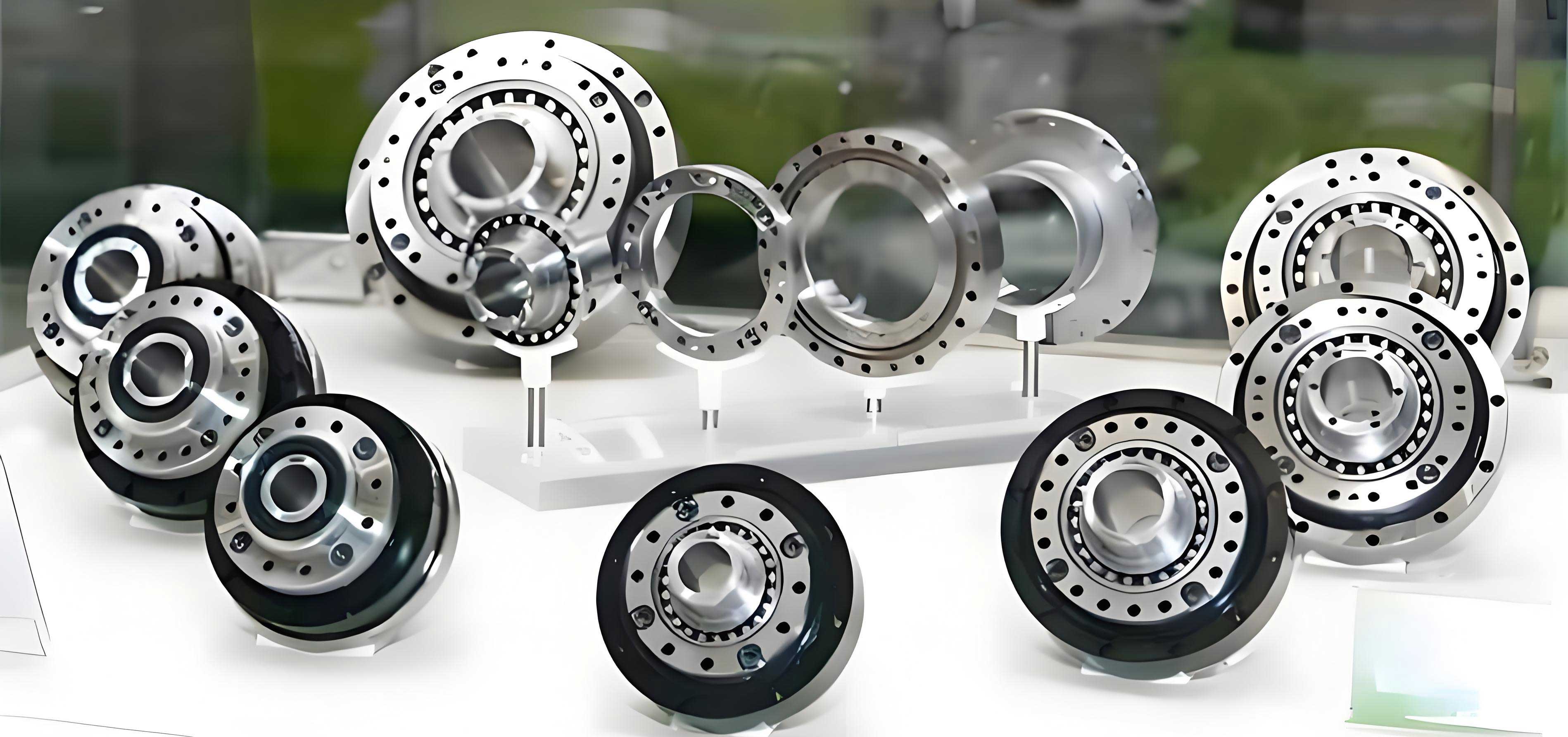
The unique motion of the cycloid gear, a combination of revolution around the pin circle center and rotation about its own axis, makes the contact analysis complex. The theoretical foundation begins with the generation of the cycloid tooth profile. A standard epicycloid can be generated by a rolling circle of radius $$r_r$$ rotating externally on a base circle of radius $$r_b$$. The point on the rolling circle traces the theoretical tooth profile. For the actual profile used in a rotary vector reducer, the point is offset by the pin radius $$r_{rp}$$. The parametric equations for the actual tooth flank are given by:
$$
\begin{aligned}
x &= r_{rp} \left[ \frac{K_1 \sin\left(\frac{z_p}{z_c}\varphi\right) – \sin\left(\frac{\varphi}{z_c}\right)}{K_1^2 + 1 – 2K_1\cos\varphi} \right] + r_p \sin\left(\frac{\varphi}{z_c}\right) – a \sin\left(\frac{z_p}{z_c}\varphi\right) \\
y &= -r_{rp} \left[ \frac{\cos\left(\frac{\varphi}{z_c}\right) – K_1 \cos\left(\frac{z_p}{z_c}\varphi\right)}{K_1^2 + 1 – 2K_1\cos\varphi} \right] + r_p \cos\left(\frac{\varphi}{z_c}\right) – a \cos\left(\frac{z_p}{z_c}\varphi\right)
\end{aligned}
$$
where $$z_c$$ and $$z_p$$ are the number of teeth on the cycloid gear and the number of pins, respectively, $$a$$ is the eccentricity, $$r_p$$ is the pin circle radius, $$K_1$$ is the shortening coefficient, and $$\varphi$$ is the meshing phase angle.
Under load from the eccentric input shaft, approximately half of the cycloid gear’s teeth engage with the pins. The force on each engaged tooth acts through the instantaneous center of rotation. Assuming linear deformation, the load on an individual pin-cycloid tooth pair $$i$$ can be expressed as:
$$
F_i = \frac{4T_c \sin \psi_i}{K_1 z_c r_p \sqrt{1 + K_1^2 – 2K_1 \cos \psi_i}}
$$
where $$T_c$$ is the output torque transmitted to the cycloid gear and $$\psi_i$$ is the angular position of the pin relative to the pin circle center. The maximum load logically occurs at the tooth with the largest moment arm.
The contact stress on the tooth flank is calculated using the Hertzian contact formula. First, the radius of curvature $$\rho$$ of the actual cycloid flank at the contact point is determined from the theoretical curvature $$\rho_0$$:
$$
\rho = \rho_0 + r_{rp} = \frac{r_p (1 + K_1^2 – 2K_1 \cos \varphi)^{3/2}}{K_1(z_p + 1)\cos \varphi – 1 – z_p K_1^2} + r_{rp}
$$
The maximum Hertzian contact stress $$\sigma_H$$ for a pair is then:
$$
\sigma_H = 0.418 \sqrt{ \frac{E_c F_i}{b_c} \cdot \frac{\rho_i r_{rp}}{\rho_i – r_{rp}} }
$$
where $$E_c$$ is the equivalent elastic modulus and $$b_c$$ is the face width of the cycloid gear. For this analysis of a rotary vector reducer, the following design parameters were used:
| Parameter | Value | Parameter | Value |
|---|---|---|---|
| Eccentricity, $$a$$ | 1.0 mm | Pin Circle Radius, $$r_p$$ | 51.0 mm |
| Cycloid Teeth, $$z_c$$ | 39 | Pin Radius, $$r_{rp}$$ | 2.0 mm |
| Number of Pins, $$z_p$$ | 40 | Cycloid Gear Width, $$b_c$$ | 9.0 mm |
| Shortening Coefficient, $$K_1$$ | 40/51 | Applied Torque, $$T_c$$ | 126.5 N·m |
Based on these parameters, the theoretical distribution of meshing force and maximum contact stress across the 19 simultaneously engaged teeth was calculated. The results showed a characteristic pattern where both force and stress increase to a maximum near the 4th tooth (counting from the point of initial engagement) and then decrease. The peak theoretical contact stress was found to be 587 MPa, well below the allowable stress for the material (GCr15 bearing steel).
To perform a more comprehensive three-dimensional analysis, a detailed finite element model was constructed in ANSYS. The three-dimensional geometry of the cycloid gear and the pin ring was created based on the parametric equations. To focus computational resources on the contact phenomena, the central portion of the cycloid gear was simplified. The mesh was heavily refined in the regions where contact was expected to occur. Contact pairs were defined between the flanks of the cycloid gear teeth and the cylindrical surfaces of the pins. Boundary conditions were applied to simulate the actual operating state of the rotary vector reducer: the outer surface of the pin ring was fully fixed, and the nodes on the inner bore of the cycloid gear were constrained in rotation except for the desired direction. The output torque was applied as a set of equivalent tangential forces on the inner bore nodes.
The finite element analysis for a single meshing configuration confirmed that 19 tooth pairs were in contact. The contact stress distribution on the cycloid gear surface revealed a band-like pattern. Extracting the maximum contact stress from each of the 19 engaged tooth surfaces yielded a distribution curve that closely matched the theoretical prediction, confirming the model’s validity. The peak value from the finite element analysis was approximately 352 MPa, showing the same trend of peaking near the 4th tooth.
A deeper investigation into the nature of the contact zone on a single tooth was conducted. By extracting nodal contact forces along lines parallel to the gear axis (z-direction) and lines perpendicular to it (x-direction), the precise shape of the contact area was mapped. The results are summarized conceptually in the table below, illustrating the contact pattern:
| Direction | Contact Force Variation | Implied Contact Zone Shape |
|---|---|---|
| Along Tooth Width (z-axis) | Forces are lower at the two end faces (z=0, z=9 mm) and higher, relatively constant, in the central region. | Contact area is narrower and/or pressure is lower at the ends of the tooth. |
| Across Tooth Profile (x-axis) | Forces are lower at the edges of the contact band and peak in the middle of the band. | Contact pressure is not uniform across the band; it is highest along a central line. |
This two-dimensional variation indicates that the actual contact zone in the rotary vector reducer is not a simple uniform stripe. Instead, it approximates a “barrel-shaped” or crowned area, where the center of the tooth face (both in width and profile height) experiences the highest contact pressure, tapering off towards the edges and ends. This is a critical insight for understanding wear patterns and for potential optimization of the tooth profile or alignment.
To understand the dynamic behavior throughout the meshing cycle, the analysis was extended to multiple engagement phases. The cycloid gear was rotated incrementally, simulating six distinct positions from its initial state. The rotation is a composite of a “revolution” around the pin circle center and a “rotation” about its own center, related by the gear ratio. The six analyzed phases are defined by their respective angles:
| Phase | Cycloid Self-Rotation Angle | Cycloid Revolution Angle |
|---|---|---|
| $$\theta_0$$ | 0° | 0° |
| $$\theta_1$$ | +1° | -39° |
| $$\theta_2$$ | +2/3° | -26° |
| $$\theta_3$$ | +1/3° | -13° |
| $$\theta_4$$ | -1/3° | +13° |
| $$\theta_5$$ | -2/3° | +26° |
| $$\theta_6$$ | -1° | +39° |
In each phase, a finite element analysis was performed. The maximum contact stress distribution across the 19 engaged teeth for all six phases was plotted. While the absolute numerical values varied slightly, all six curves exhibited the same fundamental pattern: a rise to a peak followed by a decay, with the maximum stress consistently occurring on a tooth near the region of highest load arm (around the 4th tooth relative to that phase’s engagement point). This demonstrates the stability of the load distribution characteristic within the cycloid drive of the rotary vector reducer throughout its operating cycle.
To track the history of a specific tooth, Teeth 3, 4, and 5 from the initial configuration ($$\theta_0$$) were monitored through the six phases. Their individual peak contact stress values varied with phase, each reaching its own maximum value at or near the $$\theta_0$$ position where it was most centrally loaded. For instance, Tooth 5 remained engaged through all phases. By examining the distribution of contact force across the width of Tooth 5 in each phase, it was observed that not only did the magnitude of force change, but the location of the contact band on the tooth profile also shifted. The node group experiencing the highest force moved along the x-axis (tooth profile direction) as the phase changed, indicating that the contact zone migrates from closer to the tooth root towards the tooth tip (or vice-versa) during the meshing process. This migration is a key dynamic characteristic of the cycloidal mesh in a rotary vector reducer.
In conclusion, this detailed three-dimensional finite element analysis of the cycloid drive within a rotary vector reducer provides significant insights. Firstly, the theoretical calculations for load and stress distribution are validated by the finite element results, both showing a predictable pattern peaking near the tooth with the greatest moment arm. Secondly, the contact zone is not a simple uniform strip but exhibits a crowned, barrel-shaped pattern, with maximum pressure at the center of the tooth face both in width and profile height. Thirdly, as the cycloid gear moves through its meshing cycle, the fundamental load distribution pattern among the simultaneously engaged teeth remains consistent, while individual teeth experience a cycle of increasing and decreasing load. Furthermore, the precise location of the contact band on a given tooth flank shifts along the profile during engagement. These findings on contact forces, stress distribution, and zone dynamics are crucial for optimizing the design, improving the longevity, and ensuring the reliable high performance of rotary vector reducers in demanding applications such as precision robotics.