
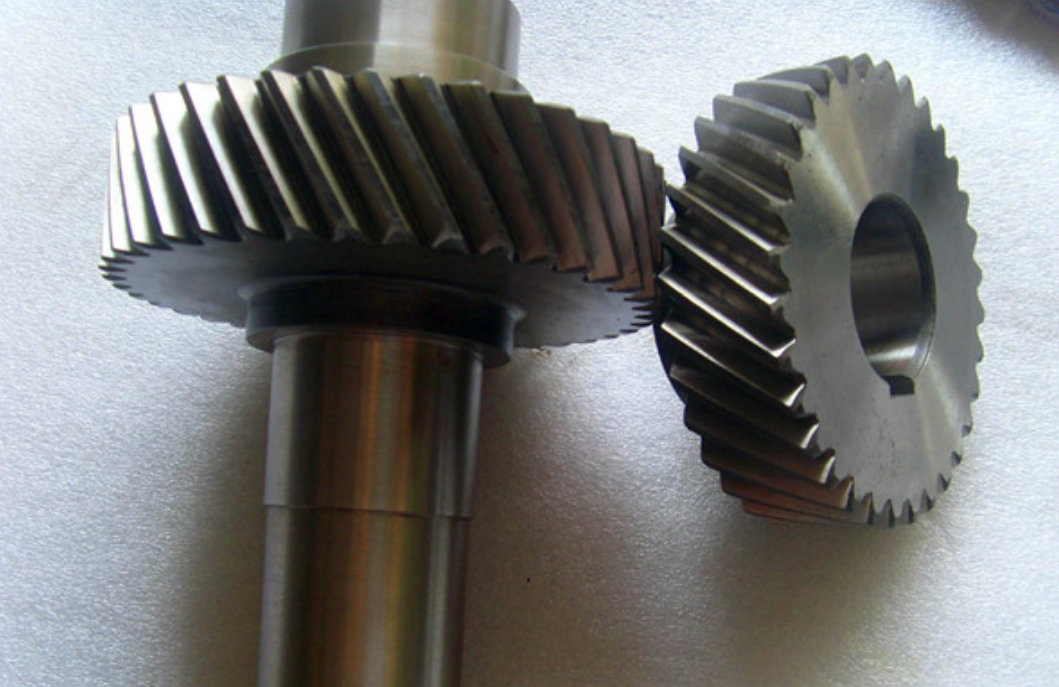
Helical gears are widely used in transmission systems across industries such as automotive, aerospace, and machinery. However, installation errors, elastic deformations, and manufacturing inaccuracies often lead to uneven load distribution, vibration, and noise. Longitudinal tooth flank modification, particularly drum-shaped modification, is a critical method to mitigate these issues. Despite its benefits, the inherent twist error introduced during the modification process significantly affects meshing performance. This study investigates the impact of twist errors on contact characteristics and provides optimization insights for helical gear design.
1. Mathematical Modeling of Modified Tooth Surfaces
The drum-shaped modification curve superimposed on the helical gear’s lead direction is expressed as:
$$ \delta_n = y(x) $$
where \( \delta_n \) represents the modification amount at position \( x \) along the tooth width. The additional rotation angle \( \sigma \) caused by modification is:
$$ \sigma = \frac{\delta_n}{r} $$
where \( r \) is the pitch circle radius. The coordinate transformation matrix for the modified helical gear tooth surface becomes:
$$ \mathbf{M}_{10} = \begin{bmatrix}
\cos(\theta_1 + \sigma) & -\sin(\theta_1 + \sigma) & 0 & 0 \\
\sin(\theta_1 + \sigma) & \cos(\theta_1 + \sigma) & 0 & 0 \\
0 & 0 & 1 & p_1\theta_1 \\
0 & 0 & 0 & 1
\end{bmatrix} $$
2. Twist Error Mechanism and Calculation
The twist error \( \Delta T \) in helical gears with drum-shaped modification is derived as:
$$ \Delta T = \frac{8B_1B_2\delta}{b\sin\beta_b} $$
where \( B_1B_2 \) denotes the meshing line length, \( \delta \) is the total modification amount, \( b \) is the tooth width, and \( \beta_b \) is the base circle helix angle. Key design parameters influencing twist errors include:
| Parameter | Effect on Twist Error |
|---|---|
| Modification amount (\( \delta \)) | Proportional increase |
| Helix angle (\( \beta \)) | Nonlinear increase via \( \sin\beta_b \) |
| Tooth width (\( b \)) | Inverse relationship |
3. Tooth Contact Analysis (TCA) with Twist Errors
The TCA model considers both geometric compatibility and force equilibrium conditions:
$$ \begin{cases}
\mathbf{r}_f^{(1)}(u_1, \theta_1, \phi_1) = \mathbf{r}_f^{(2)}(u_2, \theta_2, \phi_2) \\
\mathbf{n}_f^{(1)}(u_1, \theta_1, \phi_1) = \mathbf{n}_f^{(2)}(u_2, \theta_2, \phi_2)
\end{cases} $$
Transmission error (TE) is calculated as:
$$ TE = \phi_2 – \left( \phi_2^{(0)} + \frac{z_1}{z_2}(\phi_1 – \phi_1^{(0)}) \right) $$
4. Parametric Influence Analysis
4.1 Effect of Modification Amount
Increasing \( \delta \) amplifies transmission error fluctuations:
| \( \delta \) (μm) | Peak TE (arcsec) | Contact Area Reduction |
|---|---|---|
| 10 | 12.5 | 4.2% |
| 30 | 23.8 | 7.6% |
| 50 | 35.1 | 9.8% |
4.2 Effect of Helix Angle
Larger \( \beta \) increases contact stress concentration:
$$ \sigma_H \propto \frac{1}{\sqrt{A_c}} $$
where \( A_c \) is the contact ellipse area. For \( \delta = 30 \mu m \):
| \( \beta \) (°) | Max Stress (MPa) | Contact Area (mm²) |
|---|---|---|
| 15 | 114.8 | 0.68 |
| 20 | 160.0 | 0.54 |
| 25 | 200.3 | 0.41 |
5. Finite Element Validation
Finite element analysis confirms the TCA predictions for helical gears with twist errors:
$$ \sigma_{\text{max}} = 1.6 \times 10^2 \, \text{MPa (at } \beta = 20^\circ \text{)} $$
Edge contact phenomena become pronounced when \( \delta > 40 \mu m \) or \( \beta > 25^\circ \), requiring strict parameter optimization.
6. Conclusion
This study establishes a comprehensive framework for analyzing helical gears with longitudinal modification considering twist errors. Key findings include:
- Twist errors increase quadratically with modification amount and helix angle
- Transmission error amplitude grows by 180% when \( \delta \) increases from 10 μm to 50 μm
- Contact stress rises 74% as helix angle increases from 15° to 25°
Optimal design parameters for helical gears should balance modification benefits against twist-induced performance degradation. Future work will explore multi-objective optimization algorithms for industrial applications.