
In the field of mechanical transmission, straight bevel gears play a critical role in intersecting shaft applications, particularly in industries such as aerospace and defense. The machining of straight bevel gears using concave cutters offers advantages in terms of precision and surface quality. This study focuses on developing a comprehensive tooth contact analysis (TCA) methodology for straight bevel gears produced with concave cutters on domestic CNC spiral bevel gear machines. We establish a mathematical model for the tooth surface, perform TCA to predict contact patterns and transmission errors, and validate the results through practical machining and testing. The insights gained provide a theoretical foundation for optimizing machining parameters and tool design for straight bevel gears.
The concave cutter method, such as the Coniflex® approach, involves a specialized tool with an inward-inclined cutting edge to generate crowned tooth surfaces. This crowning enhances the meshing performance by localizing contact and reducing sensitivity to misalignments. Our work begins by explaining the principle of concave cutter machining for straight bevel gears. The cutter rotates to form a virtual generating gear, and the machining process simulates the meshing between this generating gear and the workpiece. Key parameters of the concave cutter include the concave angle, cutter diameter, and tool tip width, which influence the tooth profile and crowning amount. For instance, the crowning amount ΔS is calculated as:
$$ \Delta S = \Delta H \left[ \tan(\alpha_f + \delta) – \tan \alpha_0 \right] $$
where αf is the gear pressure angle, δ is the concave angle of the cutting edge, α0 is the tool pressure angle, and ΔH is the depth variation. Alternatively, it can be expressed as:
$$ \Delta S = \frac{b^2 \cos \alpha_f \tan \delta}{4 D_e} $$
Here, b is the face width of the straight bevel gear, and De is the cutter diameter. The cutter diameter is determined based on the gear dimensions:
$$ D_e = \frac{b^2 \cos \alpha_f}{4 \Delta H} $$
These equations highlight the interdependence of tool and gear parameters in achieving the desired tooth geometry for straight bevel gears.
To model the tooth surface of straight bevel gears, we first define the coordinate systems for the virtual generating gear and the cutter. The generating gear coordinate system Sc has its origin at the apex of the face cone. The position vector rc and unit normal vector nc of the generating gear tooth surface are given by:
$$ \mathbf{r}_c(u, v) = \begin{bmatrix} v \cos \lambda_0 \\ \pm(v \sin \lambda_0 + u \sin \alpha_0) \\ u \cos \alpha_0 \end{bmatrix} $$
$$ \mathbf{n}_c(u, v) = \frac{\mathbf{r}_{cu} \times \mathbf{r}_{cv}}{|\mathbf{r}_{cu} \times \mathbf{r}_{cv}|} $$
where u and v are parameters along the tooth height and width directions, λ0 is the half-thickness angle of the generating gear, and α0 is the tool pressure angle. These angles are computed from the basic gear parameters:
$$ \lambda_0 = \frac{s_e – h_a \tan \alpha_f}{R_e / \cos \theta_f} $$
$$ \alpha_0 = \arctan\left( \frac{\tan \alpha_f}{\cos \lambda_0} \right) $$
Here, se is the large-end tooth thickness, ha is the addendum, Re is the outer cone distance, and θf is the root angle. This formulation captures the geometry of the virtual generating gear used in machining straight bevel gears.
Next, we model the cutter in its coordinate system St, with the origin at the intersection of the cutter axis and the tip plane. The position vector rt and unit normal vector nt for a point on the cutter surface are:
$$ \mathbf{r}_t = \begin{bmatrix} \sin \theta (r – s \cos \delta) \\ \cos \theta (r – s \cos \delta) \\ s \sin \delta \\ 1 \end{bmatrix} $$
$$ \mathbf{n}_t = \frac{\mathbf{r}_{t\theta} \times \mathbf{r}_{ts}}{|\mathbf{r}_{t\theta} \times \mathbf{r}_{ts}|} = \begin{bmatrix} -\sin \theta \sin \delta \\ \cos \theta \sin \delta \\ \cos \delta \end{bmatrix} $$
where r is the cutter radius, s is the distance along the cutting edge, θ is the rotation angle, and δ is the concave angle. For the machining process, we establish multiple coordinate systems to relate the cutter, generating gear, and workpiece. The transformation matrices include rotations and translations to account for the relative positions and orientations. For example, the transformation from the cutter system St to the generating gear system Sc involves matrices M1t, M21, and Mc2, which incorporate parameters such as the tool inclination angle α, tooth space angle λ, and offsets L, E, D. The position vector in the generating gear system is:
$$ \mathbf{r}_c = \mathbf{M}_{c2} \mathbf{M}_{21} \mathbf{M}_{1t} \mathbf{r}_t $$
Similarly, the unit normal vector is transformed using the linear parts of these matrices. The machining simulation involves solving for the unknown parameters λ, α, L, E, D by equating the cutter surface to a reference point on the generating gear. The gear ratio I12 is constant and given by:
$$ I_{12} = \frac{\cos \theta_f}{\sin \delta_d} $$
where δd is the pitch cone angle. The relationship between the generating gear rotation φ1 and the workpiece rotation ψ1 is:
$$ \psi_1 = I_{12} \phi_1 $$
The tooth surface of the machined straight bevel gear is derived by transforming the cutter surface to the workpiece coordinate system Sg:
$$ \mathbf{r}_g = \mathbf{M}_{g3} \mathbf{M}_{3m} \mathbf{M}_{mc} \mathbf{M}_{c2} \mathbf{M}_{21} \mathbf{M}_{1t} \mathbf{r}_t $$
The unit normal vector is similarly transformed. The meshing condition during machining requires that the relative velocity between the generating gear and workpiece is perpendicular to the surface normal:
$$ \mathbf{v}_{12} \cdot \mathbf{n}_m = 0 $$
where vm12 is the relative velocity in the machine coordinate system. This condition allows us to solve for the parameter s as a function of φ1 and θ, generating the tooth surface as a family of contact lines.
For tooth contact analysis, we consider the meshing of a pair of straight bevel gears. The pinion and gear tooth surfaces are represented in a common mating coordinate system Sf, which coincides with the pinion coordinate system Sp. The position vectors and unit normal vectors are transformed using rotation matrices based on the assembly angles and shaft angle Σ. The contact conditions are:
$$ \mathbf{r}_{fp} = \mathbf{r}_{fg} $$
$$ \mathbf{n}_{fp} = \mathbf{n}_{fg} $$
where the subscripts p and g denote pinion and gear, respectively. The transmission error Δη2 is defined as:
$$ \Delta \eta_2 = (\eta_2 – \eta_{20}) – \frac{z_1}{z_2} (\eta_1 – \eta_{10}) $$
Here, η1 and η2 are the rotation angles of the pinion and gear, and z1 and z2 are the tooth numbers. To assess the sensitivity to misalignment, we analyze contact patterns and transmission errors at three points along the tooth width: near the toe, midpoint, and heel. The following table summarizes the basic parameters and cutter details for a sample straight bevel gear pair:
| Parameter | Pinion | Gear |
|---|---|---|
| Number of teeth | 35 | 35 |
| Module (mm) | 2.5 | 2.5 |
| Tool pressure angle (°) | 20 | 20 |
| Face width (mm) | 15 | 15 |
| Pitch cone angle (°) | 45 | 45 |
| Root cone angle (°) | 42.22 | 42.22 |
| Addendum cone angle (°) | 47.78 | 47.78 |
| Dedendum (mm) | 2.5 | 2.5 |
| Addendum (mm) | 3 | 3 |
| Cutter radius (mm) | 72.78 | 72.78 |
| Concave angle (°) | 2 | 2 |
The machine adjustment parameters for cutting are listed below:
| Parameter | Pinion | Gear |
|---|---|---|
| Gear ratio | 1.412554 | 1.412554 |
| Workpiece mounting angle (°) | 42.22 | 42.22 |
| L (mm) | 54.30 | 54.30 |
| E (mm) | 28.05 | 28.05 |
| D (mm) | 67.12 | 67.12 |
| Tooth space angle (°) | 1.612 | 1.612 |
Using these parameters, we implemented a TCA program in MATLAB to compute the contact patterns and transmission error curves. The results show that the contact ellipse covers approximately half of the face width, and the transmission error curve exhibits a parabolic shape, indicating effective crowning from the concave cutter. This behavior is beneficial for straight bevel gears as it mitigates edge loading and improves load distribution.
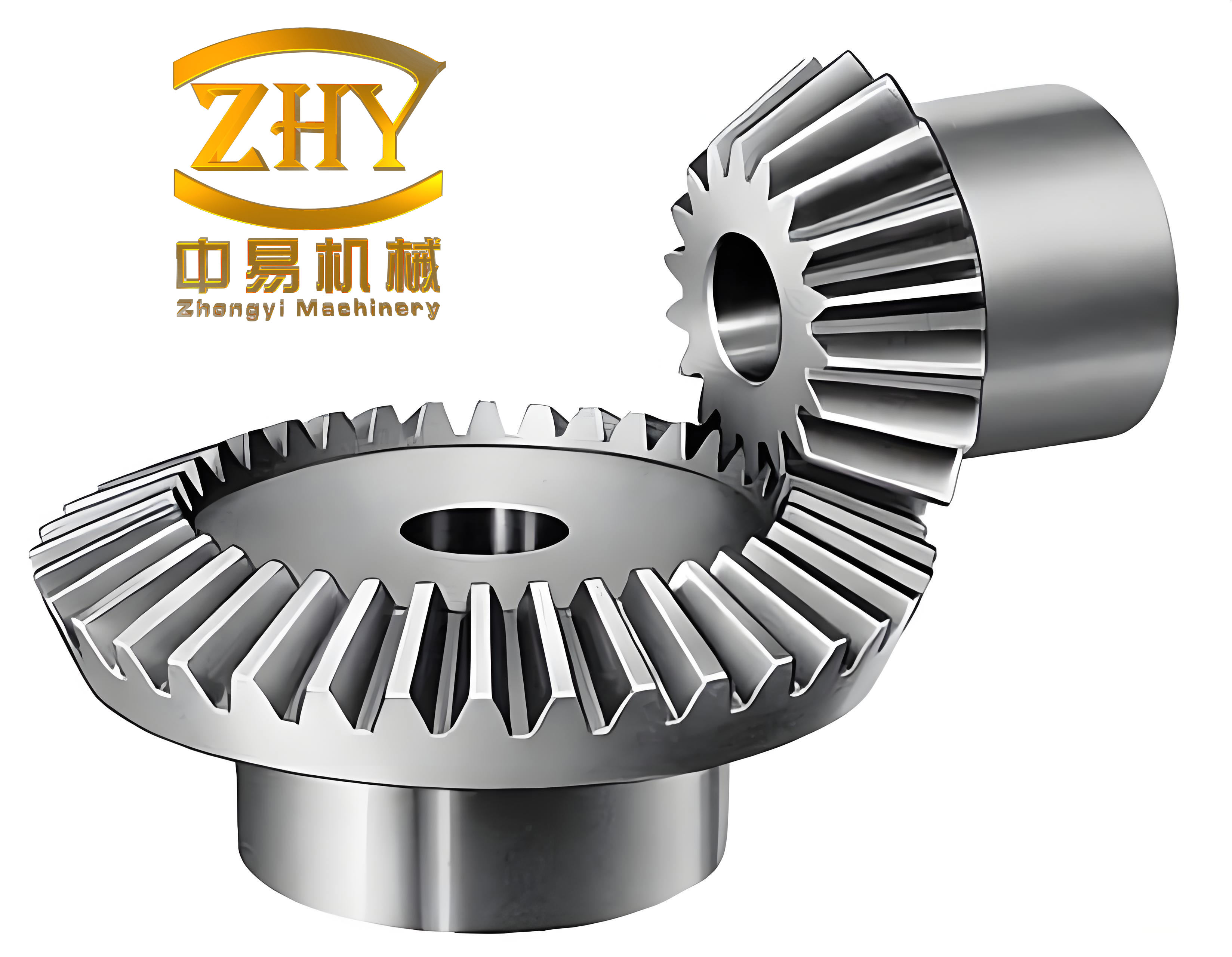
To validate the mathematical model and TCA method, we conducted practical machining on a H350C CNC gear milling machine. A pair of straight bevel gears was cut using the specified concave cutter parameters. The gears were then assembled on a rolling tester to inspect the contact patterns. The experimental contact patterns at the toe, midpoint, and heel closely match the theoretical predictions, confirming the accuracy of our approach. Additionally, tooth profile measurements on a gear measuring center revealed a maximum deviation of 11.9 μm, which is within acceptable limits for industrial applications. Minor discrepancies are attributed to factors like tool wear, machine inaccuracies, and material variations, but overall, the results demonstrate the robustness of the concave cutter method for producing high-quality straight bevel gears.
In conclusion, we have developed a comprehensive framework for modeling and analyzing straight bevel gears machined with concave cutters. The tooth surface mathematical model, based on coordinate transformations and meshing conditions, accurately predicts the gear geometry. The TCA methodology provides insights into contact behavior and transmission errors, enabling optimization of machining parameters for straight bevel gears. Experimental validation through cutting and testing confirms the theoretical findings, supporting the adoption of this approach in domestic CNC machines. Future work could explore the effects of dynamic loads and thermal variations on the performance of straight bevel gears, further enhancing their application in precision transmission systems.