
In modern gear transmission systems, the demand for high precision, low noise, and extended service life has driven significant research into tooth surface modification techniques. Among various gear types, helical gears are particularly critical due to their smooth engagement and high load-carrying capacity. However, achieving precise topological modifications on helical gears during shaping processes remains a challenge due to inherent errors in cutter geometry and machining kinematics. This article presents a comprehensive method for modifying helical gear tooth surfaces through shaping, focusing on correcting the shaping cutter via a conical grinding wheel and optimizing shaping parameters. The goal is to minimize tooth surface errors and realize desired topological modifications, thereby enhancing the performance of helical gears in applications such as automotive transmissions and industrial machinery.
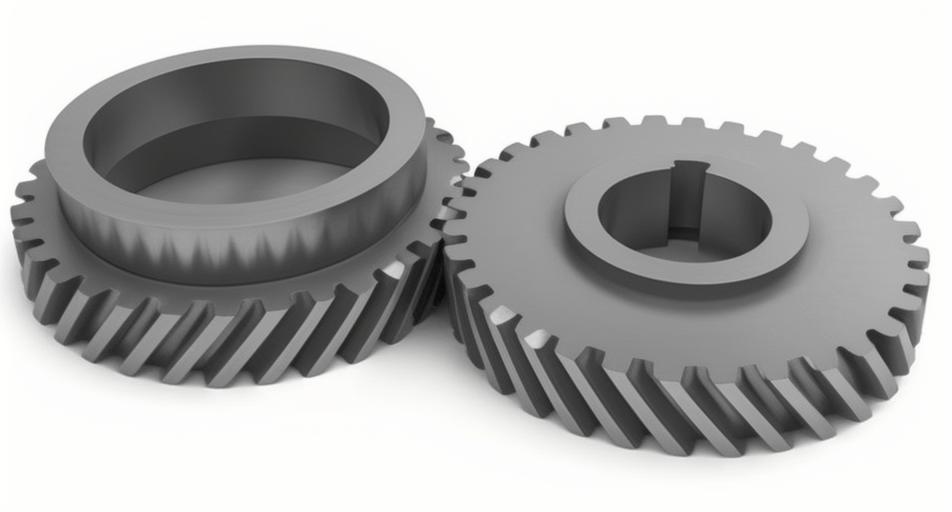
The shaping process for helical gears involves the generation of tooth surfaces through the relative motion between a cutter and the workpiece, simulating the meshing of two helical gears. Traditional shaping cutters, especially those for helical gears, exhibit profile errors due to rake and relief angles, leading to deviations in the machined gear teeth. To address this, I propose a point-contact grinding method using a conical grinding wheel with axial reciprocating strokes to sharpen the shaping cutter. This approach allows for precise control over the cutter’s cutting edge geometry, which is essential for accurate shaping of helical gears. By correcting the grinding wheel’s profile and motion, along with optimizing shaping parameters, I aim to achieve topological modifications that reduce noise and vibration while improving contact patterns for helical gears.
To begin, I developed a mathematical model for grinding the shaping cutter with a conical wheel. Based on gear meshing theory and the kinematic relationship between the grinding wheel and cutter, the cutting edge equations are derived. The coordinate systems involved include those for the grinding wheel, cutter, and workpiece. The position vector \(\mathbf{r}_c\) and normal vector \(\mathbf{n}_c\) of the cutter’s helical surface are expressed as:
$$
\begin{aligned}
\mathbf{r}_c &= \mathbf{M}_{cf} \mathbf{M}_{ft} \mathbf{M}_{tb} \mathbf{M}_{bw} \mathbf{r}_w, \\
\mathbf{n}_c &= \mathbf{L}_{cf} \mathbf{L}_{ft} \mathbf{L}_{tb} \mathbf{L}_{bw} \mathbf{n}_w, \\
f_c &= \frac{\partial \mathbf{r}_c}{\partial \theta_c} \cdot \mathbf{n}_c = 0,
\end{aligned}
$$
where \(\mathbf{r}_w\) and \(\mathbf{n}_w\) are the position and normal vectors of the grinding wheel’s axial profile, \(\mathbf{M}\) and \(\mathbf{L}\) denote transformation matrices and their submatrices, and \(f_c\) is the meshing equation. For helical gears, the cutter’s rake face is oriented in the normal direction, with a rake angle and axial relief angle. The cutting edge, as the intersection of the rake face and helical flank, has position vector \(\mathbf{r}_s\) and normal vector \(\mathbf{n}_s\):
$$
\begin{aligned}
\mathbf{r}_s &= \mathbf{M}_{sa} \mathbf{M}_{ac} \mathbf{r}_c, \\
\mathbf{n}_s &= \mathbf{L}_{sa} \mathbf{L}_{ac} \mathbf{n}_c, \\
R &= \sqrt{r_{sx}^2 + r_{sy}^2}, \quad \varepsilon = r_{sz},
\end{aligned}
$$
with \(R\) as the radial radius and \(\varepsilon\) as the regrinding depth. To minimize profile errors across the effective regrinding depth, corrections are applied to the grinding wheel’s pressure angle, axial profile, and generating motion. The correction parameters are denoted as \(\mathbf{C}_w = [a_w, a_{ww}, d_s, \delta_a]\), where \(\delta_a\) is the pressure angle correction, and \(a_w, a_{ww}, d_s\) are coefficients for quadratic and quartic parabolic profiles and profile shift. The corrected cutter profile error \(\delta_e\) is calculated as:
$$
\delta_e = (\mathbf{r}_s – \mathbf{r}_{s0}) \cdot \mathbf{n}_{s0},
$$
where \(\mathbf{r}_{s0}\) and \(\mathbf{n}_{s0}\) correspond to the standard involute surface. This correction ensures that the cutting edge deviation is minimized, which is crucial for accurate shaping of helical gears.
Next, to improve grinding efficiency, I optimized the number of grinding strokes using an equal-roughness method. The tooth surface of the cutter is enveloped by multiple strokes of the conical wheel, and the residual height affects surface quality. By determining radial positions and total stroke times to maintain constant roughness, the theoretical residual error is reduced. For instance, with a target residual height of 1 μm, the radial stroke number is calculated as 18. Compared to uniform radial or generating methods, the equal-roughness approach lowers residual errors by up to 30% for the same stroke count, enhancing the cutter’s accuracy for helical gear shaping.
The shaping model for helical gears involves two degrees of freedom: the cutter rotation \(\varphi_s\) and axial feed \(l_s\). The workpiece rotation \(\varphi_g\) and center distance \(E\) are adjusted to achieve modifications. Corrected parameters include additional center distance \(C_x\) and workpiece rotation \(C_b\), expressed as polynomials in \(l_s\) and \(\varphi_s\):
$$
\begin{aligned}
E &= r_s + r_g + C_x, \quad C_x = a_0 + a_1 l_s + a_2 l_s^2 + a_3 l_s^3 + a_4 l_s^4, \\
\varphi_g &= \frac{Z_s}{Z_g} \varphi_s + \frac{l_s \tan \beta_g}{r_g} + C_b, \quad C_b = b_1 l_s + b_2 l_s^2 + b_3 \varphi_s + b_4 \varphi_s^2 + b_5 \varphi_s l_s,
\end{aligned}
$$
where \(Z_s\) and \(Z_g\) are tooth numbers, \(r_s\) and \(r_g\) are pitch radii, and \(\beta_g\) is the helix angle of the helical gear. The grinding wheel’s additional generating motion \(C_a\) for cutter grinding is similarly expressed as a polynomial in \(\theta_c\). The workpiece tooth surface \(\mathbf{R}_g\) and normal \(\mathbf{N}_g\) are derived from the cutting edge and meshing conditions:
$$
\begin{aligned}
\mathbf{R}_g &= \mathbf{M}_{gc} \mathbf{r}_c, \quad \mathbf{N}_g = \mathbf{L}_{gc} \mathbf{n}_c, \\
f &= \frac{\partial \mathbf{R}_g}{\partial \varphi_s} \cdot \mathbf{N}_g = 0.
\end{aligned}
$$
Without corrections, shaping helical gears leads to tooth surface errors due to cutter imperfections. Let \(\mathbf{R}_g^m\) be the target modified surface with normal modification \(\delta_m\), and \(\mathbf{R}_g^0\) be the surface from uncorrected shaping with error \(\delta_g\):
$$
\begin{aligned}
\mathbf{R}_g^m &= \mathbf{R}_1 + \delta_m \mathbf{N}_1, \\
\mathbf{R}_g^0 &= \mathbf{R}_1 + \delta_g \mathbf{N}_1,
\end{aligned}
$$
where \(\mathbf{R}_1\) and \(\mathbf{N}_1\) are the ideal involute surface. After corrections, the actual normal modification \(\delta_{mg}\) on the helical gear tooth surface is:
$$
\delta_{mg} = (\mathbf{R}_g^m – \mathbf{R}_g^0) \cdot \mathbf{N}_g^0 \approx \delta_m – \delta_g (\mathbf{N}_1 \cdot \mathbf{N}_g^0).
$$
This relationship guides the correction process to achieve the desired topological modifications for helical gears.
To solve for correction parameters, I formulated a sensitivity analysis. The normal deviation \(\delta_{mg}\) is linearized with respect to correction parameters \(\zeta_j\) (including \(a_i, b_i, c_i\), and grinding wheel parameters), leading to a matrix equation:
$$
\delta_{mg} = \mathbf{S} \boldsymbol{\zeta},
$$
where \(\mathbf{S}\) is the sensitivity matrix evaluated at grid points on the tooth surface. For helical gears, I use 49 grid points (\(p=49\)) to cover the flank. The optimization minimizes the sum of squared errors:
$$
F(\boldsymbol{\zeta}) = \sum_{i=1}^{p} (\delta_{mg,i} – \mathbf{S}_i \boldsymbol{\zeta})^2.
$$
Due to potential ill-conditioning, I employ a particle swarm optimization algorithm to find optimal parameters, ensuring global convergence for this nonlinear problem. This approach effectively handles the complex interactions in shaping helical gears.
For illustration, consider a case study with parameters typical for helical gears. The basic parameters for the shaping cutter, workpiece helical gear, and grinding wheel are summarized in Table 1. These include tooth numbers, normal module, pressure angle, helix angle, and tool angles, all relevant for helical gear applications.
| Parameter | Shaping Cutter | Helical Gear (Workpiece) | Grinding Wheel |
|---|---|---|---|
| Number of Teeth | 32 | 45 | – |
| Normal Module (mm) | 3 | 3 | – |
| Normal Pressure Angle (°) | 20 | 20 | 20 |
| Helix Angle (°) | 23 | 23 | – |
| Face Width (mm) | 20 | 40 | – |
| Normal Rake Angle (°) | 6.5 | – | – |
| Axial Relief Angle (°) | 5 | – | – |
The cutting edge profiles on the rake face and transverse section are shown for different regrinding depths. For helical gears, the errors are asymmetric due to rake and relief angles, affecting both sides of the tooth differently. After applying corrections to the grinding wheel, the profile errors are significantly reduced. For example, with combined corrections to pressure angle, axial profile, and generating motion, the error is kept within 1 μm over 70% of the effective regrinding depth, as detailed in Table 2 for left and right flanks of the helical gear cutter.
| Cutter Flank | \(a_w \times 10^{-4}\) | \(a_{ww} \times 10^{-5}\) | \(d_s\) | \(\delta_a\) (°) | \(C_a\) Expression |
|---|---|---|---|---|---|
| Left Flank | 0 | 0 | 0 | 20.35 | -0.18(\theta_c + 0.087)^2 |
| Right Flank | -5 | -7 | 0 | 20.31 | 0.128(\theta_c – 0.091)^2 |
The target topological modification for the helical gear workpiece includes both profile and lead corrections, with varying amounts at the tooth tip and root. Without corrections, shaping introduces errors that deviate from this target. By deriving the actual target surface considering these errors, I optimize shaping parameters. The sensitivity matrix \(\mathbf{S}\) (excerpt in Table 3) indicates how each correction parameter influences normal deviations at different points on the helical gear tooth surface. Parameters like \(a_2\) (for center distance) and \(c_1\) (for grinding motion) show high sensitivity, emphasizing their importance in modifying helical gears.
| Point | \(a_0\) | \(a_1\) | \(a_2\) | \(b_1\) | \(b_2\) | \(c_1\) | \(c_2\) | \(a_w\) | \(d_s\) | \(\delta_a\) |
|---|---|---|---|---|---|---|---|---|---|---|
| Point 1 | 0.3398 | 6.3450 | 118.4737 | 0.1598 | 0.0300 | 11.7235 | 2.2054 | 8.1338 | 0 | 2.8542 |
| Point 2 | 0.3398 | 6.3737 | 119.5475 | 0.1247 | 0.0183 | 9.1458 | 1.3422 | 4.1952 | 0 | 2.0482 |
| Point 48 | 0.3398 | -6.9760 | 146.8478 | -0.0379 | 0.0017 | -2.7790 | 0.1239 | 4.1677 | 0 | -1.6840 |
| Point 49 | 0.3398 | -6.8567 | 138.3505 | -0.0879 | 0.0090 | -6.4482 | 0.6671 | 2.8360 | 0 | -2.8308 |
Using optimization, the optimal correction parameters for shaping helical gears are obtained. For the right flank of the helical gear, the additional center distance \(C_x\) is:
$$
C_x = 1.4 \times 10^{-4} l_s + 1.4 \times 10^{-4} l_s^2 + 1.4 \times 10^{-4} l_s^3 – 1.3 \times 10^{-7} l_s^4 – 1.0 \times 10^{-7} l_s^2 \varphi_s,
$$
and for the left flank:
$$
C_x = 9.2 \times 10^{-6} l_s + 1.25 \times 10^{-4} l_s^2 + 1.04 \times 10^{-7} l_s^3 – 1.04 \times 10^{-7} l_s^4.
$$
The workpiece additional rotation \(C_b\) for the right flank is:
$$
C_b = 0.0316 \varphi_g + 0.132 \varphi_g^2 – 2 \times 10^{-6} l_s – 9 \times 10^{-7} l_s^2,
$$
and for the left flank:
$$
C_b = 5.64 \times 10^{-4} l_s + 8.9 \times 10^{-7} l_s^2 – 6.84 \times 10^{-7} \varphi_s – 7.94 \times 10^{-7} \varphi_s^2.
$$
The grinding wheel additional motion \(C_a\) for cutter grinding is:
$$
C_a = -2.366 \theta_c – 10 \theta_c^2 \text{ for right flank}, \quad C_a = 6.165 \times 10^{-2} \theta_c – 5.68 \theta_c^2 – 7.029 \theta_c^4 \text{ for left flank}.
$$
Pressure angle corrections \(\delta_a\) are 0.062° for right flank and -0.036° for left flank, while other parameters like \(a_w\) and \(d_s\) are set as in Table 2. After applying these corrections, the shaped helical gear tooth surface exhibits minimal errors, with maximum deviation below 1 μm, closely matching the target topological modification. This demonstrates the effectiveness of the method in producing high-precision helical gears with desired surface characteristics.
In conclusion, this work presents a systematic approach to topological modification of helical gear tooth surfaces via shaping. By correcting the shaping cutter using a conical grinding wheel with optimized strokes and adjusting shaping kinematics, I achieve significant reductions in tooth surface errors. The mathematical models, sensitivity analysis, and optimization algorithms provide a robust framework for implementing these corrections. For helical gears, this method enhances accuracy and enables custom modifications to improve meshing performance. Future work could explore real-time adaptive control during shaping or extend the method to other gear types, further advancing gear manufacturing technology for helical gears and beyond.