
Gear modification is a critical technique in modern mechanical engineering, aimed at enhancing transmission performance by reducing vibration, noise, and stress concentrations. Among various types of gears, helical gears are widely used due to their smooth engagement and high load capacity. However, they are susceptible to misalignments and errors that can degrade performance. To address this, topological modification—a three-dimensional approach combining profile and lead corrections—has emerged as a powerful solution. In this article, I propose a novel topological modification method for helical gears, incorporating a circular tooth profile in the gear cutter and a drum-shaped lead modification. This approach leverages gear meshing theory and Tooth Contact Analysis (TCA) to design parameters and assess error sensitivity, ensuring robust performance under real-world conditions. The helical gear, with its angled teeth, offers inherent advantages, but its complexity demands precise modification strategies to optimize contact patterns and transmission error.
The helical gear is a cornerstone in power transmission systems, found in applications ranging from automotive drivetrains to industrial machinery. Its helical teeth provide gradual engagement, resulting in quieter operation and higher torque capacity compared to spur gears. However, this geometry also introduces challenges such as axial thrust and sensitivity to manufacturing errors. Topological modification, which involves sculpting the tooth surface in both profile and lead directions, can mitigate these issues by controlling contact distribution and minimizing edge loading. Traditional methods often rely on parabolic or linear modifications, but circular arc profiles offer unique benefits, including smoother transitions and reduced stress concentrations. In my work, I focus on a helical gear modification scheme that integrates a circular arc tool profile with a drum-shaped lead correction, aiming to achieve low error sensitivity and improved meshing characteristics.
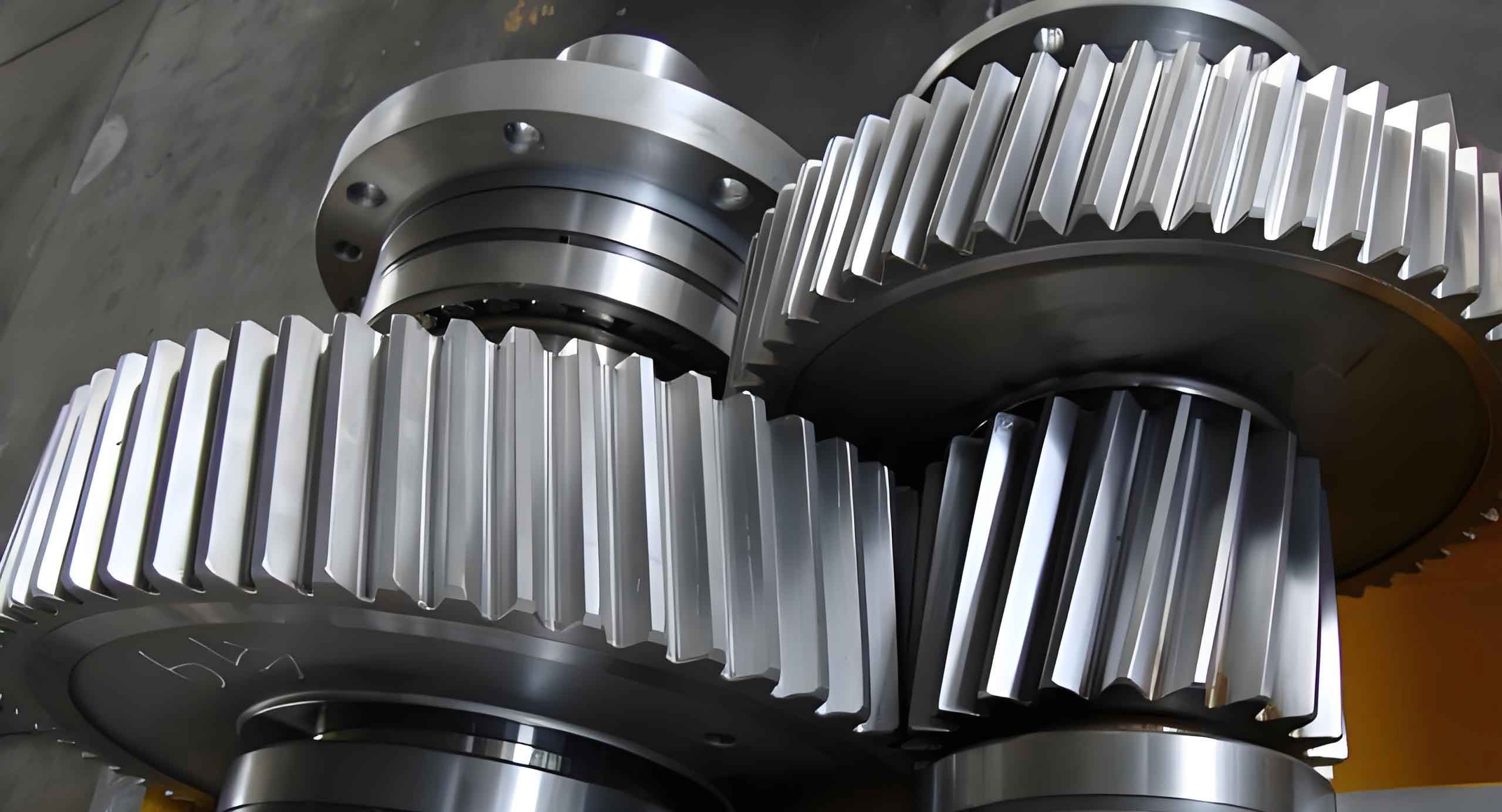
My modification strategy begins with the design of the gear cutter. Instead of a straight-line tooth profile, I use a circular arc in the normal plane of the cutter. This circular profile is defined by a radius \(R\) and a parameter \(c\) that controls the tangency point relative to the pitch line. The larger the radius \(R\), the smaller the modification magnitude, while \(c\) adjusts the distribution of modification along the tooth height. For the helical gear lead direction, I apply a drum-shaped modification, featuring a central straight segment flanked by third-order curves. This combination allows for tailored corrections that accommodate entry and exit conditions during meshing. The mathematical representation of the cutter surface is essential for generating the modified helical gear tooth surface. I establish coordinate systems to describe the cutter geometry and transformation matrices to map points from the cutter to the gear space.
Let me define the coordinate systems. A fixed coordinate system \(S_{c10}\) is attached to the gear cutter, with the \(X_{c10}Y_{c10}\) plane representing the normal plane at the center of the tooth width. The circular tooth profile in this plane is given by the position vector:
$$ \mathbf{r}_{c10} = \begin{bmatrix} u_1 \\ R – \sqrt{R^2 – u_1^2} \\ v_1 \\ 0 \end{bmatrix} $$
where \(u_1\) and \(v_1\) are parameters along the profile and lead directions, respectively, and \(R\) is the arc radius. To transform this into the cutter coordinate system \(S_{c1}\), which accounts for the helical gear geometry, I use a series of coordinate transformations. The transformation matrix \(D_{c1c10}\) incorporates the pressure angle \(\alpha\) and helix angle \(\beta\), along with parameters \(a\) (half of the normal tooth thickness at the pitch line) and \(c\). The matrix is expressed as:
$$ D_{c1c10} = \begin{bmatrix}
\cos \alpha & -\sin \alpha & 0 & c \cos \alpha \\
\cos \beta \sin \alpha & \cos \beta \cos \alpha & \sin \beta & c \cos \beta \sin \alpha + a \cos \beta \\
-\sin \beta \sin \alpha & -\sin \beta \cos \alpha & \cos \beta & -c \sin \beta \sin \alpha – a \sin \beta \\
0 & 0 & 0 & 1
\end{bmatrix} $$
Thus, the cutter surface in \(S_{c1}\) is:
$$ \mathbf{r}_{c1} = D_{c1c10} \mathbf{r}_{c10} $$
The unit normal vector \(\mathbf{n}_{c1}\) is derived from the partial derivatives of \(\mathbf{r}_{c1}\) with respect to \(u_1\) and \(v_1\):
$$ \mathbf{n}_{c1} = \frac{\partial \mathbf{r}_{c1}/\partial u_1 \times \partial \mathbf{r}_{c1}/\partial v_1}{|\partial \mathbf{r}_{c1}/\partial u_1 \times \partial \mathbf{r}_{c1}/\partial v_1|} $$
These equations fully describe the cutter surface, which is then used to generate the helical gear tooth surface through the gear generation process. For the pinion (small gear), I apply modification, while the gear (large gear) remains a standard involute helical gear. The generation involves coordinating the cutter motion with the gear rotation, as per the principle of gear cutting. The position vector and unit normal for the pinion tooth surface are obtained by applying transformation matrices that account for the rotation angle \(\phi_1\). The meshing equation ensures contact continuity:
$$ \mathbf{n}_1 \cdot \frac{\partial \mathbf{r}_1}{\partial \phi_1} = 0 $$
where \(\mathbf{r}_1\) and \(\mathbf{n}_1\) are the position and normal vectors of the pinion surface. To incorporate the drum-shaped lead modification, I superimpose a normal modification surface \(\delta(u_1, v_1)\) onto the theoretical tooth surface. The modified pinion surface is then:
$$ \mathbf{r}_{1r} = \delta(u_1, v_1) \mathbf{n}_1 + \mathbf{r}_1 $$
with the corresponding unit normal \(\mathbf{n}_{1r}\) computed from the derivatives. This approach allows for efficient generation of the topological modified helical gear tooth surface, combining both profile and lead corrections in a single process.
To analyze the meshing performance of the modified helical gear, I employ Tooth Contact Analysis (TCA). TCA simulates the contact between mating gear teeth by solving for points where their surfaces coincide in position and normal direction. I set up a fixed coordinate system \(S_s\) aligned with the gear axis. The TCA equations for the helical gear pair are:
$$ M(\phi_1)_{s1} \mathbf{r}_{1r} = M(\phi_2)_{s2} \mathbf{r}_2 $$
$$ M(\phi_1)_{s1} \mathbf{n}_{1r} = M(\phi_2)_{s2} \mathbf{n}_2 $$
where \(M(\phi_1)_{s1}\) and \(M(\phi_2)_{s2}\) are transformation matrices from the pinion and gear coordinates to \(S_s\), and \(\phi_1\) and \(\phi_2\) are the rotation angles. These equations, combined with the meshing conditions, yield the contact path and transmission error. The transmission error, defined as the deviation from ideal motion, is a key indicator of gear performance. For the helical gear with topological modification, I compute these quantities numerically to evaluate the design.
In designing the modification parameters for the helical gear, I consider a specific case: pinion teeth number 30, gear teeth number 45, normal module 3 mm, pressure angle 20°, and helix angle 15°. The circular arc radius \(R\) is set as \(R = K_1 m_n\), where \(m_n\) is the normal module, and \(K_1\) is a factor. Through TCA simulations, I found that very small \(R\) leads to edge contact, while large \(R\) results in insufficient modification. After optimization, I choose \(R = 300 m_n\) to avoid edge contact and ensure smooth engagement. The parameter \(c\) is set to zero to keep the contact points near the pitch circle, balancing bending stress between the pinion and gear. For the drum-shaped lead modification, the maximum modification magnitude is 10 μm, with a central straight segment covering 60% of the face width, based on ISO recommendations for high-precision helical gears.
The TCA results for this helical gear design show favorable characteristics. The contact pattern is centered on the tooth surface without edge contact, and the transmission error curve is symmetric with a near-zero middle segment. The maximum transmission error is -1.18 arcseconds, indicating high precision. Below is a table summarizing the transmission error under ideal conditions for the helical gear:
| Condition | Maximum Transmission Error (arcseconds) | Contact Pattern Quality |
|---|---|---|
| Ideal (No Errors) | -1.18 | Centered, No Edge Contact |
To assess the robustness of the helical gear modification, I investigate error sensitivity, focusing on helix angle and pressure angle errors. These errors are common in manufacturing and assembly of helical gears. I vary the helix angle error from -30 arcminutes to +30 arcminutes and the pressure angle error similarly, then perform TCA simulations. The results for transmission error changes are summarized in the following tables:
| Helix Angle Error (arcminutes) | Maximum Transmission Error (arcseconds) | Absolute Change (arcseconds) | Relative Change (%) |
|---|---|---|---|
| -30 | -1.25 | -0.07 | 5.9 |
| -24 | -1.235 | -0.055 | 4.66 |
| -18 | -1.225 | -0.045 | 3.8 |
| -12 | -1.2 | -0.02 | 1.69 |
| -6 | -1.195 | -0.015 | 1.26 |
| 0 | -1.18 | 0 | 0 |
| 6 | -1.16 | 0.02 | 1.69 |
| 12 | -1.145 | 0.035 | 2.97 |
| 18 | -1.13 | 0.05 | 4.23 |
| 24 | -1.115 | 0.065 | 5.5 |
| 30 | -1.1 | 0.08 | 6.8 |
| Pressure Angle Error (arcminutes) | Maximum Transmission Error (arcseconds) | Absolute Change (arcseconds) | Relative Change (%) |
|---|---|---|---|
| -30 | -1.15 | 0.03 | 2.5 |
| -24 | -1.16 | 0.02 | 1.69 |
| -18 | -1.172 | 0.008 | 0.68 |
| -12 | -1.16 | 0.02 | 1.69 |
| -6 | -1.17 | 0.01 | 0.84 |
| 0 | -1.18 | 0 | 0 |
| 6 | -1.19 | -0.01 | 0.84 |
| 12 | -1.22 | -0.04 | 3.4 |
| 18 | -1.227 | -0.047 | 3.98 |
| 24 | -1.24 | -0.06 | 5.1 |
| 30 | -1.25 | -0.07 | 5.9 |
The tables show that both helix angle and pressure angle errors cause only minor changes in transmission error for the helical gear. The absolute changes are less than 0.1 arcseconds, and relative changes are under 7%, demonstrating low sensitivity. This insensitivity is crucial for helical gears in practical applications where manufacturing tolerances are inevitable. Additionally, the contact patterns remain free from edge contact even with these errors, as verified by TCA simulations. The drum-shaped modification helps distribute contact evenly across the tooth face, while the circular arc profile ensures smooth profile transitions. This combination makes the helical gear robust against misalignments.
To further illustrate the mathematical basis, I derive the transmission error formula for the helical gear pair. The transmission error \(\Delta \phi\) is defined as the difference between the actual and ideal rotation angles of the driven gear. From the TCA equations, it can be expressed as a function of the pinion rotation angle \(\phi_1\):
$$ \Delta \phi(\phi_1) = \phi_2 – \frac{N_1}{N_2} \phi_1 $$
where \(N_1\) and \(N_2\) are the teeth numbers of the pinion and gear, respectively. For the modified helical gear, \(\Delta \phi(\phi_1)\) is computed numerically through the TCA solution. The symmetry of the transmission error curve indicates balanced loading during meshing. The circular arc modification contributes to this symmetry by providing a gradual change in tooth thickness along the profile.
In terms of stress analysis, topological modification can reduce contact and bending stresses in helical gears. While this article focuses on TCA, the principles can be extended to loaded tooth contact analysis (LTCA) to assess stress distributions. The drum-shaped lead modification minimizes edge loading, which is a common issue in helical gears under misalignment. The circular arc profile also helps in reducing stress concentrations at the tooth root and tip. Future work could integrate finite element analysis to quantify these benefits for helical gears.
The design process for helical gear modification involves iterative optimization. I use TCA simulations to adjust parameters like \(R\), \(c\), and the drum shape coefficients. The goal is to minimize transmission error amplitude and avoid edge contact. For the helical gear case studied, the optimal parameters yield a transmission error curve that is nearly parabolic, which is desirable for noise reduction. The following equation approximates the transmission error for small modifications:
$$ \Delta \phi \approx A \phi_1^2 + B \phi_1 + C $$
where \(A\), \(B\), and \(C\) are constants derived from the modification geometry. This quadratic behavior is typical for well-designed helical gear modifications.
In conclusion, the proposed topological modification method for helical gears, combining a circular tooth profile in the cutter and a drum-shaped lead correction, offers significant advantages. The helical gear exhibits low sensitivity to helix angle and pressure angle errors, with transmission error changes kept below 7% even for errors up to 30 arcminutes. The contact patterns remain centered without edge contact, ensuring reliable performance. This method provides a theoretical foundation for designing high-performance helical gears in applications demanding precision and durability. The use of TCA and mathematical modeling enables efficient parameter design, making it suitable for industrial implementation. As helical gears continue to evolve in automotive, aerospace, and robotics, such advanced modification techniques will play a key role in enhancing their efficiency and lifespan.
To summarize key formulas for helical gear modification, I list the essential equations:
Cutter surface position vector in normal plane:
$$ \mathbf{r}_{c10} = [u_1, R – \sqrt{R^2 – u_1^2}, v_1, 0]^T $$
Transformation to cutter coordinate system:
$$ \mathbf{r}_{c1} = D_{c1c10} \mathbf{r}_{c10} $$
Modified pinion surface with drum-shaped lead correction:
$$ \mathbf{r}_{1r} = \delta(u_1, v_1) \mathbf{n}_1 + \mathbf{r}_1 $$
TCA equations for helical gear pair:
$$ M(\phi_1)_{s1} \mathbf{r}_{1r} = M(\phi_2)_{s2} \mathbf{r}_2 $$
$$ M(\phi_1)_{s1} \mathbf{n}_{1r} = M(\phi_2)_{s2} \mathbf{n}_2 $$
These equations form the core of the analysis and design process for topological modified helical gears. By integrating these principles, engineers can develop helical gear systems that are resilient to errors and optimized for smooth operation.