
In the field of precision engineering, harmonic drive gears have garnered significant attention due to their exceptional performance characteristics. As a researcher focused on mechanical transmission systems, I have extensively studied the torsional behavior of these gears, particularly the role of the flexible wheel. Harmonic drive gears are renowned for their high transmission accuracy, minimal backlash, large gear ratios, lightweight design, compact size, and ability to operate under harsh conditions such as sealed environments or radiation. These attributes make them indispensable in applications ranging from aerospace robotics to精密 medical devices. However, one critical parameter that often dictates their performance in precision applications is torsional stiffness. While theoretical models suggest high stiffness values, practical measurements under small loads reveal a significant reduction, prompting a deeper investigation into the contributing components.
The overall torsional stiffness of a harmonic drive gear is typically derived from the combined compliance of its fundamental components: the wave generator, the flexible wheel, and the output shaft. According to established literature, the total compliance $\lambda_z$ is expressed as:
$$ \lambda_z = \lambda_H + \lambda_f + \lambda_s $$
where $\lambda_H$, $\lambda_f$, and $\lambda_s$ represent the compliances of the wave generator, flexible wheel, and output shaft, respectively. Consequently, the torsional stiffness $K_{HG}$ of the harmonic drive gear is given by:
$$ K_{HG} = \frac{1}{\lambda_z} = \frac{1}{\lambda_H + \lambda_f + \lambda_s} $$
Calculations based on this model often predict stiffness values on the order of $10^5$ N·m/rad. Yet, empirical data from precision harmonic drive gears under low torque conditions show actual stiffness values far lower than this theoretical estimate. This discrepancy indicates that one or more components may exhibit unexpectedly high compliance, becoming a bottleneck for system performance. To isolate the root cause, we developed specialized test systems to measure the individual torsional stiffness of each component. This article details our focused study on the flexible wheel—a core element that undergoes elastic deformation to enable the unique meshing action of harmonic drive gears. Our objective was to determine whether the flexible wheel is the weak link responsible for the observed decrease in overall torsional stiffness.
The principle of applying pure torque is paramount in torsional stiffness testing to avoid parasitic bending moments. We employ a force couple method for this purpose. A force couple consists of two parallel forces of equal magnitude but opposite direction, separated by a perpendicular distance $D$. The torque or moment $M$ produced by such a couple is given by:
$$ M = \pm |F| \cdot D $$
The sign indicates the direction of rotation. In our test setup, we apply two such force couples bidirectionally to a torque disk attached to the output side of the flexible wheel. This ensures that only a rotational moment is transmitted, eliminating side loads that could skew angle measurements. The applied torque $T$ is directly calculated from the force $F$ (via calibrated weights) and the precisely machined diameter $d$ of the torque disk: $T = F \cdot d$.
Torsional stiffness $K$ is defined as the rate of change of torque with respect to the angular displacement. For the flexible wheel, with its input end fixed and output end loaded, the stiffness is:
$$ K = \frac{dT}{d\phi} $$
where $\phi$ is the measured twist angle in radians. By applying a gradually varying torque and precisely measuring the corresponding angular deflection, we can plot a torque-angle curve. The slope of the linear region of this curve yields the torsional stiffness of the flexible wheel.
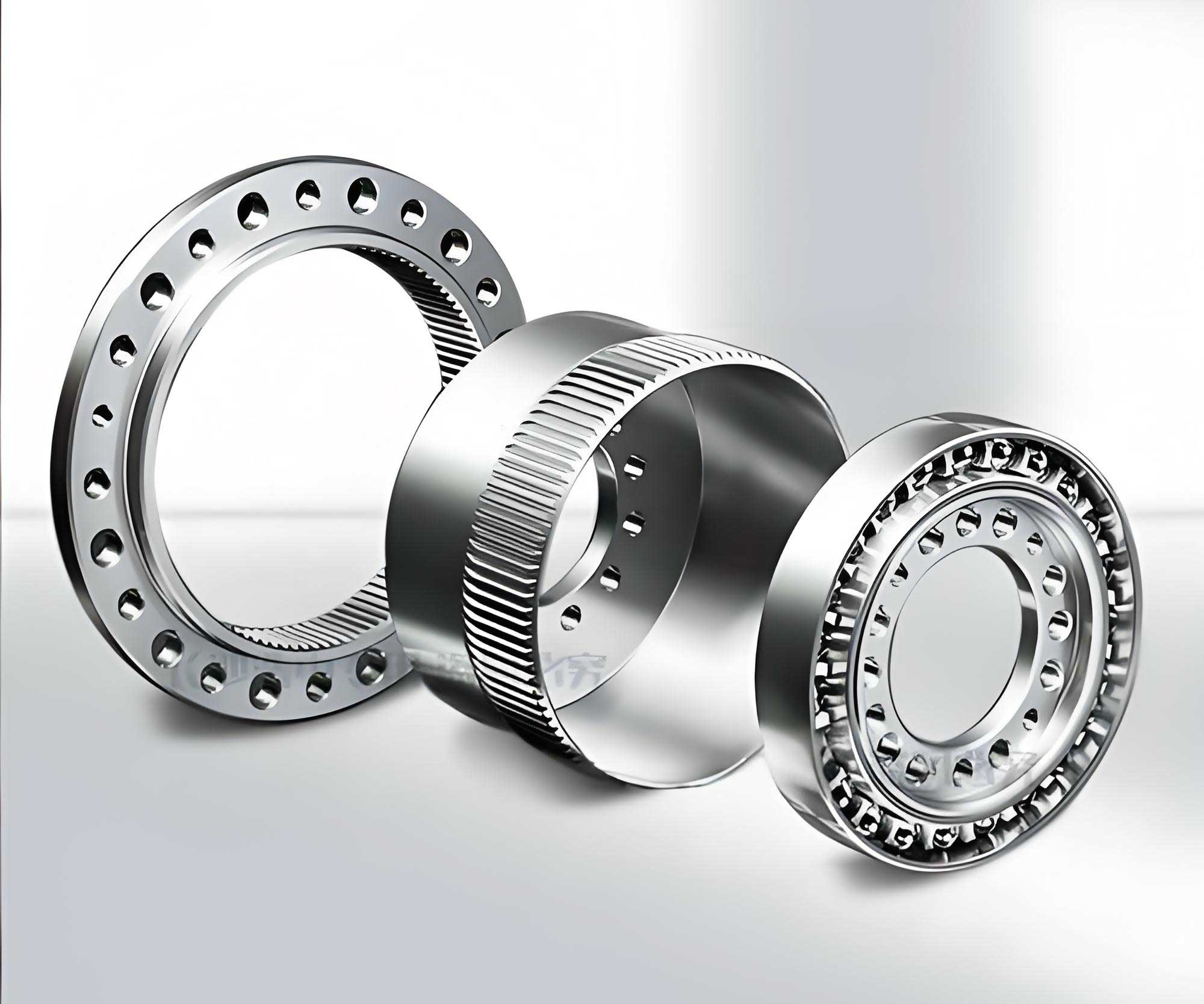
To accurately assess the flexible wheel’s stiffness under operational conditions, we designed and constructed a dedicated torsional stiffness test system. The core idea is to simulate the working state of the flexible wheel within a harmonic drive gear. A simulated wave generator, manufactured via CNC machining to replicate the exact elliptical contour of the actual wave generator (as measured by a coordinate measuring machine), is rigidly mounted on a vertical plate. The flexible wheel is then mounted onto this simulator, inducing the same deformation it experiences during normal operation. The external teeth of the flexible wheel are clamped securely by a custom fixture, effectively fixing its input end. The output end of the flexible wheel is bolted to a high-precision torque disk.
The torque application system consists of four pulleys and weight pans arranged symmetrically around the torque disk. Two pans are connected for applying clockwise torque, and the other two for counterclockwise torque. This bidirectional setup allows for seamless application of torque in both rotational directions without reversing the setup. The lines from the weight pans are aligned tangentially to the torque disk. The weights are meticulously calibrated using a precision electronic balance (TP3001N, max 3000g, d=0.1g) to ensure force accuracy. The total set of calibrated weights includes 20x200g, 4x500g, 6x1kg, 6x2kg, and 2x3kg, allowing for a maximum applied torque of approximately 40 N·m given our torque disk diameter of $d = 0.2667$ m.
Angular measurement is performed using a high-precision photoelectric autocollimator (Nikon 6B) with a resolution of 0.5 arcseconds. A cube mirror is attached to the face of the torque disk, and the autocollimator is positioned approximately 1 to 1.5 meters away. The entire mechanical structure—including the baseplate, vertical plate, and support columns—is designed for high rigidity and stability, minimizing external influences on the measurement. All positional accuracies are guaranteed by the machining tolerances of the components.
The measurement procedure is designed to characterize the flexible wheel’s behavior under both low and high torque ranges, capturing any potential nonlinearities or hysteresis. For each range, we follow a sequential loading and unloading protocol to obtain a complete hysteresis loop.
Low Torque Range Procedure (-26.67 to +26.67 N·m):
1. Start with a pre-load: Add weights to the two “positive direction” pans until a torque of +26.67 N·m (10 kg effective weight) is reached. This state is defined as the angular zero reference. The autocollimator is zeroed at this point.
2. Unload the positive torque: Remove weights from the positive pans in descending order of mass. After each removal, allow the system to stabilize and record the angular reading from the autocollimator. Continue until all weights are removed (0 N·m).
3. Load the negative torque: Add weights to the two “negative direction” pans in ascending order, recording the angle after each addition, until -26.67 N·m is reached.
4. Unload the negative torque and reload positive: Remove weights from the negative pans in descending order, recording angles. Then, add weights back to the positive pans in ascending order, recording angles, until +26.67 N·m is reached again.
This completes one full cycle, providing data for the positive unloading/negative loading branch and the negative unloading/positive loading branch.
High Torque Range Procedure (-40.005 to +40.005 N·m):
The procedure is identical, but the maximum torque is increased to ±40.005 N·m (15 kg effective weight).
The data collected from testing a specific precision harmonic drive gear flexible wheel is processed to generate torque-angle ($T-\phi$) characteristic curves. For both torque ranges, the relationship is predominantly linear, indicating elastic behavior within the tested limits. The curves exhibit slight hysteresis, as is common in mechanical systems. We perform linear regression analysis on the two distinct branches of the hysteresis loop separately.
Low Torque Range Results:
The $T-\phi$ data for the low torque range is plotted. The linear fit equations for the two branches are:
– Positive Unloading / Negative Loading Branch: $T = -0.130 \phi + 26.09$
– Negative Unloading / Positive Loading Branch: $T = -0.130 \phi + 30.24$
Here, $T$ is in N·m and $\phi$ is in arcseconds. The slopes ($k$) for both branches are identical at -0.130 N·m/arcsec.
High Torque Range Results:
Similarly, for the high torque range:
– Positive Unloading / Negative Loading Branch: $T = -0.130 \phi + 38.45$
– Negative Unloading / Positive Loading Branch: $T = -0.130 \phi + 44.25$
The slopes are again nearly identical, with the first branch at -0.130 and the second at approximately -0.130 N·m/arcsec.
To calculate the torsional stiffness $K$ in standard units of N·m/rad, we convert the slope from N·m/arcsec. The conversion factor is:
$$ 1 \text{ arcsec} = \frac{1}{3600} \text{ degree} = \frac{\pi}{180 \times 3600} \text{ radians} $$
Therefore,
$$ K = |k| \times 3600 \times \frac{180}{\pi} $$
Applying this formula to the measured slopes yields the torsional stiffness values.
| Torque Range (N·m) | Loading/Unloading Branch | Torsional Stiffness (N·m/rad) |
|---|---|---|
| Low Torque (-26.67 to +26.67) | Positive Unload / Negative Load | 26,814 |
| Negative Unload / Positive Load | 26,814 | |
| High Torque (-40.005 to +40.005) | Positive Unload / Negative Load | 26,814 |
| Negative Unload / Positive Load | 27,227 |
The results are remarkably consistent. The flexible wheel exhibits a torsional stiffness of approximately 27,000 N·m/rad. The minor variation in the high-torque range’s second branch (27,227 vs. 26,814) is within acceptable experimental error and does not indicate a fundamental change in material behavior. This value aligns well with the theoretical calculations found in foundational harmonic drive gear literature, which also predicts component stiffness on the order of $10^4$ to $10^5$ N·m/rad. Crucially, this measured stiffness is substantially higher than the often-reported overall torsional stiffness of assembled precision harmonic drive gears under small loads. This finding allows us to conclude definitively that the flexible wheel is not the primary compliance source or the weak link leading to the reduced overall stiffness observed in complete harmonic drive gear systems.
The high stiffness of the flexible wheel can be attributed to its design and material properties. Modern harmonic drive gears use high-strength alloy steels or other advanced materials for the flexible wheel, and its thin-walled, cup-shaped geometry is optimized for controlled elastic deformation in the radial direction (for tooth meshing) while maintaining high torsional rigidity. Our test method successfully isolates the torsional response by fixing the input and applying torque to the output flange, effectively measuring the shear stiffness of the flexible wheel’s structure. The close agreement between the low and high torque range stiffness values confirms that the flexible wheel behaves linearly within the operational torque spectrum typical for precision applications. Any nonlinearities or compliance in the complete harmonic drive gear assembly must therefore originate from other interfaces or components, such as the wave generator bearing compliance, the finite stiffness of the gear teeth in contact, or the output shaft connections. This insight redirects the focus for improving overall harmonic drive gear stiffness towards these other elements.
Our test system demonstrates significant versatility. By adjusting the dimensions of the simulated wave generator and the torque disk, the setup can be adapted to measure the torsional stiffness of flexible wheels from a wide variety of harmonic drive gear sizes and models. This provides a valuable tool for designers and manufacturers seeking to characterize and validate the performance of their harmonic drive gear components. Future work will involve employing this same methodological rigor to test the individual stiffness of wave generators and output shafts, building a comprehensive compliance model for the entire harmonic drive gear system. Furthermore, investigating the dynamic torsional stiffness or the stiffness under thermal gradients could yield additional insights for high-performance applications.
In summary, through the design and implementation of a specialized force-couple-based torsional stiffness test system, we have accurately measured the torsional stiffness of a precision harmonic drive gear flexible wheel under simulated working conditions. The results unequivocally show that the flexible wheel possesses high torsional stiffness (approximately 27,000 N·m/rad), which is consistent with theoretical expectations and is not the limiting factor in the overall torsional compliance of harmonic drive gear assemblies. This finding is critical for the research and development of high-performance harmonic drive gears, as it shifts the engineering focus towards optimizing other subsystems to enhance total system stiffness and precision. The methodology presented here establishes a reliable framework for the component-level characterization of harmonic drive gears, contributing to the advancement of this vital transmission technology.