
In engineering applications, gear shafts, particularly those incorporating splined connections, are critical components in power transmission systems. Their performance under torsional loads directly impacts the reliability and efficiency of machinery. This article focuses on the torsional strength calculation of rectangular spline shafts and experimental investigations into less-teeth gear shafts, which are essentially gear shafts with a low number of teeth. The need for accurate strength assessment arises from frequent failure instances in practical scenarios, where traditional handbook formulas may not provide sufficient theoretical grounding. Through theoretical derivation, computational validation, finite element simulation, and experimental testing, this study aims to enhance the understanding of torsional behavior in gear shafts.
The torsional strength of gear shafts, such as rectangular spline shafts, is often evaluated using empirical formulas found in design manuals. However, these formulas lack detailed derivation, prompting a need for a more fundamental approach based on solid mechanics principles. Here, I derive the polar moment of inertia and maximum torsional shear stress formulas for rectangular spline shafts using the concept of polar moment of inertia and the plane assumption theory. This method not only clarifies the underlying physics but also validates against established data. Furthermore, I extend the analysis to less-teeth gear shafts, which share similarities with splined gear shafts due to their integrated design, and conduct torsional experiments to observe failure modes and stress distributions. The insights gained are crucial for optimizing the design and ensuring the durability of gear shafts in demanding applications.
Theoretical Derivation for Rectangular Spline Shafts
Consider a rectangular spline shaft, which is a type of gear shaft with multiple keyways uniformly distributed around its circumference. The cross-section can be simplified as a central circle of diameter \(d\) surrounded by \(z\) rectangular teeth, each with width \(B\) and outer diameter \(D\). Under torsional loading, assuming small deformations, the plane hypothesis holds, allowing the application of circular shaft torsion theory to these gear shafts.
The torsional shear stress at a distance \(\rho\) from the center is given by:
$$ \tau_\rho = \frac{T \rho}{I_p} $$
where \(T\) is the applied torque and \(I_p\) is the polar moment of inertia of the cross-section. For gear shafts with splines, \(I_p\) consists of two parts: the polar moment of inertia of the inner circle \(I_{p0}\) and the total contribution from the teeth \(z I_{p1}\). Thus:
$$ I_p = I_{p0} + z I_{p1} $$
Substituting into the stress formula yields:
$$ \tau_\rho = \frac{T \rho}{I_{p0} + z I_{p1}} $$
The maximum shear stress occurs at the outermost radius \(\rho = D/2\):
$$ \tau_{\text{max}} = \frac{T D}{2(I_{p0} + z I_{p1})} $$
The torsional section modulus is:
$$ W_t = \frac{I_p}{D/2} = \frac{2(I_{p0} + z I_{p1})}{D} $$
And the angle of twist over length \(l\) is:
$$ \phi = \frac{T l}{G I_p} = \frac{T l}{G (I_{p0} + z I_{p1})} $$
where \(G\) is the shear modulus of the material.
To compute \(I_p\), I first determine \(I_{p0}\) for the solid circle:
$$ I_{p0} = \int_A \rho^2 \, dA = \frac{\pi d^4}{32} $$
For a single rectangular tooth, as shown in the schematic, the geometry is symmetric about the x-axis. The polar moment of inertia for one tooth, \(I_{p1}\), is calculated by integrating over the area. Splitting the tooth into segments for ease of integration, the result for the entire spline shaft cross-section is:
$$ I_p = \frac{\pi d^4}{32} + z \left\{ \frac{B}{96} \left( D^2 \sqrt{D^2 – B^2} – d^2 \sqrt{d^2 – B^2} \right) + \frac{B^3}{48} \left( \sqrt{D^2 – B^2} – \sqrt{d^2 – B^2} \right) + \frac{1}{32} \left[ D^4 \arcsin\left(\frac{B}{D}\right) – d^4 \arcsin\left(\frac{B}{d}\right) \right] \right\} $$
This derived formula provides a precise way to evaluate the torsional rigidity of gear shafts with rectangular splines, facilitating strength assessments.
Validation Against Handbook Formulas
To verify the accuracy of the derived polar moment of inertia for gear shafts, I compare it with empirical formulas from mechanical design handbooks. The table below presents calculations for medium-series rectangular splines with 6 teeth, using both methods. Here, \(I_p\) is from the derived formula, and \(I_{pn}\) is from the handbook.
| N × d × D × B (mm) | \(I_p\) (×10³ mm⁴) | \(I_{pn}\) (×10³ mm⁴) | Error |
|---|---|---|---|
| 6 × 11 × 14 × 3 | 2.5075 | 2.4921 | 0.62% |
| 6 × 13 × 16 × 3.5 | 4.4821 | 4.4597 | 0.50% |
| 6 × 16 × 20 × 4 | 10.371 | 10.322 | 0.47% |
| 6 × 18 × 22 × 5 | 16.390 | 16.306 | 0.52% |
| 6 × 21 × 25 × 5 | 27.112 | 27.028 | 0.31% |
| 6 × 23 × 28 × 6 | 42.289 | 42.104 | 0.44% |
| 6 × 26 × 32 × 6 | 67.817 | 67.571 | 0.36% |
| 6 × 28 × 34 × 7 | 90.973 | 90.615 | 0.40% |
The errors are consistently below 0.7%, confirming the reliability of the derived approach for gear shafts. This close agreement underscores the utility of the polar moment of inertia concept in torsional analysis of splined gear shafts, ensuring that design calculations can proceed with greater confidence.
Finite Element Analysis of Torsional Stress Distribution
To qualitatively analyze the torsional shear stress distribution in rectangular spline gear shafts, I employed ANSYS finite element software. A model was subjected to a torque of 29.4 N·m, and the nodal shear stress contour was generated. The stress distribution reveals complex patterns due to the geometry of the gear shafts.
The key observations from the simulation are:
- The maximum torsional shear stress occurs near the tooth root regions, attributed to stress concentration effects. This aligns with real-world failure modes in gear shafts, where cracks often initiate at these points.
- The stress distribution can be divided into three zones:
- Inside the root circle diameter, the shear stress varies linearly with radius, similar to a solid circular shaft. The minimum stress in this region is at the center.
- On the teeth, the stress is higher in the main body compared to the sharp corners, indicating that the corners experience lower stress due to geometric discontinuities.
- In transitional areas, the stress values interpolate between the maximum and the tooth body stress, showing a non-uniform pattern that complicates simple analytical solutions.
This finite element analysis highlights the importance of considering localized stress peaks in gear shafts, which can lead to premature failure if not accounted for in design. The results reinforce the need for detailed simulations alongside theoretical calculations for critical gear shafts.
Experimental Torsional Testing of Less-Teeth Gear Shafts
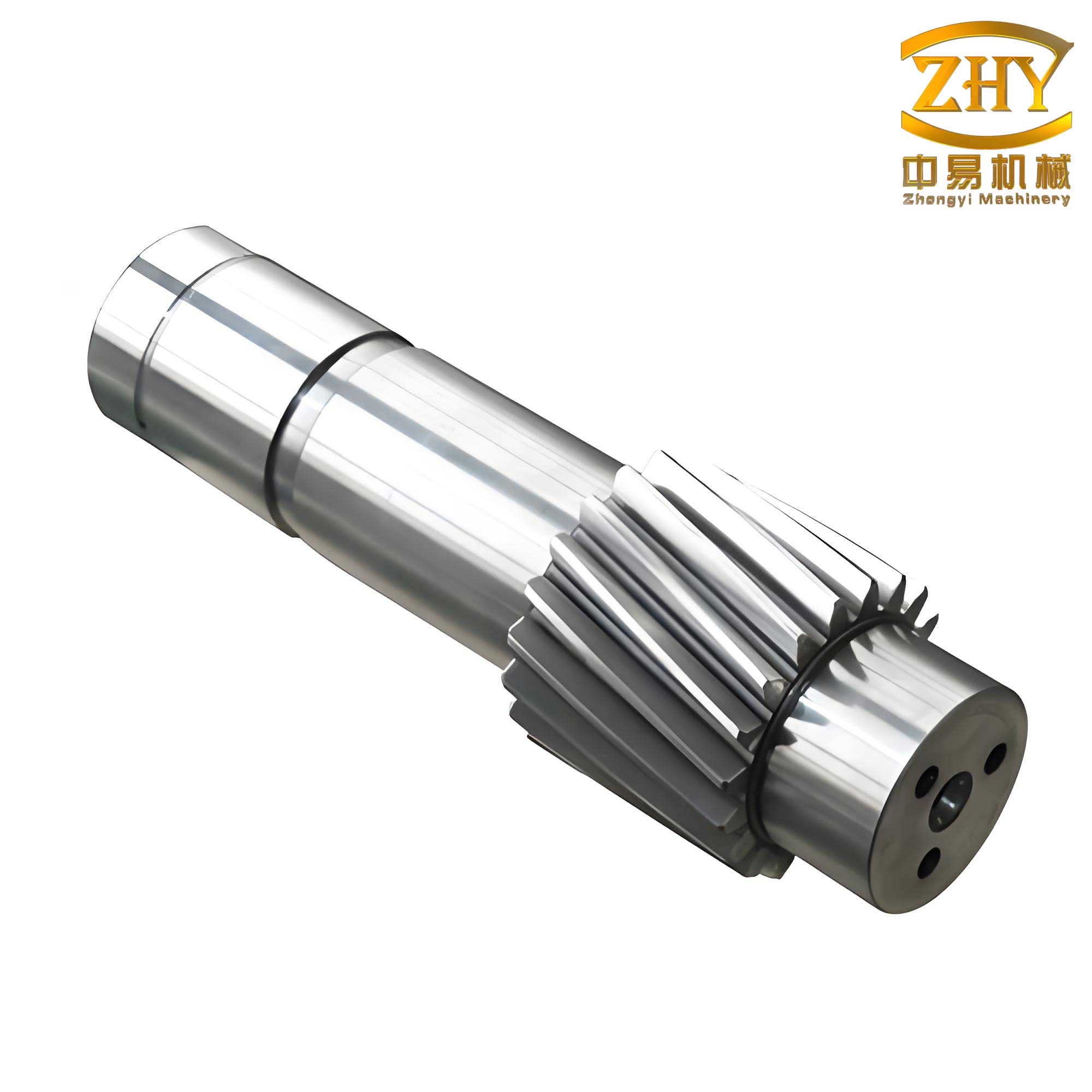
Less-teeth gear shafts, defined as those with eight or fewer teeth, are essentially gear shafts with integrated teeth, resembling involute spline shafts with helix angles. Due to their propensity for torsional failure in service, I conducted torsional experiments to study their behavior under static loading. The tests were performed using an RNJ-1000 computerized torsion testing machine, which records torque, twist angle, and generates torque-angle curves automatically.
The gear shaft specimens included designs with two and three teeth, subjected to both forward (clockwise) and reverse (counterclockwise) torsion until fracture. The fractured surfaces were examined to assess failure characteristics. The torque-angle curves provide insights into the mechanical response of these gear shafts.
From the experimental data, several conclusions were drawn:
- Reverse torsion resulted in a longer duration to fracture compared to forward torsion for the gear shafts, suggesting differences in crack propagation or material anisotropy.
- The fractured cross-sections remained approximately planar and perpendicular to the axis of the gear shafts, supporting the plane assumption used in theoretical models.
- Under forward torsion, the dynamic torque increased linearly with twist angle, indicating elastic-plastic behavior. In contrast, reverse torsion showed a nearly constant torque plateau, implying a different failure mechanism possibly due to residual stresses or loading history.
These findings emphasize the complex torsional response of less-teeth gear shafts, which must be considered in applications involving bidirectional loading or shock conditions.
Extended Analysis and Discussion
Building on the theoretical and experimental results, I further explore the implications for gear shaft design. The polar moment of inertia formula derived earlier can be adapted for various spline geometries, such as involute splines common in gear shafts. For gear shafts with asymmetric teeth or tapered sections, numerical integration may be required, but the fundamental approach remains valid.
In practice, the torsional strength of gear shafts is influenced by factors beyond geometry, including material properties, surface treatments, and operating conditions. For instance, case hardening can enhance the fatigue resistance of gear shafts under cyclic torsion. Additionally, the interaction between bending and torsional loads in gear shafts necessitates combined stress criteria, such as the von Mises yield criterion.
To illustrate the application of the derived formulas, consider a gear shaft with the following parameters: \(z = 8\), \(d = 20\) mm, \(D = 30\) mm, \(B = 5\) mm, and \(T = 100\) N·m. Using the formula for \(I_p\), the polar moment of inertia is calculated as:
$$ I_p = \frac{\pi (20)^4}{32} + 8 \left\{ \frac{5}{96} \left( 30^2 \sqrt{30^2 – 5^2} – 20^2 \sqrt{20^2 – 5^2} \right) + \frac{5^3}{48} \left( \sqrt{30^2 – 5^2} – \sqrt{20^2 – 5^2} \right) + \frac{1}{32} \left[ 30^4 \arcsin\left(\frac{5}{30}\right) – 20^4 \arcsin\left(\frac{5}{20}\right) \right] \right\} $$
Evaluating numerically:
$$ I_p \approx 78539.8 + 8 \times 1245.7 \approx 88505.4 \, \text{mm}^4 $$
The maximum shear stress is:
$$ \tau_{\text{max}} = \frac{100 \times 10^3 \times 30}{2 \times 88505.4} \approx 16.95 \, \text{MPa} $$
This value can be compared to the material’s allowable stress to assess safety. For gear shafts made of alloy steel with a yield strength of 400 MPa, a factor of safety can be applied to ensure reliability.
Furthermore, the twist angle for a gear shaft of length 500 mm and \(G = 79\) GPa is:
$$ \phi = \frac{100 \times 10^3 \times 500}{79 \times 10^3 \times 88505.4} \approx 0.0071 \, \text{rad} \approx 0.41^\circ $$
Such calculations are essential for designing gear shafts that meet stiffness requirements in precision machinery.
Comparative Study of Gear Shaft Materials
The performance of gear shafts under torsion also depends on material selection. Different materials exhibit varying shear moduli and strengths, affecting the torsional rigidity and failure thresholds. Below is a table summarizing key properties for common gear shaft materials.
| Material | Shear Modulus \(G\) (GPa) | Yield Strength \(\tau_y\) (MPa) | Typical Applications in Gear Shafts |
|---|---|---|---|
| Carbon Steel (AISI 1045) | 79 | 310 | General-purpose gear shafts |
| Alloy Steel (AISI 4140) | 80 | 415 | High-strength gear shafts |
| Stainless Steel (304) | 77 | 205 | Corrosion-resistant gear shafts |
| Aluminum 6061-T6 | 26 | 55 | Lightweight gear shafts |
| Titanium Ti-6Al-4V | 44 | 830 | Aerospace gear shafts |
Using these values, designers can tailor gear shafts for specific loads. For example, titanium gear shafts offer high strength-to-weight ratios but lower shear modulus, which may increase twist angles. The trade-offs must be balanced based on application demands, such as in automotive or aerospace gear shafts where weight and performance are critical.
Advanced Modeling Techniques for Gear Shafts
Beyond basic formulas, advanced modeling techniques like finite element analysis (FEA) and computational fluid dynamics (CFD) can optimize gear shaft designs. FEA allows for simulation of complex loading scenarios, including combined torsion, bending, and thermal effects in gear shafts. For instance, transient torsional analysis can predict vibrational responses in gear shafts subjected to fluctuating torques.
Moreover, additive manufacturing opens new possibilities for lightweight, topology-optimized gear shafts with internal structures that enhance torsional strength while reducing mass. These innovations require updated analytical models to account for non-uniform cross-sections in gear shafts.
In research, the development of smart gear shafts with embedded sensors for real-time torque monitoring is gaining traction. Such gear shafts can transmit data on stress levels, enabling predictive maintenance and improving system reliability.
Conclusion
This study comprehensively addresses the torsional strength calculation of rectangular spline gear shafts and experimental analysis of less-teeth gear shafts. The derived polar moment of inertia formula, based on fundamental mechanics, shows excellent agreement with handbook data, providing a reliable tool for designers. Finite element simulations reveal stress concentration effects in gear shafts, emphasizing the need for detailed analysis in critical applications. Experimental torsion tests on less-teeth gear shafts demonstrate distinct failure behaviors under forward and reverse loading, informing design considerations for bidirectional operations.
The insights contribute to the broader understanding of gear shafts, promoting safer and more efficient designs. Future work could explore dynamic torsional loads, fatigue life prediction, and advanced materials for gear shafts, further enhancing their performance in modern engineering systems.