
Spur gears are widely used in various mechanical transmission systems due to their simplicity and efficiency. However, the dynamic behavior of spur gear systems, particularly under torsional vibrations, is critical for ensuring reliability and performance. In this article, I analyze the torsional vibration of spur gear transmissions by considering key factors such as time-varying mesh stiffness and error excitation. I develop both single-degree-of-freedom and multi-degree-of-freedom torsional vibration models, derive equivalent comparison formulas for shaft torsional stiffness and gear mesh stiffness, and solve the dynamic equations to obtain responses like relative mesh displacement, velocity, dynamic normal load, and load factors. Through comparative analysis, I highlight the impact of stiffness variations, error excitations, and shaft flexibility on system dynamics, providing foundational insights for further research on spur gear systems.
Spur gears are fundamental components in mechanical drives, but their operation involves complex dynamic interactions. The time-varying mesh stiffness in spur gears arises from the alternating single and double tooth contact during meshing, leading to step changes that induce dynamic impacts. Additionally, manufacturing errors introduce excitation forces that exacerbate vibrations. In my analysis, I focus on modeling these effects to understand how they influence the torsional response of spur gear systems. I begin by establishing a simplified single-degree-of-freedom model that captures the essential dynamics of gear pairs, then extend it to a multi-degree-of-freedom model that incorporates shaft torsional stiffness, allowing for a more comprehensive investigation.
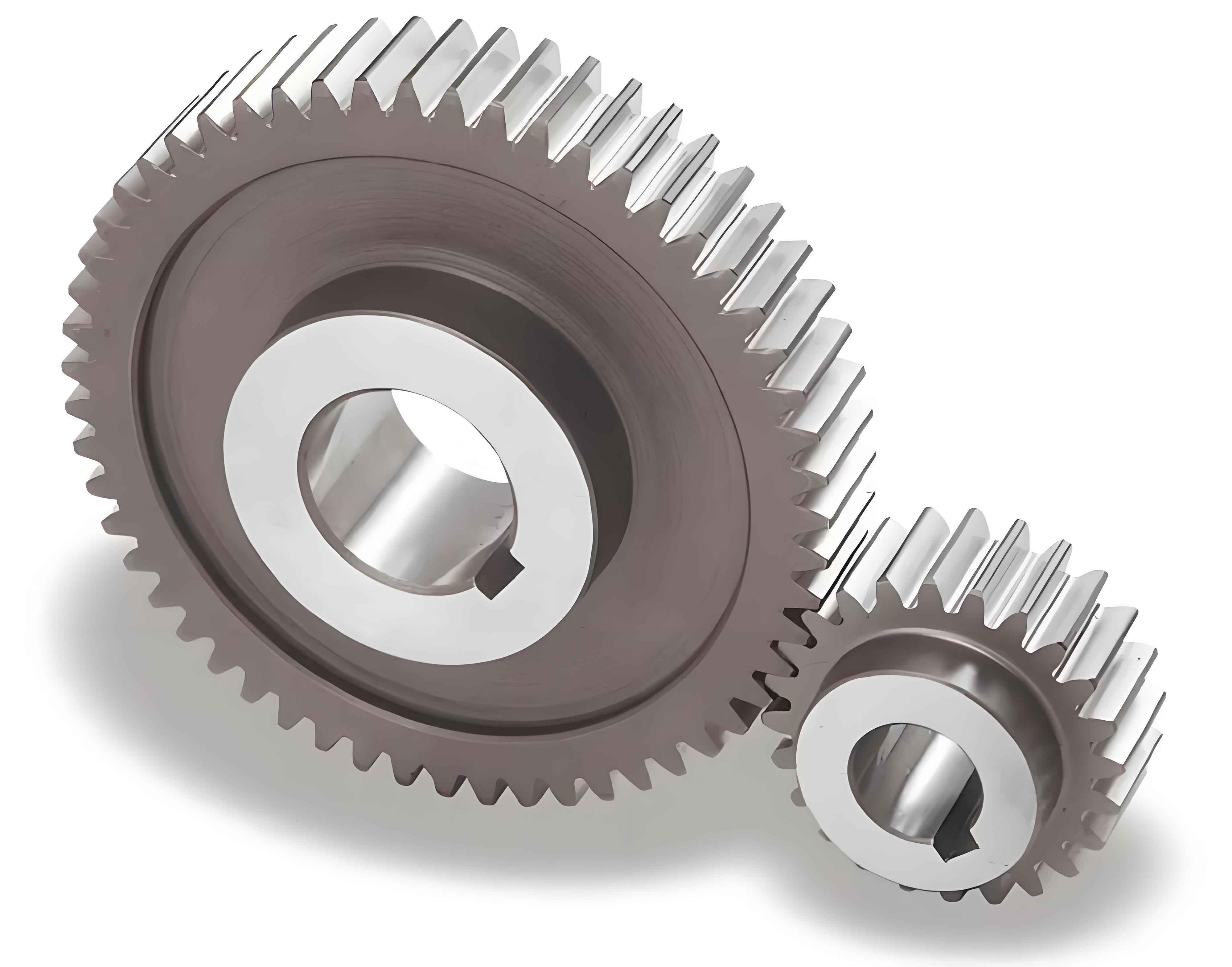
The dynamics of spur gear systems are governed by internal excitations like time-varying mesh stiffness and external factors such as load variations. For the single-degree-of-freedom torsional model, I consider two spur gears with moments of inertia \( J_1 \) and \( J_2 \), and base circle radii \( r_{b1} \) and \( r_{b2} \). The equations of motion are derived from force and moment equilibrium, resulting in a differential equation for the relative displacement along the line of action. The equivalent mass \( m_e \) for the spur gear pair is given by:
$$ m_e = \frac{J_1 J_2}{r_{b1}^2 J_1 + r_{b2}^2 J_2} $$
and the equation of motion becomes:
$$ \ddot{x} + \frac{C_g(t)}{m_e} \dot{x} + \frac{k_g(t)}{m_e} x = \frac{F_N}{m_e} + \frac{F_h}{m_e} $$
where \( x = r_{b1} \theta_1 – r_{b2} \theta_2 \) is the relative mesh displacement, \( C_g(t) \) is the time-varying mesh damping, \( k_g(t) \) is the time-varying mesh stiffness, \( F_N \) is the nominal load, and \( F_h \) represents the error-induced dynamic force. The error excitation \( e(t) \) is often modeled as a sinusoidal function of the mesh frequency \( \omega_e \):
$$ e(t) = \sum_j e_j \sin(j \omega_e t + \phi_j) $$
This formulation allows me to simulate the dynamic response of spur gears under stiffness and error excitations. For instance, the mesh stiffness \( k_g(t) \) for spur gears exhibits periodic variations with abrupt changes at tooth engagement points, as shown in later analyses. The damping coefficient \( C_g(t) \) is calculated based on the equivalent mass and stiffness:
$$ C_g(t) = 2 \xi_g \sqrt{k_g(t) m_e} $$
where \( \xi_g \) is the damping ratio, typically around 0.1 for spur gears.
In the multi-degree-of-freedom model, I include the torsional stiffness of shafts connecting the spur gears to motors and loads. This model accounts for the flexibility of the transmission system, which can significantly affect vibrations. The generalized coordinates include the torsional angles of the shafts and the mesh displacement. The mass matrix \( [M] \), damping matrix \( [C] \), and stiffness matrix \( [K] \) are derived, leading to a matrix equation of motion:
$$ [M] \{\ddot{q}\} + [C] \{\dot{q}\} + [K] \{q\} = \{F\} $$
where \( \{q\} = [\phi_1, x, \phi_2]^T \). Here, \( \phi_1 \) and \( \phi_2 \) represent the torsional angles of the input and output shafts, respectively. The equivalent comparison between shaft torsional stiffness and gear mesh stiffness is crucial; for a shaft with diameter \( D \), length \( L \), and shear modulus \( G \), the torsional stiffness \( k_s \) is:
$$ k_s = \frac{J_p G}{L} $$
with \( J_p = \frac{\pi D^4}{32} \). To compare this with the mesh stiffness of spur gears, I use an equivalence formula where 1 N·m/rad of torsional stiffness corresponds to \( \frac{1}{r_b^2} \) N/m of mesh stiffness, with \( r_b \) in meters. This equivalence helps in assessing whether shaft flexibility is comparable to gear mesh effects in spur gear systems.
For practical analysis, I consider a spur gear system with specific parameters, as summarized in the table below. This includes gear teeth numbers, pressure angles, and moduli, which are typical for industrial spur gears. The time-varying mesh stiffness is computed using energy-based methods, considering the precise tooth profile of spur gears. The results show periodic stiffness variations with peaks during double-tooth contact and drops in single-tooth regions, highlighting the dynamic nature of spur gear meshing.
| Parameter | Gear 1 | Gear 2 |
|---|---|---|
| Number of Teeth | 17 | 26 |
| Pressure Angle (°) | 25 | 25 |
| Module (mm) | 3 | 3 |
| Profile Shift Coefficient | 0.5 | 0.025 |
| Contact Ratio | 1.234 | – |
| Face Width (mm) | 24 | 24 |
The dynamic responses from the single-degree-of-freedom model reveal that step changes in mesh stiffness cause significant impacts in spur gears, leading to oscillations in relative displacement and velocity. For example, the relative mesh displacement \( x \) shows periodic fluctuations aligned with stiffness variations, while error excitation introduces additional high-frequency components. The dynamic normal load on spur gear teeth also exhibits similar patterns, with increased amplitudes at stiffness transition points. The load factor, defined as the ratio of dynamic to static load, peaks at these transitions, indicating heightened dynamic stresses in spur gears.
In the multi-degree-of-freedom model, the inclusion of shaft torsional stiffness adds flexibility to the spur gear system, amplifying vibrational responses. The torsional angles \( \phi_1 \) and \( \phi_2 \) demonstrate oscillations influenced by mesh stiffness periods, and when combined with error excitation, the system shows more complex behavior with increased amplitudes. The equivalent mass and stiffness parameters for this model are derived from the system’s inertia and geometry, as shown in the configuration table below. This table illustrates that the equivalent ratios of shaft stiffness to mesh stiffness are close to unity, confirming their comparable influence on spur gear dynamics.
| Parameter | Value |
|---|---|
| Motor Inertia (kg·m²) | 3.0 × 10⁻³ |
| Load Inertia (kg·m²) | 5.30 × 10⁻³ |
| Gear 1 Inertia (kg·m²) | 1.253 × 10⁻⁴ |
| Gear 2 Inertia (kg·m²) | 6.855 × 10⁻⁴ |
| Shaft 1 Torsional Stiffness (N·m/rad) | 3.57 × 10⁵ |
| Shaft 2 Torsional Stiffness (N·m/rad) | 7.995 × 10⁵ |
| Average Mesh Stiffness (N/m) | 4.968 × 10⁸ |
| Equivalent Shaft Stiffness to Mesh Stiffness Ratio | 1.345 (Shaft 1), 1.288 (Shaft 2) |
To solve the dynamic equations, I use numerical methods, obtaining responses such as relative mesh displacement, velocity, and dynamic load factors. For spur gears, the time-varying mesh stiffness \( k_g(t) \) is computed over a meshing cycle, showing a repetitive pattern with abrupt changes. The dynamic normal load on the tooth surface is derived from the mesh force \( F \), which includes contributions from stiffness and error terms:
$$ F = C_g(t) \left( r_{b1} \dot{\theta}_1 – r_{b2} \dot{\theta}_2 + \dot{e}(t) \right) + k_g(t) \left( r_{b1} \theta_1 – r_{b2} \theta_2 + e(t) \right) $$
This force exhibits oscillations that correlate with stiffness variations, and error excitation further increases the amplitude and frequency of these oscillations in spur gears. The load factor, a key dynamic indicator, is calculated as the ratio of dynamic to static load, and it shows significant peaks during stiffness transitions, emphasizing the critical zones for spur gear design.
In the multi-degree-of-freedom analysis, the coupling between shaft torsion and gear mesh in spur gears leads to more pronounced vibrations. The relative mesh velocity \( \dot{x} \) displays higher fluctuations compared to the single-degree-of-freedom case, and the torsional angles show modulated oscillations. The dynamic load factor in this model reaches higher values, indicating that shaft flexibility exacerbates the dynamic response in spur gears. For instance, the maximum load factor increases from 1.795 in the single-degree-of-freedom model to 2.292 in the multi-degree-of-freedom model when error excitation is included, underscoring the importance of considering shaft effects in spur gear systems.
The results demonstrate that step changes in time-varying mesh stiffness are a primary source of dynamic impact in spur gears. These changes occur at the transitions between single and double tooth contact, causing sudden shifts in system response. Error excitation, modeled as a sinusoidal function, introduces additional forcing terms that amplify these impacts, leading to increased vibration levels and higher load factors in spur gears. The equivalent comparison between shaft torsional stiffness and gear mesh stiffness shows that they are often in the same order of magnitude for typical spur gear systems, meaning that shaft flexibility cannot be neglected in dynamic analyses.
Furthermore, the series connection of torsional stiffness and mesh stiffness in spur gears increases the overall system flexibility, which can either dampen or amplify vibrations depending on the frequency content. The coupling of error excitation with shaft torsional vibration results in complex dynamic behavior, with increased oscillation amplitudes and frequencies. This coupling effect is particularly critical for spur gears in high-speed applications, where resonant conditions may lead to premature failure.
In conclusion, my analysis of spur gear torsional vibration highlights the significant roles of time-varying mesh stiffness, error excitation, and shaft flexibility. The single-degree-of-freedom model provides a baseline understanding, while the multi-degree-of-freedom model offers a more realistic representation by incorporating shaft dynamics. The derived equivalence between torsional and mesh stiffness allows for straightforward comparisons in spur gear design. The dynamic responses, including displacement, velocity, and load factors, show that stiffness variations and errors induce substantial vibrations, which are further amplified by shaft effects. These findings emphasize the need for comprehensive modeling in spur gear systems to optimize performance and reliability. Future work could explore nonlinear effects or experimental validations to enhance the predictive accuracy for spur gear applications.
Overall, the study of spur gear dynamics is essential for advancing mechanical transmission systems. By accurately modeling and analyzing these components, engineers can design spur gears that minimize vibrations and maximize efficiency. The use of mathematical models and numerical simulations, as demonstrated here, provides a robust framework for understanding and improving the behavior of spur gears in various industrial contexts.