
In my extensive experience within the industrial sector, particularly in coal processing and material handling, the reliability of scraper conveyors is paramount. These workhorses of bulk material transport operate under severe conditions, and their efficiency directly impacts overall productivity. A critical component ensuring this efficiency is the tensioning device, which maintains proper chain tension to prevent operational failures. Through firsthand involvement in numerous maintenance and retrofit projects, I have witnessed the evolution of tensioning mechanisms. This article delves deeply into the transformation and optimization of the screw gear-based tensioning system, a modification that has proven exceptionally robust and effective. The core innovation lies in harnessing the mechanical advantages of the screw gear principle to create a durable, user-friendly, and highly reliable tensioning solution. I will elaborate on the design rationale, operational benefits, and quantitative improvements achieved, supported by technical analyses, formulas, and comparative data.
The primary function of any tensioning device in a scraper conveyor system cannot be overstated. During startup, operation, and especially during fault conditions like chain misalignment or derailment, immense dynamic forces act upon the conveyor’s round-link chain. These forces induce gradual, permanent elongation known as creep. Without corrective tensioning, this creep leads to chain slack, which is a root cause of catastrophic failures such as complete derailment, chain breakage, accelerated wear on sprockets and wear plates, and even damage to the conveyor pan. The tensioning device, typically located at the tail end, actively compensates for this slack. It ensures the tail wheel maintains an optimal position relative to the tail housing, preserving the necessary wrap angle for adequate friction drive between the chain and the drive/driven sprockets. Furthermore, it allows for precise adjustment of the clearance between the chain/scrubber flights and the conveyor’s wear-resistant lining (e.g., cast basalt tiles), minimizing frictional resistance and preventing material buildup that can jam the chain. During planned maintenance for chain or flight replacement, a functional tensioning device simplifies the process by allowing controlled release of chain tension.
Traditionally, several tensioning systems have been employed, each with significant drawbacks in harsh industrial environments. A comprehensive comparison is essential to understand the context for the screw gear transformation. The table below summarizes the common types, their operating principles, and their key limitations observed in practice.
| Tensioning Device Type | Operating Principle | Key Advantages | Major Limitations & Failures |
|---|---|---|---|
| Screw (Lead Screw) Tensioner | Manual rotation of threaded rods to move the tail wheel carriage. | Simple initial design, low cost. | Prone to seizing due to corrosion and dust ingress; requires high manual force; difficult for fine adjustment during operation. |
| Counterweight Tensioner | Uses a suspended weight to provide constant tension via pulleys and cables. | Provides automatic, constant tension. | Rarely used in scraper conveyors due to large space requirements; vulnerable to material buildup and sway; maintenance-intensive. |
| Hydraulic Tensioner | Electro-hydraulic system with pumps, cylinders, and control valves to adjust tail wheel position. | Powerful, allows for remote or automated control. | Complex system with high failure points (pumps, seals, hoses); requires clean hydraulic fluid and skilled maintenance; high capital and operational cost. |
| Screw Gear (Worm Gear) Tensioner (Proposed Design) | Manual input via a worm (screw) shaft rotating a worm gear, which drives a lead screw or directly moves the carriage. | High mechanical advantage, self-locking, compact, resistant to back-driving, easy manual operation even under load. | Requires periodic lubrication; slightly more complex than simple screw design but far more reliable. |
The limitations of the traditional screw and hydraulic systems were a constant source of downtime in the facilities I managed. The seized screw tensioners often required oxy-acetylene cutting for release during breakdowns, while hydraulic failures led to prolonged diagnostics and repairs. This recurrent operational headache motivated the pursuit of a more elegant and robust mechanical solution. The answer was found in a refined application of the screw gear mechanism. The fundamental principle of a screw gear pair offers a transformative combination: a high reduction ratio and a self-locking feature. The kinematic relationship between the worm (the screw) and the worm wheel is given by the basic equation for speed reduction:
$$ i = \frac{N_w}{N_s} = \frac{Z_s}{Z_w} $$
where \( i \) is the gear ratio, \( N_w \) is the rotational speed of the worm wheel, \( N_s \) is the rotational speed of the worm (screw), \( Z_s \) is the number of threads/starts on the worm (typically 1, 2, or 4), and \( Z_w \) is the number of teeth on the worm wheel. For a single-start worm (\( Z_s = 1 \)) and a worm wheel with 40 teeth (\( Z_w = 40 \)), the gear ratio \( i = 40 \). This means one full turn of the worm input results in only \( \frac{1}{40} \)th of a turn of the worm wheel output. This high reduction ratio translates into a tremendous mechanical advantage, allowing an operator to apply a relatively small torque at the input to generate a very large linear force at the output lead screw. More critically, for most lead angles, the screw gear drive is inherently self-locking. The condition for self-locking is approximately when the lead angle \( \lambda \) is less than the friction angle \( \phi \):
$$ \lambda < \phi = \arctan(\mu) $$
Here, \( \lambda = \arctan\left(\frac{L}{\pi d_w}\right) \), where \( L \) is the lead of the worm and \( d_w \) is its pitch diameter. \( \mu \) is the coefficient of friction. This self-locking property means that any force from the loaded chain trying to push the tail wheel back cannot reverse-drive the worm. The tension, once set, is securely maintained without the need for external brakes or locks—a decisive advantage over simple screw jacks.
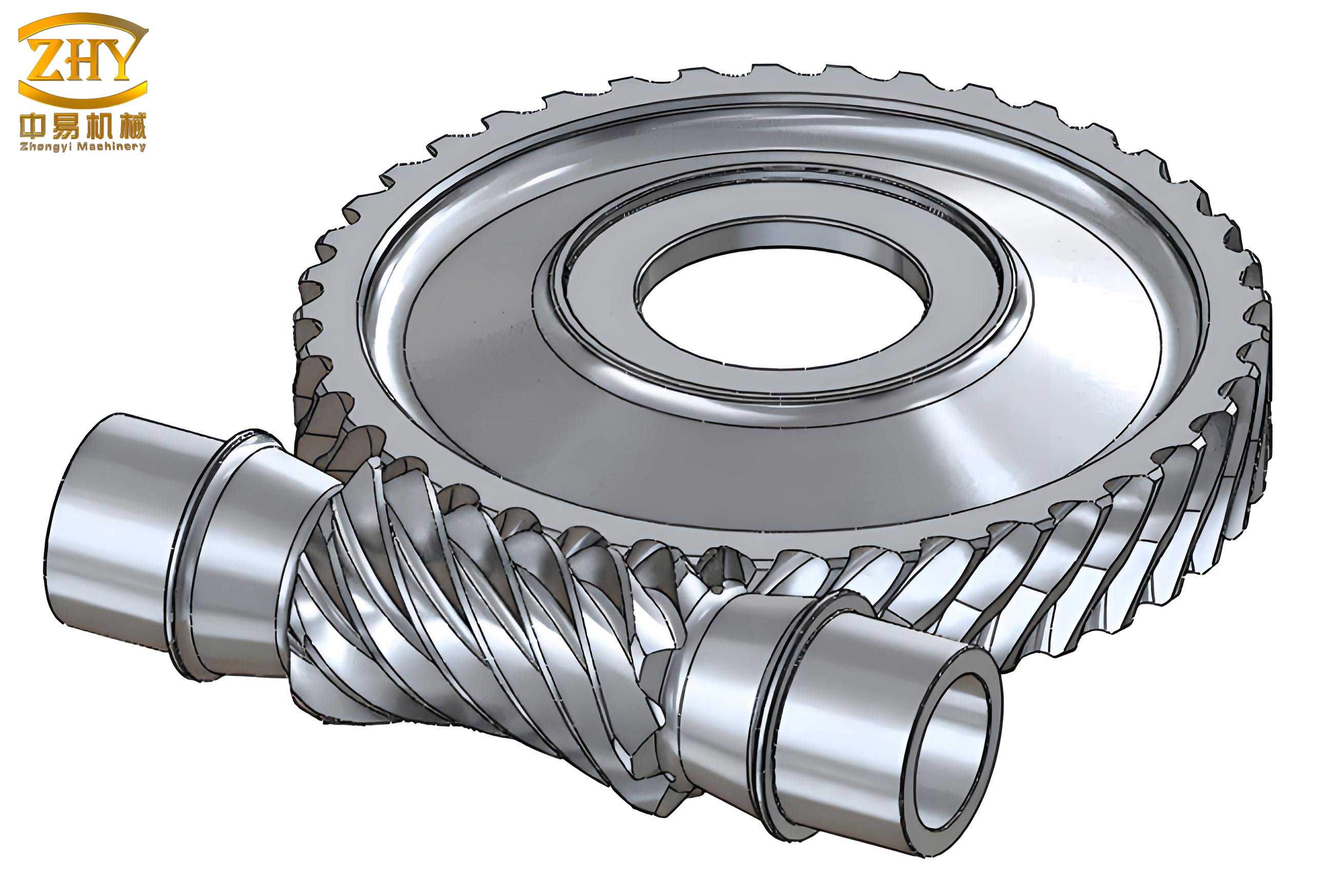
The transformed screw gear tensioning device we engineered integrates these principles into a compact, serviceable unit. The core assembly consists of a hardened steel worm shaft (the screw gear input) supported by heavy-duty roller bearings within a sealed housing. This worm engages a bronze worm wheel, chosen for its excellent wear characteristics and compatibility with steel under boundary lubrication. The worm wheel is mounted on the shaft of a large-tradition acme threaded lead screw or is directly coupled to a thrust block. As the worm is turned—using nothing more than a standard 12-inch spanner on a squared input end—the worm wheel rotates minutely, translating that rotation into precise linear travel of the lead screw nut. This nut is attached to the tail wheel carriage assembly. The force transmission path is beautifully efficient: operator torque → worm rotation → worm wheel rotation → lead screw linear motion → carriage movement → chain tension adjustment. The mechanical advantage can be quantified by considering the overall efficiency and force multiplication. The output force \( F_{out} \) at the lead screw related to the input torque \( T_{in} \) on the worm can be approximated by:
$$ F_{out} \approx \frac{2 \pi \eta_{total} T_{in}}{P_{ls}} $$
where \( \eta_{total} \) is the combined efficiency of the worm gear pair and the lead screw, and \( P_{ls} \) is the lead of the lead screw (distance traveled per revolution). With a typical worm gear efficiency \( \eta_{wg} \) of around 0.3-0.5 for self-locking designs and a lead screw efficiency \( \eta_{ls} \) of 0.3-0.6, the total efficiency might be as low as 0.1. While this seems poor, it is precisely what contributes to the self-locking behavior and allows a manageable input torque to produce a massive clamping force. For instance, with an input torque of 50 Nm, a total efficiency of 0.15, and a lead screw pitch of 5 mm (0.005 m/rev), the output force is:
$$ F_{out} \approx \frac{2 \pi \times 0.15 \times 50}{0.005} \approx 9425 \, \text{N} \, (\sim 960 \, \text{kgf}) $$
This substantial force is more than adequate to tension even heavily loaded conveyor chains. The design also incorporates lubrication ports for regular greasing of both the screw gear mesh and the lead screw, effectively combating the corrosive and abrasive plant environment that doomed the old simple screw jacks.
The operational benefits of this screw gear transformation are profound and multi-faceted. Firstly, safety and ease of use are drastically improved. Adjustments can be made safely while the conveyor is in operation, as the self-locking screw gear holds position securely. An operator detecting slight chain slack can immediately correct it with a few turns of a spanner, without needing to stop production. This contrasts sharply with hydraulic systems requiring pump activation or seized screw jacks requiring hammering. Secondly, reliability and maintenance see dramatic gains. The screw gear assembly, when properly lubricated, is largely immune to seizing. Its mechanical simplicity means fewer failure points compared to a hydraulic system. Preventive maintenance is reduced to periodic visual inspection and re-greasing. Thirdly, the precision and control over chain tension are excellent. The high reduction ratio allows for very fine adjustments, enabling operators to balance tension across dual strands of chain independently (using two synchronized screw gear units) to correct running alignment issues. This precision directly translates into extended component life.
The quantitative impact of implementing this screw gear tensioning system was measured in a long-term case study on a primary refuse conveyor (similar to the referenced 342 conveyor). Before the retrofit, this conveyor used a standard dual screw tensioner and operated with Φ18 x 64 mm round-link chain and light-duty flights. Post-retrofit, not only was the screw gear tensioner installed, but the chain was also upgraded to a heavier Φ22 x 86 mm specification with heavy-duty flights, made possible by the more reliable and powerful tensioning capability. The performance metrics before and after the screw gear transformation are summarized in the table below.
| Performance Metric | Pre-Transformation (Simple Screw) | Post-Transformation (Screw Gear) | Improvement / Change |
|---|---|---|---|
| Chain & Flight Life | 2-3 months | 5-6 months | > 100% increase |
| Monthly Downtime due to Tensioner/Chain Issues | ~10 hours | ~0.5 hours | 95% reduction |
| Frequency of Major Tensioner Repairs/Replacements | Every 6-8 months | Only scheduled inspection (>24 months) | ~70% reduction in related maintenance events |
| Ease of Adjustment (Qualitative) | Difficult, often requires tools beyond spanner (e.g., cheater bars, heat) | Easy, single spanner operation | Drastic improvement in operator ergonomics and speed |
| Material Cost Savings (Annualized) | Baseline (High chain/flight consumption) | Estimated 40-50% reduction in chain/flight replacement costs | Significant direct cost saving |
The extension in chain life is particularly noteworthy. It can be partly modeled by considering the reduced dynamic shock loads. With optimal tension maintained by the responsive screw gear system, the peak stresses on chain links during startup and engagement are lower. The theoretical stress on a chain link is proportional to the tension force \( T \) divided by its cross-sectional area \( A \). By maintaining more consistent and appropriate tension \( T_{opt} \) instead of allowing slack-tight cycles that create shock loads approaching \( T_{shock} \gg T_{opt} \), the fatigue life governed by an S-N curve relationship increases exponentially. For steel under reverse bending, the approximate relationship between cycles to failure \( N_f \) and stress range \( \Delta \sigma \) is often expressed as:
$$ N_f = C \cdot (\Delta \sigma)^{-m} $$
where \( C \) and \( m \) are material constants (e.g., \( m \approx 3 \) for many steels). A reduction in stress range \( \Delta \sigma \) by a factor, say 1.5, due to better tension control, can lead to an increase in fatigue life \( N_f \) by a factor of \( 1.5^3 \approx 3.4 \). This conceptually aligns with the observed doubling of service life. The screw gear’s role in enabling this stable tension environment is thus fundamental.
From a design engineering perspective, selecting the correct parameters for the screw gear set is crucial for optimal performance. The following formulas guide the key design choices for a screw gear tensioner intended for a specific conveyor load. The required output thrust force \( F_{req} \) is determined by the maximum chain pull needed to take up slack and pre-tension the chain. This is often a function of chain grade, conveyor length, and load. For a known required travel \( \Delta L \) of the tail wheel carriage (which equals the chain take-up length), the number of turns \( n_{worm} \) required on the worm input is:
$$ n_{worm} = \frac{\Delta L}{P_{ls}} \times i = \frac{\Delta L}{P_{ls}} \times \frac{Z_w}{Z_s} $$
where \( P_{ls} \) is the lead of the final output lead screw. This equation helps set the adjustment resolution. A finer lead \( P_{ls} \) or a higher gear ratio \( i \) gives finer control but requires more input turns for a given travel. The self-locking condition must be verified using the friction coefficient \( \mu \) for the worm-gear material pair (e.g., steel on bronze, \( \mu \approx 0.05-0.1 \) with lubrication). The lead angle of the worm \( \lambda \) should satisfy \( \lambda < \arctan(\mu) \). For a single-start worm with pitch diameter \( d_w \), the lead \( L_{worm} \) equals its axial pitch \( p_a \), and \( \lambda = \arctan\left(\frac{p_a}{\pi d_w}\right) \). Ensuring this inequality holds guarantees that the screw gear will not back-drive under the full chain load, a non-negotiable safety feature.
The success of the initial screw gear retrofit led to its adoption across multiple conveyors in the plant. Each application reinforced its advantages. The modular nature of the screw gear assembly allows it to be adapted to different conveyor sizes by scaling the gear module, number of teeth, and lead screw diameter. For heavier-duty applications, a double-enveloping worm gear design can be considered to increase contact area and load capacity, though the fundamental screw gear principle remains unchanged. The economic analysis is compelling. The initial investment for a screw gear tensioner is higher than a simple screw jack but significantly lower than a full hydraulic system. The Return on Investment (ROI) is realized rapidly through reduced downtime, lower maintenance labor costs, and extended consumable (chain, flights) life. The payback period in our implementations was consistently under one year.
In conclusion, the transformation from primitive screw jacks or complex hydraulic systems to an engineered screw gear based tensioning device represents a significant leap in scraper conveyor technology from a maintenance and reliability standpoint. The screw gear mechanism, with its inherent high reduction ratio and self-locking property, provides an ideal blend of power, control, and safety. My direct experience in implementing this screw gear solution demonstrates clear, quantifiable benefits: a drastic reduction in unplanned downtime, a doubling of critical component life, and a safer, simpler operational protocol. The screw gear tensioner is not merely a component replacement; it is a systemic upgrade that enhances the entire conveyor’s operational resilience. The principles outlined—the force multiplication, the self-locking condition, and the design calculations—provide a blueprint for engineers seeking to improve material handling reliability. For any industry reliant on scraper conveyors operating in demanding environments, embracing the screw gear transformation for tensioning is a proven strategy for achieving higher efficiency, lower operating costs, and greater operational safety. The screw gear, in this context, transcends its simple mechanical definition to become a cornerstone of dependable production.