
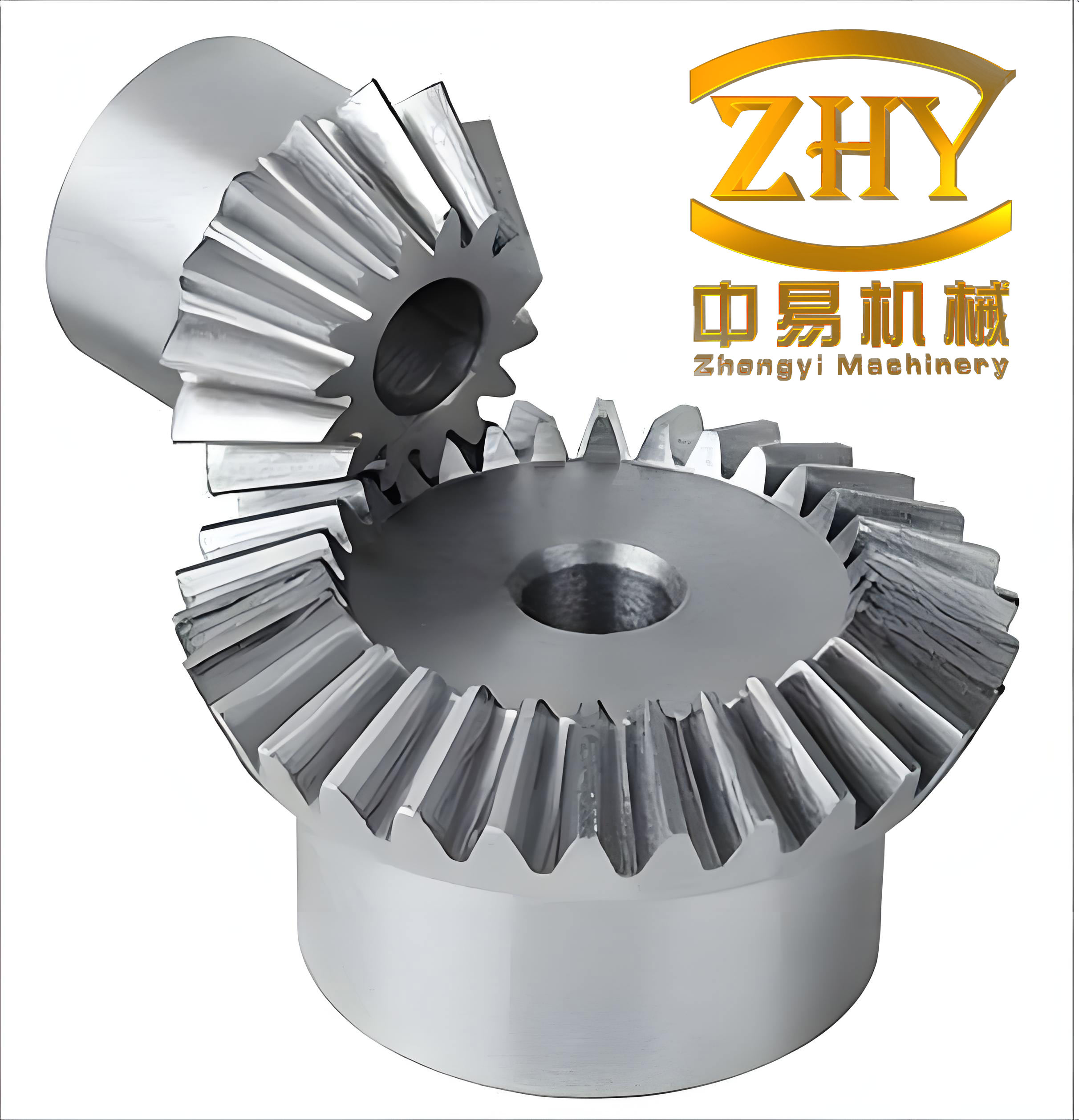
In my extensive experience with equipment maintenance and overhaul, I have frequently encountered the challenge of replacing straight bevel gears. These gears are typically machined on specialized gear planers or bevel gear generators, which are not available in most general manufacturing facilities. Often, manufacturers resort to form-cutting methods on milling machines, but this approach struggles to achieve the required precision and surface finish. Moreover, the lack of a complete set of formed module cutters for straight bevel gears can halt production entirely. To address this persistent issue, I embarked on a project to retrofit an old Y38 gear hobbing machine with numerical control (NC) technology. This transformation, performed without compromising the machine’s original capabilities, enables the roll-cutting of straight bevel gears, effectively solving a critical repair and manufacturing bottleneck.
The core principle behind hobbing a straight bevel gear lies in simulating its conical pitch surface. When hobbing a cylindrical gear, the primary motions are the rotation of the hob and the workpiece (following the generating motion), and the vertical feed of the hob carriage. The radial feed of the workpiece table is usually manually adjusted and not synchronized. For a straight bevel gear, the pitch line is inclined relative to the gear axis. To generate this inclination, a synchronized motion between the hob’s vertical feed (Z-axis) and the workpiece table’s radial feed (X-axis) is essential. This combined motion creates the necessary cone angle, allowing a standard hobbing machine to produce straight bevel gears.
The generating motion relationship between the hob and workpiece remains fundamental and is described by the following equation, which ensures the correct tooth profile is generated:
$$ \frac{\omega_w}{\omega_h} = \frac{N_h}{Z_w} $$
Where:
$\omega_w$ = rotational speed of the workpiece
$\omega_h$ = rotational speed of the hob
$N_h$ = number of starts (threads) of the hob
$Z_w$ = number of teeth on the workpiece (straight bevel gear)
The critical addition for straight bevel gear machining is the coordinated linear motion. If $s_v$ represents the vertical feed per workpiece revolution and $s_a$ represents the radial feed per workpiece revolution, then the tangent of the machining cone angle $\lambda’$ (which relates to the gear’s pitch cone angle $\delta$) is given by their ratio:
$$ \tan \lambda’ = \frac{s_a}{s_v} $$
In a conventional hobbing machine, $s_a$ is manually set and static, preventing the generation of a cone. Therefore, the retrofit must dynamically control $s_a$ in synchronization with $s_v$ to maintain a constant $\tan \lambda’$ throughout the cut. This requires a two-coordinate NC system controlling the Z and X axes.
| Motion | Symbol | Description | Control Requirement |
|---|---|---|---|
| Workpiece Rotation | $\omega_w$ | Generating motion with the hob | Maintained from original machine drive |
| Hob Rotation | $\omega_h$ | Primary cutting motion | Maintained from original machine drive |
| Hob Vertical Feed (Z-axis) | $s_v$, $v_v$ | Determines axial feed rate | NC-controlled via stepper motor |
| Table Radial Feed (X-axis) | $s_a$, $v_a$ | Determines cone angle generation | NC-controlled via stepper motor, synchronized with Z-axis |
To implement this, I designed and built a dedicated NC system. The hardware centers around an 8031 microcontroller, chosen for its robustness, cost-effectiveness, and strong anti-interference characteristics—crucial for the workshop environment. The system architecture was expanded with memory and I/O interfaces to handle program storage, operator input, and motor control signals. A summary of the core hardware components is provided below.
| Component | Part/IC | Function | Remarks |
|---|---|---|---|
| Central Processing Unit (CPU) | 8031 Microcontroller | System control and computation | Core processor |
| Program Memory | 2764 EPROM (x2) | Stores monitor program and part machining programs | One for system, one for jobs |
| Data Memory | 6264 SRAM | Stores temporary data and debugging information | Volatile memory for runtime |
| Address Decoder | 74LS138 Decoder | Manages address space for expanded chips | Ensures unified addressing |
| Input Interface | 8255 PPI (Programmable Peripheral Interface) | Accepts input from control panel and keyboard | Digital input port |
| Output Interface | 8255 PPI | Sends control signals to drivers and indicators | Digital output port |
| Isolation & Drive | Optocouplers & Power Amplifiers | Isolates logic from power circuits, drives stepper motors | Protects microcontroller from electrical noise |
| Auxiliary Circuits | Reset, Clock, Alarm | Provides system timing, reset function, and fault indication | Essential for stable operation |
The software was developed using a modular architecture to ensure maintainability and clarity. The main modules include a master control module, sub-program modules for specific tasks (like axis interpolation), an out-of-bounds alarm and emergency stop handling module, a timer-based refresh module for display buffers, and a keyboard/display scanning management module. This structure allows for efficient processing of the real-time control tasks required for synchronizing the two axes during the cutting of a straight bevel gear.
The mechanical modifications were substantial and critical for achieving the necessary precision. The original drive trains for the vertical and radial feeds were disconnected and replaced with NC-driven systems.
Vertical Feed System (Z-axis): The original mechanical link between the main motor and the hob carriage lead screw was disengaged. Specifically, the gear on the Q-axis with 16 teeth was put into neutral, and the clutch was disconnected. A 110BF003 stepper motor was then directly coupled to the original vertical feed shaft. This motor drives the existing worm gear pair and the lead screw nut mechanism to move the hob carriage. To eliminate backlash and improve accuracy, the original acme lead screw and nut were replaced with a precision-ground version, and the worm gear pair was carefully adjusted. A manual override capability was retained for setup purposes.
Radial Feed System (X-axis): The manual handwheel and the original sliding lead screw for the table were entirely removed. A new assembly was installed, featuring a 110BF004 stepper motor (with a step angle of 0.75°) connected via a single-stage gear reduction to a ball screw assembly with a 6 mm pitch. The ball screw provides high efficiency and minimal friction. To eliminate axial play, a double-nut arrangement with preload adjustment was used. The gear pair was designed with dual thin gears in a spring-loaded, anti-backlash configuration to minimize transmission error. The ball screw is supported by a pair of preloaded tapered roller bearings to maximize rigidity. Like the Z-axis, a manual adjustment capability was integrated for initial positioning.
The heart of the straight bevel gear machining process is the real-time coordination between the Z-axis and X-axis feeds. The relationship between the commanded pulse frequencies and the resulting cone angle must be precisely defined. Let $f_v$ be the pulse frequency to the Z-axis stepper motor and $f_a$ be the pulse frequency to the X-axis stepper motor. The corresponding feed velocities are:
$$ v_v = f_v \cdot \delta_v $$
$$ v_a = f_a \cdot \delta_a $$
Where $\delta_v$ and $\delta_a$ are the pulse equivalents (distance moved per pulse) for the Z and X axes, respectively. These are determined by the mechanical transmission elements:
$$ \delta_v = \frac{P_{sv} \cdot k_{wv}}{N_{sv} \cdot R_v} $$
$$ \delta_a = \frac{P_{sa}}{N_{sa} \cdot R_a} $$
Where:
$P_{sv}$, $P_{sa}$ = Lead screw pitches (vertical and radial)
$k_{wv}$ = Number of starts of the worm in the vertical feed
$N_{sv}$, $N_{sa}$ = Number of steps per revolution for the stepper motors
$R_v$, $R_a$ = Total gear reduction ratios (including worm gear) for each axis
The feed per revolution of the workpiece ($s_v$ and $s_a$) relates to the feed velocity and workpiece rotational speed $n_w$:
$$ s_v = \frac{v_v}{n_w} = \frac{f_v \cdot \delta_v}{n_w} $$
$$ s_a = \frac{v_a}{n_w} = \frac{f_a \cdot \delta_a}{n_w} $$
Substituting into the cone angle equation, we get the fundamental control law for machining a straight bevel gear:
$$ \tan \lambda’ = \frac{s_a}{s_v} = \frac{f_a \cdot \delta_a}{f_v \cdot \delta_v} $$
Therefore, for a desired cone angle $\lambda’$, the NC system must continuously adjust the ratio of the pulse frequencies according to:
$$ \frac{f_a}{f_v} = \tan \lambda’ \cdot \frac{\delta_v}{\delta_a} $$
Since $\delta_v$ and $\delta_a$ are fixed machine constants after the retrofit, the software needs to generate the pulse trains for the two stepper motors such that their frequency ratio remains constant at the value $K = \tan \lambda’ \cdot (\delta_v / \delta_a)$ throughout the cutting cycle. This is achieved through a digital interpolation algorithm running on the 8031 microcontroller. The ability to program this ratio allows for the production of straight bevel gears with a wide range of pitch cone angles, limited only by the physical travel limits of the machine axes.
| Axis | Stepper Motor | Step Angle | Lead Screw Type & Pitch | Primary Reduction | Pulse Equivalent ($\delta$) |
|---|---|---|---|---|---|
| Vertical (Z) | 110BF003 | 0.75° | Precision Ground (Original), $P_{sv}=?$ (e.g., 6 mm) | Worm Gear + Original Gearing | $\delta_v$ (Calculated) |
| Radial (X) | 110BF004 | 0.75° | Ball Screw, $P_{sa}=6 mm$ | 1:1.5 Gear Pair | $\delta_a = 0.001 mm/pulse$ (example) |
The successful implementation of this system was validated by machining a replacement straight bevel gear for a horizontal boring machine. The gear specifications were: Module $m = 4 mm$, Number of teeth $Z_w = 41$, Pressure angle $\alpha = 20^\circ$, Material 45 steel, Pitch cone angle $\delta = 15^\circ 37’$. A standard hob with module 4 was used. The machining program calculated the required pulse frequency ratio based on the derived formulas. After cutting, the gear was measured and found to be within AGMA class 9精度 (equivalent to ISO 8-9 grade), with excellent surface finish. Subsequent installation confirmed smooth and quiet operation. This single case demonstrated the viability of the approach, but the system is capable of producing a vast array of straight bevel gears for repair and small-batch production.
The advantages of this retrofit are significant. For an investment of only a few thousand dollars, an obsolete Y38 hobbing machine was transformed into a versatile, dual-axis NC machine capable of producing precision straight bevel gears. This not only solves immediate repair problems but also adds valuable capability to a workshop’s portfolio. The straight bevel gear, often a stumbling block, becomes a manageable component. The retrofit preserves all original functions for cylindrical gear hobbing, making it a highly efficient upgrade. The use of stepper motors and ball screws, coupled with anti-backlash techniques, ensures the positional accuracy needed for good gear geometry. The control software, with its modular design, can be adapted or expanded for other special machining tasks.
In conclusion, the integration of NC technology into a conventional gear hobbing machine opens new possibilities for gear manufacturing. The key to machining a straight bevel gear on such a machine is the synchronized interpolation of two linear axes to create the conical pitch surface. This project detailed the complete process from theoretical principles and control law derivation to practical hardware/software implementation and mechanical modification. The result is a cost-effective solution that extends the life and utility of older machine tools, providing a practical answer to the enduring challenge of producing high-quality straight bevel gears outside of specialized gear shops. The methodology can be applied to other models of hobbing machines, further amplifying its impact. The straight bevel gear, therefore, transitions from a procurement难题 to an in-house manufacturing opportunity.