
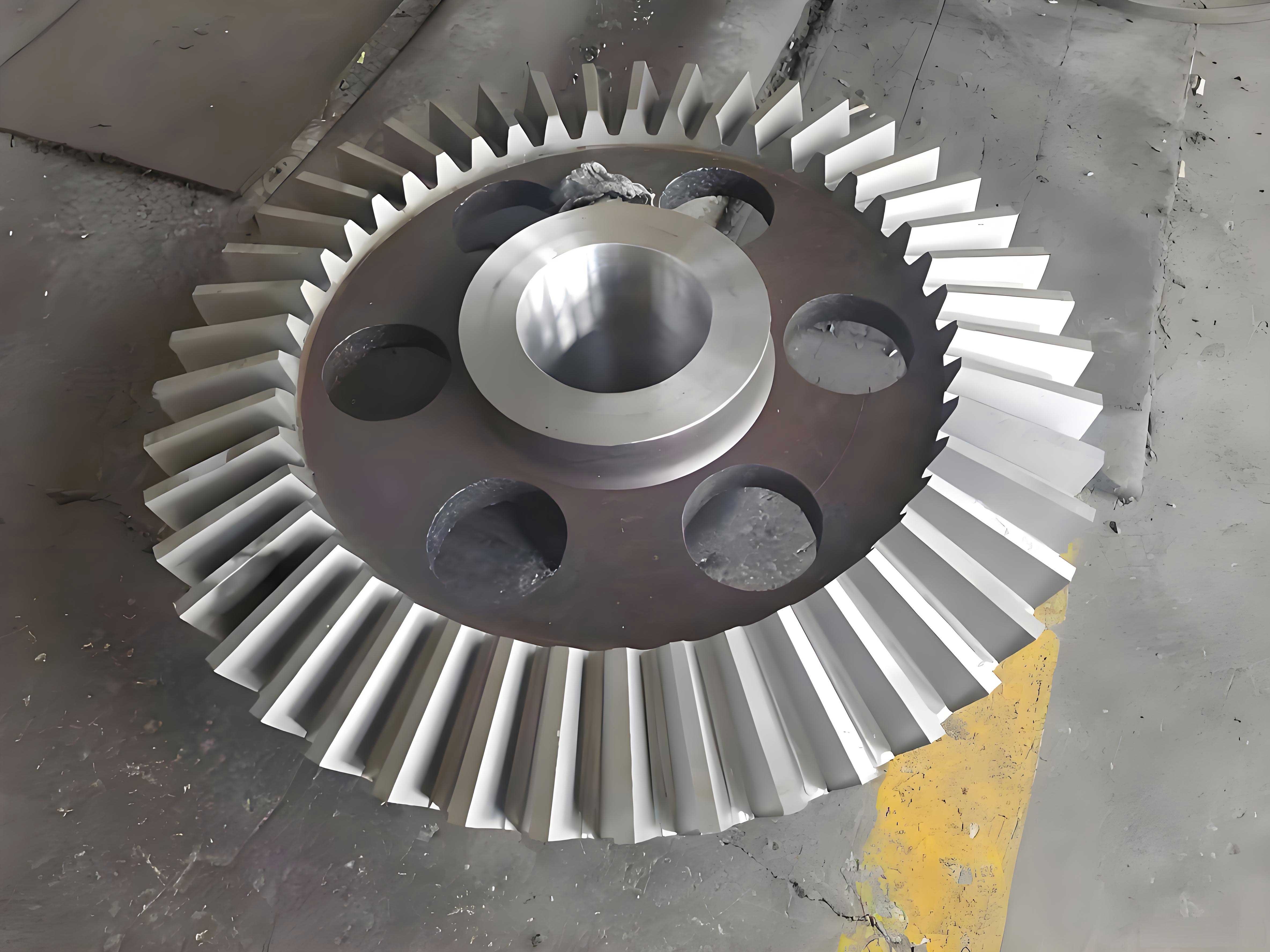
In the realm of equipment maintenance and repair, the replacement of bevel gears, particularly miter gear pairs, presents a persistent challenge. These components, essential for transmitting power between intersecting shafts, traditionally require specialized machinery like bevel gear generators or planers for accurate production. Many general manufacturing workshops lack such dedicated equipment. The common workaround involves using form milling cutters on a standard milling machine. However, this method often falls short in achieving the required precision, surface finish, and tooth profile accuracy. The situation becomes even more untenable when the necessary set of module-specific form cutters is incomplete, bringing the repair process to a complete halt. To overcome this significant bottleneck in machinery upkeep, I embarked on a project to retrofit a standard, older-model hobbing machine with a Computer Numerical Control (CNC) system. The core objective was to enable the precise hobbing of straight bevel gears, specifically miter gears, while preserving the machine’s original capability for cylindrical gear production. This technical document details the principles, design, and implementation of this successful transformation.
The Engineering Challenge and Core Principle
A standard gear hobbing machine is designed for cylindrical gears. Its fundamental kinematic chain involves the synchronized rotation of the hob and the workpiece (generating motion), combined with a vertical feed of the hob along the workpiece axis. For cylindrical gears, the gear blank is cylindrical, and the hob simply traverses parallel to its axis. A miter gear, being a conical gear, presents a different geometry: its pitch line is inclined at the pitch cone angle. To hob this conical shape, the relative motion between the hob and the workpiece must trace this inclined line.
The breakthrough principle is to synchronize the vertical feed motion of the hob (traditionally the Z-axis) with a radial infeed motion of the workpiece (which we can designate as the X-axis). By precisely controlling the ratio between the Z-axis displacement and the X-axis displacement, we can synthesize the required conical pitch surface. The relationship is defined by the tangent of the pitch cone angle $\delta’$ (for the gear being cut, complementary to the mating gear’s angle in a miter gear set):
$$\tan(\delta’) = \frac{\Delta Z}{\Delta X}$$
where $\Delta Z$ is the vertical feed distance and $\Delta X$ is the corresponding radial infeed distance. In a conventional hobbing machine, the radial adjustment of the work table is manually operated and cannot be dynamically linked to the vertical feed, making bevel gear generation impossible. The solution, therefore, lies in decoupling these feeds from their manual or purely mechanical drives and placing them under coordinated CNC control.
Architecting the CNC Retrofit System
The retrofit centered on adding a two-axis (X and Z) open-loop CNC system to manage the radial and vertical feeds independently and synchronously. The existing generating motion (hob and workpiece rotation) was left untouched and driven by the original mechanical gear train, as its accuracy is paramount and already established.
Hardware Design and Selection
For the control computer, I selected the Intel 8031 microcontroller, a member of the robust MCS-51 family known for its strong performance-cost ratio and good resistance to industrial interference. The system memory was structured using standard chips: an EPROM (2764) for the permanent monitor and control software, a second EPROM for storing part-specific machining programs, and a RAM (6264) for temporary data and runtime variables. To manage address decoding for these and future expansion chips efficiently, a 74LS138 decoder was incorporated.
Input/Output (I/O) expansion was critical for interfacing with the machine. Two 8255 Programmable Peripheral Interface (PPI) chips were used—one to read inputs from the operator control panel and another to send output signals to the drive amplifiers. Given the industrial environment, opto-isolators were employed on all critical I/O lines to protect the sensitive microcontroller from electrical noise and voltage spikes originating from the machine power circuits. The output signals, after isolation, were amplified by power driver circuits to energize the stepper motor coils. Auxiliary circuits for system reset, clock generation, and fault/limit alarm indication were also implemented. The hardware architecture is summarized below:
| Component | Part Number/Type | Primary Function |
|---|---|---|
| Central Processing Unit | Intel 8031 Microcontroller | System control, computation, and coordination. |
| Program Memory | 2764 EPROM (x2) | Stores system firmware and gear machining programs. |
| Working Memory | 6264 Static RAM | Holds temporary data and system variables. |
| Address Decoder | 74LS138 | Generates chip select signals for memory and I/O expansion. |
| I/O Expansion | 8255 PPI (x2) | Provides digital input (panel) and output (motor control) ports. |
| Isolation | Opto-coupler Modules | Electrically isolates logic control from power drive circuits. |
| Power Amplification | Stepper Motor Driver Units | Converts logic pulses to high-current phases for stepper motors. |
Software System Design
The control software was developed using a modular structure for clarity and maintainability. The main modules included:
- Main Control Module: The primary executive loop, managing high-level state and calling submodules.
- Interpolation Module: Calculates the step pulses for X and Z axes to achieve the required linear path, crucial for maintaining the correct $\tan(\delta’)$ ratio.
- Feed Rate Management Module: Handles the calculation of pulse frequencies based on the programmed feed per revolution and the actual spindle rotation speed (obtained via an encoder or inferred from the master machine cycle).
- Limit & Alarm Handling Module: Monitors limit switches and system health, executing emergency stops if boundaries are exceeded.
- Keyboard & Display Interface Module: Manages the operator panel for inputting parameters (like miter gear cone angle, module, number of teeth) and displaying status information.
Mechanical Transformation of the Hobbing Machine
The electronic control system required a corresponding mechanical overhaul to create responsive and accurate X and Z axes.
Vertical (Z-Axis) Feed Retrofit
The original vertical feed was driven from the main motor through a complex gear train. This linkage was disconnected. Specifically, the clutch on the machine’s drive shaft was disengaged, freeing the vertical feed screw from its mechanical drive. A high-torque stepper motor (e.g., model 110BF003) was then directly coupled, via a flexible coupling, to the input shaft of the original worm gear reducer that drives the vertical lead screw. This allowed the CNC system to directly control the hob head’s ascent and descent. To ensure precision, the existing lead screw nut assembly and the worm gear set were inspected, refurbished, and preloaded to eliminate backlash. A manual handwheel was retained for initial setup and positioning.
Radial (X-Axis) Feed Retrofit
This was a more significant addition. The original manual radial adjustment mechanism, including its acme lead screw, was removed. A new drive system was installed, consisting of:
- A stepper motor (e.g., 110BF004 with a step angle of 0.75°) mounted on the machine base.
- A single-stage gear reduction unit to increase torque.
- A precision ball screw with a double-nut pre-tensioning arrangement to eliminate axial backlash. The ball screw’s pitch was selected as 5 mm to provide a fine resolution.
- The ball screw nut was fixed to the underside of the work table saddle, converting rotary motion into precise linear radial movement of the entire work table.
Backlash mitigation was critical at every stage. The gear pair used a dual thin-spring loaded gear design for anti-backlash meshing. The ball screw assembly was preloaded. The screw itself was supported by a pair of angular contact ball bearings to handle both radial and axial loads with high stiffness. A manual override capability was also integrated for setup purposes.
The key mechanical parameters for the new axes are summarized below:
| Axis | Drive Motor | Final Drive Element | Backlash Control Method | Resolution (Pulse Equiv.) |
|---|---|---|---|---|
| Vertical (Z) | Stepper 110BF003 | Original Machine Lead Screw (Refurbished) | Worm gear adjustment, nut preload | Depends on original screw pitch & worm ratio |
| Radial (X) | Stepper 110BF004 | Precision Ball Screw (5 mm pitch) | Dual nut preload on ball screw, anti-backlash gears | $$ \text{Resolution}_X = \frac{5 \text{ mm}}{1.5^\circ/0.75^\circ \times 400 \text{ pulse/rev}} \approx 0.00625 \text{ mm/pulse} $$ |
The Core Algorithm: Linking Pulse Frequency to Cone Angle
The synchronization of the X and Z axes is the mathematical heart of machining a miter gear. In hobbing, feed rates are typically specified as feed per revolution of the workpiece (f_r). For our CNC axes, this translates into specific pulse frequencies ($f_z$ for Z, $f_x$ for X) sent to the stepper motors.
Let $n_w$ be the rotational speed of the workpiece (RPM). The required vertical feed velocity $v_z$ is:
$$ v_z = f_{rz} \cdot n_w $$
where $f_{rz}$ is the vertical feed per revolution. This velocity is produced by the stepper motor driving the Z-axis. The relationship between motor pulse frequency $f_z$ and linear velocity is:
$$ v_z = \delta_z \cdot f_z $$
where $\delta_z$ is the Z-axis linear movement per pulse (pulse equivalent). Combining these gives:
$$ f_z = \frac{f_{rz} \cdot n_w}{\delta_z} \quad \text{(1)} $$
Similarly, for the radial X-axis:
$$ f_x = \frac{f_{rx} \cdot n_w}{\delta_x} \quad \text{(2)} $$
where $f_{rx}$ is the radial infeed per revolution and $\delta_x$ is the X-axis pulse equivalent.
However, for generating the cone, $f_{rz}$ and $f_{rx}$ are not independent. Their ratio must satisfy the cone angle condition across one revolution. The radial infeed $\Delta X$ and vertical feed $\Delta Z$ over one workpiece revolution are precisely $f_{rx}$ and $f_{rz}$. Therefore:
$$ \tan(\delta’) = \frac{f_{rz}}{f_{rx}} $$
Using equations (1) and (2), and noting that $n_w$ is common, we derive the fundamental control relationship:
$$ \tan(\delta’) = \frac{f_z \cdot \delta_z}{f_x \cdot \delta_x} \quad \text{or} \quad \frac{f_z}{f_x} = \frac{\delta_x}{\delta_z} \cdot \tan(\delta’) $$
Since $\delta_x$ and $\delta_z$ are fixed mechanical constants from the retrofit, the CNC system must maintain the pulse frequency ratio $f_z / f_x$ proportional to $\tan(\delta’)$ throughout the cut. For a standard miter gear with a 1:1 ratio and shafts at 90°, the pitch cone angle $\delta’ = 45^\circ$, simplifying the ratio to $f_z / f_x = \delta_x / \delta_z$.
Programming and Machining a Miter Gear
The machining process for a miter gear involves programming the tool path based on gear data. A typical program structure includes parameters and a cutting loop. Key input parameters are:
| Parameter | Symbol | Example Value |
|---|---|---|
| Number of Teeth | $z$ | 30 |
| Module | $m_n$ | 3 mm |
| Pressure Angle | $\alpha$ | 20° |
| Pitch Cone Angle | $\delta’$ | 45° (for standard miter gear) |
| Face Width | $b$ | 20 mm |
| Hob Start Position (X, Z) | $X_0$, $Z_0$ | Calculated from blank size |
The CNC program calculates the total required radial travel $\Delta X_{total}$ based on the face width and cone angle: $\Delta X_{total} = b \cdot \sin(\delta’)$. The vertical travel $\Delta Z_{total}$ is similarly $\Delta Z_{total} = b \cdot \cos(\delta’)$. The program then executes a coordinated linear move from $(X_0, Z_0)$ to $(X_0 – \Delta X_{total}, Z_0 + \Delta Z_{total})$ over a defined number of workpiece revolutions, with the hob and workpiece continuously engaged in the generating motion. Multiple passes with increasing depth of cut are used to reach the full tooth depth.
Results and Validation
The retrofit was put to the test by machining a replacement miter gear for a horizontal boring machine. The gear specifications were: Module $m_n = 3$ mm, Number of Teeth $z = 30$, Pressure Angle $\alpha = 20°$, Pitch Cone Angle $\delta’ = 45°$, Material 45# Steel. A standard 3 mm module gear hob was used. Post-machining inspection revealed that the gear teeth achieved a quality grade of 8 according to AGMA or ISO standards, with excellent surface finish and profile consistency. The gear meshed smoothly with its mate under load, with minimal noise and vibration, fully validating the retrofit approach. The entire project cost was a fraction of procuring a dedicated bevel gear machine, making it an exceptionally cost-effective solution for repair workshops.
Advantages and Practical Considerations
This CNC retrofit offers several compelling advantages:
- Cost-Effectiveness: Revitalizes an older, otherwise obsolete hobbing machine into a versatile gear processor.
- Dual-Purpose Machine: Retains full functionality for cylindrical gears while adding bevel gear capability.
- Improved Accuracy over Form Milling: The generating (hobbing) principle produces a more accurate involute-like tooth profile on the conical surface compared to form milling.
- Flexibility: Can machine a wide range of cone angles by simply changing the program, not just miter gears with 45° cones.
Important considerations include:
- Machine Limits: The maximum cone angle is limited by the physical travel limits of the X and Z axes and potential collisions between the hob and workpiece fixture.
- Setup Knowledge: Requires understanding of bevel gear geometry and proper blank preparation (pre-cut cone).
- Software Reliability: The custom CNC software must be robust and fault-tolerant for shop floor use.
Conclusion
The successful integration of a two-axis CNC system onto a standard hobbing machine demonstrates a highly practical and innovative solution for manufacturing straight bevel gears, with a focused application on miter gear pairs essential for maintenance. By mastering the kinematic principle of synchronizing vertical and radial feeds according to $\tan(\delta’)$ and implementing it through a carefully designed mix of electronic control, software algorithms, and mechanical precision, a significant limitation in equipment repair has been overcome. This project underscores that with thoughtful engineering, the capabilities of existing machine tools can be dramatically expanded, offering a powerful and economical strategy for enhancing workshop versatility and tackling complex component manufacturing like the miter gear.